
Join Our JEE Preparation Group
Prep with like-minded aspirants; Get access to free daily tests and study material.
Sign in
Please select an account to continue using cracku.in
↓ →
Join Our JEE Preparation Group
Prep with like-minded aspirants; Get access to free daily tests and study material.
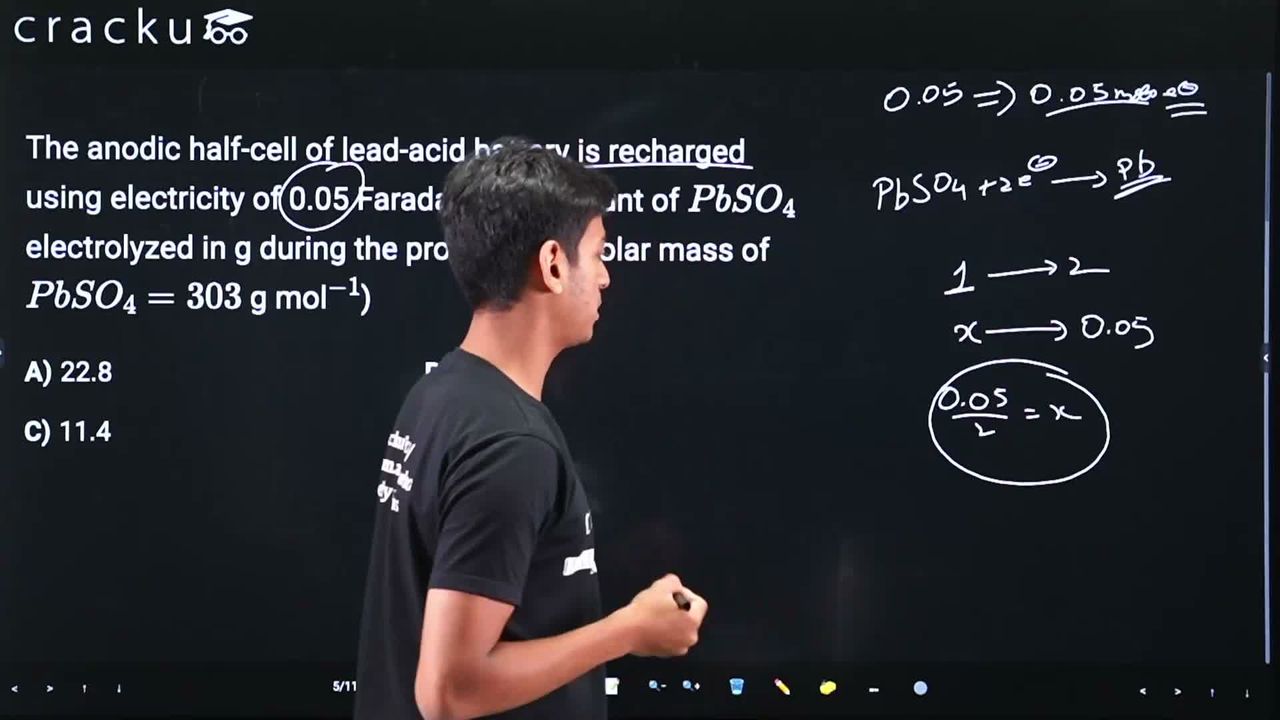
The anodic half-cell of lead-acid battery is recharged using electricity of 0.05 Faraday. The amount of $$PbSO_4$$ electrolyzed in g during the process is: (Molar mass of $$PbSO_4 = 303$$ g mol$$^{-1}$$)
We first recall the electrochemical change that occurs during re-charging of the anodic plate of a lead-acid accumulator. In the discharged condition the plate is $$PbSO_4$$. On passing current it is reconverted to metallic lead:
$$PbSO_4 + 2e^- \longrightarrow Pb + SO_4^{2-}$$
This half-reaction clearly shows that
$$1 \text{ mol of } PbSO_4 \text{ requires } 2 \text{ mol of electrons}.$$
Next, we translate the given electricity into “moles of electrons”. By definition,
$$1\ \text{Faraday} = 1\ \text{mol of electrons}.$$
The question states that only $$0.05$$ F of charge is passed, so the amount of electrons actually supplied is
$$n_{e^-}=0.05\ \text{mol}.$$
Because the stoichiometry of the half-reaction demands two electrons per mole of $$PbSO_4$$, the moles of $$PbSO_4$$ decomposed will be
$$n_{PbSO_4}= \frac{n_{e^-}}{2} = \frac{0.05}{2} = 0.025\ \text{mol}.$$
Now we convert these moles into grams. Using the given molar mass $$M_{PbSO_4}=303\ \text{g mol}^{-1}$$, the mass electrolyzed is
$$m = n_{PbSO_4}\,M_{PbSO_4}=0.025\times303 = 7.575\ \text{g}.$$
Rounding to a single decimal place,
$$m \approx 7.6\ \text{g}.$$
Hence, the correct answer is Option D.
Was this solution helpful?
Click on the Email ☝️ to Watch the Video Solution
Create a FREE account and get:
_1.webp)

Educational materials for JEE preparation

Ask our AI anything

AI can make mistakes. Please verify important information.
AI can make mistakes. Please verify important information.
