
Join Our JEE Preparation Group
Prep with like-minded aspirants; Get access to free daily tests and study material.
Sign in
Please select an account to continue using cracku.in
↓ →
Join Our JEE Preparation Group
Prep with like-minded aspirants; Get access to free daily tests and study material.
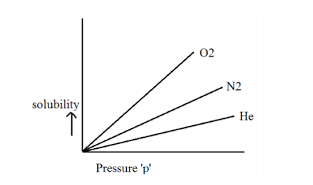
We begin by recalling Henry's law, which establishes a relation between the pressure of a gas above a liquid solution and the mole fraction of that gas dissolved in the liquid. The law is stated mathematically as
$$P = K_H \, x$$
where
$$P$$ is the partial pressure of the gas in the vapour phase above the solution,
$$x$$ is the mole fraction of the gas dissolved in the liquid, and
$$K_H$$ is Henry’s law constant, characteristic of the particular gas-solvent pair at a given temperature.
From the relation $$P = K_H \, x$$ we can algebraically solve for the mole fraction $$x$$ to see how it depends on $$K_H$$:
Dividing both sides by $$K_H$$, we obtain
$$x = \dfrac{P}{K_H}$$
This expression $$x = \dfrac{P}{K_H}$$ shows explicitly that, when the pressure $$P$$ is kept the same, the mole fraction $$x$$ (which directly represents the solubility of the gas in the liquid) is inversely proportional to the constant $$K_H$$. In simpler words, for a fixed external pressure,
• If $$K_H$$ is large, the denominator in $$\dfrac{P}{K_H}$$ is large, so the mole fraction $$x$$ becomes small, meaning the gas is less soluble.
• If $$K_H$$ is small, the denominator is small, so $$x$$ becomes large, meaning the gas is more soluble.
Therefore, a higher value of $$K_H$$ corresponds to lower solubility of the gas in the liquid.
Now let us analyse each statement in the question one by one using the facts above.
Statement A: “Different gases have different $$K_H$$ values at the same temperature.”
This is true, because $$K_H$$ depends on the nature of the gas as well as the solvent.
Statement B: “The partial pressure of the gas in the vapour phase is proportional to the mole fraction of the gas in the solution.”
This is exactly the verbal form of Henry’s law $$P = K_H x$$, so it is correct.
Statement C: “Higher the value of $$K_H$$ at a given pressure, higher is the solubility of the gas in the liquids.”
Using $$x = \dfrac{P}{K_H}$$, we found that a higher $$K_H$$ actually lowers the solubility. Hence this statement is incorrect.
Statement D: “The value of $$K_H$$ increases with increase of temperature and $$K_H$$ is function of the nature of the gas.”
Empirically, for most gases, $$K_H$$ indeed rises with temperature because gases become less soluble as temperature increases; it is also well known that $$K_H$$ varies with the identity of the gas. Thus this statement is correct.
Only Statement C contradicts the true relationship derived from Henry’s law, so it is the one that is not correct.
Hence, the correct answer is Option C.
Was this solution helpful?
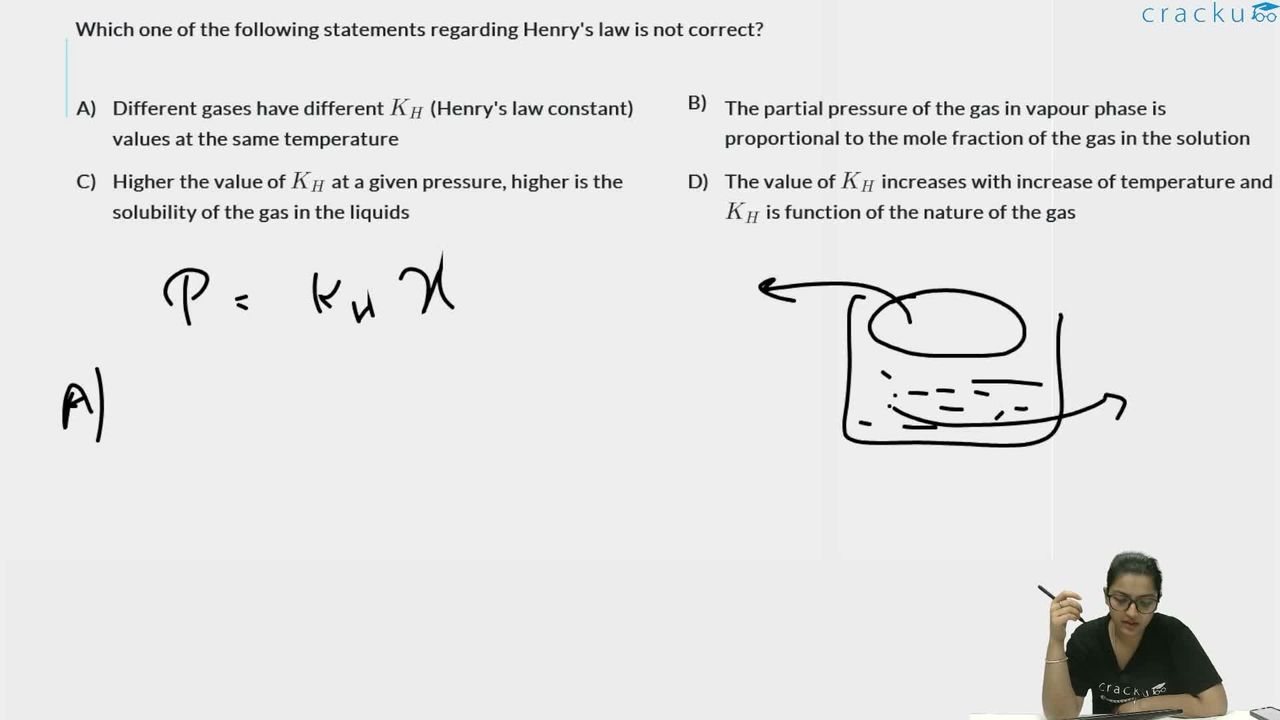
Click on the Email ☝️ to Watch the Video Solution
Create a FREE account and get:
_1.webp)

Educational materials for JEE preparation

Ask our AI anything

AI can make mistakes. Please verify important information.
AI can make mistakes. Please verify important information.
