
Join Our JEE Preparation Group
Prep with like-minded aspirants; Get access to free daily tests and study material.
Sign in
Please select an account to continue using cracku.in
↓ →
Join Our JEE Preparation Group
Prep with like-minded aspirants; Get access to free daily tests and study material.
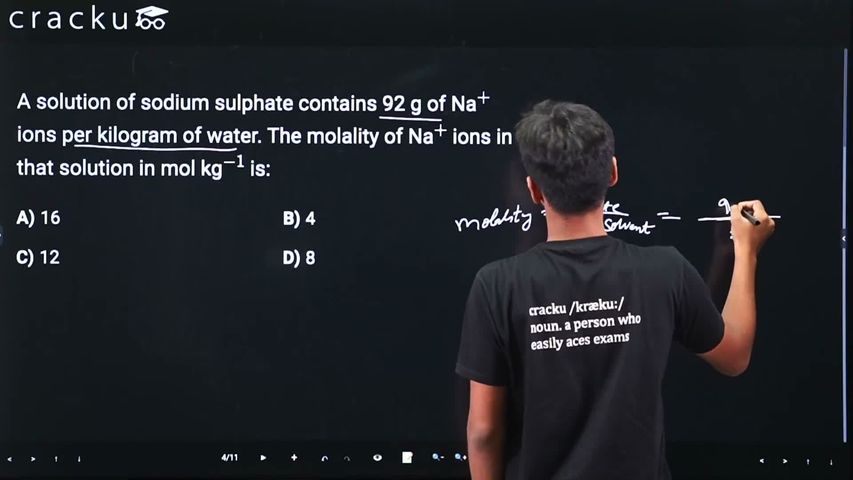
A solution of sodium sulphate contains 92 g of Na$$^+$$ ions per kilogram of water. The molality of Na$$^+$$ ions in that solution in mol kg$$^{-1}$$ is:
First, recall the definition of molality. By definition, the molality $$m$$ of any species is
$$m \;=\; \frac{\text{number of moles of solute}}{\text{mass of solvent (in kg)}}.$$
Here the ‘solute’ is the sodium ion $$\text{Na}^+$$, and the ‘solvent’ is water. The statement of the problem tells us that there are 92 g of $$\text{Na}^+$$ present per 1 kg of water. So, in the above formula the denominator is already 1 kg, which makes the calculation simpler—we only need the numerator, i.e., the number of moles of $$\text{Na}^+$$ contained in 92 g.
To convert grams to moles, we divide the given mass by the molar mass. The atomic (and hence ionic) molar mass of sodium is
$$M_{\text{Na}^+} \;=\; 23\;\text{g mol}^{-1}.$$
So, the number of moles of $$\text{Na}^+$$ present is obtained as follows:
$$ n_{\text{Na}^+} \;=\; \frac{\text{mass of }\text{Na}^+}{\text{molar mass of }\text{Na}^+} \;=\; \frac{92\;\text{g}}{23\;\text{g mol}^{-1}} \;=\; 4\;\text{mol}. $$
Now, substitute this value of moles and the given mass of solvent (1 kg) in the molality formula:
$$ m \;=\; \frac{n_{\text{Na}^+}}{\text{mass of solvent in kg}} \;=\; \frac{4\;\text{mol}}{1\;\text{kg}} \;=\; 4\;\text{mol kg}^{-1}. $$
Hence, the calculated molality of $$\text{Na}^+$$ ions is $$4\;\text{mol kg}^{-1}$$.
Comparing with the given choices, $$4$$ corresponds to Option B.
Hence, the correct answer is Option B.
Was this solution helpful?
Click on the Email ☝️ to Watch the Video Solution
Create a FREE account and get:
_1.webp)

Educational materials for JEE preparation

Ask our AI anything

AI can make mistakes. Please verify important information.
AI can make mistakes. Please verify important information.
