
Join Our JEE Preparation Group
Prep with like-minded aspirants; Get access to free daily tests and study material.
Sign in
Please select an account to continue using cracku.in
↓ →
Join Our JEE Preparation Group
Prep with like-minded aspirants; Get access to free daily tests and study material.
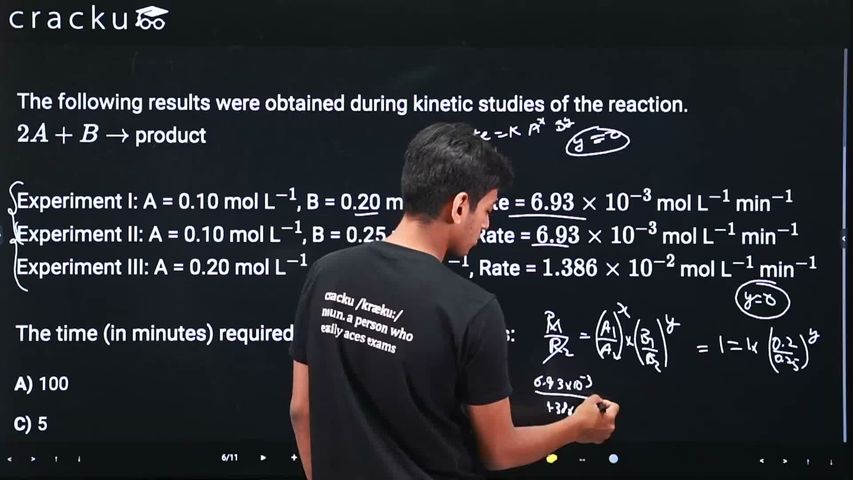
The following results were obtained during kinetic studies of the reaction.
$$2A + B \rightarrow$$ product
Experiment I: A = 0.10 mol L$$^{-1}$$, B = 0.20 mol L$$^{-1}$$, Rate = $$6.93 \times 10^{-3}$$ mol L$$^{-1}$$ min$$^{-1}$$
Experiment II: A = 0.10 mol L$$^{-1}$$, B = 0.25 mol L$$^{-1}$$, Rate = $$6.93 \times 10^{-3}$$ mol L$$^{-1}$$ min$$^{-1}$$
Experiment III: A = 0.20 mol L$$^{-1}$$, B = 0.30 mol L$$^{-1}$$, Rate = $$1.386 \times 10^{-2}$$ mol L$$^{-1}$$ min$$^{-1}$$
The time (in minutes) required to consume half of A is:
We begin by writing the general rate law for the reaction
$$2A + B \longrightarrow \text{product}$$
In its most general form, the rate can be expressed as
$$\text{Rate}=k[A]^m[B]^n$$
where $$m$$ and $$n$$ are the orders of the reaction with respect to $$A$$ and $$B$$ respectively, and $$k$$ is the rate constant.
We now compare the experiments two at a time so that one concentration changes while the other remains (essentially) the same, allowing us to isolate each order.
Determining the order with respect to $$B$$
In Experiments I and II the concentration of $$A$$ is held constant at $$0.10\ \text{mol L}^{-1}$$ while $$[B]$$ changes from $$0.20$$ to $$0.25\ \text{mol L}^{-1}$$. The corresponding rates are equal:
$$\frac{\text{Rate}_{\text{II}}}{\text{Rate}_{\text{I}}} =\frac{6.93\times10^{-3}}{6.93\times10^{-3}}=1$$
Using the rate‐law expression, we have
$$\frac{k[0.10]^m[0.25]^n}{k[0.10]^m[0.20]^n}=1$$
$$\Rightarrow \left(\frac{0.25}{0.20}\right)^n=1$$
$$\Rightarrow \left(\frac{0.25}{0.20}\right)^n=\left(1.25\right)^n=1$$
The only power of $$1.25$$ that gives $$1$$ is $$n=0$$. Thus,
$$n=0$$ and the reaction is zero order in $$B$$.
Determining the order with respect to $$A$$
Because the rate is independent of $$B$$, we can use any two experiments to find $$m$$. Choosing Experiments I and III:
Experiment I: $$[A]=0.10,\ [B]=0.20,\ \text{Rate}=6.93\times10^{-3}$$
Experiment III: $$[A]=0.20,\ [B]=0.30,\ \text{Rate}=1.386\times10^{-2}$$
The ratio of rates is
$$\frac{\text{Rate}_{\text{III}}}{\text{Rate}_{\text{I}}} =\frac{1.386\times10^{-2}}{6.93\times10^{-3}}=2$$
Because $$n=0$$, the $$[B]$$ terms drop out, giving
$$\frac{k[0.20]^m}{k[0.10]^m}=2$$
$$\Rightarrow \left(\frac{0.20}{0.10}\right)^m=2$$
$$\Rightarrow (2)^m=2$$
$$\Rightarrow m=1$$
Hence the reaction is first order in $$A$$.
Writing the specific rate law
With $$m=1$$ and $$n=0$$, the rate law simplifies to
$$\text{Rate}=k[A]$$
Calculating the rate constant $$k$$
Using the data from Experiment I (any experiment will do):
$$k=\frac{\text{Rate}}{[A]} =\frac{6.93\times10^{-3}\ \text{mol L}^{-1}\text{min}^{-1}}{0.10\ \text{mol L}^{-1}} =6.93\times10^{-2}\ \text{min}^{-1}$$
Finding the time to consume half of $$A$$
Because the reaction is first order in $$A$$, we recall the integrated first‐order law
$$\ln\!\left(\frac{[A]_0}{[A]}\right)=kt$$
For the half‐life, we set $$[A]=\dfrac{[A]_0}{2}$$, so
$$\ln\!\left(\frac{[A]_0}{[A]_0/2}\right)=\ln 2=kt_{1/2}$$
Therefore the half‐life is
$$t_{1/2}=\frac{\ln 2}{k}$$
Substituting $$k=6.93\times10^{-2}\ \text{min}^{-1}$$:
$$t_{1/2}=\frac{0.693}{6.93\times10^{-2}} =\frac{0.693}{0.0693} =10\ \text{minutes}$$
Hence, the correct answer is Option B.
Was this solution helpful?
Click on the Email ☝️ to Watch the Video Solution
Create a FREE account and get:
_1.webp)

Educational materials for JEE preparation

Ask our AI anything

AI can make mistakes. Please verify important information.
AI can make mistakes. Please verify important information.
