
Join Our JEE Preparation Group
Prep with like-minded aspirants; Get access to free daily tests and study material.
Sign in
Please select an account to continue using cracku.in
↓ →
Join Our JEE Preparation Group
Prep with like-minded aspirants; Get access to free daily tests and study material.
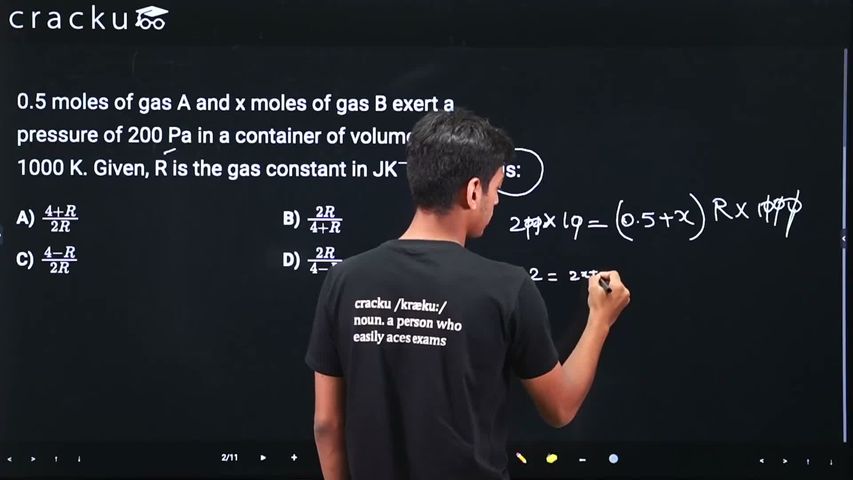
0.5 moles of gas A and x moles of gas B exert a pressure of 200 Pa in a container of volume 10 m$$^3$$ at 1000 K. Given, R is the gas constant in JK$$^{-1}$$mol$$^{-1}$$, x is:
We start with the ideal-gas equation, which states that for any ideal gas the relation $$PV = nRT$$ holds, where $$P$$ is the pressure, $$V$$ is the volume, $$n$$ is the total number of moles present, $$R$$ is the universal gas constant and $$T$$ is the absolute temperature.
In the vessel we have two gases together, so the total number of moles is the sum of the individual moles: $$n = 0.5 + x$$.
The numerical data given are: $$P = 200\ \text{Pa}, \quad V = 10\ \text{m}^3, \quad T = 1000\ \text{K}$$, while $$R$$ is to be kept as a symbol. Substituting all these directly into $$PV = nRT$$ gives
$$200 \times 10 = (0.5 + x)\, R \times 1000.$$
Simplifying the left-hand side first, we obtain
$$200 \times 10 = 2000,$$
so the equation becomes
$$2000 = (0.5 + x)\, 1000 R.$$
To isolate the bracket, we divide both sides by $$1000R$$:
$$\frac{2000}{1000R} = 0.5 + x.$$
The fraction on the left simplifies because $$2000/1000 = 2$$, hence
$$\frac{2}{R} = 0.5 + x.$$
Now we solve for $$x$$ by subtracting $$0.5$$ from both sides:
$$x = \frac{2}{R} - 0.5.$$
Writing the decimal $$0.5$$ as the fraction $$\dfrac{1}{2}$$ and bringing the two fractions to a common denominator $$2R$$, we get
$$x = \frac{2}{R} - \frac{1}{2} = \frac{4}{2R} - \frac{R}{2R} = \frac{4 - R}{2R}.$$
This expression matches Option C in the list. Hence, the correct answer is Option C.
Was this solution helpful?
Click on the Email ☝️ to Watch the Video Solution
Create a FREE account and get:
_1.webp)

Educational materials for JEE preparation

Ask our AI anything

AI can make mistakes. Please verify important information.
AI can make mistakes. Please verify important information.
