
Join Our JEE Preparation Group
Prep with like-minded aspirants; Get access to free daily tests and study material.
Sign in
Please select an account to continue using cracku.in
↓ →
Join Our JEE Preparation Group
Prep with like-minded aspirants; Get access to free daily tests and study material.
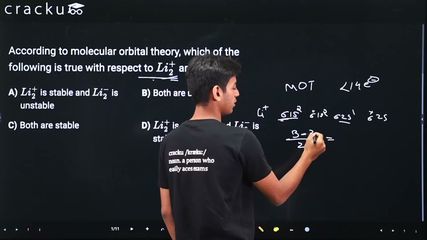
According to molecular orbital theory, which of the following is true with respect to $$Li_2^+$$ and $$Li_2^-$$?
We begin with the basic molecular-orbital (MO) framework for homonuclear diatomics formed by second-period atoms. In the energy sequence valid for $$Li_2$$ the orbitals fill in the order $$\sigma(1s),\ \sigma^*(1s),\ \sigma(2s),\ \sigma^*(2s)$$ because no $$2p$$ orbitals are reached with the small number of electrons involved.
Each lithium atom contributes three electrons, so we first write the parent configuration for the neutral molecule $$Li_2$$ and then adjust it for the ions.
The formula for bond order is stated first, because it will be used repeatedly:
$$\text{Bond order} \; (B.O.) \;=\; \dfrac{N_b - N_a}{2}$$
Here $$N_b$$ is the number of electrons occupying bonding MOs, and $$N_a$$ is the number of electrons occupying antibonding MOs.
Step 1: The neutral molecule $$Li_2$$ (for reference)
Total electrons $$= 2 \times 3 = 6$$.
Filling the MOs one by one we get
$$\sigma(1s)^2\,\sigma^*(1s)^2\,\sigma(2s)^2$$
Counting electrons, $$N_b = 2 + 2 = 4$$ (two in $$\sigma(1s)$$ and two in $$\sigma(2s)$$), while $$N_a = 2$$ (in $$\sigma^*(1s)$$). Hence
$$B.O._{Li_2} = \dfrac{4 - 2}{2} = 1$$
a positive value, so neutral $$Li_2$$ is stable. This reference will help confirm that adding or removing a single electron will not cancel the bond completely.
Step 2: The cation $$Li_2^+$$
This species has one electron fewer than neutral $$Li_2$$, so its total electron count is $$6 - 1 = 5$$.
Removing the highest-energy electron (which sits in $$\sigma(2s)$$) we obtain
$$\sigma(1s)^2\,\sigma^*(1s)^2\,\sigma(2s)^1$$
Now the counting proceeds:
Bonding electrons $$N_b = 2 + 1 = 3$$ (two in $$\sigma(1s)$$ and one in $$\sigma(2s)$$).
Antibonding electrons $$N_a = 2$$ (still the two in $$\sigma^*(1s)$$).
Substituting into the formula,
$$B.O._{Li_2^+} = \dfrac{3 - 2}{2} = \dfrac{1}{2} = 0.5$$
The bond order remains positive, though smaller than that of the neutral molecule, so $$Li_2^+$$ is predicted to be stable.
Step 3: The anion $$Li_2^-$$
This ion carries one extra electron compared with $$Li_2$$, so the total number of electrons is $$6 + 1 = 7$$.
The extra electron must occupy the next available MO, $$\sigma^*(2s)$$, giving
$$\sigma(1s)^2\,\sigma^*(1s)^2\,\sigma(2s)^2\,\sigma^*(2s)^1$$
Now we count again:
Bonding electrons $$N_b = 2 + 2 = 4$$ (from $$\sigma(1s)$$ and $$\sigma(2s)$$).
Antibonding electrons $$N_a = 2 + 1 = 3$$ (two in $$\sigma^*(1s)$$ and one in $$\sigma^*(2s)$$).
Hence,
$$B.O._{Li_2^-} = \dfrac{4 - 3}{2} = \dfrac{1}{2} = 0.5$$
Again the bond order is positive, so $$Li_2^-$$ is also stable.
Conclusion
Both $$Li_2^+$$ and $$Li_2^-$$ possess positive bond orders (0.5 each), indicating that both species are capable of existing as bound molecules. Therefore, both ions are stable according to molecular orbital theory.
Hence, the correct answer is Option C.
Was this solution helpful?
Click on the Email ☝️ to Watch the Video Solution
Create a FREE account and get:
_1.webp)

Educational materials for JEE preparation

Ask our AI anything

AI can make mistakes. Please verify important information.
AI can make mistakes. Please verify important information.
