
Join Our JEE Preparation Group
Prep with like-minded aspirants; Get access to free daily tests and study material.
Sign in
Please select an account to continue using cracku.in
↓ →
Join Our JEE Preparation Group
Prep with like-minded aspirants; Get access to free daily tests and study material.
We begin by recalling the basic definition of an isotope. Two or more atoms are called isotopes of the same element when they possess the same atomic number $$Z$$ (same number of protons, thus belonging to the same element) but different mass numbers $$A$$ because their nuclei contain different numbers of neutrons.
Hydrogen has atomic number $$Z = 1$$, meaning every hydrogen nucleus must contain exactly one proton. However, the number of neutrons present in the nucleus can vary, and this leads to three distinct nuclides (nuclear species):
1. We have the nuclide with one proton and zero neutrons. Its mass number is
$$A = Z + \text{(number of neutrons)} = 1 + 0 = 1.$$
This isotope is written as $$^1_1\text{H}$$ and is traditionally called protium.
2. Next, we consider the nuclide that again has one proton but now possesses one neutron. Its mass number is
$$A = 1 + 1 = 2.$$
This isotope is written as $$^2_1\text{H}$$ and is called deuterium.
3. Finally, there is the nuclide with one proton and two neutrons. Its mass number becomes
$$A = 1 + 2 = 3.$$
This isotope is written as $$^3_1\text{H}$$ and is called tritium.
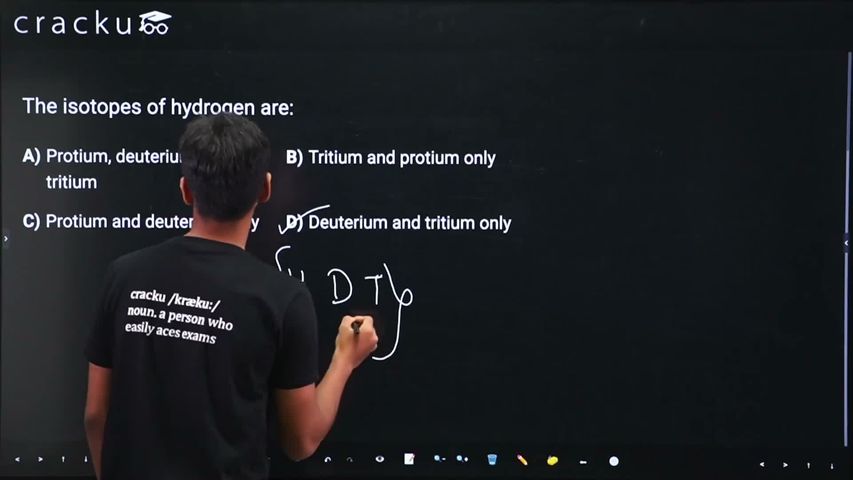
Thus, hydrogen naturally exists in three isotopic forms: protium, deuterium and tritium. No other combinations of neutron numbers are stable or commonly listed for hydrogen in introductory chemistry.
Looking at the options, only Option A lists all three—protium, deuterium and tritium—together, matching exactly with the set we have just derived.
Hence, the correct answer is Option A.
Was this solution helpful?
Click on the Email ☝️ to Watch the Video Solution
Create a FREE account and get:
_1.webp)

Educational materials for JEE preparation

Ask our AI anything

AI can make mistakes. Please verify important information.
AI can make mistakes. Please verify important information.
