The molarity of a solution obtained by mixing 750 mL of 0.5(M) HCl with 250 mL of 2(M) HCl will be

Join Our JEE Preparation Group
Prep with like-minded aspirants; Get access to free daily tests and study material.
Sign in
Please select an account to continue using cracku.in
↓ →
Join Our JEE Preparation Group
Prep with like-minded aspirants; Get access to free daily tests and study material.
The molarity of a solution obtained by mixing 750 mL of 0.5(M) HCl with 250 mL of 2(M) HCl will be
Login to view the detailed solution.
How many litres of water must be added to 1 litre of aqueous solution of HCl with a pH of 1 to create an aqueous solution with pH of 2?
Login to view the detailed solution.
Experimentally it was found that a metal oxide has formula $$M_{0.98}O$$. Metal M, is present as $$M^{2+}$$ and $$M^{3+}$$ in its oxide. Fraction of the metal which exists as $$M^{3+}$$ would be:
Login to view the detailed solution.
.webp)
A gaseous hydrocarbon on combustion gives 0.72 g of water and 3.08 g $$CO_2$$. What is the empirical formula of the hydrocarbon?
Login to view the detailed solution.
Energy of an electron is given by $$E = -2.178 \times 10^{-18}\left(\frac{Z^2}{n^2}\right)$$ J. Wavelength of light required to excite an electron in a hydrogen atom from level n=1 to n=2 will be :
$$(h = 6.62 \times 10^{-34}$$ Js and $$c = 3.0 \times 10^8$$ ms$$^{-1})$$
Login to view the detailed solution.
The first ionisation potential of Na is 5.1 eV. The value of electron gain enthalpy of Na$$^+$$ will be :
Login to view the detailed solution.
.webp)
Which of the following represents the correct order of increasing first ionization enthalpy for Ca, Ba, S, Se and Ar ?
Login to view the detailed solution.
Stability of the species $$Li_2$$, $$Li_2^-$$ and $$Li_2^+$$ increases in the order of
Login to view the detailed solution.
Which one of the following molecules is expected to exhibit paramagnetic behaviour?
Login to view the detailed solution.
.webp)
In which of the following pairs of molecules/ions, both the species are not likely to exist?
Login to view the detailed solution.
For gaseous state, if most probable speed is denoted by $$C^*$$, average speed by $$\bar{C}$$ and root mean square speed by C, then for many molecules, what is the ratios of these speeds?
Login to view the detailed solution.
A piston filled with 0.04 mol of an ideal gas expands reversibly from 50.0 mL to 375 mL at a constant temperature of 37.0°C. The values of q and w for the process will be
(R = 8.314 J/mol K) (ln7.5 = 2.01)
Login to view the detailed solution.
.webp)
Consider the following reaction:
$$x \ MnO_4^- + y \ C_2O_4^{2-} + zH^+ \rightarrow x \ Mn^{2+} + 2y \ CO_2 + \frac{z}{2} H_2O$$
The values of x, y and z in the reaction are, respectively:
Login to view the detailed solution.
A solution of (-)1-chloro-1-phenylethane in toluene racemises slowly in the presence of a small amount of $$SbCl_5$$, due to the formation of :
Login to view the detailed solution.
Arrange the following compounds in order of decreasing acidity :
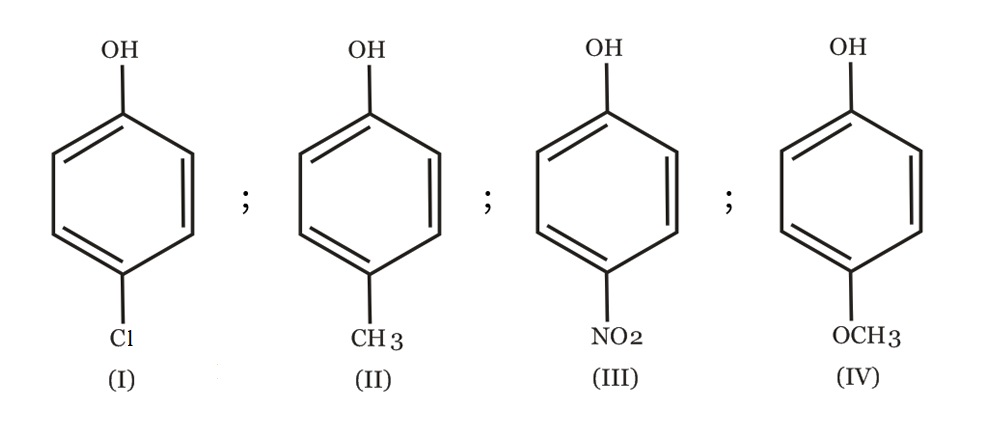
Login to view the detailed solution.

The order of stability of the following carbocations:
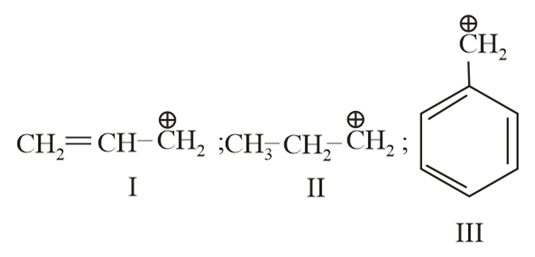
Login to view the detailed solution.
The gas leaked from a storage tank of the Union Carbide plant in Bhopal gas tragedy was :
Login to view the detailed solution.
Which of the following exists as covalent crystals in the solid state?
Login to view the detailed solution.
_1.webp)
Four successive members of the first row of transition elements are listed below with atomic numbers. Which one of them is expected to have the highest $$E^\circ_{M^{3+}/M^{2+}}$$ value?
Login to view the detailed solution.
The rate of a reaction doubles when its temperature changes from 300K to 310K. Activation energy of such a reaction will be:
$$(R = 8.314$$ JK$$^{-1}$$ mol$$^{-1}$$ and log 2 = 0.301$$)$$
Login to view the detailed solution.
The coagulating power of electrolytes having ions Na$$^+$$, Al$$^{3+}$$ and Ba$$^{2+}$$ for arsenic sulphide sol increases in the order,
Login to view the detailed solution.
Which of the following is wrong statement?
Login to view the detailed solution.
Which of the following arrangements does not represent the correct order of the property stated against it?
Login to view the detailed solution.
Given:
$$E^\circ_{Cr^{3+}/Cr} = -0.74$$ V; $$E^\circ_{MnO_4^-/Mn^{2+}} = 1.51$$ V
$$E^\circ_{Cr_2O_7^{2-}/Cr^{3+}} = 1.33$$ V; $$E^\circ_{Cl_2/Cl^-} = 1.36$$ V
Based on the data given above, strongest oxidising agent will be:
Login to view the detailed solution.
Which of the following complex species is not expected to exhibit optical isomerism?
Login to view the detailed solution.
An unknown alcohol is treated with the "Lucas reagent" to determine whether the alcohol is primary, secondary or tertiary. Which alcohol reacts fastest and by what mechanism:
Login to view the detailed solution.
Compound (A), $$C_8H_9Cl$$, gives a white precipitate when warmed with alcoholic AgNO$$_3$$. Oxidation of (A) gives an acid (B), $$C_8H_6O_4$$. (B) easily forms anhydride on heating. Identify the compound (A).
Login to view the detailed solution.
An organic compound A upon reacting with $$NH_3$$ gives B. On heating, B gives C. C in presence of KOH reacts with $$Br_2$$ to give $$CH_3CH_2NH_2$$. A is :
Login to view the detailed solution.
A compound with molecular mass 180 is acylated with $$CH_3COCl$$ to get a compound with molecular mass 390. The number of amino groups presents per molecule of the former compound is
Login to view the detailed solution.
Synthesis of each molecule of glucose in photosynthesis involves
Login to view the detailed solution.
Educational materials for JEE preparation
 Share
Share