
Join Our JEE Preparation Group
Prep with like-minded aspirants; Get access to free daily tests and study material.
Sign in
Please select an account to continue using cracku.in
↓ →
Join Our JEE Preparation Group
Prep with like-minded aspirants; Get access to free daily tests and study material.
A piston filled with 0.04 mol of an ideal gas expands reversibly from 50.0 mL to 375 mL at a constant temperature of 37.0°C. The values of q and w for the process will be
(R = 8.314 J/mol K) (ln7.5 = 2.01)
Step 1: Convert Temperature to Kelvin
$$T = 37.0^\circ\text{C} + 273.15 = 310 \text{ K}$$Step 2: Compute Reversible Isothermal Work ($$w$$)
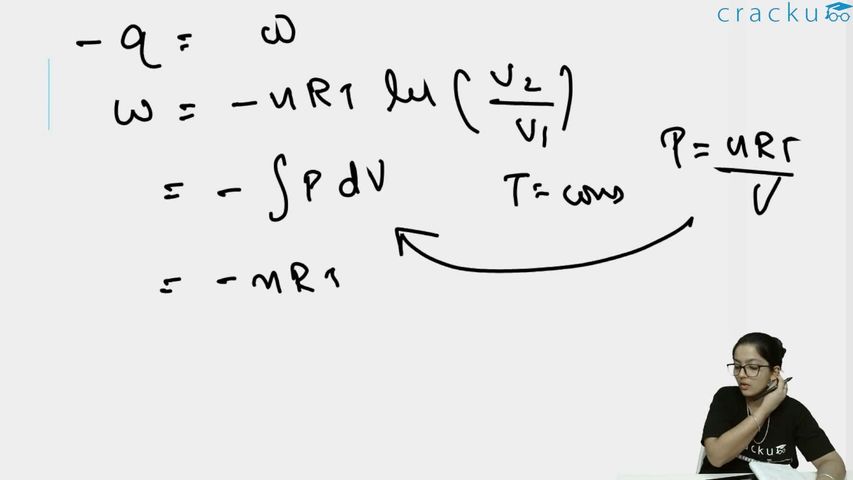
The standard thermodynamic formula for work during a reversible isothermal expansion is:
$$w = -nRT \ln\left(\frac{V_f}{V_i}\right)$$Substitute the given values into the formula:
$$w = -(0.04 \text{ mol}) \times (8.314 \text{ J mol}^{-1}\text{K}^{-1}) \times (310 \text{ K}) \times \ln\left(\frac{375 \text{ mL}}{50.0 \text{ mL}}\right)$$ $$w = -103.09 \times \ln(7.5)$$Using the given value $$\ln(7.5) = 2.01$$:
$$w = -103.09 \times 2.01 \approx -207.2 \text{ J} \approx -208 \text{ J}$$Step 3: Determine Heat ($$q$$)
Using our First Law relationship ($$q = -w$$):
$$q = -(-208 \text{ J}) = +208 \text{ J}$$The positive sign confirms that heat is absorbed by the system during expansion, matching the problem statement.
The work done by the gas during expansion is $$-208 \text{ J}$$ and the heat absorbed by the system is $$+208 \text{ J}$$.
Answer: Option C — q = +208 J, w = -208 J
Was this solution helpful?
Click on the Email ☝️ to Watch the Video Solution
Create a FREE account and get:
_1.webp)

Educational materials for JEE preparation

Ask our AI anything

AI can make mistakes. Please verify important information.
AI can make mistakes. Please verify important information.
