For the following questions answer them individually
The quantities $$x = \frac{1}{\sqrt{\mu_0 \varepsilon_0}}$$, $$y = \frac{E}{B}$$ and $$z = \frac{l}{CR}$$ are defined where C-capacitance, R-Resistance, $$l$$-length, E-Electric field, B-magnetic field and $$\varepsilon_0$$, $$\mu_0$$ - free space permittivity and permeability respectively. Then:
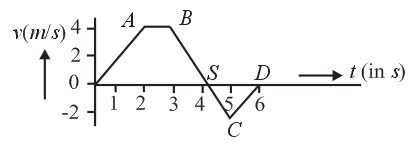
The velocity $$(v)$$ and time $$(t)$$ graph of a body in a straight line motion is shown in the figure. The point $$S$$ is at $$4.333$$ seconds. The total distance covered by the body in $$6$$ s is:
A spaceship in space sweeps stationary interplanetary dust. As a result, its mass increases at a rate $$\frac{dM(t)}{dt} = bv^2(t)$$, where $$v(t)$$ is its instantaneous velocity. The instantaneous acceleration of the satellite is:
The acceleration due to gravity on the earth's surface at the poles is $$g$$ and angular velocity of the earth about the axis passing through the pole is $$\omega$$. An object is weighed at the equator and at a height $$h$$ above the poles by using a spring balance. If the weights are found to be same, then $$h$$ is: ($$h \ll R$$, where $$R$$ is the radius of the earth)
In an experiment to verify Stokes law, a small spherical ball of radius $$r$$ and density $$\rho$$ falls under gravity through a distance $$h$$ in air before entering a tank of water. If the terminal velocity of the ball inside water is same as its velocity just before entering the water surface, then the value of $$h$$ is proportional to: (ignore viscosity of air)
Two different wires having lengths $$L_1$$ and $$L_2$$ and respective temperature coefficient of linear expansion $$\alpha_1$$ and $$\alpha_2$$, are joined end-to-end. Then the effective temperature coefficient of linear expansion is:
In an adiabatic process, the density of a diatomic gas becomes $$32n$$ times its initial value. The final pressure of the gas is found to be $$n$$ times the initial pressure. The value of $$n$$ is:
A ring is hung on a nail. It can oscillate, without slipping or sliding (i) in its plane with a time period $$T_1$$ and (ii) back and forth in a direction perpendicular to its plane, with a period $$T_2$$. The ratio $$\frac{T_1}{T_2}$$ will be:
A driver in a car, approaching a vertical wall notices that the frequency of his car horn has changed from $$440$$ Hz to $$480$$ Hz, when it gets reflected from the wall. If the speed of sound in air is $$345\,\text{m s}^{-1}$$, then the speed of the car is:
Ten charges are placed on the circumference of a circle of radius R with constant angular separation between successive charges. Alternate charges 1, 3, 5, 7, 9 have charge $$(+q)$$ each, while 2, 4, 6, 8, 10 have charge $$(-q)$$ each. The potential V and the electric field E at the centre of the circle are respectively: (Take $$V = 0$$ at infinity)
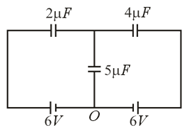
In the circuit shown, charge on the $$5\,\mu\text{F}$$ capacitor is:
A parallel plate capacitor has plate of length $$l$$, width $$w$$ and separation of plates is $$d$$. It is connected to a battery of emf $$V$$. A dielectric slab of the same thickness $$d$$ and of dielectric constant $$K = 4$$ is being inserted between the plates of the capacitor. At what length of the slab inside plates, will the energy stored in the capacitor be two times the initial energy stored?
A galvanometer is used in laboratory for detecting the null point in electrical experiments. If, on passing a current of $$6\,mA$$ it produces a deflection of $$2^\circ$$, its figure of merit is close to:
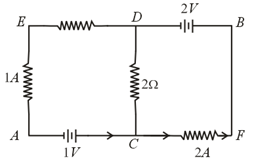
In the circuit, given in the figure currents in different branches and value of one resistor are shown. Then potential at point $$B$$ with respect to the point $$A$$ is:
An iron rod of volume $$10^{-3}\,\text{m}^3$$ and relative permeability 1000 is placed as core in a solenoid with 10 turns $$\text{cm}^{-1}$$. If a current of $$0.5\,\text{A}$$ is passed through the solenoid, then the magnetic moment of the rod will be:
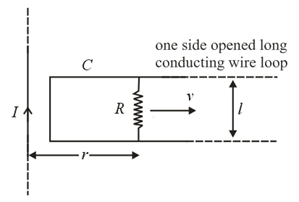
An infinitely long straight wire carrying current I, one side opened rectangular loop and a conductor C with a sliding connector are located in the same plane, as shown in the figure. The connector has length $$l$$ and resistance $$R$$. It slides to the right with a velocity $$v$$. The resistance of the conductor and the self inductance of the loop are negligible. The induced current in the loop, as a function of separation $$r$$, between the connector and the straight wire is:
The correct match between the entries in column I and column II are:
I (Radiation)Â Â Â Â Â Â Â Â II (Wavelength)
a. Microwave         i. 100 m
b. Gamma rays       ii. $$10^{-15}$$ m
c. A.M. radio         iii. $$10^{-10}$$ m
d. X-rays             iv. $$10^{-3}$$ m
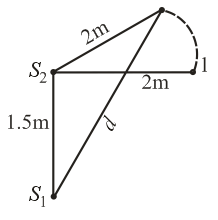
Two coherent sources of sound, $$S_1$$ and $$S_2$$, produce sound waves of the same wavelength $$\lambda = 1\,\text{m}$$ are in phase. $$S_1$$ and $$S_2$$ are placed $$1.5\,\text{m}$$ apart (see fig). A listener, located at L, directly in front of $$S_2$$, finds that the intensity is at a minimum when he is $$2\,\text{m}$$ away from $$S_2$$. The listener moves away from $$S_1$$, keeping the distance from $$S_2$$ fixed. The adjacent maximum of intensity is observed when the listener is at a distance $$d$$ from $$S_1$$. Then $$d$$ is:
A radioactive nucleus decays by two different processes. The half-life for the first process is $$10\,\text{s}$$ and that for the second is $$100\,\text{s}$$. The effective half-life of the nucleus is close to:
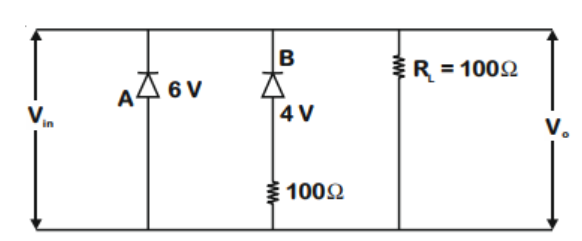
Two Zener diodes ($$A$$ and $$B$$) having breakdown voltages of $$6\,\text{V}$$ and $$4\,\text{V}$$ respectively, are connected as shown in the circuit below. The output voltage $$V_0$$ variation with input voltage linearly increasing with time, is given by ($$V_{input} = 0V$$ at $$t = 0$$):
A body of mass $$2\,\text{kg}$$ is driven by an engine delivering a constant power of $$1\,\text{J s}^{-1}$$. The body starts from rest and moves in a straight line. After $$9\,\text{s}$$, the body has moved a distance (in m)....
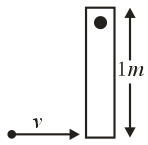
A thin rod of mass $$0.9\,\text{kg}$$ and length $$1\,\text{m}$$ is suspended, at rest, from one end so that it can freely oscillate in the vertical plane. A particle of mass $$0.1\,\text{kg}$$ moving in a straight line with velocity $$80\,\text{m s}^{-1}$$ hits the rod at its bottom most point and sticks to it (see figure). The angular speed (in $$\text{rad s}^{-1}$$) of the rod immediately after the collision will be...........
Nitrogen gas is at $$300\,^\circ\text{C}$$ temperature. The temperature (in K) at which the rms speed of a $$\text{H}_2$$ molecule would be equal to the rms speed of a nitrogen molecule, is........... (Molar mass of $$\text{N}_2$$ gas 28 g).
A prism of angle $$A = 1^\circ$$, $$\mu = 1.5$$. A good estimate for the minimum angle of deviation (in degrees) is close to $$\frac{N}{10}$$. Value of N is.........
The surface of a metal is illuminated alternately with photons of energies $$E_1 = 4\,\text{eV}$$ and $$E_2 = 2.5\,\text{eV}$$ respectively. The ratio of maximum speeds of the photoelectrons emitted in the two cases is 2. The work function of the metal in (eV) is..........