
Join Our JEE Preparation Group
Prep with like-minded aspirants; Get access to free daily tests and study material.
Sign in
Please select an account to continue using cracku.in
↓ →
Join Our JEE Preparation Group
Prep with like-minded aspirants; Get access to free daily tests and study material.
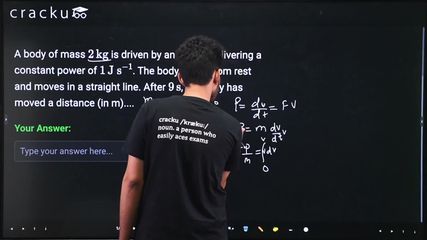
A body of mass $$2\,\text{kg}$$ is driven by an engine delivering a constant power of $$1\,\text{J s}^{-1}$$. The body starts from rest and moves in a straight line. After $$9\,\text{s}$$, the body has moved a distance (in m)....
Correct Answer: 18
We are told that the engine supplies a constant power $$P = 1\,\text{J s}^{-1}$$ to a body of mass $$m = 2\,\text{kg}$$. The body starts from rest, so its initial velocity is $$v_0 = 0$$. Power is defined as the rate at which work is done, and, for translational motion in a straight line, we have the relation
$$P \;=\; \frac{dW}{dt} \;=\; F\,v$$
Because the force responsible for the motion provides the acceleration, we can rewrite the force in terms of mass and acceleration: $$F = m\,a$$. Substituting this into the power expression gives
$$P \;=\; (m\,a)\,v \;=\; m\,a\,v$$
The acceleration $$a$$ is the time derivative of velocity, $$a = \dfrac{dv}{dt}$$. Replacing $$a$$ by $$\dfrac{dv}{dt}$$, we obtain
$$P \;=\; m\,v\,\frac{dv}{dt}$$
All the quantities in this differential equation are separable, so we rearrange to isolate the variables:
$$v\,dv \;=\; \frac{P}{m}\,dt$$
Now we integrate both sides from the initial state (velocity $$0$$ at time $$0$$) to some general state (velocity $$v$$ at time $$t$$):
$$\int_{0}^{v} v\,dv \;=\; \frac{P}{m}\int_{0}^{t} dt$$
Evaluating the integrals, we get
$$\frac{1}{2}v^{2} \;=\; \frac{P}{m}\,t$$
Multiplying by $$2$$ yields an explicit expression for the square of the velocity:
$$v^{2} \;=\; 2\,\frac{P}{m}\,t$$
Taking the positive square root (because the body moves forward), we find the velocity as a function of time:
$$v(t) \;=\; \sqrt{\frac{2P}{m}\,t}$$
The displacement $$s$$ in time $$t$$ is the time integral of the velocity:
$$s \;=\; \int_{0}^{t} v(t')\,dt' \;=\; \int_{0}^{t} \sqrt{\frac{2P}{m}\,t'}\,dt'$$
We factor out the constants to simplify the integral:
$$s \;=\; \sqrt{\frac{2P}{m}}\;\int_{0}^{t} (t')^{1/2}\,dt'$$
We now integrate the power-law function. The integral of $$t'^{1/2}$$ is $$\tfrac{2}{3}t'^{3/2}$$. Substituting the bounds gives
$$s \;=\; \sqrt{\frac{2P}{m}}\;\left[\frac{2}{3}\,t^{3/2}\right]$$
This can be rewritten more compactly as
$$s \;=\; \frac{2}{3}\,\sqrt{\frac{2P}{m}}\;t^{3/2}$$
We now substitute the numerical values $$P = 1\,\text{J s}^{-1}$$, $$m = 2\,\text{kg}$$ and $$t = 9\,\text{s}$$.
First, calculate the square-root factor:
$$\sqrt{\frac{2P}{m}} \;=\; \sqrt{\frac{2 \times 1}{2}} \;=\; \sqrt{1} \;=\; 1$$
With this, the expression for $$s$$ simplifies to
$$s \;=\; \frac{2}{3}\;t^{3/2}$$
Next, evaluate $$t^{3/2}$$ for $$t = 9\,\text{s}$$. We note that $$9^{1/2} = 3$$, so
$$9^{3/2} \;=\; (9^{1/2})^{3} \;=\; 3^{3} \;=\; 27$$
Substituting this value, we find
$$s \;=\; \frac{2}{3}\times 27 \;=\; 18$$
Therefore, after $$9\,\text{s}$$ the body has travelled a distance of $$18\,\text{m}$$.
So, the answer is $$18\,\text{m}$$.
Was this solution helpful?
Click on the Email ☝️ to Watch the Video Solution
Create a FREE account and get:
_1.webp)

Educational materials for JEE preparation

Ask our AI anything

AI can make mistakes. Please verify important information.
AI can make mistakes. Please verify important information.
