
Join Our JEE Preparation Group
Prep with like-minded aspirants; Get access to free daily tests and study material.
Sign in
Please select an account to continue using cracku.in
↓ →
Join Our JEE Preparation Group
Prep with like-minded aspirants; Get access to free daily tests and study material.
Two Zener diodes ($$A$$ and $$B$$) having breakdown voltages of $$6\,\text{V}$$ and $$4\,\text{V}$$ respectively, are connected as shown in the circuit below. The output voltage $$V_0$$ variation with input voltage linearly increasing with time, is given by ($$V_{input} = 0V$$ at $$t = 0$$):
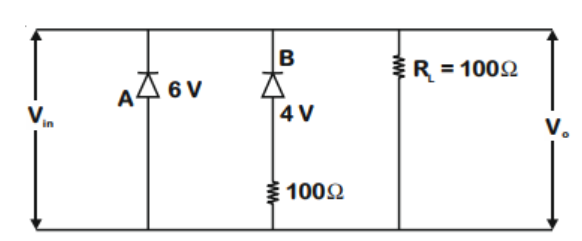
A Zener diode in reverse breakdown maintains a fixed voltage across its terminals, acting as a constant voltage drop in series with any accompanying branch resistors.
For $$V_{\text{in}} < 4\text{ V}$$:
Both Zener diodes $$A$$ and $$B$$ remain in the off-state (no breakdown). The output voltage tracks the input source directly: $$V_o = V_{\text{in}}$$
For $$4\text{ V} \le V_{\text{in}} < 6\text{ V}$$:
Zener diode $$B$$ enters its breakdown region, conducting current through its branch and dropping a fixed $$4\text{ V}$$. Because the branch introduces an additional load resistance of $$100\ \Omega$$ in parallel with $$R_L$$, it alters the overall circuit impedance. The output voltage continues to rise linearly with time, but with a reduced slope.
For $$V_{\text{in}} \ge 6\text{ V}$$:
Zener diode $$A$$ reaches its breakdown threshold. Since it is connected directly across the main output rails without any series branch resistance, it successfully clamps the output to a constant maximum value: $$V_o = 6\text{ V}$$
Was this solution helpful?
Create a FREE account and get:
_1.webp)

Educational materials for JEE preparation

Ask our AI anything

AI can make mistakes. Please verify important information.
AI can make mistakes. Please verify important information.
