
Join Our JEE Preparation Group
Prep with like-minded aspirants; Get access to free daily tests and study material.
Sign in
Please select an account to continue using cracku.in
↓ →
Join Our JEE Preparation Group
Prep with like-minded aspirants; Get access to free daily tests and study material.
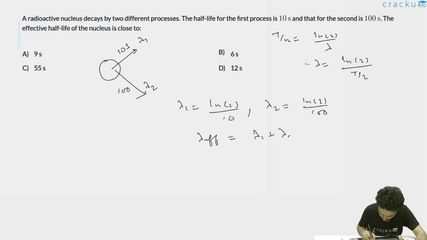
A radioactive nucleus decays by two different processes. The half-life for the first process is $$10\,\text{s}$$ and that for the second is $$100\,\text{s}$$. The effective half-life of the nucleus is close to:
First recall the fundamental relation between the decay constant $$\lambda$$ and the half-life $$T_{1/2}$$ of any radioactive process:
$$T_{1/2}=\frac{\ln 2}{\lambda}.$$
In the present problem the nucleus can disintegrate independently by two different modes. Let the decay constants be $$\lambda_1$$ and $$\lambda_2$$ for these modes. Then:
$$T_{1/2}^{(1)}=10\;\text{s}\quad\Longrightarrow\quad \lambda_1=\frac{\ln 2}{T_{1/2}^{(1)}}=\frac{\ln 2}{10}.$$
Similarly,
$$T_{1/2}^{(2)}=100\;\text{s}\quad\Longrightarrow\quad \lambda_2=\frac{\ln 2}{T_{1/2}^{(2)}}=\frac{\ln 2}{100}.$$
When two independent decay routes are available simultaneously, their probabilities add. Therefore the total or effective decay constant $$\lambda_{\text{eff}}$$ is given by
$$\lambda_{\text{eff}}=\lambda_1+\lambda_2.$$
Substituting the values just obtained, we have
$$\lambda_{\text{eff}}=\frac{\ln 2}{10}+\frac{\ln 2}{100}=\ln 2\left(\frac{1}{10}+\frac{1}{100}\right)=\ln 2\left(\frac{10}{100}+\frac{1}{100}\right)=\ln 2\left(\frac{11}{100}\right)=0.11\,\ln 2.$$
Now we wish to find the corresponding effective half-life $$T_{1/2}^{\text{(eff)}}$$. Using the same basic formula, but with the effective decay constant, we write
$$T_{1/2}^{\text{(eff)}}=\frac{\ln 2}{\lambda_{\text{eff}}}.$$
Substituting $$\lambda_{\text{eff}}=0.11\,\ln 2$$:
$$T_{1/2}^{\text{(eff)}}=\frac{\ln 2}{0.11\,\ln 2}=\frac{1}{0.11}\,\text{s}\approx 9.09\,\text{s}.$$
Rounding to the nearest whole second gives approximately $$9\,\text{s}$$.
Hence, the correct answer is Option A.
Was this solution helpful?
Click on the Email ☝️ to Watch the Video Solution
Create a FREE account and get:
_1.webp)

Educational materials for JEE preparation

Ask our AI anything

AI can make mistakes. Please verify important information.
AI can make mistakes. Please verify important information.
