
Join Our JEE Preparation Group
Prep with like-minded aspirants; Get access to free daily tests and study material.
Sign in
Please select an account to continue using cracku.in
↓ →
Join Our JEE Preparation Group
Prep with like-minded aspirants; Get access to free daily tests and study material.
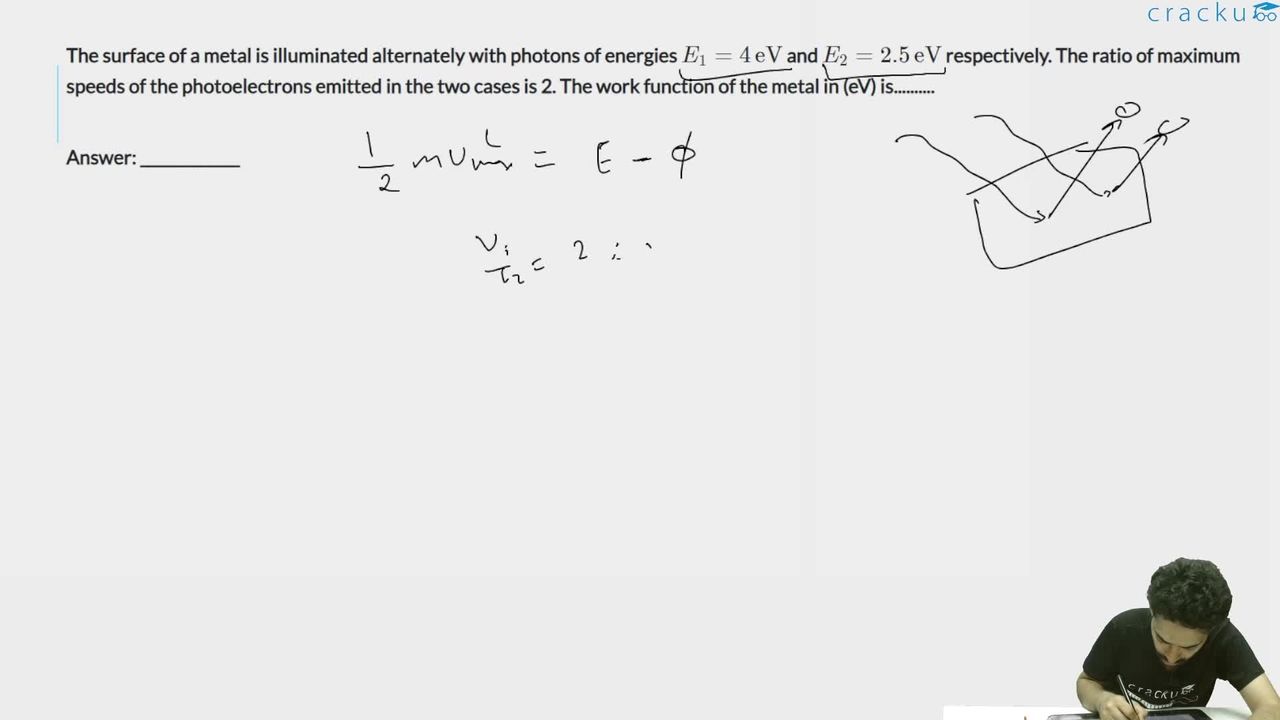
The surface of a metal is illuminated alternately with photons of energies $$E_1 = 4\,\text{eV}$$ and $$E_2 = 2.5\,\text{eV}$$ respectively. The ratio of maximum speeds of the photoelectrons emitted in the two cases is 2. The work function of the metal in (eV) is..........
Correct Answer: 2
According to Einstein’s photo-electric equation, the maximum kinetic energy of an emitted electron is equal to the energy of the incident photon minus the work function of the metal. Stating the relation in symbols, we write
$$\tfrac12\,m\,v_{\max}^2 \;=\; h\nu \;-\;\phi,$$
where $$m$$ is the electron mass, $$v_{\max}$$ is the maximum speed of the emitted photo-electrons, $$h\nu$$ (or simply $$E_{\text{photon}}$$) is the photon energy and $$\phi$$ is the work function of the metal.
The problem gives two different photon energies:
$$E_1 = 4\;\text{eV}, \qquad E_2 = 2.5\;\text{eV}.$$
Let the corresponding maximum speeds of the photo-electrons be $$v_1$$ and $$v_2$$. Using the formula separately for the two cases, we have
$$\tfrac12\,m\,v_1^{\,2} = E_1 - \phi \qquad\text{and}\qquad \tfrac12\,m\,v_2^{\,2} = E_2 - \phi.$$
The ratio of the maximum speeds is given to be 2, that is,
$$\frac{v_1}{v_2} = 2.$$
Squaring both sides we obtain
$$\left(\frac{v_1}{v_2}\right)^2 = 4.$$
Now we divide the two kinetic-energy equations term by term. The factors $$\tfrac12 m$$ cancel out, yielding
$$\frac{v_1^{\,2}}{v_2^{\,2}} = \frac{E_1 - \phi}{E_2 - \phi}.$$
Substituting the squared ratio just obtained, we write
$$4 = \frac{E_1 - \phi}{E_2 - \phi}.$$
Cross-multiplying gives
$$E_1 - \phi = 4\,(E_2 - \phi).$$
Expanding the right-hand side, we have
$$E_1 - \phi = 4E_2 - 4\phi.$$
Now we collect the $$\phi$$ terms on one side and the numerical terms on the other side:
$$-\,\phi + 4\phi = 4E_2 - E_1.$$
Simplifying the left side,
$$3\phi = 4E_2 - E_1.$$
So, the work function is
$$\phi = \frac{4E_2 - E_1}{3}.$$
Substituting the numerical values $$E_1 = 4\;\text{eV}$$ and $$E_2 = 2.5\;\text{eV},$$ we get
$$\phi = \frac{4 \times 2.5 - 4}{3} = \frac{10 - 4}{3} = \frac{6}{3} = 2\;\text{eV}.$$
So, the answer is $$2\;\text{eV}.$$
Was this solution helpful?
Click on the Email ☝️ to Watch the Video Solution
Create a FREE account and get:
_1.webp)

Educational materials for JEE preparation

Ask our AI anything

AI can make mistakes. Please verify important information.
AI can make mistakes. Please verify important information.
