
Join Our JEE Preparation Group
Prep with like-minded aspirants; Get access to free daily tests and study material.
Sign in
Please select an account to continue using cracku.in
↓ →
Join Our JEE Preparation Group
Prep with like-minded aspirants; Get access to free daily tests and study material.
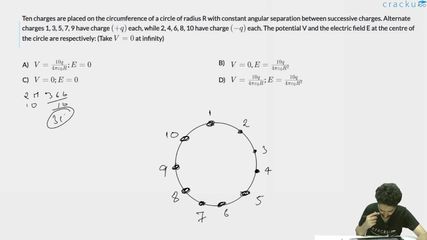
Ten charges are placed on the circumference of a circle of radius R with constant angular separation between successive charges. Alternate charges 1, 3, 5, 7, 9 have charge $$(+q)$$ each, while 2, 4, 6, 8, 10 have charge $$(-q)$$ each. The potential V and the electric field E at the centre of the circle are respectively: (Take $$V = 0$$ at infinity)
We have ten point charges fixed on the circumference of a circle of radius $$R$$. They are equally spaced, so the angular separation between successive charges is
$$\Delta\theta=\frac{2\pi}{10}=36^{\circ}.$$
Charges numbered 1, 3, 5, 7, 9 each carry $$+q$$, while 2, 4, 6, 8, 10 each carry $$-q$$. Thus there are exactly five positive charges and five negative charges.
First we examine the electric potential at the centre. The potential produced at the centre by a single point charge is obtained from the formula
$$V=\frac{1}{4\pi\varepsilon_{0}}\frac{q}{r},$$
where $$r$$ is the distance from the charge to the point of observation. Here that distance is the radius $$R$$ for every charge. Hence the contribution of one $$+q$$ charge is
$$V_{(+)}=\frac{1}{4\pi\varepsilon_{0}}\frac{(+q)}{R},$$
while that of one $$-q$$ charge is
$$V_{(-)}=\frac{1}{4\pi\varepsilon_{0}}\frac{(-q)}{R}.$$
Because there are five charges of each sign, the total potential is
$$V_{\text{total}} =5V_{(+)}+5V_{(-)} =5\left(\frac{1}{4\pi\varepsilon_{0}}\frac{q}{R}\right) +5\left(\frac{1}{4\pi\varepsilon_{0}}\frac{-q}{R}\right) =\frac{5q}{4\pi\varepsilon_{0}R} -\frac{5q}{4\pi\varepsilon_{0}R} =0.$$
So the potential at the centre is zero.
Now we turn to the electric field. The magnitude of the field at a distance $$r$$ from a point charge is given by
$$E=\frac{1}{4\pi\varepsilon_{0}}\frac{|q|}{r^{2}},$$
and its direction is along the line joining the charge and the point: radially inward for a positive charge (because the field lines point away from the charge, towards the centre), and radially outward for a negative charge (field lines point toward the charge).
For our ring, every charge lies the same distance $$R$$ from the centre, so each field contribution has magnitude
$$E_{0}=\frac{1}{4\pi\varepsilon_{0}}\frac{q}{R^{2}}.$$
Let $$\hat{r}_{k}$$ be the unit vector pointing from the centre toward the position of the $$k^{\text{th}}$$ charge. Then the field at the centre produced by that charge is
$$\vec{E}_{k}= \begin{cases} -E_{0}\hat{r}_{k}, & \text{for a } +q \text{ charge (inward)}\\[4pt] +E_{0}\hat{r}_{k}, & \text{for a } -q \text{ charge (outward)} \end{cases}.$$
Let us collect the five positive charges first. They occupy the angles
$$0^{\circ},\;72^{\circ},\;144^{\circ},\;216^{\circ},\;288^{\circ},$$
i.e. every $$72^{\circ}$$, forming a perfect regular pentagon. Their field vectors are the five inward radial vectors directed to the centre from those vertices. The vector sum of the five unit radial vectors of a regular pentagon is well known to be zero because they are symmetrically spaced; therefore
$$\sum_{\text{five }+q}\vec{E}_{k}=-E_{0}\sum_{m=0}^{4}\hat{r}_{m}=0.$$
Exactly the same argument applies to the five negative charges. They lie at the intermediate angles
$$36^{\circ},\;108^{\circ},\;180^{\circ},\;252^{\circ},\;324^{\circ},$$
another regular pentagon, merely rotated by $$36^{\circ}$$. The outward radial vectors at these angles are again symmetrically placed, so
$$\sum_{\text{five }-q}\vec{E}_{k}=+E_{0}\sum_{m=0}^{4}\hat{r}_{m}^{\,'}=0.$$
Adding the two groups together, the total electric field at the centre is
$$\vec{E}_{\text{total}}=0+0=0.$$
We therefore conclude
$$V=0,\qquad \vec{E}=0.$$
Hence, the correct answer is Option C.
Was this solution helpful?
Click on the Email ☝️ to Watch the Video Solution
Create a FREE account and get:
_1.webp)

Educational materials for JEE preparation

Ask our AI anything

AI can make mistakes. Please verify important information.
AI can make mistakes. Please verify important information.
