
Join Our JEE Preparation Group
Prep with like-minded aspirants; Get access to free daily tests and study material.
Sign in
Please select an account to continue using cracku.in
↓ →
Join Our JEE Preparation Group
Prep with like-minded aspirants; Get access to free daily tests and study material.
Nitrogen gas is at $$300\,^\circ\text{C}$$ temperature. The temperature (in K) at which the rms speed of a $$\text{H}_2$$ molecule would be equal to the rms speed of a nitrogen molecule, is........... (Molar mass of $$\text{N}_2$$ gas 28 g).
Correct Answer: 41
First, we convert the given Celsius temperature of nitrogen gas into the Kelvin scale, because all gas-kinetic formulae are written for absolute temperature. By definition,
$$T\;(\text{in K}) \;=\; T\;({}^\circ\text{C}) + 273.$$
Here the nitrogen temperature is $$300\,{}^\circ\text{C}$$, so
$$T_{\text{N}_2}=300+273=573\;\text{K}.$$
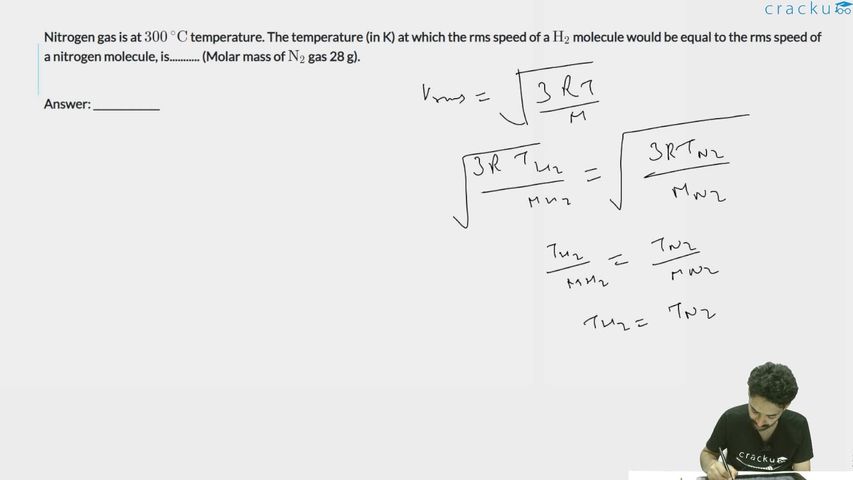
For any ideal gas the root-mean-square (rms) speed is given by the well-known kinetic-theory relation
$$v_{\text{rms}}=\sqrt{\dfrac{3RT}{M}},$$
where $$R$$ is the universal gas constant, $$T$$ is the absolute temperature, and $$M$$ is the molar mass (expressed in the same mass unit for every gas in the comparison).
We are told that the rms speed of a hydrogen molecule $$(\text{H}_2)$$ must equal the rms speed of a nitrogen molecule $$(\text{N}_2)$$. Therefore we set the two expressions equal:
$$\sqrt{\dfrac{3R\,T_{\text{N}_2}}{M_{\text{N}_2}}}\;=\;\sqrt{\dfrac{3R\,T_{\text{H}_2}}{M_{\text{H}_2}}}.$$
First we square both sides to remove the square roots, obtaining
$$\dfrac{3R\,T_{\text{N}_2}}{M_{\text{N}_2}}\;=\;\dfrac{3R\,T_{\text{H}_2}}{M_{\text{H}_2}}.$$
The common factor $$3R$$ cancels out, leaving the simple proportionality
$$\dfrac{T_{\text{N}_2}}{M_{\text{N}_2}}\;=\;\dfrac{T_{\text{H}_2}}{M_{\text{H}_2}}.$$
We now solve for the unknown temperature $$T_{\text{H}_2}$$ of hydrogen:
$$T_{\text{H}_2} = T_{\text{N}_2}\,\dfrac{M_{\text{H}_2}}{M_{\text{N}_2}}.$$
Substituting the numeric values, we use the molar mass of nitrogen as $$M_{\text{N}_2}=28\;\text{g mol}^{-1}$$ (given) and the customary molar mass of hydrogen as $$M_{\text{H}_2}=2\;\text{g mol}^{-1}$$. Hence,
$$T_{\text{H}_2} = 573\;\text{K}\,\times\,\dfrac{2}{28}.$$
Now we simplify the fraction:
$$\dfrac{2}{28} = \dfrac{1}{14}.$$
So,
$$T_{\text{H}_2} = 573\;\text{K}\,\times\,\dfrac{1}{14}.$$
Carrying out the division,
$$T_{\text{H}_2} = \dfrac{573}{14}\;\text{K} = 40.93\;\text{K}.$$
Rounding to the nearest whole number in Kelvin, we have $$T_{\text{H}_2}\approx 41\;\text{K}.$$
Hence, the correct answer is Option 41.
Was this solution helpful?
Click on the Email ☝️ to Watch the Video Solution
Create a FREE account and get:
_1.webp)

Educational materials for JEE preparation

Ask our AI anything

AI can make mistakes. Please verify important information.
AI can make mistakes. Please verify important information.
