
Join Our JEE Preparation Group
Prep with like-minded aspirants; Get access to free daily tests and study material.
Sign in
Please select an account to continue using cracku.in
↓ →
Join Our JEE Preparation Group
Prep with like-minded aspirants; Get access to free daily tests and study material.
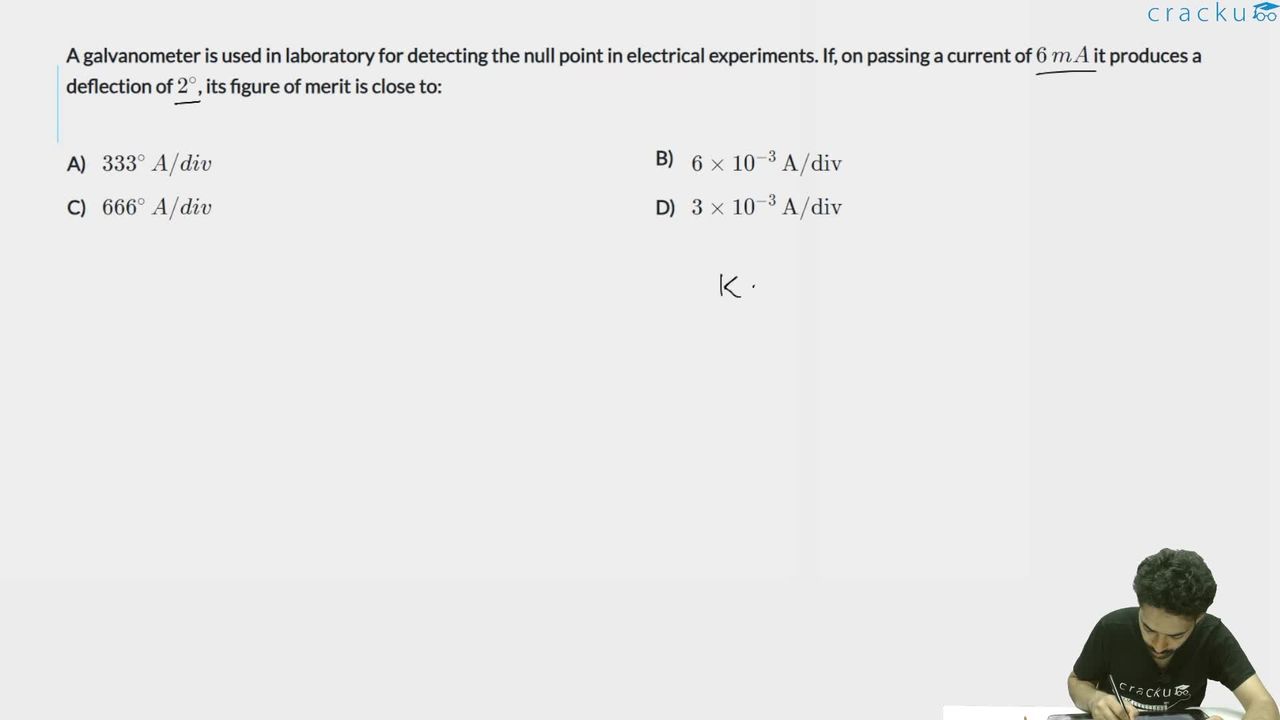
A galvanometer is used in laboratory for detecting the null point in electrical experiments. If, on passing a current of $$6\,mA$$ it produces a deflection of $$2^\circ$$, its figure of merit is close to:
The quantity that characterises a galvanometer is called its figure of merit. By definition, the figure of merit $$k$$ is the current required to produce one scale-division (or one degree) of deflection. In symbols we write
$$k \;=\; \frac{I}{\theta}$$
where $$I$$ is the current through the galvanometer and $$\theta$$ is the resulting deflection expressed in the same units (here, degrees).
We are told that a current of $$6\,\text{mA}$$ produces a deflection of $$2^\circ$$. First convert the current into amperes because the options are quoted in amperes per division:
$$I \;=\; 6\,\text{mA} \;=\; 6 \times 10^{-3}\,\text{A}$$
The deflection is already in degrees, so $$\theta = 2^\circ$$.
Now substitute these numbers into the formula for $$k$$:
$$k \;=\; \frac{I}{\theta} \;=\; \frac{6 \times 10^{-3}\,\text{A}}{2^\circ}$$
Carrying out the division step by step, we have
$$k \;=\; 3 \times 10^{-3}\,\text{A}\;/\;^\circ$$
This means that a current of $$3 \times 10^{-3}\,\text{A}$$ is needed for every one-degree deflection, which is precisely the quantity asked for.
Looking at the given options, we see that
Option D: $$3 \times 10^{-3}\,\text{A/div}$$
matches our calculated value.
Hence, the correct answer is Option D.
Was this solution helpful?
Click on the Email ☝️ to Watch the Video Solution
Create a FREE account and get:
_1.webp)

Educational materials for JEE preparation

Ask our AI anything

AI can make mistakes. Please verify important information.
AI can make mistakes. Please verify important information.
