NSEP 2016 27th Nov Question Paper

For the following questions answer them individually

Vectors A, B, C lie in XY plane and their resultant is R. The magnitudes of A, B and R are 100, 200 and 200 respectively. The angles made by these vectors with the positive direction of X axis are $$60^\circ$$, $$150^\circ$$ and $$90^\circ$$ respectively. Therefore, the magnitude and the angle made by C with positive direction of X axis respectively are

Two particles A and B are situated 10 m apart along X axis, B being farther right of A, at $$t = 0$$. Particle A is moving at 0.75 m/s parallel to +Y axis while B at 1 m/s along -X axis. After a time t they come closest to each other. Therefore, t is

Out of the following differential equations, one that correctly represents the motion of a second's pendulum is

A block of mass 2 kg drops vertically from a height of 0.4 m onto a spring whose force constant K is 1960 N/m. Therefore, the maximum compression of the spring is

Two blocks of masses $$m_1 = 8$$ kg and $$m_2 = 7$$ kg are connected by a light string passing over a light frictionless pulley. The mass $$m_1$$ is at rest on the inclined plane and mass $$m_2$$ hangs vertically. The angle of inclination is $$30^\circ$$. Therefore, the force of friction acting on $$m_1$$ is

At a certain height h above the surface of the earth the change in the value of acceleration due to gravity (g) is the same as that at a depth x below the surface. Assuming h and x to be enough small compared to the radius of the earth, $$x \colon h$$ is

Two point masses $$m_1$$ and $$m_2$$ are connected at the ends of a light rigid rod of length l. The moment of inertia of the system about an axis through their centre of mass and perpendicular to the rod is

Two particles of masses m and M are initially at rest and infinitely separated. At a later instant when they are at a finite distance d from each other, their relative velocity of approach is

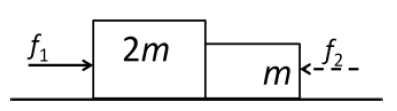
Two blocks of masses m and 2m are placed on a smooth horizontal surface as shown. In the first case only a force $$f_1$$ is applied from left. Later on only a force $$f_2$$ is applied from right. If the force acting at the interface of the two blocks in the two cases is the same, then $$f_1 \colon f_2$$ is

image

A ball A of mass 1 kg moving at a speed of 5 m/s strikes tangentially another ball B initially at rest. The ball A then moves at right angles to its initial direction at a speed of 4 m/s. If the collision is elastic, the mass (in kg) of ball B and its momentum after collision (in kg-m/s) respectively are (approximately)

A simple pendulum has a bob of mass m and a light string of length l. The string is replaced by a uniform rod of mass m and of the same length l. The time period of this pendulum is

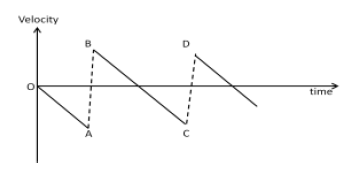
A tennis ball is released from a height and allowed to fall onto a hard surface. The adjacent graph shows the variation of velocity of the ball with time from the instant of release. The point of upward maximum velocity of the ball is indicated by point

image

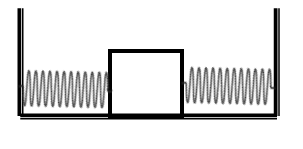
The diagram shows an oscillating block connected to two identical springs. The frequency of oscillations can be increased substantially by

image

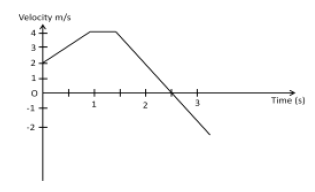
The variation of velocity with time of a toy car moving along a straight line is as shown below. Which of the following graphs correctly represents the variation of acceleration with time for the toy car?

image

Consider a relation connecting three physical quantities A, B and C given by $$A = B^n C^m$$. The dimensions of A, B and C are $$[LT]$$, $$[L^2T^{-1}]$$ and $$[LT^2]$$ respectively. Therefore, the exponents n and m have values

Two identical rooms in a house are connected by an open doorway. The temperatures in the two rooms are maintained at two different values. Therefore,

A vibrator of frequency f is placed near one end of a long cylindrical tube. The tube is fitted with a movable piston at the other end. An observer listens to the sound through a side opening. As the piston is moved through 8.75 cm, the intensity of sound recorded by the observer changes from a maximum to a minimum. If the speed of sound in air is 350 m/s, the frequency f is

A heavy metal block is dragged along a rough horizontal surface at a constant speed of 20 km/hr. The coefficient of friction between the block and the surface is 0.6. The block is made of a material whose specific heat is $$0.1\ \text{cal g}^{-1}\ ^\circ\text{C}^{-1}$$ and absorbs 25 percent of heat generated due to friction. If the block is dragged for 10 min, the rise in temperature of the block is about (take $$g = 10\ \text{ms}^{-2}$$)

A gas is made to undergo a change of state from an initial state to a final state along different paths by adiabatic process only. Therefore,

The critical angle between a certain transparent medium and air is $$\phi$$. A ray of light travelling through air enters the medium at an angle of incidence equal to its polarizing angle $$\theta$$. Therefore, the angle of refraction is

If a copper wire is stretched to make its radius decrease by 0.1 percent, the percentage change in its resistance is approximately

Consider a manual camera with a lens having a focal length of 5 cm. It is focused at infinity. For catching the picture of an object at a distance of 30 cm, one would

Initially interference is observed with the entire experimental set up inside a chamber filled with air. Now the chamber is evacuated. With the same source of light used, a careful observer will find that

Two identical loudspeakers, placed close to each other inside a room, are supplied with the same sinusoidal voltage. One can imagine a pattern around the loudspeakers with areas of increased and decreased sound intensity alternately located. Which of the following actions will NOT change the locations of these areas?

A particle at rest explodes into two fragments of masses $$m_1$$ and $$m_2$$ ($$m_1 > m_2$$) which move apart with nonzero velocities. If $$\lambda_1$$ and $$\lambda_2$$ are their de Broglie wavelengths respectively, then

The breakdown field for air is about $$2\times 10^{6}$$ volt/m. Therefore, the maximum charge that can be placed on a sphere of diameter 10 cm is

A wire in the shape of a square frame carries a current I and produces a magnetic field $$B_s$$ at its centre. Now the wire is bent in the shape of a circle and carries the same current. If $$B_c$$ is the magnetic field produced at the centre of the circular coil, then $$\frac{B_s}{B_c}$$ is

A solid wooden block with a uniform cross section is floating in water (density $$\rho_w$$) with a height $$h_1$$ below water. Now a flat slab of stone is placed over the wooden block but the block still floats with a height $$h_2$$ below water. Afterwards the stone is removed from the top and pasted at the bottom of the wooden block. The wooden block now floats with a height $$h_3$$ under water. Therefore, the density of the stone is

Two wires made of the same material, one thick and the other thin, are connected to form a composite wire. The composite wire is subjected to some tension. A wave travelling along the wire crosses the junction point. The characteristic that undergoes a change at the junction point is

Ultraviolet light of wavelength 300 nm and intensity $$1\ \text{W/m}^2$$ falls on the surface of a photosensitive material. If one percent of the incident photons produce photoelectrons then the number of photoelectrons emitted per second from an area of $$1\ \text{cm}^2$$ of the surface is nearly

Two particles of masses $$m_1$$ and $$m_2$$ carry identical charges. Starting from rest they are accelerated through the same potential difference. Then they enter into a region of uniform magnetic field and move along circular paths of radii $$R_1$$ and $$R_2$$ respectively. Therefore, the ratio of their masses $$m_1 \colon m_2$$ is

A fixed horizontal wire M carries 200 A current. Another wire N running parallel to M carries a current I and remains suspended in a vertical plane below M at a distance of 20 mm. Both the wires have a linear mass density $$10^{-2}$$ kg/m. Therefore, the current I is

An unpolarized light of intensity $$32\ \text{W/m}^2$$ passes through three polarizers, such that the transmission axis of last polarizer is crossed with that of the first. If the intensity of emergent light is $$3\ \text{W/m}^2$$, then the angle between the transmission axes of the first two polarizers is

An electron is injected directly towards the centre of a large metal plate having a uniform surface charge density of $$-2.0\times 10^{-6}\ \text{C/m}^2$$. The initial kinetic energy of the electron is $$1.6\times 10^{-17}$$ J. The electron is observed to stop as it just reaches the plate. Therefore, the distance between the plate and the point from where the electron was injected is

Graphs (drawn with the same scale) showing the variation of pressure with volume for a certain gas undergoing four different cyclic processes A, B, C and D are given below. The cyclic process in which the gas performs the greatest amount of work is

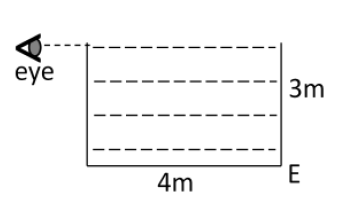
A rectangular metal tank filled with a certain liquid is as shown in the figure. The observer, whose eye is in level with the top of the tank, can just see the corner E of the tank. Therefore, the refractive index of the liquid is

image

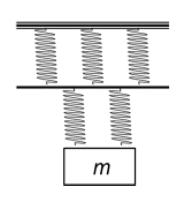
As shown in the figure, a block of mass m is suspended from a support with the help of a system of identical springs. The force constant of each spring is k. Therefore, the frequency of oscillations of the block is

image

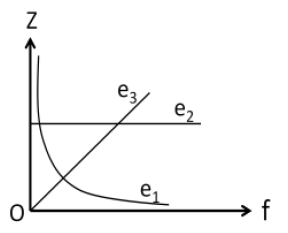
The impedance (Z) of three electrical components $$e_1$$, $$e_2$$ and $$e_3$$ has frequency (f) dependence as shown by the following three curves. The three components $$e_1$$, $$e_2$$, $$e_3$$ are respectively

image

The half-life period of a radioactive element $$E_1$$ is equal to the mean lifetime of another radioactive element $$E_2$$. Initially both the elements have the same number of atoms. Therefore,

Two factories are sounding their sirens at 400 Hz each. A man walks from one factory towards the other at a speed of 2 m/s. The speed of sound is 320 m/s. The number of beats heard per second by the man is

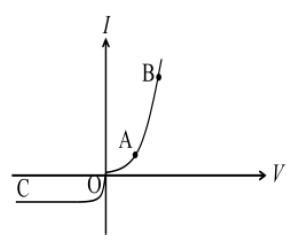
The adjacent figure shows I-V characteristics of a silicon diode. In this connection three statements are made, namely (I) the region OC corresponds to reverse bias of the diode, (II) the voltage at point A is about 0.2 volt, and (III) different scales have been used along +ve and -ve directions of Y axis. Therefore,

image

Two identical lenses made of the same material of refractive index 1.5 have the focal length 12 cm. These lenses are kept in contact and immersed in a liquid of refractive index 1.35. The combination behaves as

A cup of water is placed in a car moving at a constant acceleration a to the left. Inside the water is a small air bubble. The figure that correctly shows the shape of the water surface and the direction of motion of the air bubble is

A sphere of radius R made up of Styrofoam (light polystyrene material) has a cavity of radius $$\frac{R}{2}$$. The centre of the cavity is situated at a distance of $$\frac{R}{2}$$ from the centre of the Styrofoam sphere. The cavity is filled with a solid material of density five times that of Styrofoam. Now, the centre of mass is seen to be located at a distance x from the centre of Styrofoam sphere, therefore x is

A resistor R is connected to a parallel combination of two identical batteries each with emf E and an internal resistance r. The potential drop across the resistance R is

An ac source (sinusoidal source with frequency 50 Hz) is connected in series with a rectifying diode, a $$100\ \Omega$$ resistor, a $$1000\ \mu\text{F}$$ capacitor and a milliammeter. After some time the milliammeter reads zero. The voltage measured across the capacitor with a dc voltmeter is

The frequency of the sound produced by a siren increases from 400 Hz to 1200 Hz while its amplitude remains the same. Therefore, the ratio of the intensity of the 1200 Hz wave to that of the 400 Hz wave is

The fundamental frequency of the output of a bridge rectifier driven by ac mains is

The force of attraction between the positively charged nucleus and the electron in a hydrogen atom is given by $$F = \frac{1}{4\pi\epsilon_0}\frac{e^2}{r^2}$$. Assume that the nucleus is fixed. The electron, initially moving in an orbit of radius $$R_1$$, jumps into an orbit of smaller radius $$R_2$$. The decrease in the total energy of the atom is

It is observed that some of the spectral lines in hydrogen spectrum have wavelengths almost equal to those of the spectral lines in $$\text{He}^+$$ ion. Out of the following the transitions in $$\text{He}^+$$ that will make this possible is

A nichrome wire AB, 100 cm long and of uniform cross section is mounted on a meter scale, the points and B coinciding with 0 cm and 100 cm marks respectively. The wire has a resistance S = 50 ohm. Any point

C along this wire, between A and B is called a variable point to which one end of an electrical element connected. In the following questions this arrangement will be referred to as ‘wire AB’.

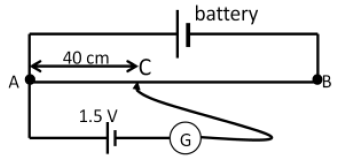
The emf of a battery is determined using the following circuit with 'wire AB'. The galvanometer shows zero deflection when one of its terminals is connected to point C. If the internal resistance of the battery is 4 ohm, its emf is

image

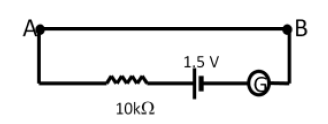
In the adjacent circuit arrangement it is found that deflection in the galvanometer is 10 divisions. Also the voltage across the ‘wire AB’ is equal to that across the galvanometer. Therefore, the current sensitivity of the galvanometer is about

image

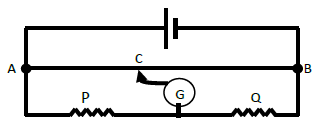
The 'wire AB' is now a part of the adjacent circuit. With the resistors $$P = 50\ \Omega$$ and $$Q = 100\ \Omega$$, the null point is obtained at C where $$AC = 33$$ cm. When the resistors are interchanged, the null point is found at C with $$AC = 67$$ cm. The systematic error in this experiment seems to be due to non-coincidence of A and B with the 0 cm mark and the 100 cm mark respectively. If these end errors are equivalent to 'a' cm and 'b' cm respectively, then they are

image

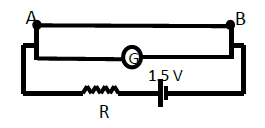
In the adjacent circuit a resistance R is used. Initially with 'wire AB' not in the circuit, the galvanometer shows a deflection of d divisions. Now, the 'wire AB' is connected parallel to the galvanometer and the galvanometer shows a deflection nearly $$\frac{d}{2}$$ divisions. Therefore

image

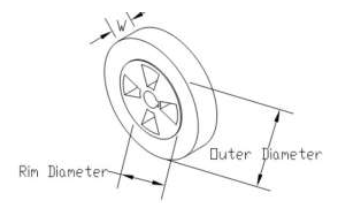
A wheel of a car is made up of two parts (1)the central metal rim, and (2)the rubber tyre. The width of the tyre W = 16.5 cm and height h = 10.7 cm. The rim overlaps the tyre. The total weight of the car is 1500 kg distributed evenly. The tyres are inflated with air to a pressure 2.0 kg/cm2. The density of air at pressure of 1.0 kg/cm2 and at room temperature equals 1.29 g/litre. The outer diameter of the tyre is 55.4 cm and that of the rim is 40 cm.

image

Consider the following two statements about a tyre of a car.
Statement A : the horizontal road surface is exactly tangential to the tyre.
Statement B : the tyre is inflated with excess pressure.
Which of the following alternatives is correct?

The left side front tyre was observed to be in contact with the road over a length L cm. The value of L is

When five persons occupy the seats L increases by 2.5 cm. The average weight of a person is

The tyres of racing cars are very wide. Their width is nearly three times the above value. This large width is for

For the following questions answer them individually

A particle moves in XY plane according to the relations $$x = kt$$ and $$y = kt(1 - pt)$$ where k and p are positive constants and t is time. Therefore,

A charge q is situated at the origin. Let $$\vec{E}_A$$, $$\vec{E}_B$$ and $$\vec{E}_C$$ be the electric fields at the points $$A(2, -3, -1)$$, $$B(-1, -2, 4)$$ and $$C(2, -4, 1)$$. Therefore,

A uniform spherical charge distribution of radius R produces electric fields $$E_1$$ and $$E_2$$ at two points at distances $$r_1$$ and $$r_2$$ respectively from the centre of the distribution. Out of the following the possible expressions for $$\frac{E_1}{E_2}$$ are

A metallic wire of length l is held between two supports under some tension. The wire is cooled through $$\theta^\circ$$. Let Y be the Young's modulus, $$\rho$$ the density and $$\alpha$$ the thermal coefficient of linear expansion of the material of the wire. Therefore, the frequency of oscillations of the wire varies as

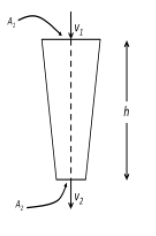
Water is flowing through a vertical tube with varying cross section as shown. The rate of flow is 52.5 ml/s. Given that speed of flow $$v_1 = 0.35$$ m/s and area of cross section $$A_2 = 0.5\ \text{cm}^2$$. Which of the following are true?

image

A simple laboratory power supply consists of a transformer, bridge rectifier and a filter capacitor. It drives a suitable load. If due to some reason one of the diodes in the rectifier circuit becomes open, then

Circuit A is a series LCR circuit with $$C_A = C$$ and $$L_A = L$$. Another circuit B has $$C_B = 2C$$ and $$L_B = \frac{L}{2}$$. Both the circuits have the same resistance and the capacitor and the inductance are assumed to be ideal components. Each of the circuits is connected to the same sinusoidal voltage source. Therefore,

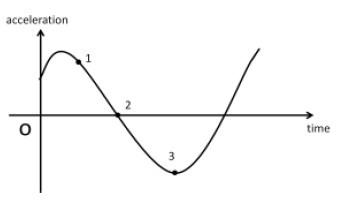
The variation of acceleration with time for a particle performing simple harmonic motion along a straight line is as in adjacent figure. Therefore,

image

Which of the following physical quantities have dimensions identical to each other?

A small ball bearing is released at the top of a long vertical column of glycerin of height 2h. The ball bearing falls through a height h in a time $$t_1$$ and then the remaining height with the terminal velocity in time $$t_2$$. Let $$W_1$$ and $$W_2$$ be the work done against viscous drag over these heights. Therefore,

Join CAT 2026 course by 5-Time CAT 100%iler

Crack CAT 2026 & Other Exams with Cracku!