Sign in
Please select an account to continue using cracku.in
↓ →
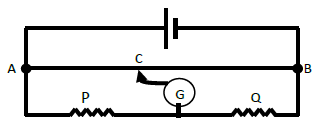
A nichrome wire AB, 100 cm long and of uniform cross section is mounted on a meter scale, the points and B coinciding with 0 cm and 100 cm marks respectively. The wire has a resistance S = 50 ohm. Any point
C along this wire, between A and B is called a variable point to which one end of an electrical element connected. In the following questions this arrangement will be referred to as ‘wire AB’.
The 'wire AB' is now a part of the adjacent circuit. With the resistors $$P = 50\ \Omega$$ and $$Q = 100\ \Omega$$, the null point is obtained at C where $$AC = 33$$ cm. When the resistors are interchanged, the null point is found at C with $$AC = 67$$ cm. The systematic error in this experiment seems to be due to non-coincidence of A and B with the 0 cm mark and the 100 cm mark respectively. If these end errors are equivalent to 'a' cm and 'b' cm respectively, then they are
_1.webp)

Start your IIM journey with the right preparation and crack CAT 2026.

Educational materials for JEE preparation

Ask our AI anything

AI can make mistakes. Please verify important information.
AI can make mistakes. Please verify important information.
 91- 6303239042