The greatest 4-digit number such that when divided by $$16$$, $$24$$ and $$36$$ leaves $$4$$ as remainder in each case is
Sign in
Please select an account to continue using cracku.in
↓ →
Join Our JEE Preparation Group
Prep with like-minded aspirants; Get access to free daily tests and study material.
The greatest 4-digit number such that when divided by $$16$$, $$24$$ and $$36$$ leaves $$4$$ as remainder in each case is
Let the number be $$n$$
The number reduced by $$4$$ must be a common multiple of $$16, 24, 36$$, so it is a multiple of their LCM.
So, $$(n-4)=k\times L.C.M[16,24,36]$$ ,where $$k$$ is some natural number
or, $$n=k\times L.C.M[16,24,36]+4$$
Since $$16 = 2^4$$, $$24 = 2^3 \times 3$$ and $$36 = 2^2 \times 3^2$$, the LCM is $$2^4 \times 3^2 = 144$$.
$$\therefore n=144k+4$$
Now, since $$n$$ is the greatest four-digit number that follows this pattern
So, we should take $$k=69$$ as any other value greater than $$69$$ makes $$n$$ a five digit number
$$\therefore n=144*69+4=9940$$
Hence, Option B is correct
$$ABCD$$ is a rectangle whose length $$AB$$ is $$20$$ units and breadth is $$10$$ units. Also, given $$AP = 8$$ units.
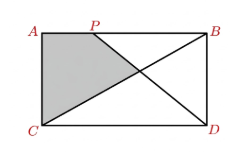
The area of the shaded region is $$\frac{p}{q}$$ sq unit, where $$p, q$$ are natural numbers with no common factors other than $$1$$. The value of $$p + q$$ is
We are given that $$AP=8$$ units and $$PB=12$$ units
Now, in triangles $$POB$$ and $$DOC$$, we have:
$$\angle BOP=\angle COD$$ [vertically opposite angles]
$$\angle BPO=\angle CDO$$ [alternate interior angle between the parallel lines $$AB$$ and $$CD$$]
$$\angle PBO=\angle OCD$$ [alternate interior angle between the parallel lines $$AB$$ and $$CD$$]
So, triangles $$POB$$ and $$DOC$$ are similar triangles
$$\therefore \dfrac{BO}{OC}=\dfrac{PB}{CD}=\dfrac{3}{5}$$
Let us assume that $$BO$$ is $$3x$$ units long
Then, $$OC$$ is $$5x$$ units long
Now, the area of triangle $$ABC=0.5*20*10=100$$ square units
Also, the area of triangle $$BOP$$ : area of triangle $$ABC=0.5*PB*OB*Sin(\angle ABC):0.5*AB*BC*Sin(\angle ABC)$$
The area of triangle $$BOP$$ : area of triangle $$ABC=0.5*12*3x*Sin(\angle ABC):0.5*20*8x*Sin(\angle ABC)$$
The area of triangle $$BOP$$ : area of triangle $$ABC=9:40$$
We know that area of triangle $$ABC$$ is $$100$$ square units
So, area of triangle $$BOP: 100=9:40$$
Hence, the area of triangle $$BOP$$ is $$=\dfrac{45}{2}$$ square units
And the area of quadrilateral $$BPOC=$$area of triangle $$ABC-$$area of triangle $$BOP$$
The area of quadrilateral $$BPOC=100-\dfrac{45}{2}=\dfrac{155}{2}$$ square units
Hence, $$p=155$$ and $$q=2$$
This makes $$p+q=155+2=157$$
Hence, Option C is correct
The solution of $$\frac{\sqrt[7]{12+x}}{x} + \frac{\sqrt[7]{12+x}}{12} = \frac{64}{3}\left(\sqrt[7]{x}\right)$$ is of the form $$\frac{a}{b}$$ where $$a, b$$ are natural numbers with $$\text{GCD}(a,b) = 1$$; then $$(b-a)$$ is equal to
$$\dfrac{\sqrt[7]{12+x}}{x} + \dfrac{\sqrt[7]{12+x}}{12} = \dfrac{64}{3}\left(\sqrt[7]{x}\right)$$
Taking $$\sqrt[7]{12+x}$$ as common we get
$$\sqrt[7]{12+x} \left( \dfrac{1}{x} + \dfrac{1}{12}\right) = \dfrac{64}{3}\left(\sqrt[7]{x}\right)$$
$$\sqrt[7]{12+x} \left( \dfrac{x+12}{12x}\right) = \dfrac{64}{3}\left(\sqrt[7]{x}\right)$$
Transposing $$12x$$ to the other side of the equation we get
$$\sqrt[7]{12+x} (12+x) = \dfrac{64}{3}\left(12x\sqrt[7]{x}\right)$$
Now, we can $$\sqrt[7]{12+x}$$ as $${(12+x)}^{\frac{1}{7}}$$. Using the exponent rule that $$x^a.x^b = x^{a+b}$$, we can write
$${(12+x)}^{1+\frac{1}{7}} = (64 \times \dfrac{12}{3}) x^{1+\frac{1}{7}}$$
Simplifying the terms we get
$${(12+x)}^{\frac{8}{7}} =( 64 \times 4) x^{\frac{8}{7}}$$
$$64$$ can be expressed as $$2^6$$ and $$4 = 2^2$$. Thus, $$64 \times 4 = 2^8$$
$${(12+x)}^{\frac{8}{7}} = 2^8 x^{\frac{8}{7}}$$
Taking the eighth root we get
$${(12+x)}^{\frac{1}{7}} = 2 x^{\frac{1}{7}}$$
And raising the expression to the power of 7 we get
$$12+x = 128x \implies 127x = 12 \ \text{or}\ x = \dfrac{12}{127} $$
We can observe that $$12,127$$ have no common factors hence their $$gcd = 1$$
Thus $$ b-a = 127-12 = 115$$
The value of $$(52+6\sqrt{43})^{3/2} - (52-6\sqrt{43})^{3/2}$$ is
We are given the expression: $$(52+6\sqrt{43})^{3/2} - (52-6\sqrt{43})^{3/2}$$
Now, the term $$52+6\sqrt{43}$$ can be rewritten as:
$$52+6\sqrt{43}=9+43+2*3*\sqrt{43}=(3+\sqrt{43})^2$$
Similarly, we can rewrite the term $$52-6\sqrt{43}$$ as:
$$52-6\sqrt{43}=9+43-2*3*\sqrt{43}=(3-\sqrt{43})^2$$ or $$(\sqrt{43}-3)^2$$
But whenever we have $$\sqrt{52-6\sqrt{43}}$$, the correct answer would be $$(\sqrt{43}-3)$$ as the square root is defined in mathematics to give only a positive answer due to functional constraints put on it.
Now, we had: $$(52+6\sqrt{43})^{3/2} - (52-6\sqrt{43})^{3/2}$$
$$=(\sqrt{52+6\sqrt{43}})^3 - (\sqrt{52-6\sqrt{43}})^3$$
$$=(3+\sqrt{43})^3-(\sqrt{43}-3)^3$$
$$=(27+\sqrt{43}^3+27\sqrt{43}+9*43)-(-27+\sqrt{43}^3+27\sqrt{43}-9*43)$$
$$=2(27+9*43)$$
$$=828$$
Hence, Option D is correct.
In the adjoining figure $$\angle DCE = 10^\circ$$, $$\angle CED = 98^\circ$$, $$\angle BDF = 28^\circ$$.
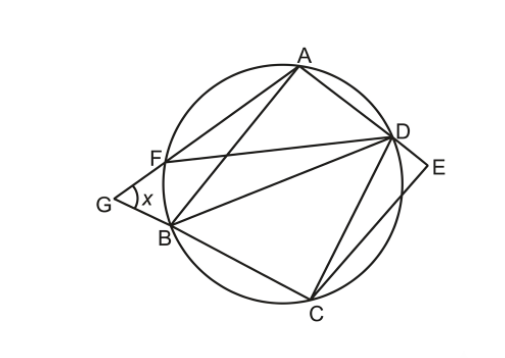
Then the measure of angle $$x$$ is
In $$\triangle CDE$$
$$\angle CDE = 180\degree - \angle DCE -\angle CED =180\degree - 10\degree - 98\degree = 72\degree$$
Since ABCD is a cyclic quadrilateral
$$\angle BAD + \angle BCD = 180\degree $$
$$\angle FAB = \angle FDB =28\degree$$ (Angles subtended by the same chord at different points on the circle)
Now, in quadrilateral GACE,
$$x + \angle FAB + \angle BAD + \angle BCD + \angle DCE+ \angle DEC =360\degree$$ (Angle sum property)
$$ x = 360\degree- (28\degree+ 180\degree+10\degree + 98\degree ) =44\degree$$
$$ABC$$ is a right triangle in which $$\angle B = 90^\circ$$. The inradius of the triangle is $$r$$ and the circumradius of the triangle is $$R$$. If $$R \colon r = 5 \colon 2$$, then the value of $$\cot^2 \frac{A}{2} + \cot^2 \frac{C}{2}$$ is
Using $$\dfrac{r}{R} = 4\sin\dfrac{A}{2}\sin\dfrac{B}{2}\sin\dfrac{C}{2}$$ with $$B = 90^\circ$$ and $$\dfrac{r}{R} = \dfrac{2}{5}$$, solving for $$A$$ (with $$C = 90^\circ - A$$) gives a specific angle, and substituting back yields $$\cot^2\dfrac{A}{2} + \cot^2\dfrac{C}{2} = 13$$.
If $$(\alpha, \beta)$$ and $$(\gamma, \beta)$$ are the roots of the simultaneous equations $$|x-1|+|y-5|=1$$, $$y = 5+|x-1|$$, then the value of $$\alpha + \beta + \gamma$$ is
We are given the equations: $$|x-1|+|y-5|=1$$, $$y = 5+|x-1|$$
From the second equation, we get:
$$|x-1|=y-5$$
Substituting this into the first equation
$$|x-1|+|y-5|=1$$
$$y-5+|y-5|=1$$
Now, we will have to make cases
CASE 1: $$y\geq5$$
$$y-5+y-5=1$$
or, $$y=\dfrac{11}{2}$$
Then, $$|x-1|=y-5=\dfrac{1}{2}$$
Which gives $$x=\dfrac{3}{2}$$ or $$x=\dfrac{1}{2}$$
Hence, we get $$2$$ solutions from case 1 for $$(x,y)$$, which are $$\left(\dfrac{1}{2},\dfrac{11}{2}\right),\left(\dfrac{3}{2},\dfrac{11}{2}\right)$$
CASE 2: $$y<5$$
$$y-5-(y-5)=1$$
or, $$0=1$$
Which is never true
So, we cannot get any answer from here.
The common $$y = \beta = \frac{11}{2}$$.
Taking $$\alpha = \frac{1}{2}$$ and $$\gamma = \frac{3}{2}$$ (or vice versa), we get:
$$\alpha+\beta+\gamma = 2 + \frac{11}{2} = \frac{15}{2}$$.
Three persons Ram, Ali and Peter were to be hired to paint a house. Ram and Ali can paint the whole house in $$30$$ days, Ali and Peter in $$40$$ days while Peter and Ram can do it in $$60$$ days. If all of them were hired together, in how many days can they all three complete $$ 50\% $$ the work?
Let the working rates of Ram, Ali and Peter be $$R,A$$ and $$P$$ respectively
$$R+A=\dfrac{1}{30}$$
$$A+P=\dfrac{1}{40}$$
$$R+P=\dfrac{1}{60}$$
Adding the three pairwise rates gives:
$$2(R+A+P) = \frac{1}{30}+\frac{1}{40}+\frac{1}{60} = \frac{3}{40}$$
So the combined rate is $$R+A+P = \frac{3}{80}$$ of the work per day.
The time for all three working together to finish the whole house is $$=\frac{80}{3} = 26\frac{2}{3}$$ days.
$$\frac{\sqrt{a+3b}+\sqrt{a-3b}}{\sqrt{a+3b}-\sqrt{a-3b}} = x$$, then the value of $$\frac{3bx^2+3b}{ax}$$ is
We are given: $$x=\dfrac{\sqrt{a+3b}+\sqrt{a-3b}}{\sqrt{a+3b}-\sqrt{a-3b}}$$
Rationalising the RHS
$$x=\dfrac{(\sqrt{a+3b}+\sqrt{a-3b})^2}{(\sqrt{a+3b}-\sqrt{a-3b})(\sqrt{a+3b}+\sqrt{a-3b})}$$
$$x=\dfrac{a+3b+a-3b+2\sqrt{a^2-9b^2}}{a+3b-a+3b}$$
$$x=\dfrac{a+\sqrt{a^2-9b^2}}{3b}$$ ....(1)
Now, squaring both sides
$$x^2=\dfrac{a^2+a^2-9b^2+2a\sqrt{a^2-9b^2}}{9b^2}$$
$$x^2=\dfrac{2a^2+2a\sqrt{a^2-9b^2}-9b^2}{9b^2}$$
$$x^2=\dfrac{2a^2+2a\sqrt{a^2-9b^2}}{9b^2}-1$$
$$x^2+1=\dfrac{2a^2+2a\sqrt{a^2-9b^2}}{9b^2}$$
$$3b(x^2+1)=\dfrac{2a^2+2a\sqrt{a^2-9b^2}}{3b}$$
$$\dfrac{3b(x^2+1)}{a}=\dfrac{2a+2\sqrt{a^2-9b^2}}{3b}$$
$$\dfrac{3b(x^2+1)}{a}=2\times\left(\dfrac{a+\sqrt{a^2-9b^2}}{3b}\right)$$
$$\dfrac{3b(x^2+1)}{a}=2\times x$$ [from 1]
$$\dfrac{3b(x^2+1)}{ax}=2$$
$$\dfrac{3bx^2+3b}{ax}=2$$
The number of integral solutions of the inequation $$\left|\frac{2}{x-13}\right| > \frac{8}{9}$$ is
The inequality rearranges to $$|x-13| < \frac{9}{4} = 2.25$$ with $$x \neq 13$$. The integers satisfying $$10.75 < x < 15.25$$, excluding $$13$$ [as at $$x=13$$ the denominator of original inequation is undefined], are $$11, 12, 14, 15$$, giving $$4$$ integral solutions.
In the adjoining figure, $$P$$ is the centre of the first circle, which touches the other circle in $$C$$. $$PCD$$ is along the diameter of the second circle. $$\angle PBA = 20^\circ$$ and $$\angle PCA = 30^\circ$$.
[image]
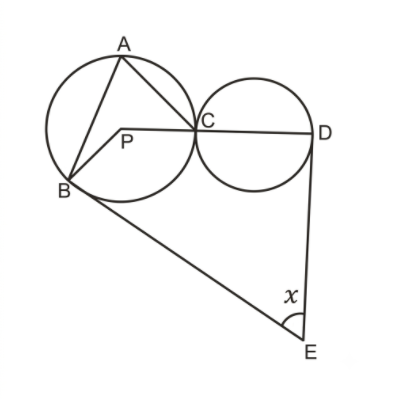
The tangents at $$B$$ and $$D$$ meet at $$E$$. The measure of the angle $$x$$ is
PA, PB, PC are the radius of the circle.
This implies $$\triangle PAB, \triangle PAC$$ are isosceles triangles.
$$\angle BAP = \angle PBA = 20\degree$$
$$\angle PAC =\angle PCA = 30\degree$$
$$\implies \angle BAC = \angle BAP+\angle PAC = 30\degree+20\degree = 50\degree$$
$$\angle BPC = 2\angle BAC = 100\degree$$ ( Angle subtended by a chord at the centre of the circle is twice the angle subtended at the point on the circumference)
Consider quadrilateral BPDE,
$$\angle PBE = \angle PDE = 90\degree$$ (Angle made by the tangent with the radius)
$$ x + \angle PBE + \angle PDE +\angle BPC = 360\degree$$
$$\implies x = 360\degree - (100\degree+90\degree+90\degree) = 80\degree$$ (Angle sum property of a quadrilateral)
If $$\alpha, \beta$$ are the values of $$x$$ satisfying the equation $$3\sqrt{\log_2 x} - \log_2 8x + 1 = 0$$, where $$\alpha < \beta$$, then the value of $$\left(\frac{\beta}{\alpha}\right)$$ is
Let $$t = \sqrt{\log_2 x}$$
So $$\log_2 x = t^2$$ and $$\log_2 8x = 3+t^2$$.
Now, the equation becomes $$3t - (3+t^2) + 1 = 0$$
$$t^2-3t+2=0$$
$$t=1$$ or $$t=2$$
So $$x = 2$$ or $$x = 16$$.
Thus $$\alpha = 2$$, $$\beta = 16$$, and $$\dfrac{\beta}{\alpha} = 8$$.
When a natural number is divided by $$11$$, the remainder is $$4$$. When the square of this number is divided by $$11$$, the remainder is
Let the number be $$n$$
If $$n$$ leaves a remainder of $$4$$ when divided by $$11$$, than we can write $$n$$ as:
$$n=11k+4$$ , where $$k$$ is some natural number
Now, squaring both sides
$$n^2=121k^2+16+88k$$
$$n^2=121k^2+88k+11+5$$
$$n^2=11(11k^2+8k+1)+5$$
So, we can see that now if $$n^2$$ is divided by $$11$$, the leftover $$5$$ becomes the new remainder.
The unit's digit of a 2-digit number is twice the ten's digit. When the number is multiplied by the sum of the digits the result is $$144$$. For another 2-digit number, the ten's digit is twice the unit's digit and the product of the number with the sum of its digits is $$567$$. Then the sum of the two 2-digit numbers is
For the first number, with tens digit $$t$$ and units digit $$2t$$, the number is $$12t$$ and the digit sum is $$3t$$, so $$36t^2 = 144$$ gives $$t=2$$ and the number is $$24$$. For the second, with units digit $$u$$ and tens digit $$2u$$, the number is $$21u$$ and the digit sum is $$3u$$, so $$63u^2=567$$ gives $$u=3$$ and the number is $$63$$. The sum of the two numbers is $$24+63 = 87$$.
$$ABCDE$$ is a pentagon. $$\angle AED = 126^\circ$$, $$\angle BAE = \angle CDE$$ and $$\angle ABC$$ is $$4^\circ$$ less than $$\angle BAE$$ and $$\angle BCD$$ is $$6^\circ$$ less than $$\angle CDE$$. $$PR, QR$$ the bisectors of $$\angle BPC, \angle EQD$$ respectively, meet at $$R$$. Points $$P, C, D, Q$$ are collinear.
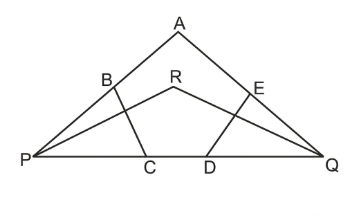
Then measure of $$\angle PRQ$$ is
Let $$\angle BAE = \angle CDE = \theta$$
Given $$\angle ABC = \angle BAE - 4\degree$$
$$\angle BCD = \angle CDE -6\degree$$
Using the pentagon angle sum we get
$$\theta+(\theta-4)+(\theta-6)+\theta+126=540$$ gives $$\theta=106\degree$$
Hence, $$\angle BAE=106\degree$$
It's given that PR and QR bisect $$\angle APQ, \angle AQP$$
Let $$\angle APR= \angle CPR = a$$, $$\angle AQR = \angle RQP = b$$
In $$\triangle PAQ, \angle PAQ + 2(a+b) = 180\degree$$
$$\implies a+b = \dfrac{1}{2}(180\degree-106\degree) = 37\degree$$
Now, in $$\triangle PRQ$$
$$\angle PRQ + a+b = 180\degree \implies \angle PRQ = 180\degree -(a+b) = 143\degree$$
$$a, b, c$$ are real numbers such that $$b - c = 8$$ and $$bc + a^2 + 16 = 0$$.
The numerical value of $$a^{2025} + b^{2025} + c^{2025}$$ is ------.
$$b=c+8$$
Substituting in the second equation we get
$$c(c+8)+a^2+16 = 0$$
$$c^2+8c+16+a^2 = 0$$
We can rewrite this as
$$ (c+4)^2 +a^2 = 0$$
Sum of squares is 0 implies that both the squares must be 0
$$\implies a = 0, c = -4, b = 4$$
$$a^{2025} + b^{2025} + c^{2025} = 0^{2025} + (4)^{2025} + (-4)^{2025} = 0$$
Given $$f(x) = \dfrac{2025x}{x+1}$$ where $$x \neq -1$$. Then the value of $$x$$ for which $$f(f(x)) = (2025)^2$$ is ------.
$$f(x) = \dfrac{2025x}{x+1}$$
$$f(f(x)) = \dfrac{2025\left(\dfrac{2025x}{x+1}\right)}{\dfrac{2025x}{x+1}+1} = \dfrac{2025^2x}{2025x+x+1} = \dfrac{2025^2x}{2026x+1} $$
Given
$$ 2025^2 = \dfrac{2025^2x}{2026x+1} \implies 2026x+1 = x \ \text{or} \ x = \dfrac{-1}{2025}$$
The sum of all the roots of the equation $$\sqrt[3]{16-x^3} = 4-x$$ is ------.
Cubing both sides gives $$16-x^3 = (4-x)^3$$,
$$\implies 16-x^3 = 4^3 - x^3 - 3\cdot4\cdot x(4-x) $$
$$\implies 48-12x(4-x) = 0$$,
$$x^2-4x+4=0$$
Sum of the roots of the quadratic equation can be obtained from the coefficients as
$$ \dfrac{-b}{a} = 4$$
In the adjoining figure, two Quadrants are touching at $$B$$. $$CE$$ is joined by a straight line, whose mid-point is $$F$$.
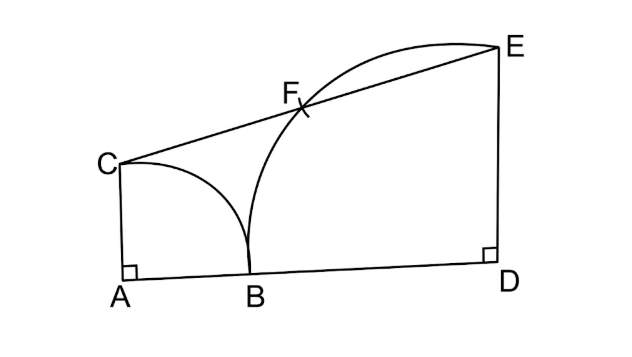
The measure of $$\angle CED$$ is ------.
Let the radius of the smaller quadrant be $$r$$, and the radius of the larger quadrant be $$R$$.
$$ \triangle CAB, \triangle EDB$$ are right angled isosceles triangles.
$$ CB = r\sqrt{2}, EB = R\sqrt{2}$$
Given, $$F$$ is the midpoint of $$CE$$.
Let $$ CF = CE = a$$
Applying pythagoras theroem in $$\triangle CBE$$
$$CB^2+BE^2 = CE^2 \implies 2r^2+2R^2 = (2a)^2 \ \text{or} \ r^2+R^2 = 2a^2$$ - Eq 1
Now, in triangle $$CBE, BF $$ is the median of the triangle.
Using Apollonius ' theorem, we can find the length of BF as
$$ 2(BF^2 + a^2) = 2r^2 + 2R^2 \implies BF^2 = R^2 +r^2 - a^2$$
From Eq 1, we can substitute the value of $$R^2+R^2$$, and we get
$$BF^2 = a^2 \implies BF = a$$.
Thus, we get that $$CF=BF=FE$$
Since $$BF = EF, \triangle BFE$$ is an isosceles triangle. $$\implies \angle FBE = \angle FEB$$
Now consider the following extension of the quadrant.
$$ \angle BGE =\dfrac{ \angle BDE} {2} = 45\degree$$ ( Angle subtended at the centre is twice the angle subtended by the chord in the same sector)
$$ \angle BFE = 180\degree - 45\degree =135\degree$$ (Opposite angles in a cyclic quadrilateral are supplementary)
$$ \implies \angle FEB = \dfrac{180\degree-135\degree}{2} =22.5\degree$$ ( Angle sum in an isosceles triangle)
$$\angle CED = \angle FEB + \angle BED = 22.5\degree+45\degree = 67.5\degree$$
The value of $$k$$ for which the equation $$x^3 - 6x^2+11x+(6-k)=0$$ has exactly three positive integer solutions is ------.
The sum of the integer roots is $$6$$ and the pairwise-product sum is $$11$$, the only positive integer triple that satisfies this condition is $$1, 2, 3$$, since $$1+2+3=6$$ and $$1\cdot2+2\cdot3+3\cdot1=11$$.
The product of roots of the cubic can be found as $$k-6$$
Comparing with $$1\times2\times3=6$$ we get $$k=12$$.
The number of 3-digit numbers of the form $$ab5$$ (where $$a, b$$ are digits) which are divisible by $$9$$ is ------.
The number $$100a+10b+5$$ is divisible by $$9$$ exactly when its digit sum $$a+b+5$$ is a multiple of $$9$$, i.e. $$a+b=4$$ or $$a+b=13$$ (with $$a\geq 1$$). For $$a+b=4$$ there are $$4$$ valid pairs ($$a=1,2,3,4$$), and for $$a+b=13$$ there are $$6$$ valid pairs ($$a=4$$ to $$9$$), giving $$4+6=10$$ numbers in total.
If $$a = \sqrt{(2025)^3 - (2023)^3}$$, the value of $$\sqrt{\frac{a^2-2}{6}}$$ is ------.
Since $$a^2 = 2025^3-2023^3 = (2024+1)^3-(2024-1)^3$$
$$a^2=2024^2+1+3*2024+3*(2024)^2-[2024^2-1+3*(2024)-3*(2024)^2]$$
$$a^2=6*(2024)^2+2$$
$$a^2-2=6*(2024)^2$$
$$\dfrac{a^2-2}{6}=2024^2$$
$$\sqrt{\dfrac{a^2-2}{6}}=2024$$
In a math Olympiad examination, $$12\%$$ of the students who appeared from a class did not solve any problem; $$32\%$$ solved with some mistakes. The remaining $$14$$ students solved the paper fully and correctly. The number of students in the class is ------.
The $$14$$ students who solved fully and correctly represent $$100\%-12\%-32\%=56\%$$ of the class. So the total number of students is $$\frac{14}{0.56}=25$$.
When $$a = 2025$$, the numerical value of $$|2a^3-3a^2-2a+1| - |2a^3-3a^2-3a-2025|$$ is ------.
$$|2a^3-3a^2-2a+1| - |2a^3-3a^2-3a-2025|$$
or, $$|2a^3-3a^2-2a+1| - |2a^3-3a^2-3a-a|$$
or, $$|2a^3-3a^2-2a+1| - |2a^3-3a^2-4a|$$
Let us assume that $$t=2a^3-3a^2-2a$$
or, $$t=a(2a^2-3a-2)$$
or, $$t=a(2a+1)(a-2)$$
or, $$t=(2a+1)(a)(a-2)$$
Since, $$a=2025$$, we will get $$t>2a$$
Now, we have: $$|2a^3-3a^2-2a+1| - |2a^3-3a^2-4a|$$
Substituting value of $$t$$, we get:
$$|t+1|-|t-2a|$$
Since both of the quantities inside the modulus are positive
So, we get:
$$t+1-t+2a$$
$$=2a+1=4051$$
A circular hoop and a rectangular frame are standing on the level ground as shown. The diagonal $$AB$$ is extended to meet the circular hoop at the highest point $$C$$. If $$AB = 18$$ cm, $$BC = 32$$ cm, the radius of the hoop (in cm) is ------.
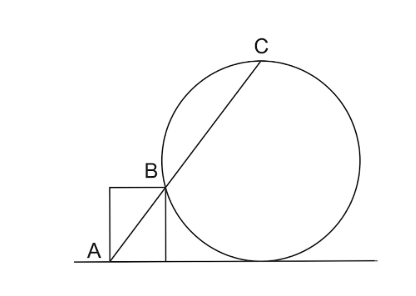

Let's assume the circle touches the ground at O. Since C is the highest point on the circle, it must be diametrically opposite to O.
Now using the tangent-secant property
$$ AB\times AC = AO^2$$
$$ AO =\sqrt{18\times 50} = 30$$cm
Now, $$\triangle AOC$$ is a right-angled triangle
$$ AO^2 + CO^2 = AC^2$$
$$CO = \sqrt{50^2 - 30^2} = 40$$ cm.
Thus, the radius of the circle is $$20$$cm.
'$$n$$' is a natural number. The number of '$$n$$' for which $$\frac{16(n^2-n-1)^2}{2n-1}$$ is a natural number is ------.
We are given the expression: $$\dfrac{16(n^2-n-1)^2}{2n-1}$$
Now, let's try to rewrite the numerator as:
$$16(n^2-n-1)^2=(2n-1)Q(n)+r$$ where $$Q(n)$$ is the quotient and $$r$$ is the remainder
So, now to find the remainder, lets put $$n=\dfrac{1}{2}$$ on both sides
$$16(\dfrac{1}{4}-\dfrac{1}{2}-1)^2=(0)Q(\dfrac{1}{2})+r$$
$$25=r$$
So, $$16(n^2-n-1)^2=(2n-1)Q(n)+25$$
Now, $$\dfrac{16(n^2-n-1)^2}{2N-1}=Q(x)+\dfrac{25}{2n-1}$$
Now, $$Q(n)$$ is going to be a cubic function, which will give integral results
Only, term $$\dfrac{25}{2n-1}$$ will be troublesome
So $$2n-1$$ must divide $$25$$. The positive divisors of $$25$$ are $$1, 5, 25$$, giving $$n=1, 3, 13$$, so there are exactly $$3$$ such values of $$n$$
But we still need to verify these values so that we get natural numbers as a solution
Putting $$n=1$$ in $$\dfrac{16(n^2-n-1)^2}{2n-1}$$, we get :$$16$$
Putting $$n=3$$ in $$\dfrac{16(n^2-n-1)^2}{2n-1}$$, we get :$$80$$
Putting $$n=13$$ in $$\dfrac{16(n^2-n-1)^2}{2n-1}$$, we get :$$15,376$$
All of these are natural numbers, hence there are $$3$$ possible values of $$n$$
The number of solutions $$(x,y)$$ of the simultaneous equations $$\log_4 x - \log_2 y = 0$$, $$x^2 = 8+2y^2$$ is ------.
The first equation gives $$\log_2 x = 2\log_2 y$$, i.e. $$x = y^2$$
Now, both $$x,y>0$$ as they are the arguments of the log function in the given equations
Substituting into the second equation gives $$y^4-2y^2-8=0$$,
Which can be factored as:
$$(y^2-4)(y^2+2)=0$$
So $$y^2=4$$,
$$y=2$$ (taking the positive root)
$$x=4$$.
This gives exactly $$1$$ valid solution pair which is $$(4,2)$$
In the adjoining figure, $$PA, PB$$ are tangents. $$AR$$ is parallel to $$PB$$.
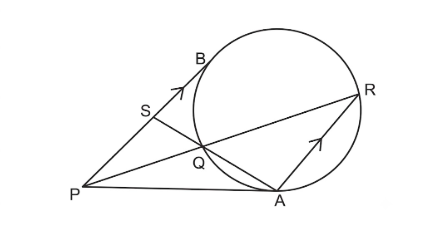
$$PQ = 6$$; $$QR = 18$$.
Length $$SB$$ = ------.
Using the tangent-secant property, we get
$$ PA^2 = PB^2 = PQ \times PR = 6 \times 24 = 144$$
$$ PA = PB = 12$$cm
Consider $$\triangle PQS, \triangle RQA$$
$$\angle PQS = \angle RQA $$(Vertically opposite angles)
$$\angle SPQ = \angle ARQ$$ (Interior alternate angles)
$$\angle PSQ = \angle RAQ$$( Interior alternate angles)
Thus, by AAA similarity criterion
$$\triangle PQS \sim \triangle RQA$$
$$\dfrac{QS}{QA} = \dfrac{PS}{RA}= \dfrac{PQ}{RQ} =\dfrac{1}{3}$$ -Eq 1
Now consider $$\triangle PAQ, \triangle PRA$$
$$ \angle RPA = \angle APQ$$ (Common angle)
$$\angle PRA = \angle PAQ$$ (Alternate segment theorem)
Using the AA similarity criterion,
$$\triangle PAQ \sim \triangle PRA$$
$$\dfrac{AQ}{RA}= \dfrac{PQ}{PA} =\dfrac{PA}{PR} = \dfrac{1}{2}$$
Let $$ RA =6x, QA =3x$$
Using Eq 1 we get
$$QS = x, PS = 2x$$
Now we can once again apply tangent-secant theorem to find SB
$$ SB = 12 - PS = 12-2x$$
$$SB^2 = SQ\times SA = 4x^2 \implies SB = 2x$$
Equating the two we get
$$12-2x = 2x \implies x=3 ,SB = 2x = 6$$
A large watermelon weighs $$20$$ kg with $$98\%$$ of its weight being water. It is left outside in the sunshine for some time. Some water evaporated and the water content in the watermelon is now $$95\%$$ of its weight in water. The reduced weight in kg is ------.
The pulp (non-water) content is $$2\%$$ of $$20$$ kg, i.e. $$0.4$$ kg, and this stays constant.
After evaporation, the solid content is $$5\%$$ of the new weight.
$$\dfrac{5}{100} w = 0.4$$kg
So, the new weight is
$$\dfrac{0.4}{0.05}=8$$ kg.
The weight reduction is $$20-8=12$$ kg.
In a geometric progression, the fourth term exceeds the third term by $$24$$ and the sum of the second and third term is $$6$$. Then, the sum of the second, third and fourth terms is ------.
We can write the terms as $$6-a_3,a_3,a_3 +24$$
Since the terms are in GP, $$a_3^2 = a_4a_2$$
$$a_3^2 = (6-a_3)(a_3+24)$$
$$ 2a_3^2+18a_3-144 = 0$$
$$a_3^2+9a_3-72=0$$
Solving using the quadratic formula we get
$$ a_3 = \dfrac{-9\pm \sqrt{81+288}}{2} = \dfrac{-9\pm\sqrt{ 369}}{2}$$
$$a_3 = 5.1 \text{ or } -14.1$$
Thus, sum of the terms is
$$a_3 + 30 = 35.1 \text{ or } 15.9$$
Predict your JEE Main percentile, rank & performance in seconds
Educational materials for JEE preparation