Sign in
Please select an account to continue using cracku.in
↓ →

Join Our JEE Preparation Group
Prep with like-minded aspirants; Get access to free daily tests and study material.
$$ABCDE$$ is a pentagon. $$\angle AED = 126^\circ$$, $$\angle BAE = \angle CDE$$ and $$\angle ABC$$ is $$4^\circ$$ less than $$\angle BAE$$ and $$\angle BCD$$ is $$6^\circ$$ less than $$\angle CDE$$. $$PR, QR$$ the bisectors of $$\angle BPC, \angle EQD$$ respectively, meet at $$R$$. Points $$P, C, D, Q$$ are collinear.
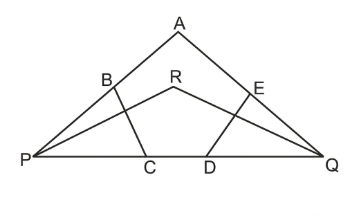
Then measure of $$\angle PRQ$$ is
Let $$\angle BAE = \angle CDE = \theta$$
Given $$\angle ABC = \angle BAE - 4\degree$$
$$\angle BCD = \angle CDE -6\degree$$
Using the pentagon angle sum we get
$$\theta+(\theta-4)+(\theta-6)+\theta+126=540$$ gives $$\theta=106\degree$$
Hence, $$\angle BAE=106\degree$$
It's given that PR and QR bisect $$\angle APQ, \angle AQP$$
Let $$\angle APR= \angle CPR = a$$, $$\angle AQR = \angle RQP = b$$
In $$\triangle PAQ, \angle PAQ + 2(a+b) = 180\degree$$
$$\implies a+b = \dfrac{1}{2}(180\degree-106\degree) = 37\degree$$
Now, in $$\triangle PRQ$$
$$\angle PRQ + a+b = 180\degree \implies \angle PRQ = 180\degree -(a+b) = 143\degree$$
Was this solution helpful?
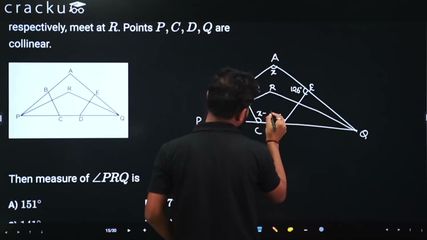
Click on the Email ☝️ to Watch the Video Solution
_1.webp)
Predict your JEE Main percentile, rank & performance in seconds

Educational materials for JEE preparation

Ask our AI anything

AI can make mistakes. Please verify important information.
AI can make mistakes. Please verify important information.
 91- 6303239042