91- 6303239042


 Group
Group
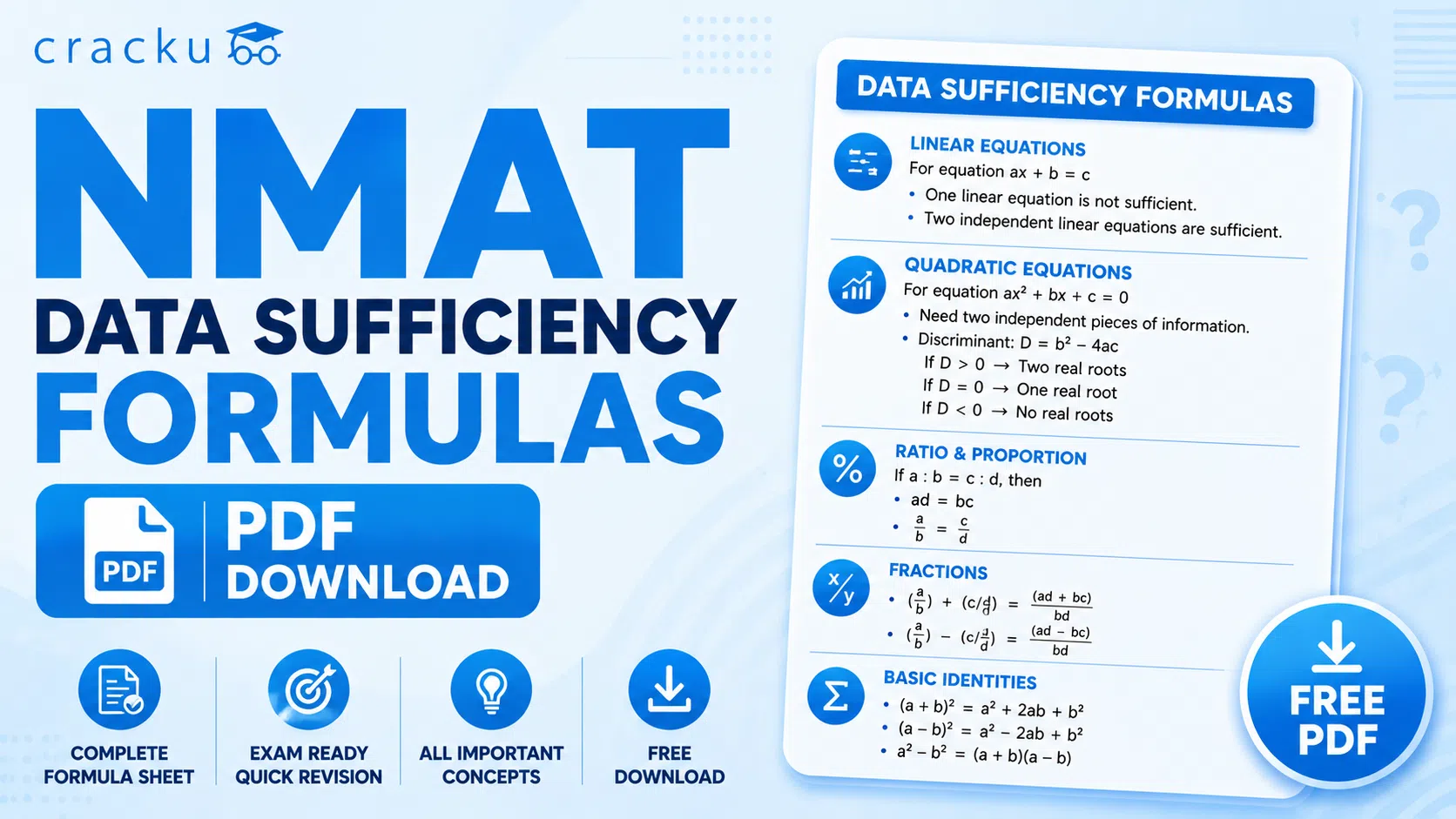
NMAT Data Sufficiency Formulas PDF
NMAT Data Sufficiency Formula PDF is an important part of the NMAT exam's Quantitative Skills section. Data Sufficiency questions test a candidate's ability to analyze information and determine whether the given statements are enough to answer a question. Unlike regular quantitative questions, Data Sufficiency focuses on evaluating the adequacy of information rather than calculating the final answer.
Students aiming for a high overall NMAT score must develop a strong understanding of Data Sufficiency concepts, formulas, and shortcuts. Regular revision of these formulas and techniques can significantly improve speed and accuracy during the exam. This PDF serves as an excellent resource for quick revision, mock test preparation, and last-minute practice before the NMAT exam.
Importance of NMAT Data Sufficiency Formulas
Data Sufficiency is one of the most scoring yet challenging topics in the NMAT Quantitative Skills section. Having a dedicated formula PDF helps aspirants approach questions systematically and make quicker decisions during the exam.
Helps students identify whether the given statements are sufficient to answer a question.
Improves logical reasoning and analytical thinking required for Data Sufficiency questions.
Reduces time spent on lengthy calculations by focusing on information analysis.
Enables aspirants to solve number properties, arithmetic, algebra, and probability-based Data Sufficiency questions efficiently.
Minimizes mistakes by providing standard formulas and concepts in one place.
Strengthens conceptual understanding and boosts confidence in solving NMAT Data Sufficiency questions.
Improves overall Quantitative Skills performance and sectional score.
Read Also, NMAT Formulas PDF, Download NMAT Quant Important Formulas
Complete NMAT Data Sufficiency Formula List
NMAT Data Sufficiency formulas collected in one place make preparation easier and revision faster. The list below covers the most important formulas frequently used in Data Sufficiency questions.
Number Properties
Product of Two Numbers Using HCF and LCM
a × b = HCF(a, b) × LCM(a, b)
Total Number of Factors
If n = p₁ᵉ¹ × p₂ᵉ² × p₃ᵉ³ ...
Number of Factors = (e₁ + 1)(e₂ + 1)(e₃ + 1)...
Sum of All Factors
If n = p₁ᵉ¹ × p₂ᵉ² × ...
Sum of Factors = [(p₁^(e₁+1) − 1)/(p₁ − 1)] × [(p₂^(e₂+1) − 1)/(p₂ − 1)] × ...
Highest Power of Prime p in n!
Power of p in n! = ⌊n/p⌋ + ⌊n/p²⌋ + ⌊n/p³⌋ + ...
Divisibility Rule for 11
A number is divisible by 11 if:
(Sum of digits at odd places − Sum of digits at even places) = 0 or a multiple of 11
Arithmetic
Percentage Change
Percentage Change = ((New Value − Old Value) / Old Value) × 100
Average (Mean)
Average = Sum of All Values / Number of Values
Division in Ratio
Share of A = (m / (m + n)) × Total
Share of B = (n / (m + n)) × Total
Simple Interest
SI = (P × R × T) / 100
Compound Interest Amount
A = P(1 + R/100)^T
Combined Work Rate
1/T = 1/T₁ + 1/T₂ + ...
Relative Speed
Same Direction = |v₁ − v₂|
Opposite Direction = v₁ + v₂
Profit Percentage
Profit % = ((Selling Price − Cost Price) / Cost Price) × 100
Algebra
Sum and Product of Roots
For ax² + bx + c = 0
Sum of Roots = −b/a
Product of Roots = c/a
Discriminant
Δ = b² − 4ac
- Δ > 0 → Two Distinct Real Roots
- Δ = 0 → Equal Real Roots
- Δ < 0 → Complex Roots
Unique Solution Condition for Two Linear Equations
For:
a₁x + b₁y = c₁
a₂x + b₂y = c₂
A unique solution exists when:
a₁/a₂ ≠ b₁/b₂
Sum of First n Terms of GP
Sₙ = a(1 − rⁿ)/(1 − r), where r ≠ 1
Probability and Permutations
Permutations
nPr = n! / (n − r)!
Combinations
nCr = n! / [r!(n − r)!]
Basic Probability
Probability = Favourable Outcomes / Total Outcomes
Expected Value
E = Σ(Value × Probability)
NMAT Data Sufficiency Question Distribution Over the Years
Data Sufficiency contributes a noticeable number of questions in the NMAT Quantitative Skills section every year. Questions are generally based on Number Properties, Arithmetic, Algebra, and Probability concepts. The table below provides the approximate trend of Data Sufficiency questions in recent NMAT exams.
| NMAT Exam Year | Data Sufficiency Questions | Total Quant Questions |
|---|---|---|
| NMAT 2024 | 4–6 | 36 |
| NMAT 2023 | 4–6 | 36 |
| NMAT 2022 | 3–5 | 36 |
Tips to Master Important Data Sufficiency Formulas for NMAT
After downloading the NMAT Data Sufficiency Formula PDF, aspirants can follow these important strategies to improve their performance in mock tests and the NMAT exam.
Understand the Concept of Sufficiency: Focus on determining whether the information is sufficient rather than solving the entire question.
Learn Standard Answer Patterns: Become familiar with common Data Sufficiency answer choices and elimination techniques.
Practice Multiple Cases: Test statements using different numerical values to check whether they always produce a unique answer.
Revise Important Formulas Regularly: Number Properties, Arithmetic, Algebra, and Probability formulas should be revised frequently.
Analyse Mock Test Mistakes: Identify situations where statements were incorrectly judged as sufficient or insufficient.
Improve Logical Thinking: Develop the habit of evaluating information systematically and avoiding unnecessary calculations.
Read Also, NMAT Number Properties Formulas PDF, Preparation Tips & Tricks
Download Cracku's Free NMAT Data Sufficiency Formulas PDF
Cracku's Free NMAT Data Sufficiency Formulas PDF is a complete revision resource covering important concepts and formulas from Number Properties, Arithmetic, Algebra, Probability, Permutations, and Combinations. Download this PDF to strengthen your NMAT preparation, improve accuracy, and develop the analytical skills required to solve Data Sufficiency questions efficiently. This formula PDF helps aspirants revise important concepts quickly and allocate more time to other NMAT topics during preparation.
Read Also, NMAT Syllabus 2026 PDF, Section Wise Important Topics
NMAT Data Sufficiency Formulas PDF: Conclusion
The NMAT Data Sufficiency Formulas PDF is an essential study resource for candidates aiming to improve their performance in the Quantitative Skills section. By compiling important formulas from Number Properties, Arithmetic, Algebra, Probability, and Permutations, it enables quick revision and strengthens conceptual understanding before the exam.
Regular practice with these formulas, combined with strong analytical thinking and Data Sufficiency techniques, can significantly improve accuracy and speed. Download the NMAT Data Sufficiency Formulas PDF and make it a part of your NMAT preparation strategy to maximize your score and perform confidently on exam day.