91- 6303239042


 Group
 Group


 Preferred Source

 Google Discover
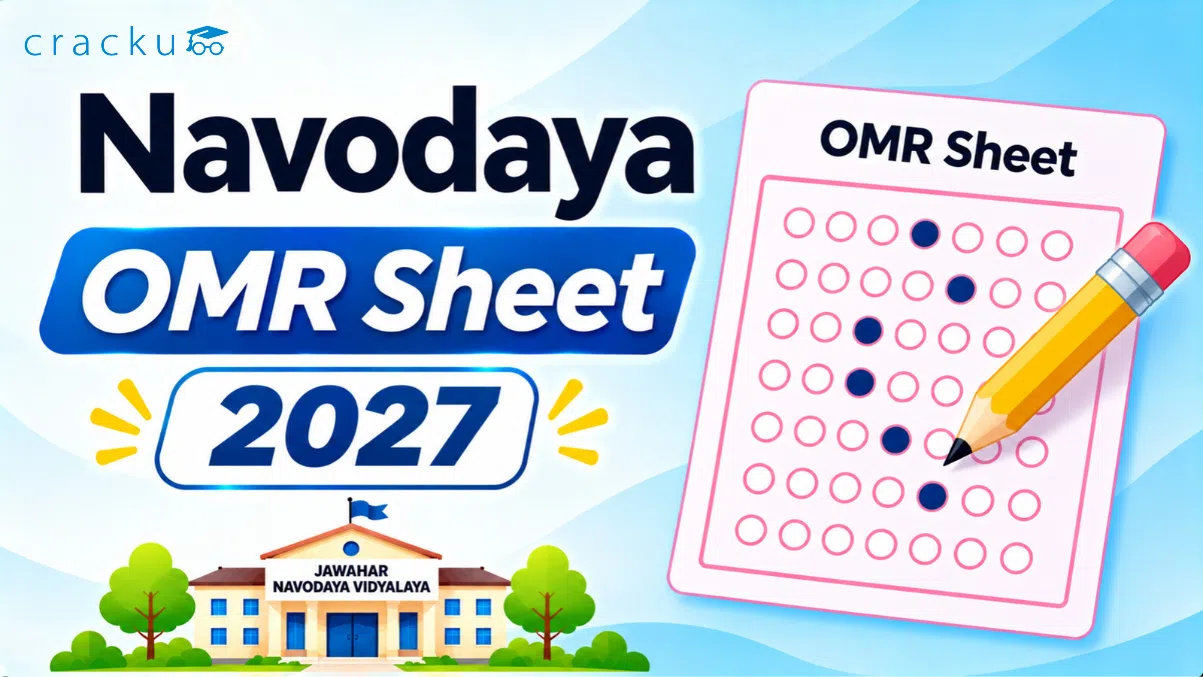
Navodaya OMR Sheet 2027
November 28, 2026, is the Navodaya Class 6 exam. It's time you learned how to fill the OMR sheet. Your children might be busy solving Navodaya Class 6 previous-year question papers, but along with practising, they should also know how to bubble the circles in the Navodaya OMR sheet. Because one small mistake while bubbling, entering the roll number or striking any words can affect the evaluation.
Parents and teachers should explain the OMR process before the exam. Children may understand the questions well but still need practice with filling circles, writing details and following instructions. Use the sample OMR sheet below to familiarise them with the format. Encourage children to practise marking answers while solving Navodaya previous year papers.
Navodaya OMR Sheet Sample PDF
The Navodaya OMR answer sheet has two sides. Side 1 contains the roll number and important instructions. Side 2 contains candidate details, identification fields and the answer area.
OMR Sheet Detail | Who Fills It? |
Roll number | Candidate |
Test booklet number | Candidate |
Candidate's name in capital letters | Candidate |
Father's name in capital letters | Candidate |
State, district, block and centre codes | Invigilator |
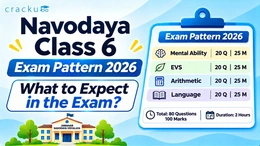
Answers to questions 1–80 | Candidate |
Candidate's signature | Candidate |
Invigilator's signature and centre stamp | Invigilator |
The roll number and test booklet number also have corresponding digit bubbles. Children must write each number in the boxes and darken the matching bubbles below them. The sample also displays a booklet code and an answer sheet number. These are used to identify the test booklet and OMR sheet.
The OMR sheet is designed for recording answers in a format that can be read by an OMR scanner. The scanner reads the darkened circles, so children must mark the correct bubbles clearly. Writing an answer only in the question booklet will not record it on the OMR answer sheet.
Also Read: Navodaya Class 6 Model Paper 2026 PDF: Pattern & Marking Scheme
How to Fill Navodaya OMR Sheet Correctly?
Parents and teachers should walk children through the following steps before the Navodaya Class 6 examination.
Step 1: Fill in the roll number
Ask the child to copy the roll number exactly as printed on the Navodaya admit card. The sample sheet has separate boxes for each digit, followed by rows of numbered circles. Children must write the digits in the boxes and darken the matching circles.
For example, if the roll number is 1732172, the child must fill each digit in its correct column. A wrong digit or mismatched bubble can create an identification error.
Step 2: Enter the test booklet number
The test booklet number must also be written in the given boxes. Children should darken the corresponding digit bubbles below it. They must not confuse this number with the roll number.
Step 3: Write the candidate's name and father's name
The sample provides separate spaces for the candidate's name and father's name. Both must be written in capital letters. Children should write neatly and avoid spelling mistakes.
Step 4: Fill in the answer bubbles
The answer area contains question numbers and four options: A, B, C and D. For every question, the child must darken the circle corresponding to the selected answer.
For example, if the answer to Question 8 is A, the child must fill the circle under A in the row marked 08. The answer must be marked against the correct question number.
Step 5: Sign the OMR sheet
The candidate must sign in the space provided, using their usual running-hand signature. The invigilator will complete the fields reserved for them, including the centre details and signature.
Also Read: Navodaya Class 6 Expected Questions 2026 PDF with Solutions
Navodaya OMR Sheet Instructions and Marking Rules
The sample OMR sheet clearly lists the rules candidates must follow. Parents and teachers should explain not just what to do, but also why each instruction matters.
Instruction | Why Is It Important? |
Use only a blue or black ball-point pen. | The OMR scanner reads clear, dark marks. Pencil marks can smudge or be erased, so the sheet specifically requires a ball-point pen. |
Darken the complete circle. | A partly filled circle may not be read correctly by the scanner. |
Mark only one option for each question. | The sample states that marking more than one circle makes the answer incorrect. |
Do not change an answer after marking it. | Overwriting or changing a marked answer is not allowed under the printed instructions. |
Avoid stray marks on the sheet. | The scanner may read unwanted marks as responses or interfere with answer detection. |
Do not use blade, correction fluid or other materials on the sheet. | Such tampering is prohibited and can damage the OMR sheet. |
Do not do rough work on the OMR sheet. | The answer sheet is meant only for recording responses. Use the space allowed in the question booklet for rough work. |
Mark the answer against the correct question number. | A correct option marked in the wrong row will be recorded against a different question. |
Children should also check that the test booklet code printed on the OMR sheet matches the code on their question booklet. If the codes do not match, they must immediately inform the invigilator and ask for both the question booklet and OMR sheet to be replaced.
Before handing over the OMR sheet, candidates should check that the roll number and test booklet number have been filled in and marked correctly.
This process can make the kids nervous, so practising with Navodaya mock tests can make them accustomed to it. So, download the OMR sheet and give them time to practice on it.
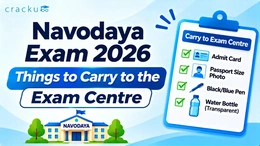
Also Read: Navodaya Vidyalaya 2026 Exam Day Guidelines & Things to Carry
Common Mistakes to Avoid While Filling the Navodaya OMR Sheet
Children may make avoidable mistakes when they fill an OMR sheet for the first time. Parents and teachers can help prevent them through regular practice.
Filling only the boxes: Writing the roll number is not enough. Children must also darken the matching digit bubbles.
Marking half a circle: A small tick or dot is not the correct way to mark an answer. The complete circle must be darkened.
Marking two options: Children should select only one answer for each question. Multiple marked options will be treated as incorrect.
Skipping question numbers: They must match every answer with the correct question number before darkening a bubble.
Using a pencil or the wrong pen: Keep a blue or black ball-point pen ready and teach children to use it during practice.
Making rough marks: Do not allow doodling, calculations or unnecessary marks on the OMR sheet.
Rushing through personal details: Children should carefully check their roll number, booklet number and name before moving to the answers.
Conclusion
Whenever children solve a Navodaya model paper or previous year question paper, give them an OMR sheet as well. Ask them to read each question, select an answer and darken the corresponding bubble. They should practise filling in their roll number and other details using a sample sheet, too.