91- 6303239042


 Group
 Group


 Preferred Source

 Google Discover
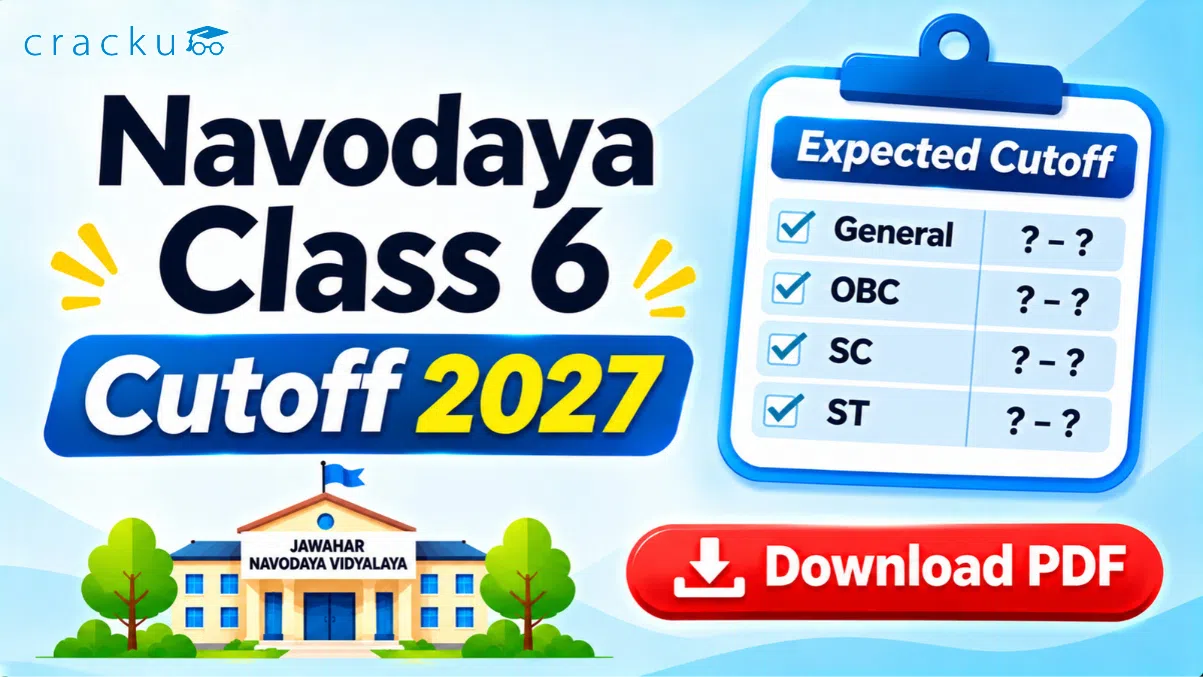
Navodaya Class 6 Cutoff 2027
The Navodaya Class 6 cutoff 2027 will help parents, teachers and students understand the marks required for admission to Jawahar Navodaya Vidyalayas (JNVs). However, there is no single cutoff that applies to every candidate across India. Selection depends on the district, reservation category, rural or open quota and available seats.
The JNVST Class 6 examination carries 100 marks. A score of 80 or above may look competitive, but the actual selection marks can be considerably higher in districts with stronger competition. Although the cut-off plays a key role in knowing the admission chances, it's not the ultimatum. First, let the children focus on their preparation with Navodaya previous year question papers, and then you can calculate the admission chances.
Navodaya Cutoff 2026 PDF
The Navodaya Vidyalaya Samiti (NVS) released the JNVST Class 6 2026 cutoff alongside the Summer Bound selection results. The announced records contain district-wise cutoff scores and ranks, with separate entries for rural and open categories.
Parents can refer to the previous year's cutoff PDF to understand the competition in their child's district.
The 2026 records are particularly useful because they show that cutoff marks can change even between blocks of the same district. For example, the rural unreserved cutoff in different blocks of Annamayya district, Andhra Pradesh, ranged from 77.50 to 93.75 marks. The district's open unreserved cutoff was 95 marks.
Navodaya Class 6 Expected Cutoff 2027
The expected cutoff for JNVST 2027 admissions should be treated as a preparation benchmark, not an admission guarantee. Based on the 2025 and 2026 district-level cutoff records, candidates should aim for a score that gives them a reasonable margin over the previous selection marks.
The following ranges are estimates for 2027. They account for the higher competition seen in several districts and the differences between rural and open selection quotas.
Selection category | Expected cutoff 2027 |
Rural Unreserved | 87–94 |
Open Unreserved | 93–97 |
Rural OBC | 85–92 |
Open OBC | 91–95 |
Rural SC | 82–90 |
Open SC | 88–95 |
Rural ST | 78–89 |
Open ST | 85–93 |
These are estimated planning ranges, not official NVS predictions or guaranteed minimum marks.
A child scoring 95 or above in the Navodaya mock tests would have a stronger score position across several selection categories. However, even this score on exam day cannot guarantee admission because the relevant district and quota determine the final selection.
Parents should also remember that rural unreserved selection follows block-wise reservation. Therefore, two children from different blocks within the same district may face different cutoff marks.
Also Read: Navodaya Class 6 Model Paper 2026 PDF: Pattern & Marking Scheme
Navodaya Class 6 Category-wise Cutoff 2027 (Expected)
Category-wise expected cutoffs help parents compare their child's performance with the relevant reservation group. However, rural and open selection have different cutoff patterns.
Category | Open Selection | Rural Selection |
General (UR) | 93–97 | 87–94 |
OBC | 91–95 | 85–92 |
SC | 88–95 | 82–90 |
ST | 85–93 | 78–89 |
1. High scores matter for open unreserved selection. Several district records show cutoffs around 95 marks or higher. Therefore, targeting 90 marks alone may not provide a sufficient safety margin.
2. Rural selection needs a separate comparison. The 2025 cutoff document specifically confirms block-wise reservation for rural unreserved seats. A district average cannot represent every block.
Also Read: Navodaya Class 6 Expected Questions 2026 PDF with Solutions
JNVST Class 6 State-wise Cutoff 2027
The following ranges represent the Navodaya lowest and highest district-level Open UR cutoffs recorded in each state.
State | Gen UR Boys | Gen UR Girls |
Andhra Pradesh | 90.00–96.25 | 87.50–96.25 |
Arunachal Pradesh | 77.50–91.25 | 73.75–87.50 |
Assam | 78.75–95.00 | 77.50–93.75 |
Bihar | 95.00–100.00 | 92.50–100.00 |
Chhattisgarh | 68.75–98.75 | 76.25–97.50 |
Goa | 76.25–82.50 | 73.75–85.00 |
Gujarat | 76.25–97.50 | 77.50–95.00 |
Haryana | 82.50–92.50 | 80.00–91.25 |
Himachal Pradesh | 85.00–90.00 | 85.00–88.75 |
Jharkhand | 85.00–97.50 | 86.25–96.25 |
Karnataka | 83.75–98.75 | 83.75–97.50 |
Kerala | 81.25–88.75 | 80.00–87.50 |
Madhya Pradesh | 82.50–97.50 | 80.00–96.25 |
Maharashtra | 91.25–98.75 | 85.00–98.75 |
Manipur | 77.50–97.50 | 80.00–100.00 |
Odisha | 88.75–96.25 | 86.25–96.25 |
Punjab | 77.50–93.75 | 76.25–91.25 |
Rajasthan | 83.75–97.50 | 78.75–97.50 |
Telangana | 91.25–97.50 | 86.25–93.75 |
Tripura | 83.75–91.25 | 81.25–90.00 |
Uttar Pradesh | 87.50–98.75 | 80.00–98.75 |
Uttarakhand | 81.25–92.50 | 78.75–88.75 |
West Bengal | 91.25–98.75 | 90.00–97.50 |
Andaman & Nicobar Islands | 80.00–85.00 | 75.00–81.25 |
Chandigarh | 81.25 | 80.00 |
Dadra & Nagar Haveli and Daman & Diu | 61.25–82.50 | 62.50–81.25 |
Delhi | 77.50–91.25 | 80.00–92.50 |
Jammu & Kashmir | 83.75–85.00 | 83.75–86.25 |
Lakshadweep | — | 78.75 |
Puducherry | 47.50–75.00 | 35.00–75.00 |
Navodaya Class 6 Previous Year Cutoff Marks Analysis
Previous-year cutoffs provide a better starting point than generic qualifying-mark estimates. The 2025 and 2026 records show that selection marks can remain high in competitive districts, particularly for open unreserved seats.
High scores matter for open unreserved selection. Several district records show cutoffs around 95 marks or higher. Therefore, targeting 90 marks alone may not provide a sufficient safety margin.
Category-wise differences are not always predictable. Reservation categories have separate selection arrangements, but their cutoffs also depend on the number of candidates, available seats and local competition.
Conclusion
For preparation, parents can encourage children to target 90–95 marks or higher, while keeping the relevant district cutoff in mind. This is a preparation target, not a promise of selection.
Ultimately, the Navodaya Class 6 cutoff 2027 will become clear only after NVS publishes the official selection data. Until then, previous-year records and realistic score targets are the most useful references for families.