91- 6303239042


 Group
 Group


 Preferred Source

 Google Discover
The Navodaya Class 6 exam pattern helps kids to get familiar with what they have to do in the exam hall. Also, parents and teachers get to know what their kids' practice should focus on. For that, ensure you download the Navodaya Class 6 previous year question papers to teach your kids the difficulty level and help them with the problems. Also, for rigorous and interesting practice sessions, you can use Navodaya Class 6 model papers to help your child identify mistakes and improve their score.
Navodaya Class 6 Exam Pattern 2026
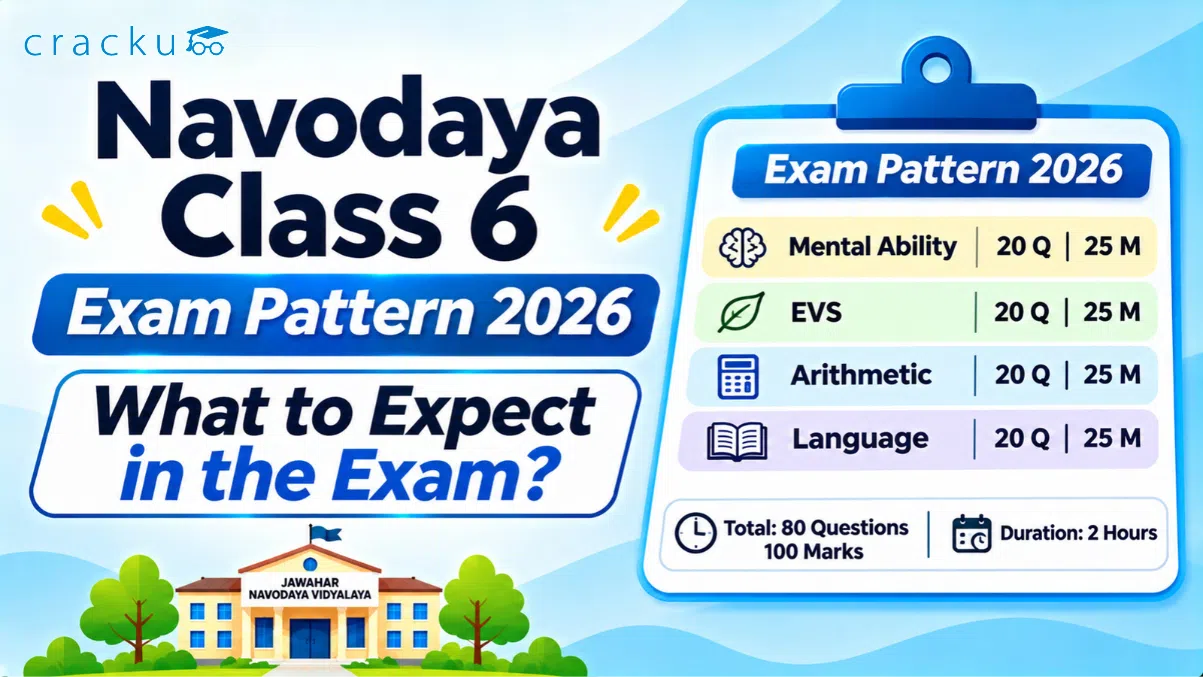
The JNVST Class 6 examination has three sections: Mental Ability+EVS, Arithmetic and Language. Mental Ability carries the highest weightage, with 40 (20+20) questions for 50 (25+25) marks.
Particulars | Details |
Examination | Jawahar Navodaya Vidyalaya Selection Test (JNVST) |
Admission Class | Class 6 |
Exam Year | 2026 |
Conducting Authority | Navodaya Vidyalaya Samiti (NVS) |
Exam Mode | Offline (OMR-based) |
Question Type | Objective (MCQs) |
Total Questions | 80 |
Total Marks | 100 |
Exam Duration | 2 hours |
Exam Timing | 11:30 AM to 1:30 PM |
Negative Marking | No |
Navodaya Subject-Wise Questions and Marks
Parents should give children more practice time for Mental Ability because it carries 50% of the total marks. Arithmetic and Language carry 25 marks each.
Subject | Questions | Marks | Weightage |
Mental Ability Test+EVS | 40 (20+20) | 50 (25+25) | 50% |
Arithmetic Test | 20 | 25 | 25% |
Language Test | 20 | 25 | 25% |
Total | 80 | 100 | 100% |
What should children practise in each section?
Mental Ability: Analogy, classification, figure matching, pattern completion, mirror images, embedded figures and series.
Arithmetic: Number system, four fundamental operations, fractions, decimals, factors, multiples, measurement, profit and loss.
Language: Reading comprehension, vocabulary, sentence formation and understanding passages.
Parents can use this distribution to divide weekly practice sessions. For example, children can spend three sessions on Mental Ability, two on Arithmetic and two on Language each week.
Navodaya Exam Duration and Section-Wise Timing
The total examination duration is 120 minutes. The prescribed section-wise time distribution is 60 minutes for Mental Ability and 30 minutes each for Arithmetic and Language.
Section | Questions | Suggested Time | Average Time per Question |
Mental Ability+EVS | 40 (20+20) | 60 minutes | 1.5 minutes |
Arithmetic | 20 | 30 minutes | 1.5 minutes |
Language | 20 | 30 minutes | 1.5 minutes |
Total | 80 | 120 minutes | 1.5 minutes |
Children should practise completing questions within these time limits. Parents can use a stopwatch during mock tests to check whether a child spends too much time on one question.
For example, if a child takes three minutes to solve one figure-based question, encourage them to mark it for review and move ahead during practice. This habit can help improve time management.
Also Read: Navodaya Class 6 Model Paper 2026 PDF: Pattern & Marking Scheme
Navodaya 2026 Marking Scheme
The Navodaya marking scheme is simple. Children receive marks for correct answers, and there is no deduction for incorrect answers.
Particulars | Marking Details |
Correct Answer | +1.25 marks |
Incorrect Answer | 0 marks |
Unattempted Question | 0 marks |
Negative Marking | No |
Total Questions | 80 |
Maximum Marks | 100 |
A few examples will help parents explain the marking scheme:
Correct Answers | Marks Obtained |
20 | 25 |
40 | 50 |
60 | 75 |
70 | 87.5 |
80 | 100 |
Since there is no negative marking, children should attempt every question. However, they should first answer questions they understand and use the remaining time for difficult ones.
Also Read: Navodaya Class 6 Expected Questions 2026 PDF with Solutions
Navodaya Class 6 OMR Sheet: Instructions and Filling Process
The JNVST examination uses an Optical Mark Recognition (OMR) sheet to record answers. A computer-based scanning process reads the marked circles, so children must follow the instructions carefully.
Important OMR instructions for parents to explain:
- Use only a blue or black ballpoint pen to mark answers.
- Do not use a pencil on the OMR sheet.
- Each question has four options: A, B, C and D.
- Darken the circle corresponding to the selected answer completely.
- Do not leave a circle partially filled.
- Do not erase, strike out or change a marked answer.
- Do not use correction fluid or white ink on the OMR sheet.
How should children fill the OMR sheet?
Suppose the correct answer to Question 10 is option C. The child must darken the circle below C against Question 10.
Parents and teachers should arrange a few OMR practice sheets before the examination. Children should practise matching question numbers with answer rows and filling circles neatly.
How to Prepare for Navodaya Exam 2026 Based on the Exam Pattern?
The exam pattern provides a clear preparation direction for parents and teachers. Instead of asking children to study all subjects for equal hours, divide practice according to marks, question types and difficulty levels.
Here are five practical preparation steps:
- Prioritise Mental Ability: Allocate regular practice time to figure-based questions, series and classification. This section carries 50 marks (Mental Ability + EVS).
- Strengthen Arithmetic Basics: Help children practise calculations, fractions, decimals and measurement problems. Give them 20–25 questions during each revision session.
- Improve Reading Skills: Ask children to read one passage daily and answer five comprehension questions. Discuss incorrect answers to improve understanding.
- Attempt Full-Length Mock Tests: Schedule two mock tests every week. Keep the examination duration at 120 minutes and use an OMR sheet.
- Review Every Test: Record the number of correct and incorrect answers in each section. Set weekly improvement targets based on the results.
Practice Record | Target |
Full-length mock tests | 2 per week |
Reading practice | 1 passage daily |
Arithmetic revision | 20–25 questions per session |
Mental Ability practice | 20 questions per session |
Mistake review | After every mock test |
The main goal is to help children understand questions, manage time and mark answers correctly. Consistent practice with the right guidance can make the Navodaya entrance examination more familiar and manageable.
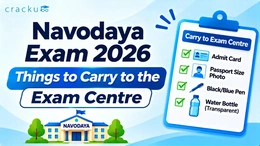
Also Read: Navodaya Exam 2026: Things to Carry to the Exam Centre
Navodaya Class 6 Exam Pattern 2026: Final Preparation Tips
When choosing a Navodaya Class 6 model paper, check the first section before your child starts. For the November 2026 exam, it should include 20 Mental Ability questions and 20 EVS questions. Give your child 60 minutes for this section, followed by 30 minutes each for Arithmetic and Language. Use an OMR practice sheet so that marking answers is part of the two-hour session.
After the mock test, record the correct answers separately for Mental Ability, EVS, Arithmetic and Language. A combined first-section score can hide a gap: a child who solves most figure patterns may still need help reading an EVS passage. Use that result to choose the next revision task, whether it is explaining a passage, revisiting fractions or checking OMR rows more carefully.