MAH CET 9th Mar 2024 Slot 1
DIRECTIONS for the question: Study the following information carefully and answer the questions given below it.
Six persons A, B, C, D, E and F are sitting in two rows, three in each.
E is not at the end of any row.
D is second to the left of F.
C, the neighbour of E, is sitting diagonally opposite to D.
B is the neighbour of F.
MAH CET 9th Mar 2024 Slot 1 - Question 71
Which of the following are in the same row?
MAH CET 9th Mar 2024 Slot 1 - Question 72
Which of the following are sitting diagonally opposite to each other?
DIRECTIONS for the question: Study the following information carefully and answer the questions given below it.
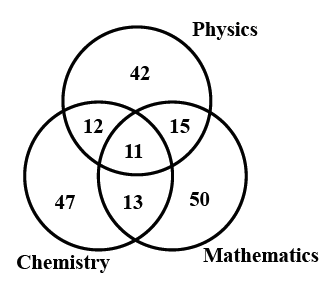
The diagram given below shows the number of students who got distinction in three subjects out of 500 students. Study the diagram carefully and answer the questions that follow:
MAH CET 9th Mar 2024 Slot 1 - Question 73
What is the percentage of students who got distinction in two subjects?
MAH CET 9th Mar 2024 Slot 1 - Question 74
What is the percentage of students who got distinction?
MAH CET 9th Mar 2024 Slot 1 - Question 75
The percentage of students with distinction marks in Mathematics is
For the following questions answer them individually
MAH CET 9th Mar 2024 Slot 1 - Question 76
DIRECTION for the question: In the following question, a related pair of figures (unnumbered) is followed by five other pairs of figures numbered as 1, 2, 3, 4 and 5. Out of the five numbered pairs, select the pair that has a relationship similar to that in the unnumbered pair.

MAH CET 9th Mar 2024 Slot 1 - Question 77
DIRECTIONS for the question: Following question consists of four Problem Figures marked A, B, C and D and five Answer Figures marked 1, 2. 3, 4 and 5. Select a figure from amongst the Answer Figures which will continue the series established by the four Problem Figures.

MAH CET 9th Mar 2024 Slot 1 - Question 78
DIRECTION for the question: Following question consists of two sets of figures. Figures A, B, C and D constitute the Problem Set while figures 1, 2, 3, 4 and 5 constitute the Answer Set. There is a definite relationship between figures A and B. Establish a similar relationship between figures C and D by selecting a suitable figure from the Answer Set that would replace the question mark (?) in fig (D).

MAH CET 9th Mar 2024 Slot 1 - Question 79
DIRECTION for the question: In the following question, a related pair of figures (unnumbered) is followed by five other pairs of figures numbered as 1, 2, 3, 4 and 5. Out of the five numbered pairs, select the pair that has a relationship similar to that in the unnumbered pair.

MAH CET 9th Mar 2024 Slot 1 - Question 80
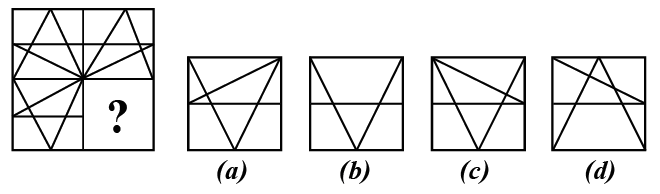
DIRECTION for the question: In following question, select a figure from amongst the four alternatives (a), (b), (c) and (d), which when placed in the blank space of fig. (X) would complete the pattern. If the correct figure to complete the pattern of fig. (X) is not there in the given alternatives (a), (b), (c) and (d) then choose option (e) None of these.