
 Group
Group
 Group
Group
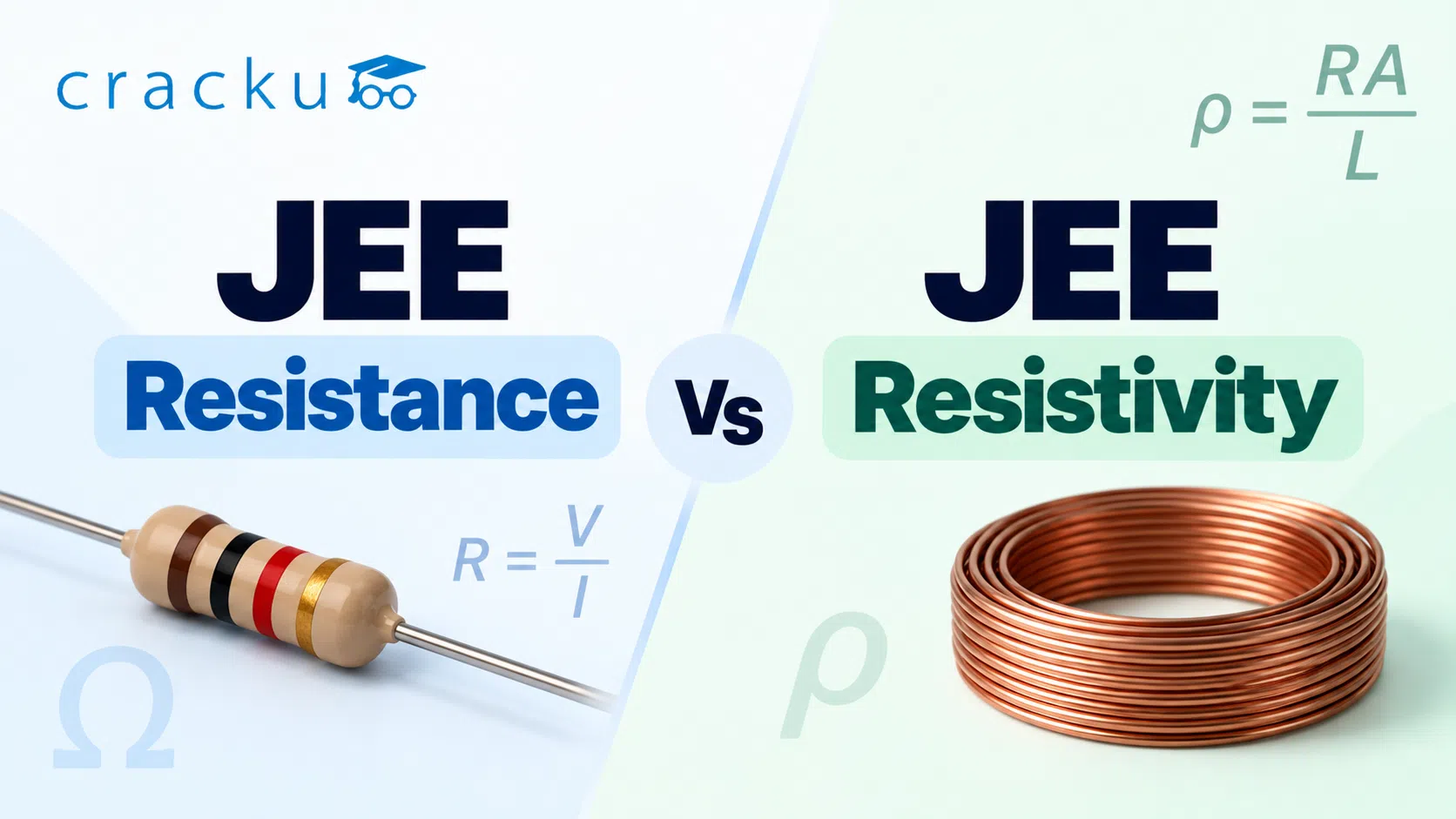
JEE Resistance vs Resistivity
The difference between resistance and resistivity is the first distinction you must get right in Current Electricity, because almost every wire-stretching, wire-cutting and temperature-variation question in JEE depends on it. Resistance belongs to a particular conductor and changes the moment you alter its length or thickness. Resistivity belongs to the material and stays fixed as long as the substance and its temperature stay the same. This comparison covers definitions, formulas, SI units, dimensions, geometry dependence and how the two are actually tested.
What are Resistance and Resistivity?
Resistance
Resistance is the opposition a specific conductor offers to the flow of charge through it. For an ohmic conductor kept at constant temperature, the potential difference across it is directly proportional to the current, and the constant of proportionality is the resistance:
$$R = \frac{V}{I}$$
Resistance is measured in ohms. It is an extensive quantity: two identical copper wires joined end to end have double the resistance of one wire, even though the copper has not changed in any way. The moment you cut, stretch, thicken or replace the conductor, the resistance changes.
Resistivity
Resistivity, also called specific resistance, measures how strongly a given material resists current, independent of the size or shape of the sample. Numerically, it equals the resistance of a conductor of that material having unit length and unit cross-sectional area:
$$\rho = \frac{RA}{L}$$
Resistivity is measured in ohm metre. It is an intensive quantity and therefore acts like a material fingerprint: copper has a resistivity of about $$1.72 \times 10^{-8}$$ ohm metre and nichrome about $$1.0 \times 10^{-6}$$ ohm metre at room temperature, no matter whether you take a thin filament or a thick rod. The only common variable that alters resistivity is temperature.
Key Differences Between Resistance and Resistivity
The table below collects every distinguishing point that JEE questions exploit. Read the geometry rows carefully, since most trap questions are built by changing dimensions and checking whether you wrongly change resistivity too.
| Property | Resistance | Resistivity |
|---|---|---|
| Definition | Opposition offered by a specific conductor to current flow | Opposition offered by unit length and unit area of a material |
| Symbol | $$R$$ | $$\rho$$ |
| Defining formula | $$R = \dfrac{V}{I}$$ | $$\rho = \dfrac{RA}{L}$$ |
| SI unit | ohm | ohm metre |
| Dimensional formula | $$[M L^2 T^{-3} A^{-2}]$$ | $$[M L^3 T^{-3} A^{-2}]$$ |
| Nature of quantity | Extensive, depends on the sample | Intensive, characteristic of the material |
| Effect of length | Directly proportional to length | Independent of length |
| Effect of area | Inversely proportional to area of cross-section | Independent of area of cross-section |
| Effect of shape | Changes on stretching, folding or cutting | Unchanged by any reshaping |
| Effect of temperature | Changes with temperature | Changes with temperature |
| Reciprocal quantity | Conductance, unit siemens | Conductivity, unit siemens per metre |
| Microscopic expression | $$R = \dfrac{mL}{n e^2 \tau A}$$ | $$\rho = \dfrac{m}{n e^2 \tau}$$ |
| Typical use | Circuit calculations, series and parallel networks | Material selection, comparing conductors and insulators |
The single relation that ties both quantities together, and the one that decides most objective questions, is:
$$R = \rho \frac{L}{A}$$
Formulas, Units and Dimensions
Start from the macroscopic relation and read it in both directions. Given the material and the geometry, it hands you the resistance. Given a measured resistance and the dimensions of the sample, it hands you the resistivity, which is exactly how a metre bridge experiment determines the specific resistance of a wire.
$$R = \rho \frac{L}{A} \quad \text{and} \quad \rho = \frac{RA}{L}$$
The reciprocal pair is equally important. Conductance and conductivity are defined as:
$$G = \frac{1}{R} \quad \text{and} \quad \sigma = \frac{1}{\rho}$$
Conductance is measured in siemens and conductivity in siemens per metre. The microscopic form of Ohm's law uses conductivity rather than conductance, because it connects two field quantities at a point inside the conductor:
$$\vec{J} = \sigma \vec{E}$$
Free electron theory gives resistivity in terms of the electron density $$n$$, the relaxation time $$\tau$$, the electron mass $$m$$ and the electronic charge $$e$$:
$$\rho = \frac{m}{n e^2 \tau}$$
Notice that not one symbol in this expression refers to the shape of the wire. That is the cleanest proof that resistivity cannot depend on length or thickness. Substituting it back gives the microscopic form of resistance, in which the geometric factor reappears:
$$R = \frac{m}{n e^2 \tau} \cdot \frac{L}{A}$$
These relations sit at the heart of Current Electricity, and revising them in one pass along with drift velocity and current density is quicker if you keep a set of condensed JEE Formula Sheets for the last ten minutes before a mock test.
How Length, Area and Temperature Affect Each Quantity
This is where marks are won and lost. Work through the standard transformations once and the pattern becomes automatic.
Stretching a wire
When a wire is stretched, the volume of the material stays the same, so length and area change together. If the length becomes $$n$$ times the original, the area becomes $$1/n$$ times, and:
$$R' = n^2 R$$
Example. A wire of resistance 5 ohm is stretched uniformly to three times its original length. Its new resistance is $$9 \times 5 = 45$$ ohm. The resistivity is still exactly what it was, because the metal has not been replaced.
Cutting and rejoining
Example. A uniform wire of resistance 12 ohm is cut into three equal pieces and the pieces are connected in parallel. Each piece has resistance 4 ohm, so the combination gives $$4/3$$ ohm, that is $$R/9$$. Again, the resistivity of the metal is untouched.
Changing thickness at constant length
Example. Two wires are drawn from the same material. The second has twice the length and twice the radius of the first. Then
$$R_2 = \rho \frac{2L}{\pi (2r)^2} = \frac{1}{2} \cdot \rho \frac{L}{\pi r^2} = \frac{R_1}{2}$$
Doubling the radius quadruples the area, which beats the doubling of length, so the longer wire is actually the better conductor here. Practising mixed stretching, cutting and redrawing problems from a large bank of JEE Questions trains you to identify which quantity the examiner has silently held constant.
Temperature
Temperature is the one factor that shifts both quantities. Over a moderate range, for a metallic conductor:
$$R_T = R_0 (1 + \alpha \Delta T) \quad \text{and} \quad \rho_T = \rho_0 (1 + \alpha \Delta T)$$
Example. A copper coil has a resistance of 20 ohm at 0 degree Celsius, with $$\alpha = 3.9 \times 10^{-3}$$ per degree Celsius. At 100 degree Celsius, the resistance becomes $$20(1 + 0.39) = 27.8$$ ohm.
For metals, $$\alpha$$ is positive: more thermal vibration means shorter relaxation time and higher resistivity. For semiconductors such as silicon and germanium, and for electrolytes, $$\alpha$$ is negative, because heating releases far more charge carriers than the loss in relaxation time costs. Alloys like nichrome, manganin and constantan have very small temperature coefficients, which is why they are used for standard resistors and heating elements.
Similarities Between Resistance and Resistivity
Despite the contrast, the two quantities share several features that are worth stating clearly:
- Both measure opposition to the flow of charge, differing only in whether the opposition is attributed to a sample or to a substance.
- Both are scalar quantities with no direction attached.
- Both increase with temperature for metals and decrease with temperature for semiconductors, sharing the same temperature coefficient for a given material.
- Both have a defined reciprocal: conductance for resistance, conductivity for resistivity.
- Both carry the dimensional combination $$A^{-2}$$ for current, since both descend from the ratio of potential difference to current.
- Both are independent of the applied voltage and the current for an ohmic conductor, provided the temperature is steady.
- Both become larger as you move from conductors to semiconductors to insulators, spanning roughly twenty-four orders of magnitude.
JEE Exam Perspective
Current Electricity is a reliable scoring chapter, and resistance with resistivity appears in Mains almost every session, usually as a single-concept numerical worth four marks. The recurring formats are these:
- A wire is stretched, drawn or folded and you must report the new resistance using the constant-volume condition.
- A wire is cut into equal parts and reconnected in series or parallel.
- Resistivity is computed from a metre bridge or potentiometer reading, with the diameter given in millimetres so that unit conversion becomes the trap.
- Resistance at one temperature is given and you must find it at another, or find the temperature coefficient from two readings.
- Assertion and reason items that claim resist
JEE Resistance vs Resistivity: Conclusion
Understanding the difference between resistance and resistivity is essential for mastering the Current Electricity chapter in JEE Physics. Resistance depends on the conductor's length and cross-sectional area, whereas resistivity is a characteristic property of the material at a given temperature. The formulas R = ρL/A and ρ = RA/L, along with their SI units and dimensional formulas, help students solve conceptual and numerical problems effectively.
For JEE preparation, students should practise questions based on wire stretching, cutting and rejoining, changes in thickness, and temperature variation. A clear understanding of how resistance changes while resistivity remains constant during geometrical modifications can help avoid common mistakes. Revising these concepts with Current Electricity formulas and numerical practice can strengthen preparation for JEE Main and other engineering entrance examinations.
.webp)