91- 6303239042



 Group
Group
 Group
Group


 Preferred Source

 Google Discover
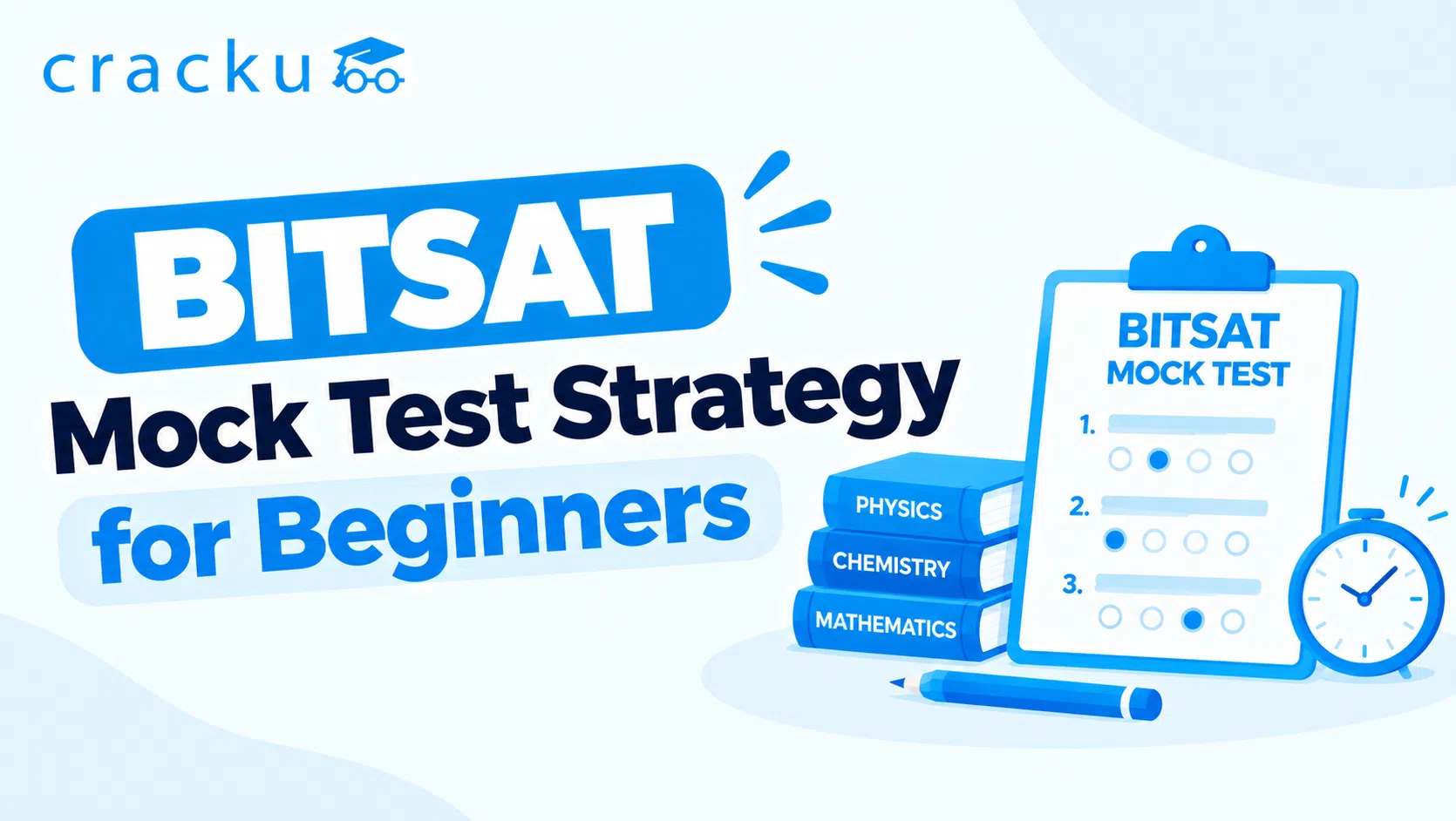
BITSAT Mock Test Strategy for Beginners
BITSAT demands a different preparation mindset than JEE Main. It tests your speed and accuracy across 130 questions in 180 minutes. Many students with strong concepts struggle because they run out of time. A disciplined BITSAT mock test routine trains beginners to manage time and maximize their score.
Random practice without a plan leads to score plateaus. Beginners often take tests without checking where they lose marks. You must combine regular mock practice, strict sectional time limits, and question analysis. This guide shows beginners how to build an effective mock test plan.
How to Start Preparing with BITSAT Mock Tests
You do not need to finish your entire syllabus before your first mock test. Start testing once you cover 60 percent of the syllabus. An early test shows your starting speed and reveals your weak chapters.
Beginners should take their tests on a computer. BITSAT is a computer-based test with an on screen timer and question palette. Practising on paper will not build proper screen discipline. You should take a regular BITSAT mock test on a desktop to get used to the real exam layout.
Follow these rules during every practice test:
- Sit at a desk and use a computer mouse for navigation.
- Complete the full 180 minutes without taking breaks.
- Divide your rough sheets into clear boxes to prevent calculation errors.
- Turn off your phone and close all other browser tabs.
The table below shows how your testing schedule should change as your preparation grows.
Syllabus Covered | Test Frequency | Main Target |
50% to 60% | 1 test every 10 days | Learn the screen interface and baseline speed |
70% to 85% | 1 to 2 tests per week | Build strict time limits for each subject |
100% | 2 to 3 tests per week | Build mental focus for the full 3 hours |
Assessing Baseline Readiness with a Diagnostic Test
Your first test serves as a diagnostic benchmark. Use this score to spot chapters where you forgot formulas. Check which section consumed most of your time.
Transitioning from Topic Practice to Full-Length Mocks
Chapter tests teach you concepts, but full mocks teach you stamina. Switching between Physics, Chemistry, Mathematics, English, and Logic tires the brain. Full-length practice forces you to change mental gears quickly.
Also Read: BITSAT Marks vs Rank 2026, Check Previous Year Analysis
How to Manage Time During a BITSAT Mock Test
Time management decides your BITSAT rank. You have 180 minutes to solve 130 questions. That gives you about 83 seconds per question. If a problem takes more than 90 seconds, you must skip it. Here is a tested time plan for all 5 sections of the paper.
Section | Time Budget | Target Plan |
English & Logic (30 Qs) | 25-30 mins | Score fast marks with zero calculations |
Chemistry (30 Qs) | 30-35 mins | Answer memory based & direct questions first |
Physics (30 Qs) | 40-45 mins | Solve direct numericals; skip lengthy derivations |
Math / Biology (40 Qs) | 55-60 mins | Solve standard problems & leave hard algebra |
Buffer Time | 10-15 mins | Revisit flagged questions or check bonus options |
Sectional Time Allocation Across 130 Questions
Start your test with English Proficiency and Logical Reasoning. These 30 questions carry 90 marks and require very little calculation. Finishing them in 25 minutes gives you confidence and banks early marks. Move to Chemistry next to answer direct theoretical questions quickly. Save Mathematics or Biology for the second half of your test. Attempt a free BITSAT mock test to track your sectional speed.
Two-Cycle Attempt Strategy and Bonus Question Rules
Never solve the paper in one continuous pass. Use a 2 cycle method instead. In Cycle 1, answer every question that you can solve in under 50 seconds. Mark medium difficulty questions for review and skip hard questions immediately. In Cycle 2, use your remaining time to solve the marked questions.
BITSAT gives you 12 bonus questions if you answer all 130 questions. But bonus questions carry high risk. You cannot return to the original 130 questions once you unlock the bonus set. Beginners often guess 10 to 15 questions just to see the bonus section. Each wrong guess deducts one mark.
BITSAT Mock Test Analysis and Revision
Taking a mock test without analyzing it wastes your effort. Spend at least two hours reviewing every 3 hour test. Your total score only tells you where you stand today. Detailed analysis shows you how to gain 20-30 marks in your next test.
Keep an error notebook for your preparation. Write down every question you get wrong. Record the topic name, the formula needed, and why you made the mistake. Review this notebook before you attempt your next test.
Use the table below to sort your mistakes during analysis.
Error Type | Main Cause | Corrective Action |
Concept Gap | Forgot the formula or theory | Reread notes & solve 10 practice problems |
Calculation Slip | Rushed through rough work | Keep rough steps neat & check basic signs |
Time Trap | Spent 2+ minutes on 1 item | Enforce the 45 second skip rule strictly |
Reading Error | Missed words like ‘NOT’ | Circle key condition words before solving |
Classifying Errors: Conceptual, Calculation, and Time Trap
Review your score report by dividing errors into 3 buckets. Conceptual errors show topics that need fresh study. Calculation slips show that you rushed under timer pressure. Time traps show poor question selection. Grouping your errors helps you fix the root cause of lost marks.
Closing Learning Gaps Before the Next Mock
Follow a simple 48 hour revision loop after every test:
- Re-solve every wrong question without looking at the answer key.
- Solve skipped questions without a timer to test your core concept.
- Read short notes for chapters that produced two or more errors.
- Take a short 15 minute topic quiz on your weak areas before the next mock.
Also Read: BITSAT 2026 Exam Analysis, Difficulty Level, Good Attempts
Common Mistakes Beginners Make in BITSAT Mock Test
Negative marking affects beginner scores more than unattempted questions. BITSAT gives +3 marks for a correct answer and -1 mark for an incorrect answer. If you guess four questions and get only one right, you gain zero marks. Multiple wrong guesses quickly pull your score below branch cutoffs. The table below highlights common beginner traps and their fixes:
Beginner Trap | Practical Fix |
Blind guessing | Guess only after ruling out two options |
JEE style solving | Skip lengthy questions within 40 seconds |
Ignoring English & LR | Practice vocabulary & reasoning daily |
Taking tests back to back | Review every mistake before the next test |
BITSAT Mock Test Strategy for Beginners: Conclusion
A consistent BITSAT mock test strategy helps beginners improve speed, accuracy, and confidence before the exam. Start with regular practice tests, follow a structured time management plan, and gradually increase your test frequency as you complete more of the syllabus. Focus on solving easy questions efficiently while learning when to skip time-consuming problems.
Mock test analysis is just as important as taking the test itself. Review your mistakes, identify weak concepts, and revise them before attempting the next mock. By combining full-length tests, sectional practice, and targeted revision, you can build better exam discipline and work towards improving your BITSAT score.