
 Group
Group
 Group
Group
JEE Reflection vs Refraction
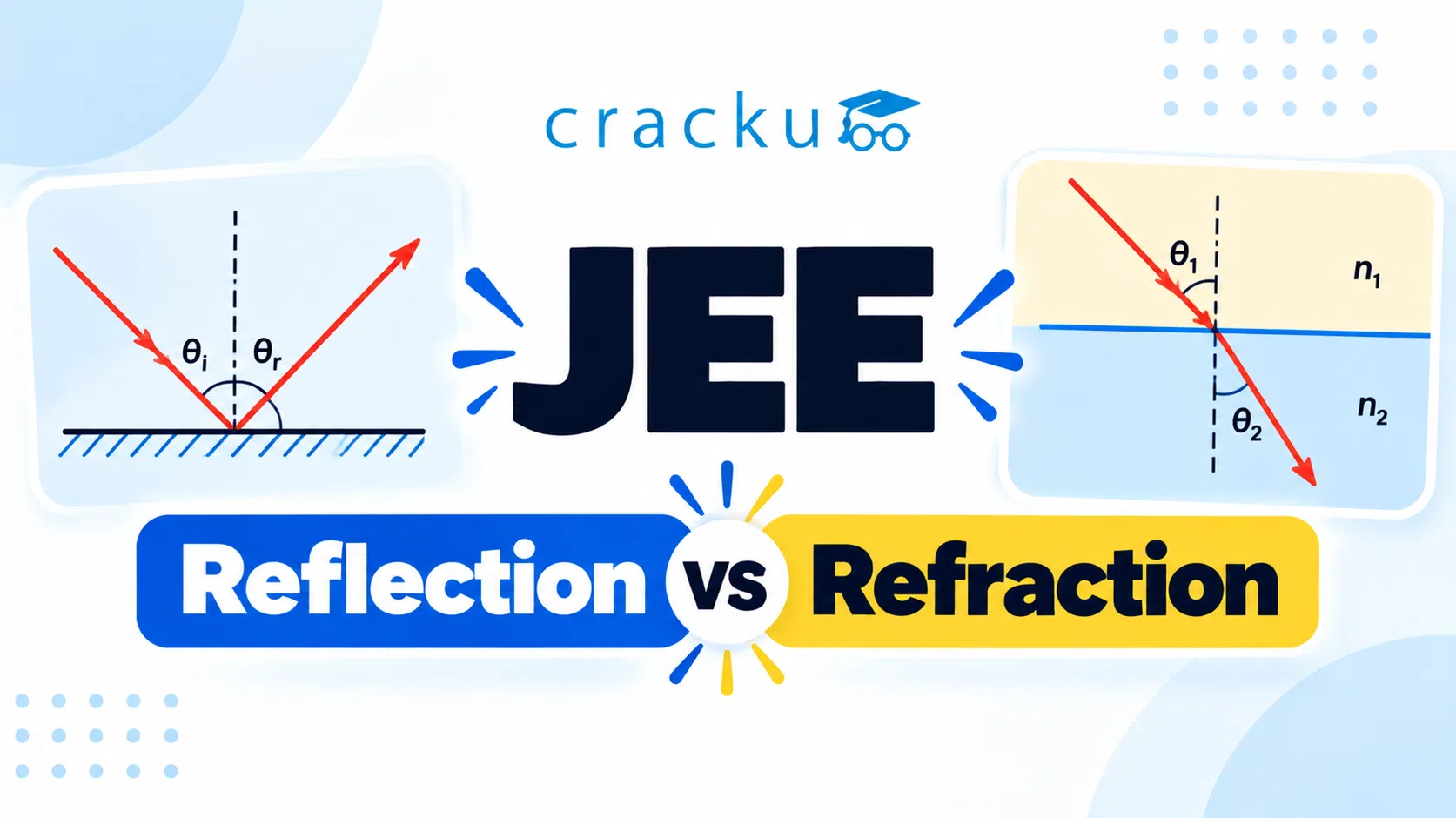
Reflection is the bouncing back of light when it strikes the surface separating two media, staying in the original medium. A mirror image is the simplest example.
Refraction is the bending of light as it passes obliquely from one transparent medium to another because its speed changes. A straw appearing bent in water shows refraction.
Both processes conserve energy and obey Fermat’s principle of least time, yet they differ in the path the ray finally takes. Knowing the distinction is a routine two-mark check in JEE Main optics questions.
Key Differences Between Reflection and Refraction
| Property | Reflection | Refraction |
|---|---|---|
| Basic definition | Return of light into first medium | Deviation of light into second medium |
| Laws involved | Law of reflection: $$\angle i=\angle r$$ | Snell’s law: $$n_1\sin i=n_2\sin r$$ |
| Path change | Ray reverses component perpendicular to surface | Ray changes both direction and speed |
| Speed of light | Unchanged (stays in same medium) | Changes to $$v=c/n$$ in new medium |
| Wavelength | Unchanged | Changes in proportion to speed: $$\lambda=v/f$$ |
| Phase shift | Possible $$\pi$$ shift at denser boundaries | No phase reversal, only optical path difference |
| Image formation devices | Plane or curved mirrors | Lenses, prisms, optical fibres |
| Critical angle concept | Not applicable | Defines onset of total internal reflection |
| Typical JEE marks | 1–2 marks, direct law or mirror equation | 2–3 marks, Snell’s law or lens maker’s results |
Working through mixed-chapter JEE Questions on optics shows how examiners test these contrasts back-to-back, often by asking which quantity changes when light enters glass.
Laws and Mechanism of Reflection
- First law: The incident ray, reflected ray, and the normal all lie in one plane.
- Second law: Angle of incidence equals angle of reflection: $$\angle i=\angle r$$.
Mirror formula for a spherical mirror: $$\frac1f=\frac1v+\frac1u$$.
Sign convention (Cartesian) decides the positive or negative focal length, a favourite trick in objective problems. For example, if a concave mirror of focal length 15 cm forms a 10 cm tall image at 20 cm in front of it, find object height using the magnification $$m=-\frac v u=-\frac{20}{u}$$.
Keep core formulas handy on a single sheet using the JEE Mains Formula Sheets so you do not waste time re-deriving sign rules during mocks.
Laws and Mechanism of Refraction
- Snell’s law: $$n_1\sin i = n_2\sin r$$, where $$n=c/v$$ is refractive index.
- Reversibility: Path of light is reversible; swapping media swaps $$i$$ and $$r$$.
- Critical angle: $$\sin C = n_2/n_1$$ for $$n_1>n_2$$. Beyond \(C\), total internal reflection occurs.
- Apparent depth: $$\text{Apparent depth}=\frac{\text{Real depth}}{n}$$, explaining why pool floors look shallower.
Worked example: Light from air (\(n=1\)) enters water (\(n=1.33\)) at \(i=30^\circ\). Snell’s law gives \(\sin r =\frac{\sin30^\circ}{1.33}=0.376\); hence \(r\approx22^\circ\). Note the smaller angle inside the denser medium, demonstrating the bending toward the normal.
Similarities Between Reflection and Refraction
- Both obey Fermat’s principle: actual path makes time stationary.
- Incident, normal, and emergent rays are coplanar.
- Energy and frequency remain conserved.
- Ray diagrams use the same sign convention and Cartesian axes.
- Total internal reflection is a limiting case linking both concepts.
A quick sketch comparing a mirror ray with a lens ray often saves one mark by visual confirmation of sign conventions.
JEE Exam Perspective
Optics averages 8–12 % of JEE Main physics marks, and at least one MCQ or numerical each year asks for the correct law to apply or the quantity that changes. Attempt a timed JEE Mock on optics to notice how reflection questions are calculation-light while refraction ones demand multi-step algebra.
Reflection focus: Plane mirror image count, mirror equation, sign tests.
Refraction focus: Lens maker’s formula, prism deviation, optical instruments.
Mixed problems: Combination of mirrors and lenses, or a mirror submerged in water.
Prepare short notes listing when frequency, speed, or wavelength change; this single distinction answers at least two rapid-fire questions every alternate paper.
JEE Reflection vs Refraction: Conclusion
Reflection sends light back into its original medium, while refraction occurs when light enters another medium and changes speed. A refracted ray may also change direction, depending on how it meets the boundary. In both processes, the light’s frequency remains unchanged; its speed and wavelength change when it enters a medium with a different refractive index.
For JEE optics, first identify whether the ray returns from a surface or passes through it. Then apply the relevant law and check the ray diagram before calculating. Practising mirrors, lenses, prisms and mixed ray paths will help you choose the right approach and avoid confusing the two processes.