
 Group
Group
 Group
Group


 Preferred Source

 Google Discover
JEE Cathode vs Anode
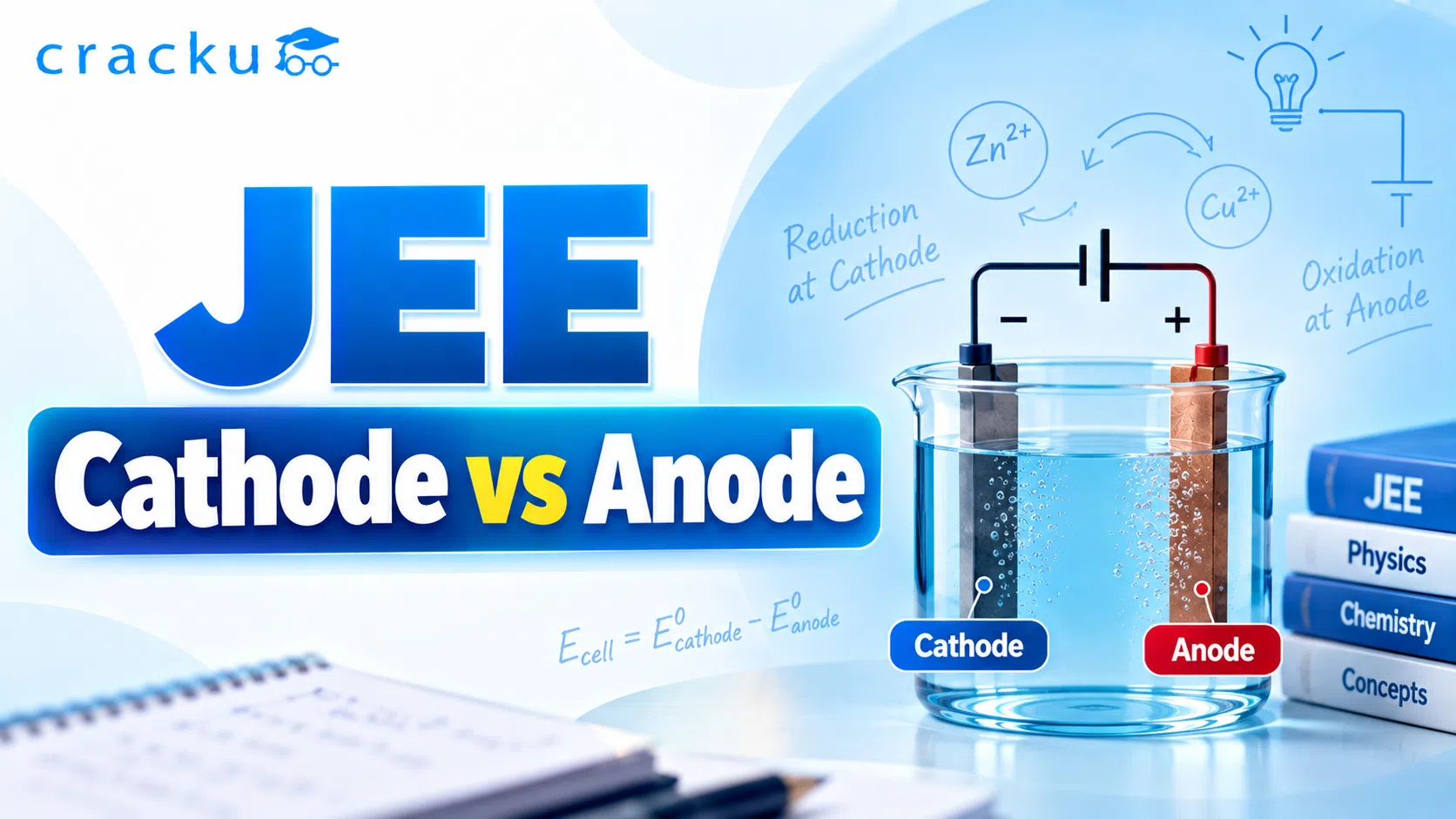
The Difference Between Cathode and Anode reduces to one rule that never changes: reduction occurs at the cathode and oxidation occurs at the anode, whatever the device. What trips students up is the sign, because the cathode is negative in a cathode ray tube and an electrolytic cell but positive in a galvanic cell. This article fixes the definitions, the polarity in each device, and the calculations JEE actually asks.
What are Cathode and Anode?
An electrode is a conductor through which current enters or leaves a non-metallic medium such as an electrolyte, a gas, or a vacuum. The two electrodes are named by the chemical process happening on them, not by their charge.
Anode: the electrode where oxidation takes place. Species lose electrons here, so electrons leave the cell through the anode and move into the external circuit.
Cathode: the electrode where reduction takes place. Species gain electrons here, so electrons enter the cell at the cathode from the external circuit.
Two mnemonics keep this straight. AN OX means ANode: OXidation, and RED CAT means REDuction: CAThode. For circuit direction, ACID means Anode Current Into Device: conventional current enters a passive device at its anode.
Key Differences Between Cathode and Anode
| Property | Cathode | Anode |
|---|---|---|
| Defining process | Reduction: gain of electrons | Oxidation: loss of electrons |
| Electron movement | Electrons enter the cell here from the external circuit | Electrons leave the cell here into the external circuit |
| Conventional current inside electrolyte | Current arrives at the cathode | Current leaves the anode |
| Ions attracted | Cations such as $$Cu^{2+}$$, $$H^{+}$$, $$Na^{+}$$ | Anions such as $$Cl^{-}$$, $$OH^{-}$$, $$SO_4^{2-}$$ |
| Sign in a galvanic (voltaic) cell | Positive | Negative |
| Sign in an electrolytic cell | Negative | Positive |
| Sign in a vacuum tube, CRT or X-ray tube | Negative, emits electrons | Positive, collects electrons |
| Semiconductor diode terminal | n-side | p-side |
| Typical product in electrolysis of aqueous $$CuSO_4$$ with inert electrodes | Copper metal deposits | Oxygen gas is liberated |
| Mass change during electroplating | Object gains mass as metal plates on it | Sacrificial metal anode loses mass |
Sign Convention Across Devices: Where Students Lose Marks
The circuit decides the polarity of an electrode, while the reaction decides its name. Memorise the reaction rule and derive the sign every time.
| Device | Cathode is | Anode is | Reason |
|---|---|---|---|
| Galvanic cell (Daniell cell, dry cell) | Positive terminal | Negative terminal | Spontaneous reaction pushes electrons out of the anode, so the anode is the electron-rich terminal |
| Electrolytic cell (electrolysis, electroplating, charging a battery) | Negative terminal | Positive terminal | An external source drives electrons onto the cathode and pulls them from the anode |
| Cathode ray tube, diode valve, X-ray tube | Negative, heated emitter | Positive target or plate | Free electrons must be repelled from the emitter and accelerated toward a higher potential |
| p-n junction diode | n-region lead | p-region lead | Forward bias means the anode is held at the higher potential |
Notice that a rechargeable cell swaps labels between discharging and charging. During discharge it behaves as a galvanic cell; during charging the same physical plate that was the anode becomes the cathode. Solving mixed-circuit problems from a bank of JEE Questions is the fastest way to stop guessing polarity and start deriving it.
Electron Flow, Current Direction and Faraday's Laws
Inside the electrolyte, positive ions drift toward the cathode and negative ions drift toward the anode, so the conventional current inside the cell runs from anode to cathode. The quantity of charge decides how much substance is deposited or liberated.
$$m = \dfrac{M I t}{n F}$$
Here $$M$$ is the molar mass in g/mol, $$I$$ the current in amperes, $$t$$ the time in seconds, $$n$$ the number of electrons per ion, and $$F = 96500$$ C/mol is the Faraday constant. The same expression is often written as $$m = Z I t$$, where $$Z = M/(nF)$$ is the electrochemical equivalent.
Worked example (cathode deposition): a current of 2 A flows for 30 minutes through aqueous copper sulphate.
- Charge: $$Q = I t = 2 \times 1800 = 3600$$ C
- For $$Cu^{2+} + 2e^- \rightarrow Cu$$, $$n = 2$$ and $$M = 63.5$$ g/mol
- $$m = \dfrac{63.5 \times 3600}{2 \times 96500} \approx 1.18$$ g of copper on the cathode
Worked example (anode to cathode acceleration): in a vacuum tube an electron released at rest from the cathode is accelerated through 1000 V.
- $$eV = \dfrac{1}{2} m v^2$$, so $$v = \sqrt{\dfrac{2eV}{m}}$$
- $$v = \sqrt{\dfrac{2 \times 1.6 \times 10^{-19} \times 1000}{9.1 \times 10^{-31}}} \approx 1.9 \times 10^{7}$$ m/s
In an X-ray tube the same accelerated electrons strike the anode target, and the shortest wavelength produced follows $$\lambda_{\min} = \dfrac{hc}{eV}$$, which gives about 0.31 Å at 40 kV. Keeping these three relations together on one page of your JEE Formula Sheets saves rework, because examiners like to combine electrolysis with a tube calculation in the same set.
Also Read: JEE Resistance vs Resistivity: Differences & Examples
Similarities Between Cathode and Anode
- Both are electrodes: conductors that transfer charge between a circuit and an electrolyte, gas or vacuum.
- Both host half-reactions, and the two half-reactions must transfer the same number of electrons in a balanced cell.
- Both carry the same current, since the circuit is a series loop.
- Neither label depends on the sign of the terminal; the labels always come from oxidation and reduction.
- Both can be made of the same material, as in the refining of copper where a crude copper anode dissolves and pure copper plates onto the cathode.
- Both follow Faraday's laws, so the charge passed fixes the mass change at each of them.
JEE Exam Perspective
Electrode identification rarely comes as a standalone question in Physics. It appears embedded inside three familiar areas:
- Current electricity and chemical effects of current: numericals on Faraday's laws, electrochemical equivalent, and time needed for a given deposit.
- Dual nature of matter and radiation: accelerating potential, electron speed, de Broglie wavelength, X-ray cutoff wavelength, and the direction of the cathode ray beam in electric or magnetic fields.
- Semiconductor electronics: reading diode symbols, deciding forward or reverse bias, and tracing current through a rectifier.
Assertion-reason and statement-based items frequently test the statement "the cathode is always negative", which is false. Scanning the electrostatics and modern physics sets in JEE Mains Previous Papers shows how often the examiner reuses this exact trap with a different device attached. If you are building a structured revision plan around such high-yield traps, guided JEE Mains Online Coaching keeps the electrochemistry and modern physics overlap in one thread instead of two disconnected chapters.
Also Read: JEE Scalar Quantity Vs Vector Quantity, Differences & Examples
JEE Cathode vs Anode: Conclusion
Fix the reaction rule first: oxidation at the anode, reduction at the cathode, electrons out at the anode and in at the cathode. Then read the circuit to decide the sign, because the cathode is positive only in a spontaneous galvanic cell and negative everywhere an external source is doing the driving. Pair that logic with Faraday's law and the accelerating-potential equation, and this topic becomes a guaranteed two-mark pickup rather than a coin toss.
.webp)