

 Group
Group
 Group
Group
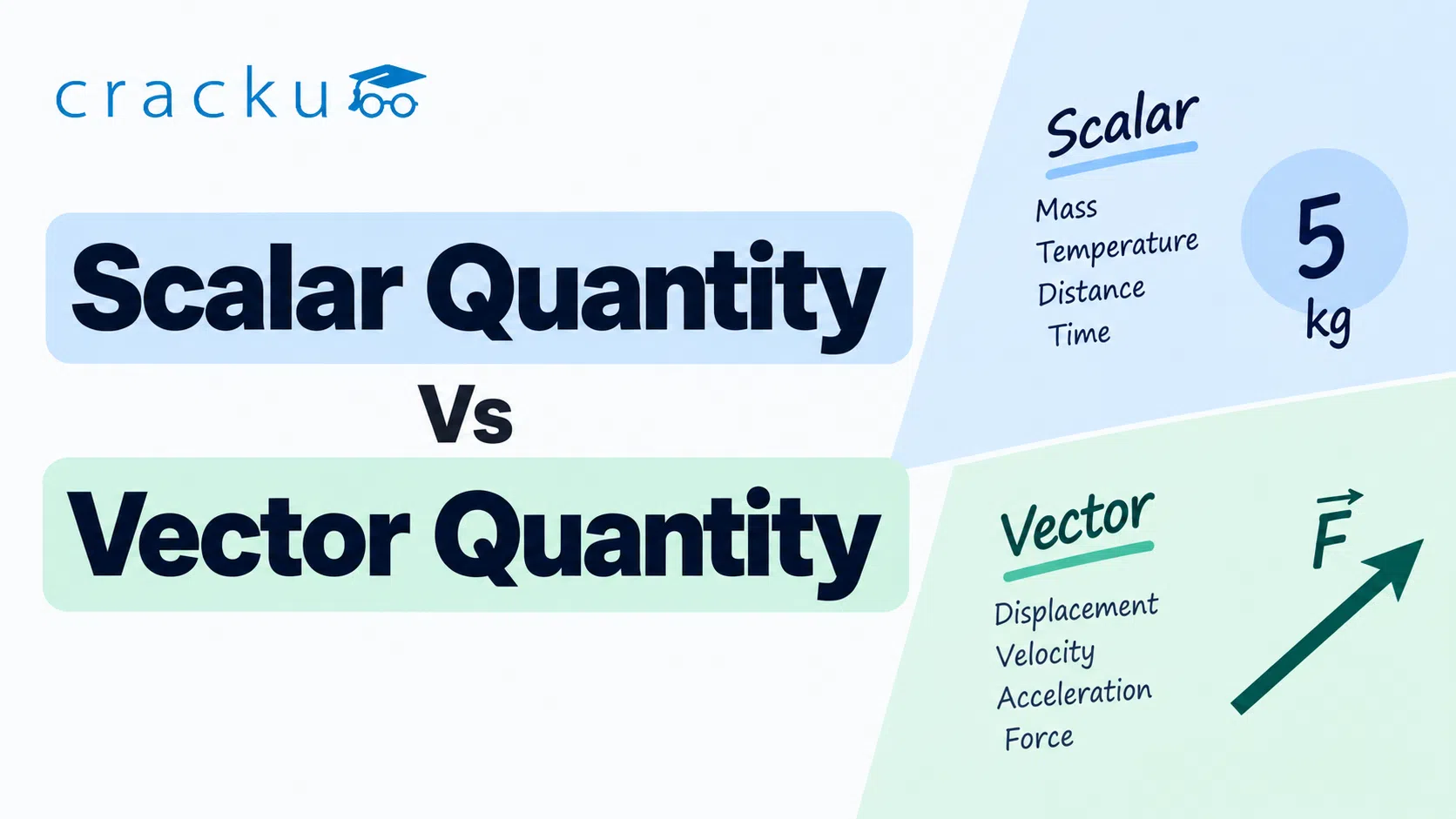
Scalar Quantity Vs Vector Quantity
The difference between scalar and vector quantity is the first idea you meet in JEE Physics, and it quietly decides whether your kinematics, force and work-energy answers come out right. A scalar is fully described by a magnitude with a unit; a vector needs a magnitude, a unit and a direction, and it must add by the triangle law. Get this classification wrong and you will add 3 N and 4 N to get 7 N when the answer is 5 N. The sections below cover definitions, notation, algebra, exam traps and the exact points examiners like to test.
What are Scalar and Vector Quantities?
A scalar quantity is a physical quantity that is completely specified by a single number together with a unit. Mass, time, temperature, distance, speed, work, energy, power, charge, density, pressure and electric current are scalars. Saying "the mass is 2 kg" leaves nothing else to state.
A vector quantity needs both a magnitude and a direction, and it must obey the rules of vector addition. Displacement, velocity, acceleration, force, momentum, impulse, torque, electric field, magnetic field and angular velocity are vectors. Saying "the force is 10 N" is incomplete; you must say "10 N along the positive x-axis".
The direction requirement alone is not enough. Electric current has a sense of flow, yet it is treated as a scalar because currents at a junction add algebraically, not by the parallelogram law. Finite angular rotations also have direction but do not commute, so they are not vectors either. The real test is the addition rule, not the presence of an arrow.
Quick sorting list
- Scalars: distance, speed, mass, time, temperature, work, energy, power, pressure, current, potential, frequency, area (in elementary treatment).
- Vectors: displacement, velocity, acceleration, force, weight, momentum, impulse, torque, angular momentum, electric field, magnetic field, dipole moment.
Key Differences Between Scalar and Vector Quantity
| Property | Scalar Quantity | Vector Quantity |
|---|---|---|
| Specification | Magnitude and unit only | Magnitude, unit and direction |
| Notation | Plain italic symbol, such as $$m$$, $$t$$, $$W$$ | Arrow or bold symbol, such as $$\vec{F}$$, $$\vec{v}$$ |
| Addition rule | Ordinary algebra: $$2 + 3 = 5$$ | Triangle or parallelogram law, depends on the angle |
| Equality condition | Equal if the numerical values match | Equal only if both magnitude and direction match |
| Meaning of a negative sign | Indicates a value below the reference, as in $$-10^\circ$$C | Indicates reversal of direction, same magnitude |
| Resolution into components | Not possible | Resolves as $$A_x = A\cos\theta$$, $$A_y = A\sin\theta$$ |
| Multiplication | One product, ordinary multiplication | Two products: dot product and cross product |
| Division | Division by a scalar is defined | Division by a vector is not defined |
| Effect of rotating the axes | Value is unchanged | Components change, magnitude is unchanged |
| Zero element | The number zero | Null vector $$\vec{0}$$, with arbitrary direction |
| Typical examples | Speed 20 m/s, work 50 J, mass 5 kg | Velocity 20 m/s north, force 50 N upward |
| Change in one dimension | Only magnitude can change | Magnitude, direction or both can change |
Notation, Representation and Unit Vectors
A vector is drawn as a directed line segment whose length is proportional to the magnitude and whose arrowhead gives the direction. Its magnitude is written as
$$|\vec{A}| = A \ge 0$$
The magnitude of a vector is itself a scalar, and it can never be negative. The associated unit vector carries the direction alone:
$$\hat{A} = \frac{\vec{A}}{|\vec{A}|}, \qquad |\hat{A}| = 1$$
In Cartesian form, with $$\hat{i}$$, $$\hat{j}$$, $$\hat{k}$$ along the x, y and z axes,
$$\vec{A} = A_x\hat{i} + A_y\hat{j} + A_z\hat{k}$$
$$|\vec{A}| = \sqrt{A_x^{2} + A_y^{2} + A_z^{2}}$$
Scalars have no such structure. Work done is simply $$W = 50$$ J, and no axis system can split it into parts. Keeping your notation consistent between the arrow form and the component form removes most sign errors in problems, and the vector pages of the JEE Formula Sheets are a fast way to confirm the standard symbols before a mock test.
Standard vector types worth memorising
- Equal vectors: same magnitude, same direction.
- Negative vector: same magnitude, opposite direction, so $$\vec{A} + (-\vec{A}) = \vec{0}$$.
- Collinear vectors: parallel or antiparallel, angle is $$0^\circ$$ or $$180^\circ$$.
- Coplanar vectors: all lie in one plane; any two vectors are always coplanar.
- Position vector: drawn from the origin to a point, written as $$\vec{r} = x\hat{i} + y\hat{j} + z\hat{k}$$.
Vector Algebra Versus Scalar Algebra
Scalars follow the arithmetic you already know: add the numbers, mind the units, done. Vectors follow a different set of laws, and the single most important one is the resultant of two vectors separated by angle $$\theta$$.
$$|\vec{A} + \vec{B}| = \sqrt{A^{2} + B^{2} + 2AB\cos\theta}$$
The direction of this resultant, measured from $$\vec{A}$$, is
$$\tan\alpha = \frac{B\sin\theta}{A + B\cos\theta}$$
Two useful consequences: the resultant is largest when $$\theta = 0^\circ$$ and smallest when $$\theta = 180^\circ$$, so
$$|A - B| \le |\vec{A} + \vec{B}| \le A + B$$
Worked example: same numbers, different answers
Take forces of magnitude 3 N and 4 N.
- Scalar-style sum (wrong for forces): $$3 + 4 = 7$$
- At $$\theta = 90^\circ$$: $$\sqrt{9 + 16} = 5$$ N
- At $$\theta = 60^\circ$$: $$\sqrt{9 + 16 + 2(3)(4)(0.5)} = \sqrt{37} \approx 6.08$$ N
- At $$\theta = 180^\circ$$: $$4 - 3 = 1$$ N
Only when the vectors are collinear does vector addition look like ordinary addition. Practise resultants for angles other than $$0^\circ$$, $$90^\circ$$ and $$180^\circ$$, because those cases expose a weak grip on the parallelogram law, and a mixed set of JEE Mains Questions on vector addition makes the pattern obvious within a few attempts.
Products: how scalars and vectors mix
| Operation | Formula | Result type | Physical example |
|---|---|---|---|
| Scalar times vector | $$\vec{p} = m\vec{v}$$ | Vector | Momentum |
| Dot product | $$\vec{A}\cdot\vec{B} = AB\cos\theta$$ | Scalar | Work, flux, power |
| Cross product | $$|\vec{A}\times\vec{B}| = AB\sin\theta$$ | Vector | Torque, magnetic force |
| Vector divided by scalar | $$\vec{a} = \vec{F}/m$$ | Vector | Acceleration |
Two numerical checks. A force of 10 N acting on a body displaced 2 m at $$60^\circ$$ to the force does work $$W = (10)(2)\cos 60^\circ = 10$$ J, a scalar. A force of 5 N applied perpendicular to a spanner at 0.2 m from the pivot gives torque of magnitude $$(5)(0.2)\sin 90^\circ = 1$$ N m, a vector directed along the axis of rotation.
Similarities Between Scalar and Vector Quantity
- Both are physical quantities with definite units and dimensions, so both obey dimensional homogeneity in every equation.
- Both carry a magnitude; the magnitude of a vector is a scalar.
- Both can be zero, and zero is physically meaningful in each case.
- Both can be multiplied by a pure number and both follow the same rules of unit conversion.
- Both appear together in a single relation, as in $$\vec{F} = m\vec{a}$$, where mass is a scalar and force and acceleration are vectors.
- Equations of either type must be dimensionally consistent, and only like quantities may be equated: a scalar can never equal a vector.
Distance and displacement: one motion, two quantities
Walk 4 m east, then 3 m north. The distance covered is $$4 + 3 = 7$$ m, a scalar. The displacement has magnitude $$\sqrt{4^{2} + 3^{2}} = 5$$ m directed at $$\tan^{-1}(3/4) = 36.87^\circ$$ north of east. If the total time is 5 s, the average speed is $$7/5 = 1.4$$ m/s while the magnitude of average velocity is $$5/5 = 1$$ m/s. The scalar value is never smaller than the vector magnitude, which is why average speed is greater than or equal to the magnitude of average velocity.
JEE Exam Perspective
Scalars and vectors sit in the Units, Dimensions and Basic Mathematics block of the JEE Main syllabus, and they feed directly into Kinematics, Laws of Motion, Work-Energy, Rotation, Electrostatics and Magnetism. Direct questions in JEE Main usually take one of three shapes.
- Classification: pick the scalar or vector from a list. Current, pressure, potential and flux are the usual traps.
- Resultant or range: find the resultant of two vectors, or the possible magnitudes of a sum, often using the inequality on the range.
- Product identification: decide whether a given physical quantity comes from a dot product or a cross product, then use $$\cos\theta$$ or $$\sin\theta$$ accordingly.
JEE Advanced rarely asks the definition outright but leans on vector handling in relative motion, constrained motion, torque and field problems where the wrong sign convention destroys the whole solution. Scanning the kinematics and vectors portions of JEE Mains Previous Papers makes clear how often the examiner tests the label itself rather than a long calculation.
Errors that cost marks
- Adding force or velocity magnitudes arithmetically without checking the angle.
- Treating electric current as a vector because it has a direction of flow.
- Calling pressure a vector because it is force divided by area; pressure is a scalar in fluid statics.
- Writing a negative magnitude for a vector instead of reversing the unit vector.
- Equating average speed with the magnitude of average velocity when the path is curved.
- Using $$\cos\theta$$ in a torque calculation or $$\sin\theta$$ in a work calculation.
Scalar Quantity Vs Vector Quantity: Conclusion
Scalars and vectors are fundamental concepts in JEE Physics. A scalar quantity has only magnitude and a unit, while a vector quantity has both magnitude and direction. Understanding their differences, addition rules, and products helps you solve problems in kinematics, force, work-energy, and rotational motion. Remember to classify physical quantities correctly, apply the appropriate vector laws, and avoid common mistakes in calculations to build a strong foundation for JEE Main and Advanced.