Group
Group
 Group
Group


 Preferred Source

 Google Discover
JEE Heat vs Temperature
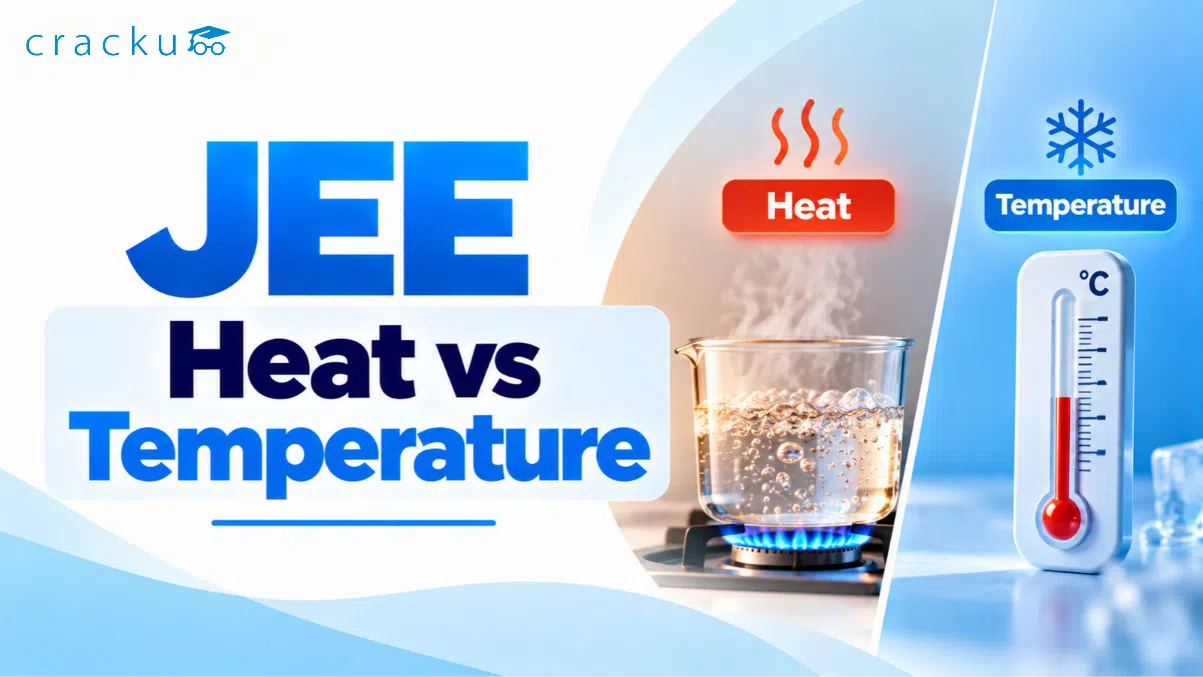
The Difference Between Heat and Temperature is one of those basics that JEE quietly tests inside calorimetry, thermodynamics and kinetic theory questions every year. Heat is energy that moves between two bodies because they are at different temperatures, while temperature is the quantity that decides which way that energy moves. Students who blur the two end up writing wrong energy balances in mixing problems and wrong signs in first-law questions. This guide separates the two cleanly, with formulas, worked numbers and the exam angle.
What are Heat and Temperature?
Heat is energy in transit. It is the energy transferred across the boundary of a system purely because of a temperature difference, and it stops the moment the temperature difference vanishes. Its SI unit is the joule (J), and the older unit is the calorie, with $$1$$ cal $$= 4.186$$ J.
A body never "contains" heat. What it contains is internal energy, the sum of the kinetic and potential energies of its molecules. Heat is one of the two ways (the other being work) of changing that internal energy, as stated by the first law:
$$\Delta U = Q - W$$
Temperature measures the degree of hotness of a body and, at the microscopic level, the average translational kinetic energy of its molecules. For an ideal gas, the average translational kinetic energy per molecule is
$$\bar{K} = \frac{3}{2}k_B T$$
where $$k_B = 1.38 \times 10^{-23}$$ J/K. Temperature is a state variable: it has a definite value at every instant, independent of how the system reached that state. Its SI unit is the kelvin (K).
Key Differences Between Heat and Temperature
The table below collects the distinctions that actually decide answers in objective questions.
| Property | Heat | Temperature |
|---|---|---|
| Physical meaning | Energy transferred due to a temperature difference | Measure of average translational kinetic energy of molecules |
| Nature of quantity | Form of energy in transit | Degree of hotness; a thermodynamic state variable |
| SI unit | joule (J); also calorie, erg | kelvin (K); also °C and °F |
| Usual symbol | $$Q$$ (or $$\delta Q$$ for small transfer) | $$T$$ (kelvin) or $$t$$ (celsius) |
| Path or state function | Path function; depends on the process followed | State function; depends only on the present state |
| Dependence on mass | Extensive: doubling the mass doubles the heat needed for the same rise | Intensive: independent of the amount of substance |
| Measured with | Calorimeter (indirectly, from mass, specific heat and temperature change) | Thermometer, thermocouple, pyrometer |
| Direction rule | Always flows from the body at higher temperature to the one at lower temperature | Decides the direction of flow; does not itself flow |
| Behaviour at phase change | Continues to be absorbed or released as latent heat | Stays constant throughout melting or boiling |
| Zero value | Zero when there is no transfer, as in an adiabatic process | Absolute zero is $$0$$ K, where molecular translational motion ceases |
| Sign convention | Positive when supplied to the system, negative when rejected | Kelvin temperature is never negative |
Three quick takeaways: a large iceberg has far more internal energy than a cup of boiling water, yet heat still flows from the cup to the iceberg; heat is measured in joules, temperature in kelvin, so they can never appear on the same side of an equation as like terms; and adding heat does not guarantee a temperature rise.
Specific Heat, Latent Heat and Calorimetry
The bridge between the two quantities is specific heat capacity. For a body of mass $$m$$ and specific heat $$c$$ whose temperature changes by $$\Delta T$$ without a phase change:
$$Q = mc\,\Delta T$$
This single relation shows why the two are not interchangeable. Equal heat given to equal masses produces very different temperature rises if $$c$$ differs.
Worked example: Supply $$2090$$ J each to $$100$$ g of water ($$c = 4180$$ J/kg·K) and $$100$$ g of copper ($$c = 385$$ J/kg·K).
- Water: $$\Delta T = \dfrac{2090}{0.1 \times 4180} = 5$$ K
- Copper: $$\Delta T = \dfrac{2090}{0.1 \times 385} \approx 54.3$$ K
Same heat, temperature changes differing by more than a factor of ten. During a phase change the link breaks completely, because
$$Q = mL$$
Melting $$1$$ kg of ice at $$0$$ °C needs $$3.34 \times 10^{5}$$ J, and the temperature stays pinned at $$0$$ °C for the whole process. Keeping the specific heat and latent heat values of water, ice and common metals at your fingertips speeds up calorimetry sums, and a consolidated set of JEE Mains Formula Sheets is handy when you revise these constants along with the heat transfer relations.
Mixing example: Mix $$100$$ g of water at $$80$$ °C with $$300$$ g of water at $$20$$ °C in an ideal calorimeter. Heat lost equals heat gained:
$$0.1 \times 4180 \times (80 - T) = 0.3 \times 4180 \times (T - 20)$$
This gives $$T = 35$$ °C, with $$18810$$ J transferred. Note that heat is the conserved bookkeeping quantity here; temperature is not. The average of $$80$$ and $$20$$ is $$50$$, which is not the answer, because the masses are unequal.
Temperature Scales, Thermal Equilibrium and Heat Flow
Temperature has scales; heat does not. Conversions you must be fluent with:
| Conversion | Relation |
|---|---|
| Celsius to kelvin | $$T_K = t_C + 273.15$$ |
| Celsius to fahrenheit | $$t_F = \frac{9}{5}t_C + 32$$ |
| General linear scale | $$\frac{X - X_{ice}}{X_{steam} - X_{ice}}$$ is the same fraction on every scale |
A useful check: $$-40$$ °C equals $$-40$$ °F, the only point where the two scales read alike. Also remember that a temperature difference of $$1$$ °C equals $$1$$ K exactly, which is why $$c$$ can be quoted in J/kg·K or J/kg·°C without change.
The zeroth law of thermodynamics states that if A is in thermal equilibrium with C and B is in thermal equilibrium with C, then A and B are in thermal equilibrium with each other. Equilibrium means equal temperature and zero net heat transfer, which is exactly what makes temperature measurable by a thermometer.
Heat transfer itself is governed by temperature differences in all three modes:
- Conduction: $$\frac{dQ}{dt} = \frac{kA(T_1 - T_2)}{L}$$
- Radiation (Stefan-Boltzmann): $$P = \sigma e A T^4$$
- Newton's law of cooling: $$\frac{dT}{dt} = -k(T - T_s)$$
In each case the rate of heat flow is driven by temperature, which reinforces the cause-and-effect relationship between the two. Practising mixed conceptual problems where the answer depends on temperature rather than on total energy content is worthwhile, and the topic-wise JEE Questions contains plenty of such items from thermal physics.
Similarities Between Heat and Temperature
- Both are scalar quantities with no direction in the vector sense.
- Both belong to thermal physics and are linked through specific heat capacity.
- Both appear in the same equation set: calorimetry, the first law and kinetic theory.
- Both are zero-referenced to physical situations: no heat flow at thermal equilibrium, no molecular translational motion at absolute zero.
- Both influence the state of a substance, deciding melting, boiling and thermal expansion.
- Neither can be measured directly by counting; both are inferred from observable effects such as expansion, resistance change or emf.
Also Read: JEE Resistance vs Resistivity: Differences & Examples
JEE Exam Perspective
Thermal physics contributes roughly two to three questions in a typical JEE Main paper, spread across calorimetry, the first law, kinetic theory and heat transfer. Direct one-liners asking for the difference are rare; instead the distinction is embedded in the numerical work.
Common traps to watch:
- Assuming the final temperature is the average. Valid only when masses and specific heats are identical.
- Ignoring latent heat. If the mixture crosses $$0$$ °C or $$100$$ °C, check whether the phase change completes before continuing with $$mc\Delta T$$.
- Sign of $$Q$$ in the first law. With $$\Delta U = Q - W$$, heat supplied is positive and work done by the gas is positive; in an isothermal process $$\Delta T = 0$$ and $$\Delta U = 0$$, so $$Q = W$$, a clean demonstration that heat can flow without any temperature change.
- Confusing internal energy with heat. Internal energy is a state function of temperature for an ideal gas; heat is not.
- Using celsius inside fourth-power or ratio formulas. Radiation and gas-law problems need kelvin.
Tracking how examiners rotate these traps is easier once you solve the thermal physics questions from several years of JEE Mains Previous Papers in one sitting and compare the sign conventions used.
Also Read: JEE Scalar Quantity Vs Vector Quantity, Differences & Examples
Conclusion
Heat is energy on the move, measured in joules, dependent on the process and on the mass of the body. Temperature is a state property, measured in kelvin, independent of mass, and it alone decides the direction of heat flow. The equations $$Q = mc\Delta T$$ and $$Q = mL$$ show how they are related and where the relation breaks. Fix this distinction early, and calorimetry, thermodynamics and heat transfer questions become bookkeeping exercises rather than conceptual hurdles.
.webp)