Join WhatsApp Icon JEE WhatsApp Group
JEE Magnetic Effects of Current Questions

Magnetic Effects of Current, often studied as Moving Charges and Magnetism, is a core chapter in the Electrodynamics unit of JEE Physics. It explains how moving charges and currents produce magnetic fields and how those fields exert forces on charges and conductors. Because it blends vector reasoning with field calculations, JEE Magnetic Effects of Current questions are reliably tested in both JEE Main and JEE Advanced and reward students who master the geometry of magnetic fields. This chapter covers the magnetic force on charges and currents, motion of charged particles in magnetic fields, the Biot-Savart law, Ampere's circuital law, magnetic fields due to wires, loops, and solenoids, the force between parallel currents, torque on current loops, and the moving-coil galvanometer. JEE Main typically tests field calculations and forces, while JEE Advanced often combines magnetism with mechanics or geometry. Practising topic-wise JEE Questions helps you handle vector directions and field integrals with confidence.

A strong grasp of this chapter sets up electromagnetic induction and alternating currents, where changing magnetic fields take centre stage. The chapter rewards students who keep right-hand rules and vector cross products straight and who recognise when symmetry allows Ampere's law to replace lengthy integration.
Magnetic Effects of Current Topic Overview

Parameter

Details

Topic Name

Magnetic Effects of Current (Moving Charges and Magnetism)

Subject

Physics

JEE Main Weightage

~4–6% (2–3 questions on average)

JEE Advanced Weightage

~5–7% (often combined)

Difficulty Level

Moderate to High

Important Concepts

Magnetic Force, Biot-Savart Law, Ampere's Law, Solenoids, Torque on Loops

Recommended Practice Level

High – attempt 70+ mixed problems

Why Practice JEE Magnetic Effects of Current Questions?

  • High weightage: This chapter contributes 2–3 questions in JEE Main most years.
  • Sets up induction: It is the foundation for EMI and alternating currents.
  • Vector skill builder: Cross products and right-hand rules sharpen vector reasoning.
  • Strong in Advanced: Charged-particle motion and field geometry are JEE Advanced favourites.
  • Symmetry rewards: Ampere's law turns symmetric problems into quick solutions.
  • Concept-rich: Forces, fields, and torques build deep electromagnetic intuition.
  • Reliable field questions: Standard configurations yield consistent, scoring problems.

Important Concepts and Subtopics

Concept

Importance

Difficulty Level

Frequently Asked In

Magnetic Force on Charges (Lorentz Force)

Very High

Moderate

JEE Main & Advanced

Motion of Charges in Magnetic Fields

Very High

Moderate–High

JEE Main & Advanced

Biot-Savart Law

High

Moderate–High

JEE Main & Advanced

Ampere's Circuital Law

Very High

Moderate

JEE Advanced

Field due to Wires, Loops & Solenoids

Very High

Moderate

JEE Main & Advanced

Force Between Parallel Currents

High

Moderate

JEE Main

Torque on Current Loops & Galvanometer

High

Moderate

JEE Main & Advanced

Preparation Strategy for JEE Magnetic Effects of Current

Concept learning: Begin with the Lorentz force and the motion of charged particles in uniform fields, including circular and helical paths. Learn the Biot-Savart law for field calculations and Ampere's law for symmetric cases. Then study fields due to standard configurations and the torque on current loops.

Formula revision: Keep the Lorentz-force expression, Biot-Savart and Ampere's law forms, standard field results, and torque relations together for quick review. Well-organised JEE Study Material helps you keep these formulas and their geometric conditions in one place for fast revision before the exam.

Problem-solving techniques: Use right-hand rules consistently to fix directions. Apply Ampere's law whenever symmetry allows, reserving Biot-Savart integration for non-symmetric cases. For charged-particle motion, separate velocity components parallel and perpendicular to the field.

Common mistakes: Direction errors in cross products, misapplying Ampere's law to non-symmetric configurations, confusing the fields of a loop and a solenoid, and forgetting that magnetic force does no work.

Exam strategy: Solve direct force and standard-field questions first, then attempt charged-particle-motion and integration problems that need more setup. When magnetism combines with mechanics, resolve the force geometry before writing equations of motion.

JEE Main & Advanced Weightage Analysis

Exam

Average Questions

Expected Marks

JEE Main

2–3

8–12

JEE Advanced

2–3 (often combined)

8–16

Magnetic Effects of Current is a consistently heavy chapter in JEE Main and a frequent source of charged-particle and field-geometry problems in JEE Advanced. Mastery here directly supports the induction and AC chapters that follow.

Tips to Solve Magnetic Effects of Current Questions Faster

  • Apply right-hand rules consistently to fix the directions of force and field.
  • Use Ampere's law for symmetric configurations to avoid lengthy integration.
  • For charged-particle motion, split velocity into components along and across the field.
  • Remember magnetic force does no work, so speed stays constant in a pure magnetic field.
  • Use standard results for wires, loops, and solenoids instead of re-deriving them.
  • For force between parallel wires, recall like currents attract and unlike currents repel.

Reinforcing these techniques with a timed JEE Mock Test builds the directional fluency that magnetism problems reward.

JEE Magnetic Effects of Current Questions

Question 1

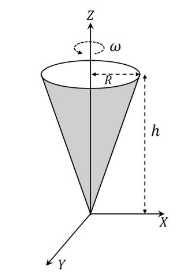
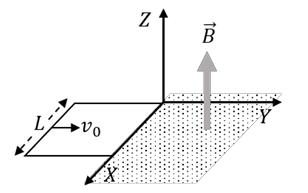
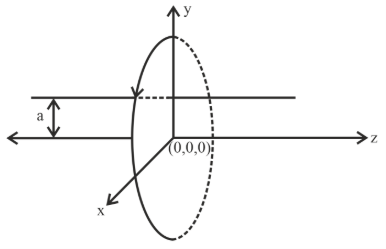
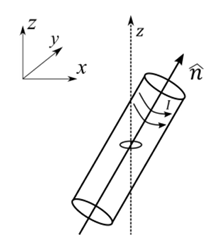
A hollow, right circular cone of base radius $$R$$ and height $$h$$, with its tip at the origin is rotating about the $$Z$$-axis with an angular velocity $$\omega$$, as shown in the figure. The cone carries a total charge $$Q$$ uniformly distributed on its curved surface. The magnitude of magnetic field at a point $$(0,0,z)$$, where $$z\gg R$$ and $$z\gg h$$, is $$\dfrac{n\mu_0}{4\pi}\dfrac{QR^2\omega}{z^3}$$. The value of $$n$$ is:

image
Question 2

A particle having charge $$10^{-9}$$ C moving in the x-y plane in fields of $$0.4\hat{j}$$ N/C and $$4 \times 10^{-3}\hat{k}$$ T experiences a force of $$(4\hat{i} + 2\hat{j}) \times 10^{-10}$$ N. The velocity of the particle at that instant is :

Question 3

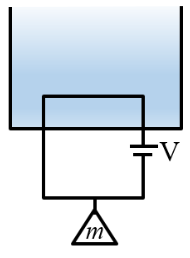
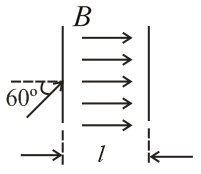
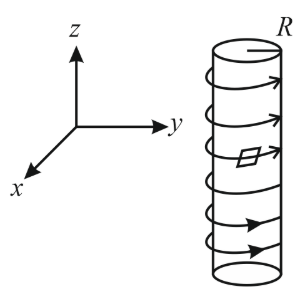
A current carrying solenoid is placed vertically and a particle of mass m with charge Q is released from rest. The particle moves along the axis of solenoid. lf g is acceleration due to gravity then the acceleration (n) of the charged particle will satisfy :

Question 4

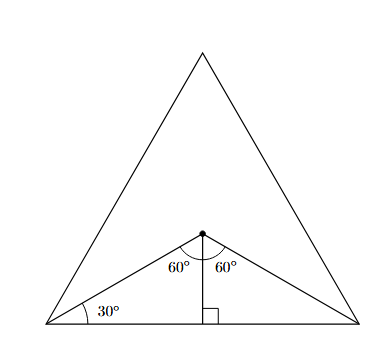
The current passing through a conducting loop in the form of equilateral triangle of side $$4\sqrt{3}$$ cm is 2A. The magnetic field at its centroid is $$\alpha\times10^{-5}T.$$ The value of $$\alpha$$ is______.
(Given :$$\mu_{o}=4\pi\times 10^{-7} SI$$ units)

Video Solution
Question 5

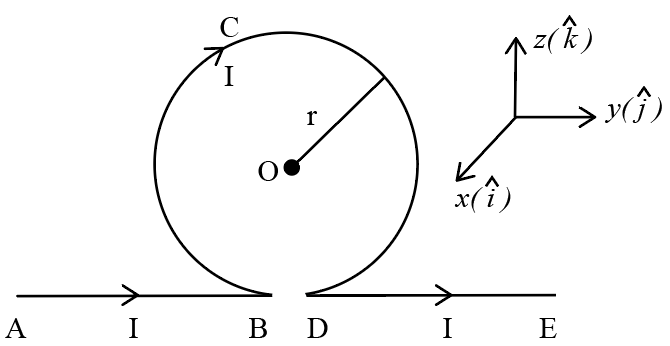
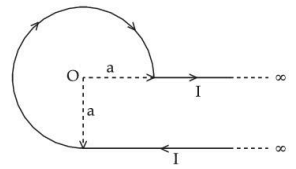
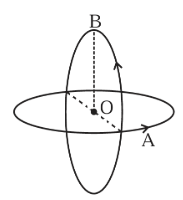
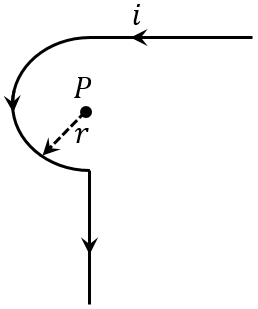
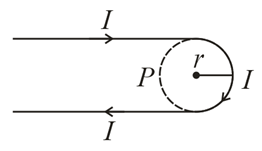
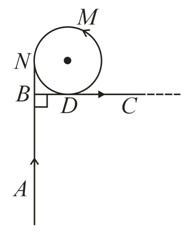
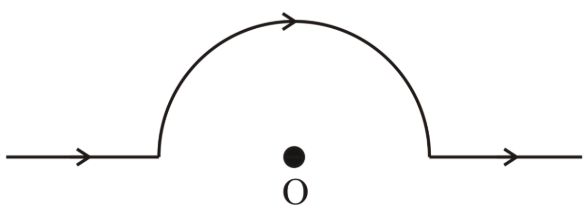
An infinitely long straight wire carrying current I is bent in a planer shape as shown in the diagram. The radius of the circular part is r. The magnetic field at the centre O of the circular loop is :

34 slot 2
Question 6

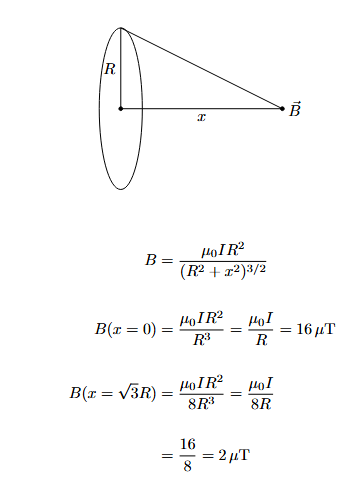
The magnetic field at the centre of a current carrying circular loop of radius R is $$16\mu T$$. The magnetic field at a distance $$x = \sqrt{3}R$$ on its axis from the centre is______$$\mu T$$.

Question 7
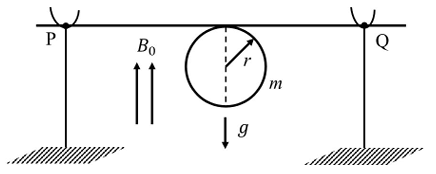
image

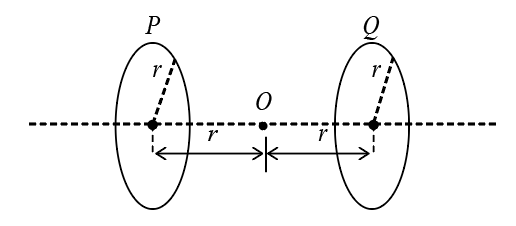
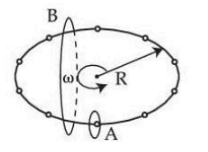
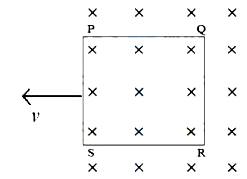
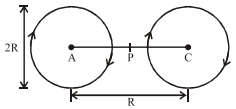
Two identical circular loops P and Q each of radius r are lying in parallel planes such that they have common axis. The current through P and Q are I and 4I respectively in clockwise direction as seen from 0 . The net magnetic field at O is:

Question 8

A long cylindrical conductor with large cross section carries an electric current distributed uniformly over its cross-section. Magnetic field due to this current is:
A. maximum at either ends of the conductor and minimum at the midpoint
B. maximum at the axis of the conductor
C. minimum at the surface of the conductor
D. minimum at the axis of the conductor
E. same at all points in the cross-section of the conductor
Choose the correct answer from the options given below :

Question 9

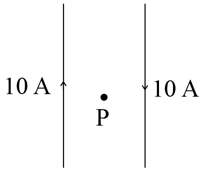
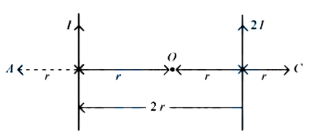
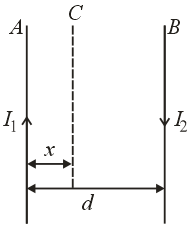
A current of 30 A each flows in opposite directions in two conducting wires, placed parallel to each other at a distance of 8 cm. The magnetic field at the mid point between the two wires is __________ $$\mu$$T. ($$\dfrac{\mu_0}{4\pi} = 10^{-7}$$ N/A$$^2$$)

Question 10

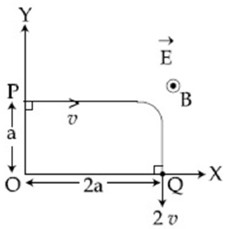
A particle of charge $$q$$ and mass $$m$$ is projected  from origin with an initial velocity has $$\vec{v} = \frac{v_0}{\sqrt{2}}\hat{x} + \frac{v_0}{\sqrt{2}}\hat{y}$$. There exists a uniform magnetic field $$\vec{B} = B_0\hat{z}$$ and a space varying electric field $$\vec{E} = E_0 e^{-\lambda x}\hat{x}$$ within the region $$0 \leq x \leq L$$. After travelling a distance such that x-coordinate has changed from $$x=0$$ to $$x=L$$, the change in the kinetic energy  is_________.

Question 11

A current carrying circular loop of radius 2 cm with unit normal $$\hat{n} = \frac{\hat{k} + \hat{i}}{\sqrt{2}}$$ is placed in a magnetic field, $$\vec{B} = B_0(3\hat{i} + 2\hat{k})$$. If $$B_0 = 4 \times 10^{-3}$$ T and current $$I = 100\sqrt{2}$$ A, the torque experienced by the loop is __________ Wb.A. ($$\pi = 3.14$$)

Question 12

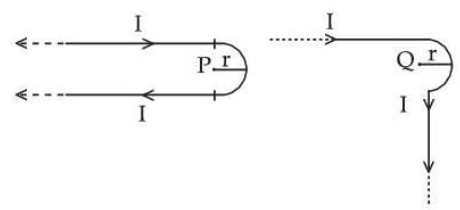
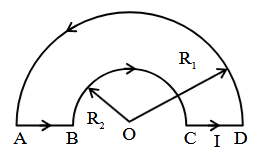
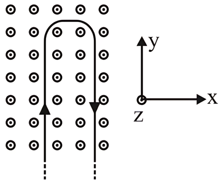
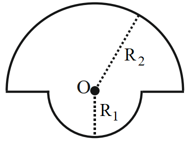
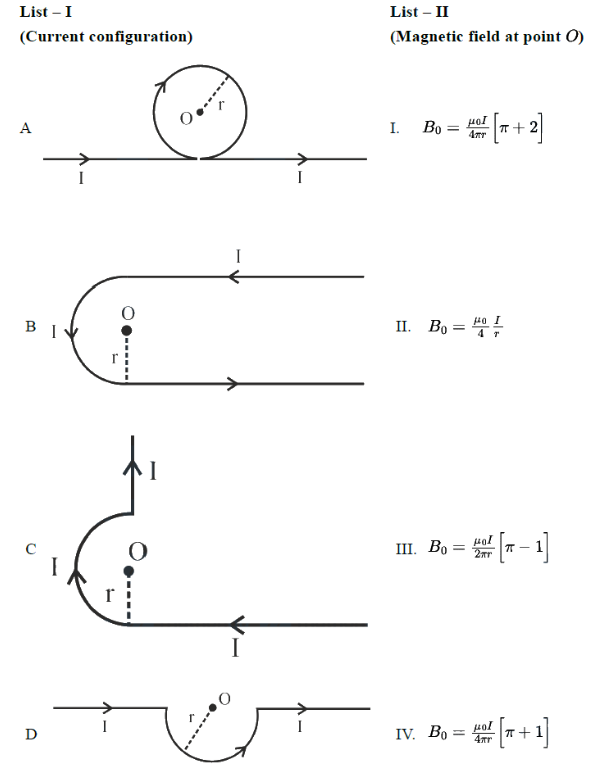
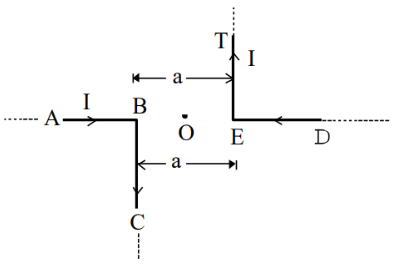
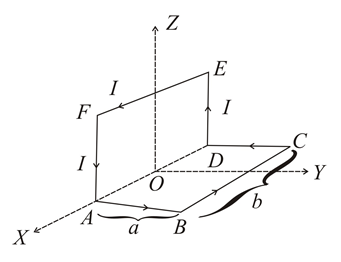
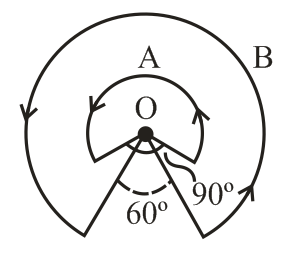
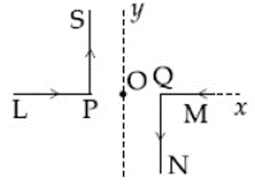
Two identical long current carrying wires are bent into the shapes shown in the following figures. If the magnitude of magnetic fields at the centres P and Q of a semicircular arc are B$$_1$$ and B$$_2$$ respectively, then the ratio $$\frac{B_1}{B_2}$$ is __________.

image
Question 13

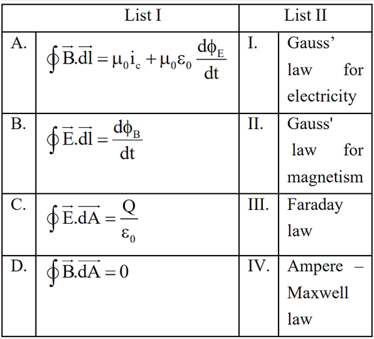
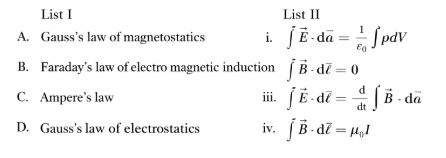
Matd1 List - I with List - II.
atd1 List - I with List - II.
List - I List - II
Relation Law
A. $$\oint\overrightarrow{E}.\overrightarrow{dl}=-\frac{d}{dt}\oint\overrightarrow{B}.\overrightarrow{da}$$ I. Ampere's circuital law
B. $$\oint\overrightarrow{B}.\overrightarrow{dl}=\mu_{\circ}\left(I+\epsilon_{\circ}\frac{d\phi_{E}}{dt}\right)$$ II. Faraday's laws of electromagnetic induction
C. $$\oint\overrightarrow{E}.\overrightarrow{da}=\frac{1}{\epsilon_{\circ}}\int_{v}^{} \rho dv$$ III. Ampere - Maxwell law
D. $$\oint\overrightarrow{B}.\overrightarrow{dl}=\mu_{\circ}I$$ IV. Gauss's law of electrostatics
Choose the correct answer from the options given below :

Question 14

An insulated wire is wound so that it forms a flat coil with $$N = 200$$ turns. The radius of the innermost turn is $$r_1 = 3$$ cm, and of the outermost turn $$r_2 = 6$$ cm. If 20 mA current flows in it then the magnetic moment will be $$\alpha \times 10^{-2}$$ A·m². The value of $$\alpha$$ is :

Question 15

A conducting circular loop of area $$1.0m^{2}$$ is placed perpendicular to a magnetic field which varies as $$B = \sin(100 t)$$ Tesla. If the resistance of the loop is $$100 \Omega$$, then the average thermal energy dissipated in the loop in one period is _______J.

Question 16

A small cube of side 1 mm is placed at the centre of a circular loop of radius 10 cm carrying a current of 2 A. The magnetic energy stored inside the cube is $$\alpha \times 10^{-14}$$ J. The value of $$\alpha$$ is _______.
$$(\mu_0 = 4\pi \times 10^{-7}$$ Tm/A, $$\pi = 3.14)$$

Question 17

A moving coil galvanometer of resistance $$100\Omega$$ shows a full scale deflection for a current of 1 mA. The value of resistance required to convert this galvanometer into an ammeter, showing full scale deflection for a current of 5 mA, is ____ $$\Omega$$

Question 18

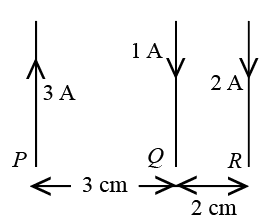
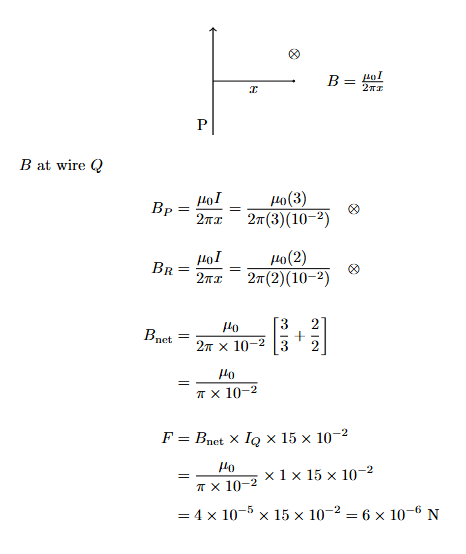
Three long straight wires carrying current are arranged mutually parallel as shown in the figure. The force experienced by 15 cm length of wire Q is_______.

44


$$(\mu_{\circ} =4\pi \times 10^{-7} T.m/A)$$

Question 19

1 $$\mu$$C charge moving with velocity $$\vec{v} = \left(\hat{i} - 2\hat{j} + 3\hat{k}\right)$$ m/s in the region of magnetic field $$\vec{B} = \left(2\hat{i} + 3\hat{j} - 5\hat{k}\right)$$ T. The magnitude of force acting on it is $$\sqrt{\alpha} \times 10^{-6}$$ N. The value of $$\alpha$$ is __________.

Question 20

A 5 mg particle carrying a charge of $$5\pi \times 10^{-6}$$ C is moving with velocity of $$(3\hat{i} + 2\hat{k}) \times 10^{-2}$$ m/s in a region having magnetic field $$\vec{B} = 0.1 \hat{k}$$ Wb/m$$^2$$. It moves a distance of $$a$$ meter along $$\hat{k}$$ when it completes 5 revolutions. The value of $$a$$ is __________.

Question 21

A circular coil of radius 2 cm and 125 turns carries a current of 1 A. The coil is placed in a uniform magnetic field of magnitude 0.4 T. The axis of the coil makes an angle of 30° with the direction of the magnetic field. The torque acting on the coil is $$\alpha \times 10^{-4}$$ N.m. The value of $$\alpha$$ is ______.

($$\pi = 3.14$$)

Question 22

The charged particle moving in a uniform magnetic field of $$(3\hat{i} + 2\hat{j})$$ T has an acceleration $$\left(4\hat{i} - \frac{x}{2}\hat{j}\right)$$ m/s$$^2$$. The value of $$x$$ is

Question 23

In a vacuum chamber, a particle of charge $$1\,\mu\mathrm{C}$$ and mass $$1\,\mathrm{mg}$$ is projected with a velocity $$(\hat{i}+2\hat{j})\,\mathrm{ms^{-1}}$$ from the $$XZ$$ plane at time $$t=0$$ in an electric field of $$1\hat{i}\,\mathrm{Vm^{-1}}$$. At $$t=0.2\,\mathrm{s}$$, the electric field is switched off and a magnetic field of $$6\hat{j}\,\mathrm{T}$$ is switched on. The acceleration due to gravity is $$-10\hat{j}\,\mathrm{ms^{-2}}$$. Correct option(s) is/are:

Frequently Asked Questions