
Join Our JEE Preparation Group
Prep with like-minded aspirants; Get access to free daily tests and study material.
Sign in
Please select an account to continue using cracku.in
↓ →
Join Our JEE Preparation Group
Prep with like-minded aspirants; Get access to free daily tests and study material.
A particle having charge $$10^{-9}$$ C moving in the x-y plane in fields of $$0.4\hat{j}$$ N/C and $$4 \times 10^{-3}\hat{k}$$ T experiences a force of $$(4\hat{i} + 2\hat{j}) \times 10^{-10}$$ N. The velocity of the particle at that instant is :
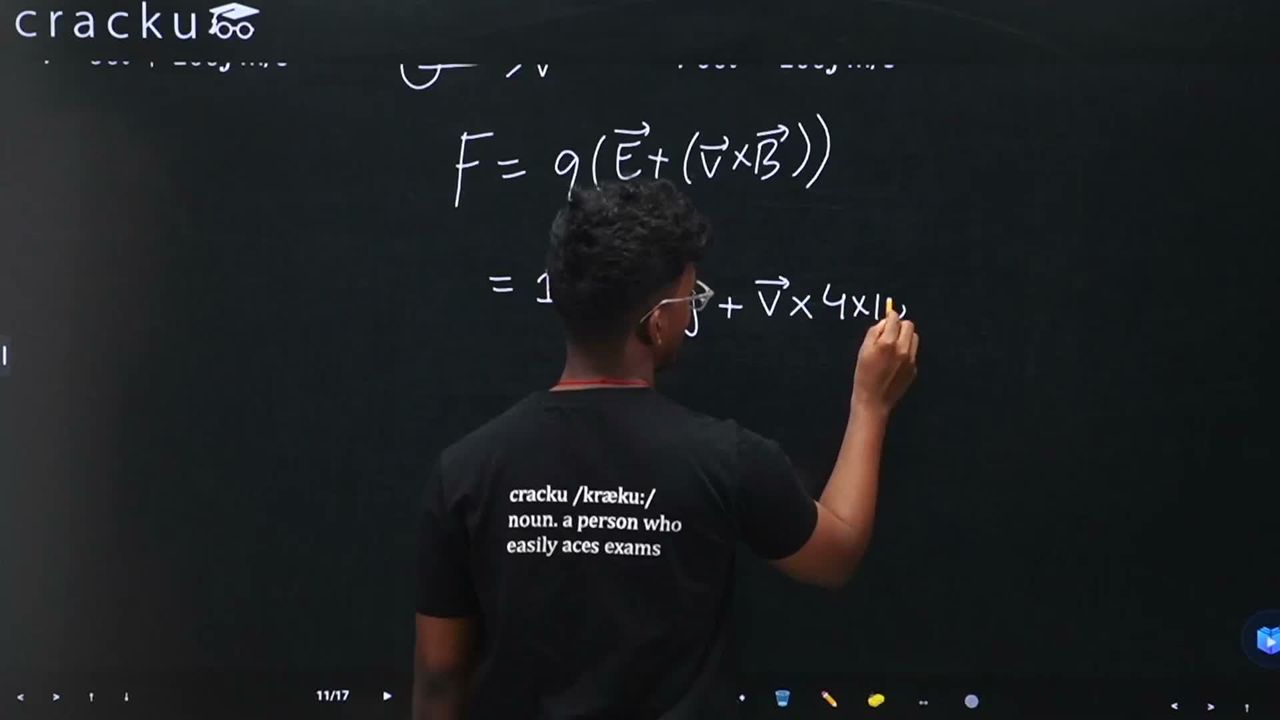
The net Lorentz force on a charged particle is given by
$$\mathbf{F}=q\left(\mathbf{E}+\mathbf{v}\times\mathbf{B}\right)$$
Given data:
Charge $$q = 10^{-9}\,{\rm C}$$
Electric field $$\mathbf{E}=0.4\,\hat{\jmath}\,{\rm N\,C^{-1}}$$
Magnetic field $$\mathbf{B}=4\times10^{-3}\,\hat{k}\,{\rm T}$$
Force $$\mathbf{F}=(4\hat{\imath}+2\hat{\jmath})\times10^{-10}\,{\rm N}$$
Let the velocity in the x-y plane be $$\mathbf{v}=v_x\hat{\imath}+v_y\hat{\jmath}$$. Its cross-product with $$\mathbf{B}$$ (which is along $$\hat{k}$$) is
$$\mathbf{v}\times\mathbf{B}=(v_x\hat{\imath}+v_y\hat{\jmath})\times(B\hat{k})$$ $$\qquad =B\bigl(v_y\hat{\imath}-v_x\hat{\jmath}\bigr)$$ Substituting $$B=4\times10^{-3}\,{\rm T}$$,
$$\mathbf{v}\times\mathbf{B}=4\times10^{-3}\bigl(v_y\hat{\imath}-v_x\hat{\jmath}\bigr).$$
Add the electric field: $$\mathbf{E}+\mathbf{v}\times\mathbf{B}=0.4\hat{\jmath}+4\times10^{-3}(v_y\hat{\imath}-v_x\hat{\jmath}).$$
Now apply $$\mathbf{F}=q(\mathbf{E}+\mathbf{v}\times\mathbf{B})$$ component-wise.
i-component: $$q\,(4\times10^{-3}v_y)=4\times10^{-10}$$ $$\Rightarrow (10^{-9})(4\times10^{-3})v_y=4\times10^{-10}$$ $$\Rightarrow 4\times10^{-12}v_y=4\times10^{-10}$$ $$\Rightarrow v_y=100\,{\rm m/s}.$$
j-component: $$q\left(0.4-4\times10^{-3}v_x\right)=2\times10^{-10}$$ $$\Rightarrow (10^{-9})\left(0.4-4\times10^{-3}v_x\right)=2\times10^{-10}$$ $$\Rightarrow 0.4-4\times10^{-3}v_x=0.2$$ $$\Rightarrow 4\times10^{-3}v_x=0.2$$ $$\Rightarrow v_x=\frac{0.2}{4\times10^{-3}}=50\,{\rm m/s}.$$
Therefore $$\mathbf{v}=50\hat{\imath}+100\hat{\jmath}\;{\rm m/s}.$$
Option A which is: $$50\hat{\imath}+100\hat{\jmath}\;{\rm m/s}$$
Was this solution helpful?
Click on the Email ☝️ to Watch the Video Solution
Create a FREE account and get:
_1.webp)

Educational materials for JEE preparation

Ask our AI anything

AI can make mistakes. Please verify important information.
AI can make mistakes. Please verify important information.
