
Join Our JEE Preparation Group
Prep with like-minded aspirants; Get access to free daily tests and study material.
Sign in
Please select an account to continue using cracku.in
↓ →
Join Our JEE Preparation Group
Prep with like-minded aspirants; Get access to free daily tests and study material.
Two blocks of masses 2 kg and 1 kg respectively, are tied to the ends of a string which passes over a light frictionless pulley as shown in the figure. The masses are held at rest at the same horizontal level and then released. The distance traversed by the centre of mass in 2 s is _________ m. (Take $$g = 10$$ m/s$$^2$$)
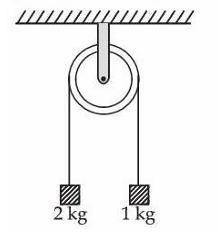
Let the heavier block have mass $$m_1 = 2\; \text{kg}$$ and the lighter block have mass $$m_2 = 1\; \text{kg}$$. The system is an ideal Atwood machine (light, inextensible string and light, frictionless pulley).
Step 1 - Acceleration of the system
For an Atwood machine, the magnitude of the common acceleration is
$$a = \frac{(m_1 - m_2) g}{m_1 + m_2}$$
$$\Rightarrow a = \frac{(2 - 1)\,g}{2 + 1} = \frac{g}{3} = \frac{10}{3}\;\text{m s}^{-2}$$
The 2 kg block accelerates downward, the 1 kg block upward, both with the same magnitude $$a$$.
Step 2 - Individual displacements in 2 s
Starting from rest, the distance travelled in time $$t$$ under constant acceleration $$a$$ is
$$s = \frac{1}{2}\,a\,t^{2}$$
For $$t = 2\;\text{s}$$,
$$s = \frac{1}{2}\,\left(\frac{10}{3}\right)\,(2)^{2} = \frac{1}{2}\,\left(\frac{10}{3}\right)\,4 = \frac{20}{3}\;\text{m} \approx 6.67\;\text{m}$$
Thus, after 2 s:
• the 2 kg block has moved $$+s$$ (downward)
• the 1 kg block has moved $$-s$$ (upward)
Step 3 - Position of the centre of mass
Choose the initial horizontal level as origin and take downward as positive.
The centre-of-mass coordinate after 2 s is
$$y_{\text{cm}} = \frac{m_1 y_1 + m_2 y_2}{m_1 + m_2}$$
$$\Rightarrow y_{\text{cm}} = \frac{\,2(+s) + 1(-s)}{2 + 1} = \frac{(2 - 1)s}{3} = \frac{s}{3}$$
Substituting $$s = \frac{20}{3}\;\text{m}$$:
$$y_{\text{cm}} = \frac{1}{3}\left(\frac{20}{3}\right) = \frac{20}{9}\;\text{m} \approx 2.22\;\text{m}$$
The centre of mass has shifted downward by $$\mathbf{2.22\;m}$$ in 2 s.
Option C which is: $$2.22$$
Click on the Email ☝️ to Watch the Video Solution
Create a FREE account and get:
_1.webp)

Educational materials for JEE preparation

Ask our AI anything

AI can make mistakes. Please verify important information.
AI can make mistakes. Please verify important information.


