
Join Our JEE Preparation Group
Prep with like-minded aspirants; Get access to free daily tests and study material.
Sign in
Please select an account to continue using cracku.in
↓ →
Join Our JEE Preparation Group
Prep with like-minded aspirants; Get access to free daily tests and study material.
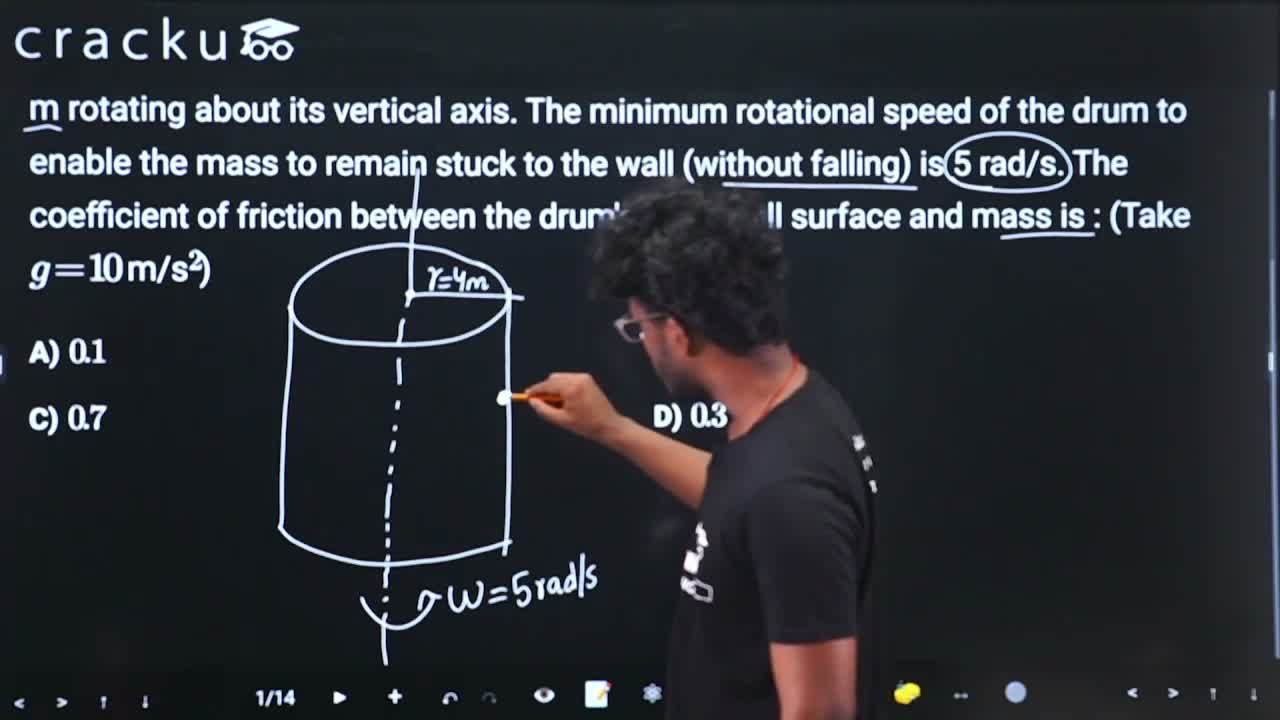
A 0.5 kg mass is in contact against the inner wall of a cylindrical drum of radius 4 m rotating about its vertical axis. The minimum rotational speed of the drum to enable the mass to remain stuck to the wall (without falling) is 5 rad/s. The coefficient of friction between the drum's inner wall surface and mass is : (Take $$g = 10$$ m/s$$^2$$)
Let the mass of the block be $$m = 0.5 \text{ kg}$$ and the radius of the cylindrical drum be $$r = 4 \text{ m}$$.
The drum rotates with a minimum angular speed $$\omega = 5 \text{ rad s}^{-1}$$ so that the block just stays stuck to the wall without sliding down.
1. Identify the forces on the block
• Weight acts vertically downward: $$mg$$.
• Normal reaction from the wall acts horizontally towards the axis: $$N$$.
• Static friction acts vertically upward (opposing the possible downward motion): $$f_s$$, with the limiting value $$f_{\max} = \mu N$$.
2. Centripetal force requirement
The normal reaction is the only horizontal force and therefore provides the necessary centripetal force:
$$N = m\omega^{2}r \quad -(1)$$
3. Condition for vertical equilibrium
At the minimum speed, static friction is at its limiting value and exactly balances the weight:
$$f_{\max} = mg \quad\Longrightarrow\quad \mu N = mg \quad -(2)$$
4. Substitute $$N$$ from (1) into (2)
$$\mu \bigl(m\omega^{2}r\bigr) = mg$$
$$\mu = \frac{mg}{m\omega^{2}r} = \frac{g}{\omega^{2}r}$$
5. Insert the numerical values
$$\mu = \frac{10}{(5)^{2} \times 4} = \frac{10}{25 \times 4} = \frac{10}{100} = 0.1$$
Hence, the coefficient of friction between the block and the drum is $$0.1$$.
Option A which is: 0.1
Click on the Email ☝️ to Watch the Video Solution
Create a FREE account and get:
_1.webp)

Educational materials for JEE preparation

Ask our AI anything

AI can make mistakes. Please verify important information.
AI can make mistakes. Please verify important information.


