
 Group
Group
 Group
Group


 Preferred Source

 Google Discover
JEE Line vs Line Segment
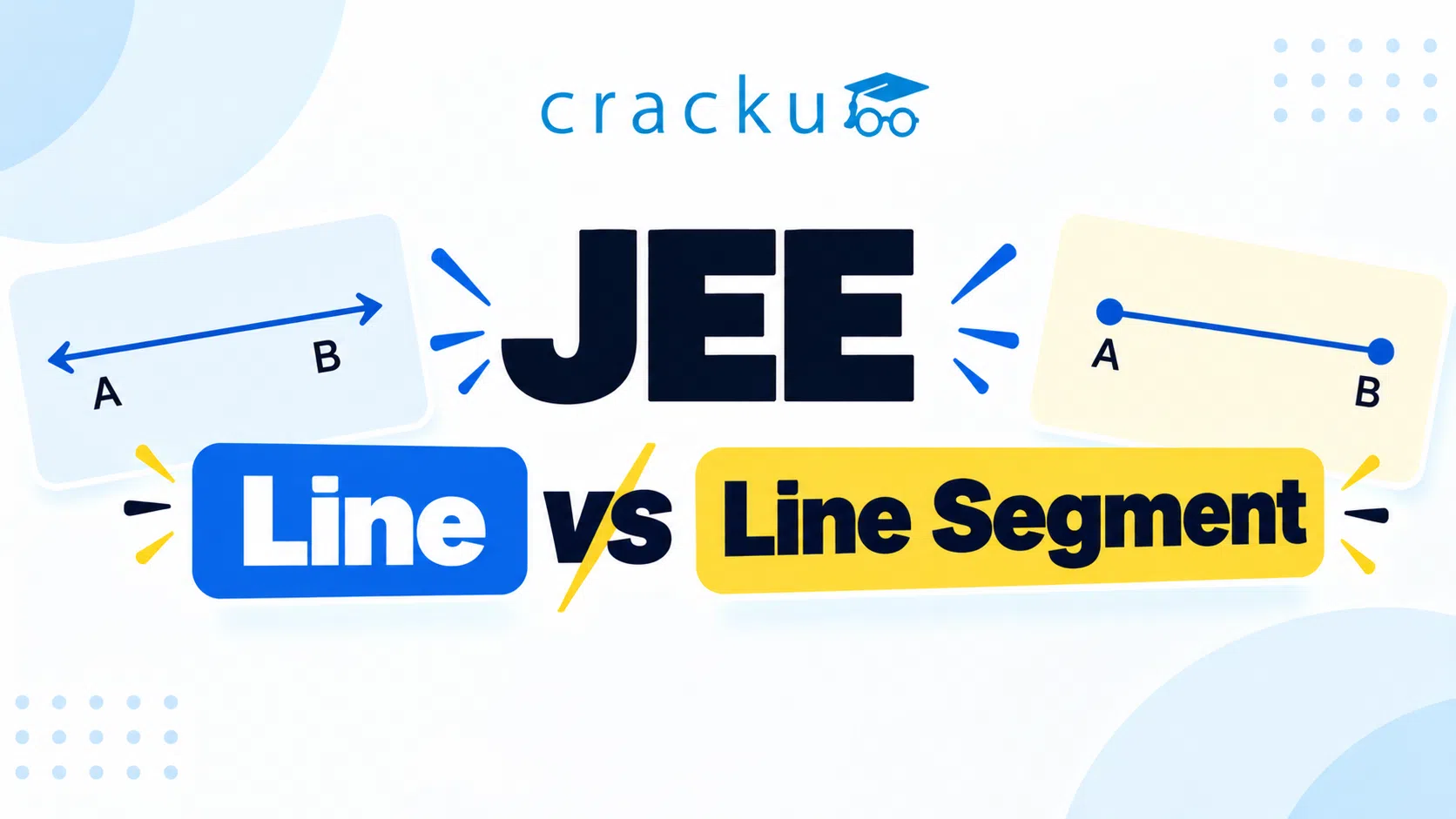
The Difference Between Line and Line Segment comes down to one idea: a line runs without end in both directions, while a line segment is the bounded piece of that line between two fixed endpoints. In JEE coordinate geometry this distinction decides whether a parameter is free or restricted, whether length is defined, and whether two objects actually meet. Most students lose marks not on the equation of a line but on missing the restriction that a segment imposes. This comparison fixes the concept with formulas, a worked example and exam-level usage.
What are a Line and a Line Segment?
A line is a one-dimensional figure with no thickness that extends infinitely in both directions. It has no endpoints, no length, and is completely determined by any two distinct points on it. The line through points $$A$$ and $$B$$ is written $$\overleftrightarrow{AB}$$.
A line segment is the portion of a line lying between two endpoints, both of which belong to the segment. It has a definite, finite length and is written $$\overline{AB}$$. A ray, written $$\overrightarrow{AB}$$, sits between the two: one endpoint, infinite in the other direction.
- Line: $$\overleftrightarrow{AB}$$, unbounded on both sides.
- Segment: $$\overline{AB}$$, bounded on both sides.
- Ray: $$\overrightarrow{AB}$$, bounded on one side only.
Key Differences Between Line and Line Segment
| Property | Line | Line Segment |
|---|---|---|
| Definition | Set of points extending endlessly in both directions | Set of points between and including two endpoints |
| Endpoints | None | Exactly two |
| Length | Undefined (infinite) | Finite, given by $$\sqrt{(x_2-x_1)^2+(y_2-y_1)^2}$$ |
| Notation | $$\overleftrightarrow{AB}$$ or simply $$L$$ | $$\overline{AB}$$ |
| Vector form | $$\vec{r}=\vec{a}+\lambda(\vec{b}-\vec{a}),\ \lambda\in\mathbb{R}$$ | $$\vec{r}=(1-\lambda)\vec{a}+\lambda\vec{b},\ 0\le\lambda\le1$$ |
| Parameter range | Unrestricted | Restricted to a closed interval |
| Midpoint | Not defined | $$\left(\dfrac{x_1+x_2}{2},\dfrac{y_1+y_2}{2}\right)$$ |
| Can be measured | No | Yes, in metres, units or cm |
| Can be drawn fully | No, only a part is drawn with arrowheads | Yes, complete figure fits on paper |
| Typical JEE use | Equation of straight line, family of lines, angle and distance problems | Section formula, triangle sides, chords, intersection tests |
Equations, Parameters and Representation
Both objects satisfy the same Cartesian equation. The difference lives entirely in the domain of the parameter.
Equation of a line in 2D:
$$ax+by+c=0$$
Parametric (distance) form through $$(x_1,y_1)$$ with inclination $$\theta$$:
$$x=x_1+r\cos\theta,\qquad y=y_1+r\sin\theta$$
For a line, $$r$$ takes every real value. For the segment from $$(x_1,y_1)$$ of length $$d$$ in that direction, $$r$$ is confined to $$0\le r\le d$$. The single formula that separates the two objects is the convex-combination form:
$$\vec{r}=(1-\lambda)\vec{a}+\lambda\vec{b}$$ gives the segment $$\overline{AB}$$ when $$0\le\lambda\le1$$, and the entire line $$\overleftrightarrow{AB}$$ when $$\lambda\in\mathbb{R}$$.
In 3D the same logic applies to $$\dfrac{x-x_1}{a}=\dfrac{y-y_1}{b}=\dfrac{z-z_1}{c}=\lambda$$, where restricting $$\lambda$$ carves out a segment. Revising the symmetric, parametric and vector forms side by side stops you from mixing them under time pressure, and a condensed set of JEE Formula Sheets keeps all the straight-line representations on one page.
Length, Midpoint and Section Formula
Every metric result in this chapter belongs to the segment, not the line. A line has no length, no midpoint and no perpendicular bisector of its own; the perpendicular bisector is always of a segment.
- Length: $$AB=\sqrt{(x_2-x_1)^2+(y_2-y_1)^2}$$
- Midpoint: $$\left(\dfrac{x_1+x_2}{2},\dfrac{y_1+y_2}{2}\right)$$
- Internal division in ratio $$m:n$$: $$\left(\dfrac{mx_2+nx_1}{m+n},\dfrac{my_2+ny_1}{m+n}\right)$$
- External division in ratio $$m:n$$: $$\left(\dfrac{mx_2-nx_1}{m-n},\dfrac{my_2-ny_1}{m-n}\right)$$
Worked example. For $$A(2,-1)$$ and $$B(6,2)$$, the length is $$\sqrt{(6-2)^2+(2+1)^2}=\sqrt{16+9}=5$$ units, and the midpoint is $$(4,\ 0.5)$$. Note that the point dividing $$\overline{AB}$$ externally in ratio $$3:1$$ is $$(8,\ 3.5)$$, which lies on the line $$\overleftrightarrow{AB}$$ but outside the segment. External division always produces a point off the segment, and that is exactly where sign errors creep in. Drilling both cases through a filtered bank of JEE Questions on straight lines makes the convention automatic.
Intersection: Where the Distinction Actually Bites
Two non-parallel lines always meet at exactly one point. Two segments lying on those same lines may not meet, because the intersection can fall outside one or both segments.
Standard test. Let $$L(x,y)=ax+by+c$$. The line $$L(x,y)=0$$ meets the segment joining $$P(x_1,y_1)$$ and $$Q(x_2,y_2)$$ if and only if
$$L(P)L(Q)\le 0.$$
A negative product means the line crosses between the endpoints. If one value is zero, the line meets the segment at that endpoint. If both are zero, the entire segment lies on the line. When the line crosses between the endpoints, the ratio of division is $$-\dfrac{L(P)}{L(Q)}$$.
Example. Does $$3x-2y+1=0$$ cut the segment joining $$A(1,1)$$ and $$B(-1,3)$$?
- $$L(A)=3(1)-2(1)+1=2$$
- $$L(B)=3(-1)-2(3)+1=-8$$
- The product is $$-16<0$$, so the line crosses the segment between its endpoints.
- The ratio is $$-\dfrac{2}{-8}=\dfrac{1}{4}$$. Thus, it divides $$\overline{AB}$$ internally in the ratio $$1:4$$ at $$\left(\dfrac{3}{5},\dfrac{7}{5}\right)$$.
Substituting this point into the line equation gives $$3\left(\tfrac{3}{5}\right)-2\left(\tfrac{7}{5}\right)+1=0$$, confirming the result.
Similarities Between Line and Line Segment
- Both are one-dimensional sets of collinear points with zero width.
- Both satisfy the same equation $$ax+by+c=0$$; only the parameter range differs.
- Both have the same slope $$m=\dfrac{y_2-y_1}{x_2-x_1}$$ and the same direction ratios.
- A segment is a subset of a line; extending a segment indefinitely both ways produces the line.
- Angle between two segments equals the angle between their parent lines, found from $$\tan\theta=\left|\dfrac{m_1-m_2}{1+m_1m_2}\right|$$.
- Both can be parallel, perpendicular or coincident under the same conditions.
JEE Exam Perspective
Straight lines carry steady weightage in JEE Main, usually one to two questions, and the segment version of a concept appears far more often than the pure-line version in applied problems.
- Section formula and centroid: medians, incentre and centroid problems are all segment-based.
- Same side or opposite side: region problems, family of lines and locus questions use the sign test above.
- Triangle and quadrilateral geometry: sides are segments, so length, ratio and midpoint conditions apply.
- Vectors and 3D: position vector of a dividing point uses $$0\le\lambda\le1$$; forgetting the bound gives extra, invalid answers.
- Conics: a chord is a segment, a tangent is a line; latus rectum length is a segment length.
A frequent trap: a question asks for the point on a segment nearest to a given point. If the foot of the perpendicular falls outside the segment, the nearest point is an endpoint, not the foot. Working through JEE Mains Previous Papers on coordinate geometry shows how regularly the examiner hides a bound like this inside a longer problem.
JEE Line vs Line Segement : Conclusion
A line extends indefinitely in both directions, while a line segment has two endpoints and a finite length. This difference determines whether length and midpoint formulas apply. In coordinate geometry, points on a segment satisfy the equation of its parent line, but only points within the endpoint bounds belong to the segment.
When solving JEE questions, identify whether the figure is a line, ray or segment before using a formula. If the question specifies a segment, check that your final point lies between its endpoints. This simple step is especially useful in intersection, section formula and shortest-distance problems.