

 Group
Group
 Group
Group


 Preferred Source

 Google Discover
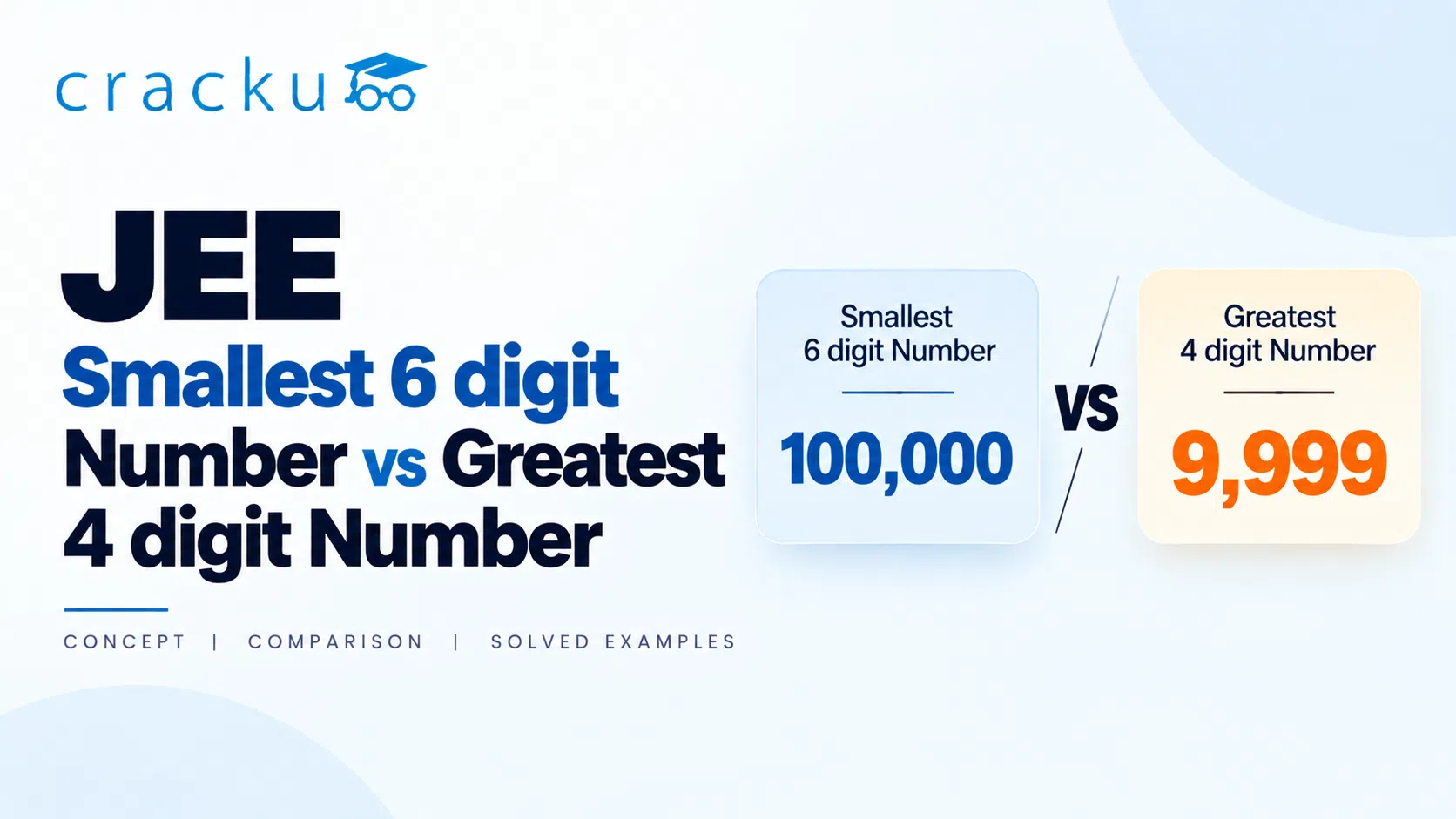
JEE Smallest 6 digit Number vs Greatest 4 digit Number
The Indian school curriculum fixes clear cutoffs for the length of a whole number. A 6-digit number starts at 1,00,000 and a 4-digit number tops out at 9,999. Therefore:
- Smallest 6-digit number: 1,00,000 (one lakh).
- Greatest 4-digit number: 9,999 (nine thousand nine hundred ninety-nine).
Both boundary numbers often appear in JEE Main class questions that test positional notation, significant figures, scientific notation and quick estimation. Knowing exactly where these boundaries lie avoids the classic off-by-one error while counting digits.
Key Differences Between Smallest 6-digit Number and Greatest 4-digit Number
The table summarises every exam-relevant contrast. Memorise the bolded properties for rapid elimination in multiple-choice items.
| Property | Smallest 6-digit Number | Greatest 4-digit Number |
|---|---|---|
| Symbol | 1,00,000 | 9,999 |
| Digit count | 6 | 4 |
| Place value of left-most digit | $$1\times10^{5}$$ (lakh) | $$9\times10^{3}$$ (thousand) |
| Scientific notation | $$1.0\times10^{5}$$ | $$9.999\times10^{3}$$ |
| Magnitude order | Hundreds of thousands | Thousands |
| Sum of digits | 1 | 36 |
| Even / Odd | Even | Odd |
| Immediate neighbour on number line | Predecessor: 99,999 Successor: 1,00,001 | Predecessor: 9,998 Successor: 10,000 |
| Zeros present | 5 consecutive zeros | No zeros |
| Use in rounding | Lower limit while rounding to lakh | Upper limit while rounding to thousand |
For any positive integer $$n$$, the number of digits $$k$$ follows $$10^{k-1}\le n\le10^{k}-1$$. 1,00,000 satisfies $$k=6$$, whereas 9,999 satisfies $$k=4$$.
Place Value and Positional Notation
The difference in digit count is really a difference in powers of ten. In 1,00,000 each digit shifts one place to the left compared to 9,999.
- 1,00,000 = 1 × 10⁵ + 0 × 104 + … + 0 × 100
- 9,999 = 9 × 10³ + 9 × 10² + 9 × 101 + 9 × 100
Notice how the left-most non-zero digit in the 6-digit number sits in the 105 place, giving a quantum jump in magnitude. Revision tip: copy the full place-value chart into your JEE Formula Sheets so you can settle place-value doubts instantly during practice.
In scientific notation, the exponent tells you straightaway which category the number belongs to. An exponent of 5 means at least six digits; an exponent of 3 means at most four digits.
Number Line Position and Magnitude
Plotting both numbers on a common number line reinforces their relative distance.
- The gap between 9,999 and 1,00,000 is 90,001 units.
- The gap is larger than the entire span of 4-digit numbers (only 9,000 units long).
Many single-correct JEE questions hide a trap here: they expect you to spot that 10,000 is not the greatest 4-digit number, so the jump from 9,999 to 10,000 already crosses into five digits.
When tackling integer inequality problems, try computing the number of integers in a closed interval; practising such counting with random limits using the worksheet engine inside JEE Questions shows how spacing and boundaries work out.
Similarities Between Smallest 6-digit Number and Greatest 4-digit Number
- Both are natural numbers and hence belong to the set ℕ ⊂ ℤ.
- Neither contains a fractional or decimal component.
- Each is used as a boundary value for rounding and estimation; one as the lower break-point for lakh, the other as the upper break-point for thousand.
- Both can be expressed uniquely in base-10 and in other bases like binary or hexadecimal.
- In modular arithmetic with modulus higher than 10, both behave like any other integers; their special status is positional, not algebraic.
JEE Exam Perspective
How often does this boundary pair show up in actual papers? A sweep through JEE Main memory-based questions from 2015-2023 reveals:
- 2–3 numeric-answer questions per year on significant figures where identifying digit count is the first step.
- At least one multiple-choice on scientific notation ranges that includes 105 and 103 orders.
- One integer-type on counting how many different 5-digit numbers can be formed, where recognising that 9,999 is below the 5-digit threshold is crucial.
Work through the boundary-value problems inside JEE Mains Previous Papers to notice how examiners disguise the two numbers inside inequalities like $$n\lt10^{5}$$ or $$n\ge10^{4}$$.
In JEE Advanced, the concepts seldom appear directly, but they underpin logarithmic estimations and error analysis. Mastery here prevents cascading mistakes in longer calculations.
JEE Smallest 6 digit Number vs Greatest 4 digit Number: Conclusion
The smallest 6-digit number is 1,00,000, while the greatest 4-digit number is 9,999. Understanding these two boundary numbers makes it easier to identify digit counts, place values, magnitude, and number-line positions. The transition from 9,999 to 10,000 is particularly important because it marks the beginning of 5-digit numbers.
For JEE Main preparation, these basic number-system concepts can help avoid common mistakes in questions involving inequalities, place value, scientific notation, estimation, and counting. Remembering these boundaries clearly can make calculations faster and improve accuracy in problems where digit count and numerical ranges are important.
.webp)