One mole of an ideal diatomic gas expands from volume $$V$$ to $$2 V$$ isothermally at a temperature $$27^{o}C$$ and does W joule of work. lf the gas undergoes same magnitude of expansion adiabatically from $$27^{o}C$$ doing the same amount of work $$W$$, then its final temperature will be (close to) ____ $$^{\circ}C.$$
$$(\log_{e}2 = 0.693)$$
JEE Laws of Thermodynamics Questions
We have one mole of an ideal diatomic gas. We need to compare isothermal and adiabatic expansions from volume $$V$$ to $$2V$$, both starting at $$27^\circ C$$ (i.e., $$T = 300$$ K).
For isothermal expansion of an ideal gas:
$$W = nRT \ln\left(\frac{V_f}{V_i}\right) = 1 \times R \times 300 \times \ln 2 = 300R \times 0.693$$
For an adiabatic process, the work done by the gas is:
$$W = \frac{nR(T_1 - T_2)}{\gamma - 1}$$
For a diatomic gas, $$\gamma = \frac{7}{5}$$, so $$\gamma - 1 = \frac{2}{5}$$.
Since both processes do the same work $$W$$:
$$300R \times 0.693 = \frac{R(300 - T_2)}{2/5}$$
$$300 \times 0.693 = \frac{5}{2}(300 - T_2)$$
$$207.9 = 2.5(300 - T_2)$$
$$300 - T_2 = \frac{207.9}{2.5} = 83.16$$
$$T_2 = 300 - 83.16 = 216.84 \text{ K}$$
$$T_2 = 216.84 - 273 \approx -56^\circ C$$
The correct answer is Option 4: $$-56^\circ C$$.
The volume of an ideal gas increases 8 times and temperature becomes $$(1/4)^{th}$$ of initial temperature during a reversible change. If there is no exchange of heat in this process $$(\triangle Q = 0)$$ then identify the gas from the following options (Assuming the gases given in the options are ideal gases):
$$V_2 = 8V_1$$, $$T_2 = T_1/4$$. For reversible: $$PV^\gamma = const$$... $$TV^{\gamma-1} = const$$. $$(T_1/4)(8V_1)^{\gamma-1} = T_1 V_1^{\gamma-1}$$. $$8^{\gamma-1} = 4$$. $$2^{3(\gamma-1)} = 2^2$$. $$\gamma = 5/3$$ (monatomic). He is monatomic.
The answer is Option 2: He.
A cylinder with adiabatic walls is closed at both ends and is divided into two compartments by a frictionless adiabatic piston. Ideal gas is filled in both (left and right) the compartments at same P, V, T. Heating is started from left side until pressure changes to $$27 P/8$$. If initial volume of each compartment was 9 litres then the final volume in right-hand side compartment is __________ litres. (for this ideal gas $$C_P/C_V = 1.5$$)
Given below are two statements: one is labelled as Assertion A and the other is labelled as Reason R.
Statement I: Change in internal energy of a system containing $$n$$ mole of ideal gas can be written as $$\Delta U = n C_v (T_f - T_i) = \frac{nR}{\gamma - 1}(T_f - T_i)$$, where $$\gamma = \frac{C_p}{C_v}$$, $$T_i$$ = initial temperature, $$T_f$$ = final temperature.
Statement II: Relation between degree of freedom $$f$$ and $$ \gamma$$ (= $$C_p/C_v$$) is $$\left(\gamma = 1 + \frac{2}{f}\right)$$.
Choose the correct answer from the options given below
Let’s check both statements clearly.
Statement I
$$ΔU=nCᵥ(Tf−Ti)$$ is correct.
Also, using relation:
$$C_v=\frac{R}{\gamma-1}$$
so,
$$\Delta U=n\frac{R}{\gamma-1}(T_f-T_i)$$
So Statement I is correct.
Statement II
Relation:
$$\gamma=1+\frac{2}{f}$$
This is correct for an ideal gas (from kinetic theory).
Now relation between them
Statement II helps derive relations between Cₚ, Cᵥ, and γ, which is used in Statement I.
So II correctly explains I.
final answer:
Both statements are correct and II is the correct explanation of I
10 mole of an ideal gas is undergoing the process showu in the figure. The heat involved in the process from $$P_{1}$$ to $$P_{2}$$ is $$\alpha$$ Joule(P_{1}= 21.7Pa and $$P_{2} = 30$$ Pa, $$C_{v}=21J/K.mol, R=8.3 J/mol.K.$$) The value of $$\alpha$$ is _________.
From the PV diagram, the two curved paths are adiabatic (their shape indicates $$PV^{\gamma}=\text{constant}$$, and the process from $$P_1$$ to $$P_2$$ at $$V=1m^3$$ is vertical, i.e. an isochoric process.
Since volume is constant, work done is zero:
W=0
So heat supplied equals change in internal energy:
$$Q=nC_v(T_2-T_1)$$
Using ideal gas law,
$$T_1=\frac{P_1V}{nR}=\frac{21.7\times1}{10\times8.3}$$
$$T_2=\frac{P_2V}{nR}=\frac{30\times1}{10\times8.3}$$
Thus,
$$T_2−T_1=\frac{\left(30−21.7\right)}{83}=\frac{8.3}{83}=0.1K$$
Therefore,
$$Q=10\times21\times0.1$$
$$Q=21J$$
So,
$$α=21$$
Consider the following statements:
A. Zeroth law of thermodynamics gives concept of temperature
B. First law of thermodynamics gives concept of internal energy
C. In isothermal expansion of ideal gas, $$\Delta Q \neq \Delta W$$
D. Product of intensive and extensive variables is extensive
E. The ratio of any extensive variable to mass will be an extensive variable
Choose the correct combination of statements from the options given below:
A. Zeroth law gives concept of temperature
correct. it states that if two systems are each in thermal equilibrium with a third system, they are in equilibrium with each other. this allows us to define a common property called temperature.
B. First law gives concept of internal energy
correct. the first law relates heat, work and internal energy through ΔU = Q − W. this establishes internal energy as a state function of the system.
C. In isothermal expansion of ideal gas, ΔQ ≠ ΔW
wrong. in isothermal process, temperature remains constant so ΔU = 0. hence heat supplied is exactly equal to work done, so ΔQ = ΔW.
D. Product of intensive and extensive variables is extensive
correct. an intensive quantity does not depend on system size, while an extensive one does. multiplying them (like pressure × volume) gives a quantity that scales with size, so it is extensive.
E. Ratio of any extensive variable to mass is extensive
wrong. dividing an extensive quantity by mass gives a “specific” property (like density or specific heat), which does not depend on size, so it is intensive.
Heat is supplied to a diatomic gas at constant pressure. Then the ratio of $$\Delta Q : \Delta U : \Delta W$$ is __________.
For an ideal diatomic gas (with only translational + rotational degrees of freedom), the number of degrees of freedom is $$f = 5$$. Therefore
$$C_V = \frac{f}{2}R = \frac{5}{2}R,$$
and
$$C_P = C_V + R = \frac{5}{2}R + R = \frac{7}{2}R.$$
Let the gas contain $$n$$ moles and undergo a small temperature rise $$\Delta T$$ at constant pressure.
Heat supplied at constant pressure:
$$\Delta Q = n C_P \,\Delta T = n \left(\frac{7}{2}R\right)\Delta T.$$
Change in internal energy:
$$\Delta U = n C_V \,\Delta T = n \left(\frac{5}{2}R\right)\Delta T.$$
Work done by the gas (ideal gas, constant pressure):
$$\Delta W = P\,\Delta V = nR \,\Delta T.$$
Taking the ratio $$\Delta Q : \Delta U : \Delta W$$ and cancelling the common factors $$nR\Delta T$$, we get
$$\frac{7}{2} : \frac{5}{2} : 1 \;=\; 7 : 5 : 2.$$
Hence the required ratio is $$7:5:2$$.
Option D which is: $$7:5:2$$
One mole of diatomic gas having rotational modes only is kept in a cylinder with a piston system. The cross-section area of the cylinder is 4 cm$$^2$$. The gas is heated slowly to raise the temperature by 1.2 $$^\circ$$C during which the piston moves by 25 mm. The amount of heat supplied to the gas is __________ J. (Atmospheric pressure = 100 kPa, $$R = 8.3$$ J/mol. K) (Neglect mass of the piston)
10 mole of oxygen is heated at constant volume from $$30^{\circ}C \text{to} 40^{\circ}C$$. The change in the internal energy of the gas is ____ cal (the molecular specific heat of oxygen at constant pressure, $$C_{p}= 7 \text{cal}/\text{mol}.^{\circ}C \text{and} R = 2 \text{cal}./\text{mol}.^{\circ}C).$$
$$\Delta U = nC_v\Delta T$$. For O₂: $$C_v = C_p - R = 7 - 2 = 5$$ cal/mol.°C.
$$\Delta U = 10 \times 5 \times 10 = 500$$ cal.
The answer is 500.
A diatomic gas ( y= 1.4) does 100 J of work when it is expanded isobarically. Then the heat given to the gas ____ J.
A diatomic gas with $$\gamma = 1.4$$ does 100 J of work during isobaric (constant pressure) expansion. We need to find the heat given to the gas.
We first recall the key thermodynamic relations for an isobaric process. For an ideal gas at constant pressure:
- Work done: $$W = P\Delta V = nR\Delta T$$ (using the ideal gas law $$PV = nRT$$)
- Heat absorbed: $$Q = nC_p\Delta T$$ (at constant pressure, heat = $$nC_p\Delta T$$)
- The molar heat capacity at constant pressure: $$C_p = \frac{\gamma R}{\gamma - 1}$$ (derived from $$\gamma = \frac{C_p}{C_v}$$ and $$C_p - C_v = R$$)
Next, we find the ratio $$\frac{Q}{W}$$:
$$ \frac{Q}{W} = \frac{nC_p\Delta T}{nR\Delta T} = \frac{C_p}{R} $$
Substituting $$C_p = \frac{\gamma R}{\gamma - 1}$$ gives
$$ \frac{Q}{W} = \frac{\gamma R}{(\gamma - 1) \times R} = \frac{\gamma}{\gamma - 1} $$
Substituting $$\gamma = 1.4$$, we get
$$ \frac{Q}{W} = \frac{1.4}{1.4 - 1} = \frac{1.4}{0.4} = \frac{14}{4} = 3.5 $$
Therefore, the heat absorbed is
$$ Q = 3.5 \times W = 3.5 \times 100 = 350 \text{ J} $$
We can verify this result using the First Law of Thermodynamics. According to the First Law, $$Q = \Delta U + W$$, where $$\Delta U = nC_v\Delta T$$.
We find
$$\frac{\Delta U}{W} = \frac{nC_v\Delta T}{nR\Delta T} = \frac{C_v}{R} = \frac{1}{\gamma - 1} = \frac{1}{0.4} = 2.5$$
Hence, $$\Delta U = 2.5 \times 100 = 250$$ J, and so $$Q = 250 + 100 = 350$$ J, which confirms the previous calculation.
The heat given to the gas is $$\boxed{350}$$ J.
A thermodynamic system is taken through the cyclic process $$ABC$$ as shown in the figure. The total work done by the system during the cycle $$ABC$$ is ______ J.
In a cyclic process on a P-V diagram, net work done equals area enclosed by the loop.
From graph:
- $$A=(2m^3,100Pa)$$
- $$B=(5m^3,300Pa)$$
- $$C=(5m^3,100Pa)$$
The path ABCA forms a triangle.
Work done = area of triangle
$$W=\frac{1}{2}\times\text{base}\times\text{height}$$
Base (change in volume):
$$5-2=3\ \text{m}^3$$
Height (change in pressure):
$$300-100=200\ \text{Pa}$$
So,
$$W=\frac{1}{2}(3)(200)$$
$$W=300\ \text{J}$$
A vessel contains 0.15 m$$^3$$ of a gas at pressure 8 bar and temperature 140 °C with $$c_p = 3R$$ and $$c_v = 2R$$. It is expanded adiabatically till pressure falls to 1 bar. The work done during this process is __________ kJ. (R is gas constant)
For an ideal gas undergoing a reversible adiabatic (isentropic) process the two standard relations are
• $$P_1V_1^{\gamma}=P_2V_2^{\gamma}$$
• $$W=\dfrac{P_2V_2-P_1V_1}{1-\gamma}$$
Step 1 : Convert the given data to SI units
Initial pressure, $$P_1 = 8\text{ bar}=8\times10^{5}\,\text{Pa}$$
Final pressure, $$P_2 = 1\text{ bar}=1\times10^{5}\,\text{Pa}$$
Initial volume, $$V_1 = 0.15\,\text{m}^3$$
Initial temperature, $$T_1 = 140^{\circ}\text{C}=140+273 = 413\,\text{K}$$
Step 2 : Calculate the ratio of specific heats
Given $$c_p = 3R,\;c_v = 2R\;$$ so $$\gamma=\dfrac{c_p}{c_v}=\dfrac{3R}{2R}=1.5=\dfrac{3}{2}$$
Step 3 : Obtain the final volume $$V_2$$ using $$P_1V_1^{\gamma}=P_2V_2^{\gamma}$$
$$V_2 = V_1\left(\dfrac{P_1}{P_2}\right)^{\frac{1}{\gamma}}
= 0.15\left(\dfrac{8}{1}\right)^{\frac{1}{1.5}}
= 0.15\,(8)^{\frac{2}{3}}
= 0.15 \times 4
= 0.60\,\text{m}^3$$
Step 4 : Compute the work done
Using $$W=\dfrac{P_2V_2-P_1V_1}{1-\gamma}$$ with $$\gamma=1.5$$:
$$P_2V_2 = (1\times10^{5})(0.60)= 6.0\times10^{4}\,\text{J}$$
$$P_1V_1 = (8\times10^{5})(0.15)=1.20\times10^{5}\,\text{J}$$
$$W = \dfrac{6.0\times10^{4}-1.20\times10^{5}}{1-1.5} = \dfrac{-6.0\times10^{4}}{-0.5} = 1.20\times10^{5}\,\text{J} = 120\,\text{kJ}$$
Work done during the adiabatic expansion = 120 kJ.
5 moles of unknown gas is heated at constant volume from 10 °C to 20 °C. The molar specific heat of this gas at constant pressure $$c_p = 8$$ cal/mol.°C and $$R = 8.36$$ J/mol.°C. The change in internal energy of the gas is _________ calorie.
The process is carried out at constant volume, so the change in internal energy $$\Delta U$$ is given by
$$\Delta U = n\,c_v\,\Delta T$$
where
$$n = 5$$ moles (amount of gas)
$$\Delta T = 20^{\circ}\text{C} - 10^{\circ}\text{C} = 10^{\circ}\text{C}$$ (temperature rise)
$$c_v$$ = molar specific heat at constant volume (to be found).
The data provided is the molar specific heat at constant pressure: $$c_p = 8$$ cal mol⁻¹ °C⁻¹.
For any ideal gas, the relation between molar heats is
$$c_p - c_v = R$$
We must use $$R$$ in the same units as $$c_p$$, i.e. calories. Given
$$R = 8.36\;\text{J mol}^{-1}\,^{\circ}\text{C}^{-1}$$
and $$1\;\text{cal} = 4.184\;\text{J}$$, we convert:
$$R = \frac{8.36}{4.184}\;\text{cal mol}^{-1}\,^{\circ}\text{C}^{-1} \approx 2.00\;\text{cal mol}^{-1}\,^{\circ}\text{C}^{-1}$$
Hence
$$c_v = c_p - R = 8 - 2 = 6\;\text{cal mol}^{-1}\,^{\circ}\text{C}^{-1}$$
Now calculate $$\Delta U$$:
$$\Delta U = n\,c_v\,\Delta T = 5 \times 6 \times 10 = 300\;\text{cal}$$
Therefore, the change in internal energy of the gas is 300 calorie.
During the melting of a slab of ice at 273 K at atmospheric pressure :
Melting takes place isothermally at $$T = 273\;\text{K}$$ and constant atmospheric pressure $$P = 1\;\text{atm}$$ (≈ $$1.013\times10^{5}\;\text{Pa}$$).
At constant pressure the heat absorbed equals the molar enthalpy of fusion:
$$q_{p}= \Delta H_{fus} \;\;(\text{positive})$$
The first-law relation connecting enthalpy and internal energy is
$$\Delta H = \Delta U + P\,\Delta V \quad -(1)$$
Rearranging, the change in internal energy is
$$\Delta U = \Delta H - P\,\Delta V \quad -(2)$$
When ice converts to water its volume decreases because water is denser than ice:
density of ice ≈ $$0.917\;\text{g cm}^{-3}$$, density of water ≈ $$1.00\;\text{g cm}^{-3}$$.
Hence $$\Delta V \lt 0$$ (final volume < initial volume).
Work done by the system on the atmosphere is
$$w = P\,\Delta V$$.
Since $$\Delta V \lt 0$$, $$w$$ is negative: the system does negative work, that is, the atmosphere does positive work on the system.
Substituting $$\Delta V \lt 0$$ in $$(2)$$:
$$\Delta U = \Delta H - P\,(\text{negative}) = \Delta H + (\text{positive term})$$.
Therefore $$\Delta U \gt 0$$; the internal energy increases, it certainly does not remain unchanged or decrease.
Summarising:
• Internal energy increases ⇒ Options A and C are incorrect.
• Work done on the system is positive ⇒ Option B is incorrect, Option D is correct.
Hence the correct choice is Option D: Positive work is done on the ice-water system by the atmosphere.
Given below are two statements. One is labelled as Assertion (A) and the other is labelled as Reason (R).
Assertion (A) : With the increase in the pressure of an ideal gas, the volume falls off more rapidly in an isothermal process in comparison to the adiabatic process.
Reason (R) : In isothermal process, PV = constant, while in adiabatic process $$PV^{\gamma}$$ = constant. Here $$\gamma$$ is the ratio of specific heats, P is the pressure and V is the volume of the ideal gas. In the light of the above statements, choose the correct answer from the options given below :
Assertion (A): With increase in pressure, volume falls off more rapidly in an isothermal process compared to an adiabatic process.
For isothermal: $$PV = C$$, so $$\frac{dV}{dP} = -\frac{V}{P}$$
For adiabatic: $$PV^\gamma = C$$, so $$\frac{dV}{dP} = -\frac{V}{\gamma P}$$
Since $$\gamma > 1$$: $$\left|\frac{dV}{dP}\right|_{isothermal} = \frac{V}{P} > \frac{V}{\gamma P} = \left|\frac{dV}{dP}\right|_{adiabatic}$$
So the volume decreases more rapidly (larger magnitude of dV/dP) in the isothermal process. Assertion A is true.
Reason (R): States the equations PV = constant (isothermal) and $$PV^\gamma$$ = constant (adiabatic). This is true and directly explains why the assertion holds (the extra factor of $$\gamma$$ in the adiabatic case makes the volume change slower).
Both A and R are true, and R is the correct explanation of A.
The correct answer is Option 1.
The left and right compartments of a thermally isolated container of length $$L$$ are separated by a thermally conducting, movable piston of area $$A$$. The left and right compartments are filled with $$\frac{3}{2}$$ and 1 moles of an ideal gas, respectively. In the left compartment the piston is attached to a spring with spring constant $$k$$ and natural length $$\frac{2L}{5}$$. In thermodynamic equilibrium, the piston is at a distance $$\frac{L}{2}$$ from the left and right edges of the container as shown in the figure. Under the above conditions, if the pressure in the right compartment is $$P = \frac{kL}{A} \alpha$$, then the value of $$\alpha$$ is ______.
Let the number of moles, the pressure and the volume in the left compartment be $$n_1,\;P_L,\;V_L$$ and in the right compartment be $$n_2,\;P_R,\;V_R$$.
Given
$$n_1 = \frac32,\qquad n_2 = 1$$
length of each compartment at equilibrium: $$\frac{L}{2}$$
cross-sectional area of the piston: $$A$$
Therefore
$$V_L = A \left(\frac{L}{2}\right)=V_R = A\left(\frac{L}{2}\right)=V$$ where $$V = \frac{AL}{2}\,.$$
The piston is thermally conducting, hence the two gases finally attain the same temperature $$T$$. For an ideal gas, $$PV=nRT$$; therefore
$$P_LV = n_1 RT,\qquad P_RV = n_2 RT$$
Dividing the first relation by the second,
$$\frac{P_L}{P_R} = \frac{n_1}{n_2}= \frac{3/2}{1}= \frac32 \quad\Longrightarrow\quad P_L = \frac32\,P_R\;.$$ -(1)
Next, write the force-balance for the movable piston. Choose the rightward direction as positive.
• Force on piston by left gas (to the right): $$P_LA$$
• Force on piston by right gas (to the left): $$P_RA$$
• Force by the spring (to the left): $$F_s$$
At mechanical equilibrium, net force is zero:
$$P_LA - P_RA - F_s = 0 \quad\Longrightarrow\quad (P_L-P_R)A = F_s\;.$$ -(2)
The spring is fixed to the left wall; its natural length is $$\dfrac{2L}{5}$$ and its actual length equals the left-hand length $$\dfrac{L}{2}$$. Hence the extension is
$$\Delta x = \frac{L}{2} - \frac{2L}{5} = \frac{L}{10}\;.$$
Thus the spring force is
$$F_s = k\,\Delta x = k\left(\frac{L}{10}\right)=\frac{kL}{10}\;.$$ -(3)
Insert $$(1)$$ and $$(3)$$ into $$(2)$$:
$$(P_L-P_R)A = \frac{kL}{10}$$ $$\left(\frac32\,P_R - P_R\right)A = \frac{kL}{10}$$ $$\left(\frac12\,P_R\right)A = \frac{kL}{10}$$ $$P_R = \frac{kL}{10A}\times 2 = \frac{kL}{5A}\;.$$
Therefore the pressure in the right compartment is
$$P = P_R = \frac{kL}{A}\left(\frac15\right)\,.$$
Comparing with the required form $$P = \dfrac{kL}{A}\,\alpha$$ gives
$$\alpha = \frac15 = 0.2\;.$$
Hence, the desired value is 0.2.
An ideal gas exists in a state with pressure $$P_0$$, volume $$V_0$$. It is isothermally expanded to 4 times of its initial volume $$(V_0)$$, then isobarically compressed to its original volume. Finally the system is heated isochorically to bring it to its initial state. The amount of heat exchanged in this process is:
Initial state:
$$(P_0,V_0)$$For one complete cycle,
$$ΔU=0$$So net heat exchanged equals net work done:
$$Q=W$$
Now calculate work in each process.
- Isothermal expansion from $$V_0\ to\ 4V_0$$
For isothermal process,
$$W_1=nRT\ln\frac{4V_0}{V_0}$$
Since initially
$$nRT=P_0V_0$$
So
$$W_1=P_0V_0\ln4$$
- Isobaric compression
After isothermal expansion pressure becomes
$$P=\frac{P_0V_0}{4V_0}=\frac{P_0}{4}$$
Compression occurs at constant pressure $$\frac{P_0}{4}\ from\ 4V_0\ to\ V_0$$.
Work done:
$$W_2=P\Delta V=\frac{P_0}{4}(V_0-4V_0)$$$$=-\frac{3}{4}P_0V_0$$- Isochoric heating
$$W_3=0$$
Net work:
$$W=P_0V_0\ln4-\frac{3}{4}P_0V_0$$
The magnitude of heat exchanged by a system for the given cyclic process ABCA (as shown in figure) is (in SI unit) :
For a cyclic process,
$$ΔU=0$$
So net heat exchanged equals net work done:
$$Q=W$$
And work done in a cycle is area enclosed in P-V diagram.
The path ABCA encloses the upper semicircle.
From figure:
- Center at
$$(300\text{ cc},300\text{ kPa})$$
- Radius:
$$r=100\text{ cc}$$
Area of semicircle:
$$W=\frac{1}{2}\pi r^2$$
$$=\frac{1}{2}\pi(100)^2$$
$$=5000\pi$$
Units are
$$(\text{kPa})(\text{cc})$$
Convert to SI:
$$1(\text{kPa})(\text{cc})=10^3\times10^{-6}=10^{-3}\text{ J}$$
So
$$Q=5000\pi\times10^{-3}$$
$$=5\pi J$$
Water falls from a height of 200 m into a pool. Calculate the rise in temperature of the water assuming no heat dissipation from the water in the pool. (Take $$g = 10$$ m/s$$^2$$, specific heat of water = 4200 J/(kg K))
When water falls freely, its gravitational potential energy is converted into internal energy (heat) on reaching the pool.
Ignoring any heat loss to the surroundings, the gain in internal energy raises the water’s temperature.
For a mass $$m$$ of water falling through height $$h$$, the potential energy lost is
$$\text{Potential energy} = m g h$$
This energy appears as heat: $$m c \Delta T$$, where $$c$$ is the specific heat capacity and $$\Delta T$$ is the rise in temperature.
Equating the two energies:
$$m g h = m c \Delta T$$
Cancel the common factor $$m$$ (mass of water):
$$g h = c \Delta T$$
Hence the temperature rise is
$$\Delta T = \frac{g h}{c}$$
Insert the given values: $$g = 10 \text{ m s}^{-2}$$, $$h = 200 \text{ m}$$, $$c = 4200 \text{ J kg}^{-1} \text{ K}^{-1}$$.
$$\Delta T = \frac{10 \times 200}{4200}$$
$$\Delta T = \frac{2000}{4200} = 0.476 \text{ K} \approx 0.48 \text{ K}$$
Therefore, the rise in temperature of the water is about $$0.48 \text{ K}$$.
Correct option: Option D (0.48 K)
An ideal gas goes from an initial state to final state. During the process, the pressure of gas increases linearly with temperature.
A. The work done by gas during the process is zero.
B. The heat added to gas is different from change in its internal energy.
C. The volume of the gas is increased.
D. The internal energy of the gas is increased.
E. The process is isochoric (constant volume process) Choose the correct answer from the options given below:
Use ideal gas law:
$$PV=nRT$$
Given pressure increases linearly with temperature,
$$P∝T$$
or
$$\frac{P}{T}=\text{constant}$$
From ideal gas law,
$$\frac{P}{T}=\frac{nR}{V}$$
Since P/T is constant,
$$V=\text{constant}$$
So process is isochoric.
Hence statement E is true.
For isochoric process,
$$W=\int PdV=0$$
So A is true.
First law:
$$Q=\Delta U+W$$
Since
W=0
$$Q=ΔU$$
So B ("heat added is different from change in internal energy") is false.
Volume does not increase (constant), so C is false.
Pressure increases linearly with temperature, so temperature increases.
For ideal gas internal energy depends only on temperature, so internal energy increases.
D is true.
Correct statements:
A, D, E
The difference of temperature in a material can convert heat energy into electrical energy. To harvest the heat energy, the material should have
This question is about thermoelectric materials (Seebeck effect), where a temperature difference is converted to electrical energy.
For efficient thermoelectric energy harvesting, the material should:
1. Have high electrical conductivity - to efficiently transport the generated electrical current with minimal resistive losses.
2. Have low thermal conductivity - to maintain the temperature difference across the material (if thermal conductivity is high, heat flows quickly and the temperature gradient disappears).
This is characterized by a high figure of merit $$ZT = \frac{S^2\sigma T}{\kappa}$$, where $$S$$ is the Seebeck coefficient, $$\sigma$$ is electrical conductivity, $$\kappa$$ is thermal conductivity, and $$T$$ is temperature.
A high ZT requires high electrical conductivity ($$\sigma$$) and low thermal conductivity ($$\kappa$$).
The correct answer is Option 4: low thermal conductivity and high electrical conductivity.
Water of mass m gram is slowly heated to increase the temperature from $$T_{1}$$ to $$T_{2}$$ The change in entropy of the water, given specific heat of water is $$1Jkg^{-1}K^{-1}$$, is :
For reversible heating,
$$dS=\frac{dQ}{T}$$
For water,
$$dQ=mcdT$$
so
$$dS=\frac{mcdT}{T}$$
Integrating from $$T_1\ to\ T_2$$,
$$ΔS=\int^{_{ }}\frac{mcdT}{T}$$
$$\Delta S=mc\ln\left(\frac{T_2}{T_1}\right)$$
Given specific heat
$$c=1\ \text{J kg}^{-1}\text{K}^{-1}$$
Thus
$$\Delta S=m\ln\left(\frac{T_2}{T_1}\right)$$
Given are statements for certain thermodynamic variables, (A) Internal energy, volume (V) and mass (M) are extensive variables. (B) Pressure (P), temperature (T) and density $$(\rho)$$ are intensive variables. (C) Volume (V), temperature (T) and density $$(\rho)$$ are intensive variables. (D) Mass (M), temperature (T) and internal energy are extensive variables. Choose the correct answer from the options given below :
Concept: Extensive vs intensive thermodynamic variables.
Definitions:
Extensive variables depend on the size/amount of the system (they scale with the quantity of matter). Examples: internal energy, volume, mass, enthalpy, entropy.
Intensive variables are independent of the size of the system. Examples: pressure, temperature, density.
Evaluating each statement:
(A) Internal energy, volume (V), and mass (M) are extensive variables.
All three depend on the amount of matter. Statement A is correct.
(B) Pressure (P), temperature (T), and density ($$\rho$$) are intensive variables.
None of these depend on the system size. Statement B is correct.
(C) Volume (V), temperature (T), and density ($$\rho$$) are intensive variables.
Volume is an extensive variable (it doubles when the system size doubles). Statement C is incorrect.
(D) Mass (M), temperature (T), and internal energy are extensive variables.
Temperature is an intensive variable. Statement D is incorrect.
Correct statements: (A) and (B) only, which corresponds to Option 4.
A Carnot engine (E) is working between two temperatures 473 K and 273 K . In a new system two engines - engine $$E_{1}$$ works between 473 K to 373 K and engine $$E_{2}$$ works between 373 K to 273 K . If $$\eta_{12},\eta_{1}$$ and $$\eta_{2}$$ are the efficiencies of the engines $$E,E_{1}$$ and $$E_{2}$$, respectively, then
The efficiency of a Carnot engine is given by the formula:
$$\eta = 1 - \frac{T_c}{T_h}$$
where $$T_c$$ is the cold reservoir temperature and $$T_h$$ is the hot reservoir temperature, both in Kelvin.
For the original engine $$E$$ working between $$T_1 = 473 \, \text{K}$$ and $$T_2 = 273 \, \text{K}$$:
$$\eta_{12} = 1 - \frac{T_2}{T_1} = 1 - \frac{273}{473} = \frac{473 - 273}{473} = \frac{200}{473}$$
For engine $$E_1$$ working between $$T_1 = 473 \, \text{K}$$ and $$T_3 = 373 \, \text{K}$$:
$$\eta_1 = 1 - \frac{T_3}{T_1} = 1 - \frac{373}{473} = \frac{473 - 373}{473} = \frac{100}{473}$$
For engine $$E_2$$ working between $$T_3 = 373 \, \text{K}$$ and $$T_2 = 273 \, \text{K}$$:
$$\eta_2 = 1 - \frac{T_2}{T_3} = 1 - \frac{273}{373} = \frac{373 - 273}{373} = \frac{100}{373}$$
Now, evaluate the options:
Option A: $$\eta_{12} = \eta_1 \eta_2$$
Compute $$\eta_1 \eta_2$$:
$$\eta_1 \eta_2 = \left( \frac{100}{473} \right) \times \left( \frac{100}{373} \right) = \frac{10000}{473 \times 373}$$
Compare with $$\eta_{12} = \frac{200}{473}$$:
$$\frac{200}{473} \neq \frac{10000}{473 \times 373}$$
Since they are not equal, option A is incorrect.
Option B: $$\eta_{12} \geq \eta_1 + \eta_2$$
Compute $$\eta_1 + \eta_2$$:
$$\eta_1 + \eta_2 = \frac{100}{473} + \frac{100}{373} = 100 \left( \frac{1}{473} + \frac{1}{373} \right) = 100 \left( \frac{373 + 473}{473 \times 373} \right) = 100 \times \frac{846}{473 \times 373} = \frac{84600}{473 \times 373}$$
Now, express $$\eta_{12}$$ with the same denominator:
$$\eta_{12} = \frac{200}{473} = \frac{200 \times 373}{473 \times 373} = \frac{74600}{473 \times 373}$$
Compare $$\frac{74600}{473 \times 373}$$ and $$\frac{84600}{473 \times 373}$$:
Since $$74600 < 84600$$, it follows that $$\eta_{12} < \eta_1 + \eta_2$$.
Thus, $$\eta_{12} \geq \eta_1 + \eta_2$$ is false, so option B is incorrect.
Option C: $$\eta_{12} = \eta_1 + \eta_2$$
From above:
$$\eta_{12} = \frac{200}{473} \approx 0.4228$$
$$\eta_1 + \eta_2 = \frac{100}{473} + \frac{100}{373} \approx 0.2114 + 0.2681 = 0.4795$$
Since $$0.4228 \neq 0.4795$$, they are not equal. Thus, option C is incorrect.
Option D: $$\eta_{12} \leq \eta_1 + \eta_2$$
From the comparison in option B, $$\eta_{12} < \eta_1 + \eta_2$$, which implies $$\eta_{12} \leq \eta_1 + \eta_2$$ is true.
Therefore, option D is correct.
The correct answer is option D.
Identify the characteristics of an adiabatic process in a monoatomic gas.
(A) Internal energy is constant.
(B) Work done in the process is equal to the change in internal energy.
(C) The product of temperature and volume is a constant.
(D) The product of pressure and volume is a constant.
(E) The work done to change the temperature from $$T_1$$ to $$T_2$$ is proportional to $$(T_2 - T_1)$$
Choose the correct answer from the options given below :
For an adiabatic process of an ideal gas, the heat exchanged with the surroundings is zero: $$Q = 0$$.
First law of thermodynamics: $$\Delta U = Q + W$$, where $$W$$ is the work done on the gas.
Because $$Q = 0$$, we have
$$\Delta U = W \quad -(1)$$
For a monoatomic ideal gas, the internal energy is $$U = \dfrac{3}{2}nRT$$. Hence
$$\Delta U = \dfrac{3}{2}nR\,(T_2 - T_1) \quad -(2)$$
Using $$(1)$$ and $$(2)$$, the work done on the gas is
$$W = \dfrac{3}{2}nR\,(T_2 - T_1) \quad -(3)$$
Thus, $$W$$ is directly proportional to $$(T_2 - T_1)$$.
For an adiabatic change of an ideal gas, the pressure-volume relation is $$PV^{\gamma} = \text{constant}$$, where $$\gamma = \dfrac{C_P}{C_V}$$. For a monoatomic gas, $$\gamma = \dfrac{5}{3}$$. Consequently
$$TV^{\gamma - 1} = TV^{2/3} = \text{constant}$$,
which is not simply $$TV = \text{constant}$$, and $$PV$$ is also not constant.
Now examine each statement:
Statement (A): “Internal energy is constant.”
From $$(2)$$, $$\Delta U \neq 0$$ when temperature changes, so (A) is false.
Statement (B): “Work done in the process is equal to the change in internal energy.”
Equation $$(1)$$ shows $$W = \Delta U$$ (with the ‘work on the gas’ sign convention). Hence (B) is true.
Statement (C): “The product of temperature and volume is a constant.”
We have $$TV^{2/3} = \text{constant}$$, not $$TV$$. Therefore (C) is false.
Statement (D): “The product of pressure and volume is a constant.”
For adiabatic change, $$PV^{5/3} = \text{constant}$$, so $$PV$$ is not constant. (D) is false.
Statement (E): “The work done to change the temperature from $$T_1$$ to $$T_2$$ is proportional to $$(T_2 - T_1)$$.”
Equation $$(3)$$ confirms this proportionality. Hence (E) is true.
Therefore, only statements (B) and (E) are correct.
Option C (B, E only) is the correct choice.
A monoatomic gas having $$\gamma = \frac{5}{3}$$ is stored in a thermally insulated container and the gas is suddenly compressed to $$\left(\frac{1}{8}\right)^{\text{th}}$$ of its initial volume. The ratio of final pressure and initial pressure is :
($$\gamma$$ is the ratio of specific heats of the gas at constant pressure and at constant volume)
The process is sudden and the container is thermally insulated, so no heat enters or leaves the gas. Such a process is adiabatic.
For an adiabatic change in an ideal gas, the equation is
$$P V^{\gamma} = \text{constant}$$
Let the initial state be $$(P_1 , V_1)$$ and the final state be $$(P_2 , V_2)$$. Writing the adiabatic relation for the two states gives
$$P_1 V_1^{\gamma} = P_2 V_2^{\gamma}$$
Re-arrange to obtain the pressure ratio:
$$\frac{P_2}{P_1} = \left(\frac{V_1}{V_2}\right)^{\gamma}$$ $$-(1)$$
The gas is compressed to $$\left(\frac{1}{8}\right)^{\text{th}}$$ of its original volume, so
$$V_2 = \frac{V_1}{8}$$ ⇒ $$\frac{V_1}{V_2} = 8$$
Given $$\gamma = \frac{5}{3}$$ for a monoatomic gas, substitute these values in $$(1)$$:
$$\frac{P_2}{P_1} = 8^{\,\frac{5}{3}}$$
Write 8 as $$2^3$$ and simplify:
$$8^{\,\frac{5}{3}} = \left(2^3\right)^{\frac{5}{3}} = 2^{\,3 \times \frac{5}{3}} = 2^5 = 32$$
Hence the ratio of the final pressure to the initial pressure is $$32$$.
Therefore, Option C is correct.
A piston of mass M is hung from a massless spring whose restoring force law goes as $$F = -kx^3$$, where k is the spring constant of appropriate dimension. The piston separates the vertical chamber into two parts, where the bottom part is filled with 'n' moles of an ideal gas. An external work is done on the gas isothermally (at a constant temperature T) with the help of a heating filament (with negligible volume) mounted in lower part of the chamber, so that the piston goes up from a height $$L_0$$ to $$L_1$$, the total energy delivered by the filament is (Assume spring to be in its natural length before heating)
Since the gas is heated isothermally,
$$ΔU=0$$
(for ideal gas internal energy depends only on temperature)
So heat supplied by filament equals work done by gas:
$$Q=W$$
Total work done by gas has two parts:
- Work done against atmosphere/piston weight
- Work done in stretching spring
At equilibrium initially,
$$P_0A=Mg$$
where A is piston area.
Gas expands from height $$L_0$$ to $$L_1$$
Change in volume:
$$\Delta V=A(L_1-L_0)$$Work against piston weight:
$$W_1=Mg(L_1-L_0)$$
Spring force law:
$$F=kx^3$$
Initially spring is natural length, so initial extension
x=0
Final extension:
$$x=L_1-L_0$$
Work stored in spring:
$$W_2=\int kx^3dx\ \ from\ 0\ to\ L_{1\ }-L_0$$
$$\frac{k}{4}(L_1-L_0)^4$$
Also because process is reversible isothermal,
$$W=nRT\ln\frac{V_1}{V_0}$$
with
$$V_1=AL_1,\quad V_0=AL_0$$so
$$W_3=nRT\ln\frac{L_1}{L_0}$$
This is the expansion work of ideal gas.
Hence total energy supplied by filament
$$Q=nRT\ln\frac{L_1}{L_0}+\frac{k}{4}(L_1-L_0)^4+Mg(L_1-L_0)$$
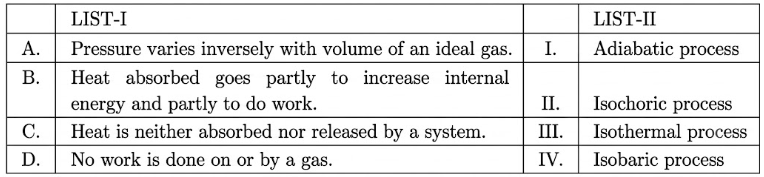
A. Pressure varies inversely with volume of an ideal gas.
For an isothermal process,
$$PV=\text{constant}$$So
$$P\propto\frac{1}{V}$$
A → III
B. Heat absorbed goes partly to increase internal energy and partly to do work.
That is true for isobaric process:
$$Q=\Delta U+W$$Both $$ΔU$$ and W are generally nonzero.
B → IV
C. Heat is neither absorbed nor released.
That is adiabatic process:
Q=0
C → I
D. No work is done on or by gas.
In isochoric process volume is constant:
$$W=P\Delta V=0$$
D → II
A gas is kept in a container having walls which are thermally non-conducting. Initially the gas has a volume of 800 cm$$^3$$ and temperature 27°C. The change in temperature when the gas is adiabatically compressed to 200 cm$$^3$$ is :
(Take $$\gamma = 1.5$$ : $$\gamma$$ is the ratio of specific heats at constant pressure and at constant volume)
For an adiabatic process involving an ideal gas, the relation between temperature and volume is
$$T\,V^{\gamma-1}= \text{constant}$$
Given data:
Initial volume $$V_1 = 800\;\text{cm}^3$$
Final volume $$V_2 = 200\;\text{cm}^3$$
Initial temperature $$T_1 = 27^\circ\text{C} = 27 + 273 = 300\;\text{K}$$
Specific-heat ratio $$\gamma = 1.5$$
Applying the adiabatic relation for the final temperature $$T_2$$:
$$T_1\,V_1^{\gamma-1}=T_2\,V_2^{\gamma-1}$$
Solve for $$T_2$$:
$$T_2 = T_1\left(\frac{V_1}{V_2}\right)^{\gamma-1}$$
Compute the volume ratio and exponent:
$$\frac{V_1}{V_2} = \frac{800}{200} = 4$$
$$\gamma - 1 = 1.5 - 1 = 0.5$$
Therefore,
$$T_2 = 300\,\text{K}\;\times\;4^{0.5} = 300\,\text{K}\;\times\;2 = 600\,\text{K}$$
The change in temperature is
$$\Delta T = T_2 - T_1 = 600\,\text{K} - 300\,\text{K} = 300\,\text{K}$$
Hence, the temperature rises by $$300\;\text{K}$$.
Option D is correct.
In an adiabatic process, which of the following statements is true?
For any thermodynamic process the first law of thermodynamics states
$$dQ = dU + dW$$ where
$$dQ$$ = heat supplied to the system, $$dU$$ = change in internal energy and $$dW$$ = work done by the system.
Adiabatic process: By definition no heat is exchanged with the surroundings, hence
$$dQ = 0$$ $$-(1)$$
Putting $$dQ = 0$$ in the first-law equation $$-(1)$$ gives
$$0 = dU + dW \;\;\Longrightarrow\;\; dU = -\,dW$$ $$-(2)$$
Equation $$-(2)$$ shows that the work done by the gas is numerically equal to the decrease (negative) in its internal energy, or equivalently, the increase in internal energy is numerically equal to the negative of the work done.
Now recall the definition of molar heat capacity for any path:
$$C = \frac{1}{n}\,\frac{dQ}{dT}$$ where $$n$$ is the number of moles.
For an adiabatic process $$dQ = 0$$, therefore
$$C = \frac{1}{n}\,\frac{0}{dT} = 0$$ $$-(3)$$
Hence the molar heat capacity along an adiabatic path is zero.
Let us test each option:
Option A The molar heat capacity is infinite - contradicts $$-(3)$$ (false).
Option B Work done by the gas equals the increase in internal energy - according to $$-(2)$$ the signs are opposite (false).
Option C The molar heat capacity is zero - matches $$-(3)$$ (true).
Option D The internal energy of the gas decreases as the temperature increases - no such rule exists; internal energy is directly related to temperature for an ideal gas (false).
Therefore the correct statement is Option C: the molar heat capacity in an adiabatic process is zero.
Using the given P - V diagram, the work done by an ideal gas along the path ABCD is :
Path is:
$$A(2V_0,P_0)→B(3V_0,P_0)→C(3V_0,2P_0)→D(V_0,2P_0)$$
Work done is
$$W=\int PdV$$
Calculate segment-wise.
Along AB (constant pressure $$P_0$$):
$$W_{AB}=P_0(3V_0-2V_0)=P_0V_0$$
Along BC (constant volume):
$$W_{BC}=0$$
Along CD (constant pressure $$2P_0$$ compression):
$$W_{CD}=2P_0(V_0-3V_0)$$
$$=2P_0(-2V_0)=-4P_0V_0$$
Total work:
$$W=W_{AB}+W_{BC}+W_{CD}$$
$$P_0V_0-4P_0V_0$$
$$=-3P_0V_0$$
A cup of coffee cools from $$90^{\circ}$$ to $$80^{\circ}$$ in t minutes when the room temperature is $$20^{\circ}$$. The time taken by the similar cup of coffee to cool from $$80^{\circ}$$ to $$60^{\circ}$$ at the same room temperature is :
Using Newton's law of cooling in the approximate form:
$$ \frac{\Delta T}{t} = k\left(\bar{T} - T_s\right) $$
where $$\bar{T}$$ is the average temperature and $$T_s$$ is the surrounding temperature.
First case: Cooling from 90° to 80° in time $$t$$:
$$\bar{T} = 85°$$, $$\Delta T = 10°$$
$$ \frac{10}{t} = k(85 - 20) = 65k \quad \cdots (1) $$
Second case: Cooling from 80° to 60° in time $$t'$$:
$$\bar{T} = 70°$$, $$\Delta T = 20°$$
$$ \frac{20}{t'} = k(70 - 20) = 50k \quad \cdots (2) $$
Dividing (2) by (1):
$$ \frac{20/t'}{10/t} = \frac{50k}{65k} $$
$$ \frac{2t}{t'} = \frac{10}{13} $$
$$ t' = \frac{2t \times 13}{10} = \frac{26t}{10} = \frac{13t}{5} $$
The correct answer is Option 4: $$\frac{13}{5}t$$.
The workdone in an adiabatic change in an ideal gas depends upon only :
For an adiabatic process, $$Q = 0$$ (no heat exchange with the surroundings).
From the first law of thermodynamics:
$$\Delta U = Q - W = -W$$
$$W = -\Delta U$$
For an ideal gas, the internal energy depends only on temperature:
$$\Delta U = nC_v\Delta T$$
Therefore:
$$W = -nC_v\Delta T$$
This shows that the work done in an adiabatic process depends only on the change in temperature (for a given amount of ideal gas with fixed $$C_v$$).
The answer is Option A: change in its temperature.
Match List-I with List-II.

Choose the correct answer from the options given below :
The first law of thermodynamics gives the relation $$\Delta Q = \Delta U + \Delta W$$ where:
• $$\Delta Q$$ is the heat supplied to the system,
• $$\Delta U$$ is the change in internal energy,
• $$\Delta W$$ is the work done by the system.
For each thermodynamic process we check which of these three quantities is zero or non-zero.
Case A: Isothermal process
Definition: Temperature remains constant.
For an ideal gas, internal energy depends only on temperature, so when temperature is constant $$\Delta U = 0$$.
Heat supplied equals work done, but both are generally non-zero.
Hence the correct description is $$\Delta U = 0$$, i.e. List-II item (IV).
Case B: Adiabatic process
Definition: No heat is exchanged with the surroundings.
Therefore $$\Delta Q = 0$$.
Neither $$\Delta U$$ nor $$\Delta W$$ is automatically zero; they are related by $$\Delta U = -\Delta W$$.
Thus the matching statement is $$\Delta Q = 0$$, i.e. List-II item (II).
Case C: Isobaric process
Definition: Pressure remains constant.
At constant pressure, the gas expands or compresses, so work is done: $$\Delta W \ne 0$$.
Temperature usually changes, so internal energy changes: $$\Delta U \ne 0$$.
Only $$\Delta U \ne 0$$ is listed among the four given statements, therefore we match with List-II item (III).
Case D: Isochoric process
Definition: Volume remains constant.
Work done for a volume change is $$\Delta W = P\,\Delta V$$. With $$\Delta V = 0$$ we get $$\Delta W = 0$$.
Heat added goes entirely into changing internal energy: $$\Delta Q = \Delta U$$, so neither of them is necessarily zero.
Thus the matching statement is $$\Delta W = 0$$, i.e. List-II item (I).
Collecting the matches:
(A) Isothermal → (IV) $$\Delta U = 0$$
(B) Adiabatic → (II) $$\Delta Q = 0$$
(C) Isobaric → (III) $$\Delta U \ne 0$$
(D) Isochoric → (I) $$\Delta W = 0$$
This corresponds to Option C.
Final Answer: Option C [ (A)-(IV), (B)-(II), (C)-(III), (D)-(I) ]
A poly-atomic molecule ($$C_V = 3R,\, C_P = 4R$$, where R is gas constant) goes from phase space point $$A\ (P_A = 10^5\,\text{Pa},\ V_A = 4 \times 10^{-6}\,\text{m}$$ to point $$B\ (P_B = 5 \times 10^4\,\text{Pa},\ V_B = 6 \times 10^{-6}\,\text{m}^3)$$ to point $$C\,(P_C = 10^4\,\text{Pa},\; V_C = 8 \times 10^{-6}\,\text{m}^3).$$ A to B is an adiabatic path B and C to is an isothermal path. The net heat absorbed per unit mole by the system is :
From the graph,$$A→B$$ is adiabatic, so no heat is exchanged in this part:
$$Q_{AB}=0$$
Hence net heat absorbed by the gas comes only during $$B→C$$, which is an isothermal expansion.
For one mole of an ideal gas in an isothermal process,
$$Q=W=RT\ln\frac{V_C}{V_B}$$
From the diagram, the path $$B→C$$ lies on the $$450K$$ isotherm, so
$$T=450K$$
Also,
$$\frac{V_C}{V_B}=\frac{8\times10^{-6}}{6\times10^{-6}}=\frac{4}{3}$$
Therefore,
$$Q=450R\ln\frac{4}{3}$$
Match List-I with List-II.

Choose the correct answer from the options given below :
The first law of thermodynamics for a quasi-static process is written as $$\Delta Q = \Delta U + \Delta W$$, where $$\Delta W$$ is the work done by the gas.
For expansion/compression work at constant external pressure, $$\Delta W = P\,\Delta V$$, so the first law becomes $$\Delta Q = \Delta U + P\,\Delta V$$ $$-(1)$$.
Now analyse each process in List-I.
Case A: Isobaric (constant pressure)
Pressure stays constant, therefore $$P = \text{constant}$$. Substituting in $$(1)$$ gives
$$\Delta Q = \Delta U + P\,\Delta V$$.
This is exactly the expression in List-II (IV). Hence A → IV.
Case B: Isochoric (constant volume)
Here $$\Delta V = 0$$, so no work is done: $$\Delta W = P\,\Delta V = 0$$.
Using the first law: $$\Delta Q = \Delta U + 0 \; \Rightarrow \; \Delta Q = \Delta U$$.
This matches List-II (II). Hence B → II.
Case C: Adiabatic (no heat exchange)
By definition, $$\Delta Q = 0$$ for an adiabatic process.
Thus the relation in List-II (III) fits. Hence C → III.
Case D: Isothermal (constant temperature)
For an ideal gas, internal energy depends only on temperature. Since temperature is constant,
$$\Delta U = 0$$.
First law then gives $$\Delta Q = \Delta W$$.
This is relation (I) in List-II. Hence D → I.
Collecting the matches: (A-IV), (B-II), (C-III), (D-I).
The option with this sequence is Option C.
Final Answer: Option C
Given below are two statements. One is labelled as Assertion (A) and the other is labelled as Reason (R). Assertion (A) : In an insulated container, a gas is adiabatically shrunk to half of its initial volume. The temperature of the gas decreases. Reason (R): Free expansion of an ideal gas is an irreversible and an adiabatic process. In the light of the above statements, choose the correct answer from the options given below :
We need to evaluate the Assertion and Reason about adiabatic processes.
Assertion (A): "In an insulated container, a gas is adiabatically shrunk to half of its initial volume. The temperature of the gas decreases."
Analysis: The term "shrunk to half its volume" in an insulated container describes a free expansion or compression scenario. However, "adiabatically shrunk" means the gas is compressed (volume decreases). For adiabatic compression of an ideal gas, using the relation $$TV^{\gamma - 1} = \text{constant}$$:
$$T_1 V_1^{\gamma - 1} = T_2 V_2^{\gamma - 1}$$
Since $$V_2 = V_1/2$$ (volume halved) and $$\gamma > 1$$:
$$T_2 = T_1 \left(\frac{V_1}{V_2}\right)^{\gamma - 1} = T_1 \cdot 2^{\gamma - 1} > T_1$$
The temperature increases during adiabatic compression, not decreases. Assertion (A) is FALSE.
Reason (R): "Free expansion of an ideal gas is an irreversible and an adiabatic process."
Analysis: Free expansion occurs when a gas expands into a vacuum. It is indeed both irreversible (spontaneous, cannot be reversed without external work) and adiabatic (no heat exchange since $$Q = 0$$; also $$W = 0$$ against vacuum). For an ideal gas, free expansion produces no temperature change ($$\Delta U = 0$$). Reason (R) is TRUE.
The correct answer is Option 2: (A) is false but (R) is true.
An ideal gas initially at $$0^{\circ}$$C temperature, is compressed suddenly to one fourth of its volume. If the ratio of specific heat at constant pressure to that at constant volume is 3/2, the change in temperature due to the thermodynamic process is _____ K.
For an adiabatic process (sudden compression), the relation between temperature and volume is $$ TV^{\gamma - 1} = \text{constant} $$. In this case, $$\gamma = \frac{C_p}{C_v} = \frac{3}{2}$$, the initial temperature is $$T_1 = 0°C = 273$$ K, and the gas is compressed to one-fourth of its original volume, so $$V_2 = \frac{V_1}{4}$$.
Applying $$ T_1 V_1^{\gamma - 1} = T_2 V_2^{\gamma - 1} $$ gives $$ T_2 = T_1 \left(\frac{V_1}{V_2}\right)^{\gamma - 1} = 273 \times (4)^{3/2 - 1} = 273 \times 4^{1/2} = 273 \times 2 = 546 \text{ K} $$.
Therefore, the change in temperature is $$ \Delta T = T_2 - T_1 = 546 - 273 = 273 \text{ K} $$. The temperature rise is 273 K.
The given figure represents two isobaric processes for the same mass of an ideal gas, then
For an ideal gas,
$$PV=nRT$$
For an isobaric process (P= constant),
$$V=\frac{nR}{P}T$$
This is a straight line on a V-T graph, with slope
$$slope=\frac{nR}{P}$$
Since same mass of gas is used, n is constant, so slope is inversely proportional to pressure:
$$\text{slope}\propto\frac{1}{P}$$
Line $$P_2$$ is steeper than line $$P_1$$, so
$$\frac{nR}{P_2}>\frac{nR}{P_1}$$
which gives
$$P_1>P_2$$
The specific heat at constant pressure of a real gas obeying $$PV^2 = RT$$ equation is:
For a real gas, the relation between the molar specific heats is
$$C_P - C_V \;=\; T\Bigl(\frac{\partial P}{\partial T}\Bigr)_V \Bigl(\frac{\partial V}{\partial T}\Bigr)_P$$
This identity is obtained from the first & second laws together with exact-differential criteria, and it is valid for one mole of any substance.
The gas in the question obeys the equation of state
$$P\,V^2 \;=\; R\,T \;\;-(1)$$
Step 1: Find $$\Bigl(\dfrac{\partial P}{\partial T}\Bigr)_V$$.
From $$(1)$$: $$P \;=\; \dfrac{R\,T}{V^{2}}$$. Keeping $$V$$ constant and differentiating with respect to $$T$$:
$$\Bigl(\frac{\partial P}{\partial T}\Bigr)_V = \frac{R}{V^{2}} \;\;-(2)$$
Step 2: Find $$\Bigl(\dfrac{\partial V}{\partial T}\Bigr)_P$$.
Rewrite $$(1)$$ to express $$V$$ in terms of $$T$$ at fixed $$P$$:
$$V^{2} = \frac{R\,T}{P} \quad\Longrightarrow\quad 2V\,dV = \frac{R}{P}\,dT$$ so
$$\Bigl(\frac{\partial V}{\partial T}\Bigr)_P = \frac{R}{2\,P\,V} \;\;-(3)$$
Step 3: Compute $$C_P - C_V$$.
Substitute $$(2)$$ and $$(3)$$ into the heat-capacity relation:
$$\begin{aligned} C_P - C_V &= T\left(\frac{R}{V^{2}}\right)\left(\frac{R}{2\,P\,V}\right)\\[4pt] &= \frac{T\,R^{2}}{2\,P\,V^{3}} \;\;-(4) \end{aligned}$$
Step 4: Eliminate $$P$$ using the equation of state.
From $$(1)$$: $$P = \dfrac{R\,T}{V^{2}}$$. Insert this in $$(4)$$:
$$\begin{aligned} C_P - C_V &= \frac{T\,R^{2}}{2\,(\tfrac{R\,T}{V^{2}})\,V^{3}}\\[6pt] &= \frac{T\,R^{2}}{2\,R\,T\,V}\\[4pt] &= \frac{R}{2\,V} \end{aligned}$$
Therefore
$$C_P = C_V + \frac{R}{2\,V}$$
Among the given options this matches Option C.
Answer: Option C
P-T diagram of an ideal gas having three different densities $$\rho_1, \rho_2, \rho_3$$ (in three different cases) is shown in the figure. Which of the following is correct:
For an ideal gas,
$$PV=nRT$$
Also density,
$$\rho=\frac{m}{V}$$
and
$$n=\frac{m}{M}$$
So ideal gas law becomes
$$P=\frac{\rho}{M}RT$$
or
$$P=\left(\frac{\rho R}{M}\right)T$$
This is the equation of a straight line in a P-T graph, whose slope is
$$slope=\frac{\rho R}{M}$$
Since R and molar mass M are constant, slope is directly proportional to density:
$$slope∝ρ$$
From the graph, line corresponding to $$\rho_1$$ has greatest slope, then
$$\rho_2\ then\ \rho_3$$
Hence,
$$\rho_1>\rho_2>\rho_3$$
The heat absorbed by a system in going through the given cyclic process is :
For a cyclic process,
ΔU=0
So from first law,
Q=W
Thus heat absorbed equals net work done, which is area enclosed by the cycle on the P-V diagram.
The loop is a circle touching
P=340, P=60 and
V=340, V=60
So diameter is
$$340−60=280$$
Hence radius is
r=140
Area enclosed
$$W=\pi r^2$$
$$=\pi(140)^2$$
$$=19600\pi$$
Now units:
Pressure is in cc and volume in kPa (as labeled), so
$$1(\text{kPa})(\text{cc})=10^3\times10^{-6}=10^{-3}J$$
Thus
$$Q=19600\pi\times10^{-3}$$
$$=19.6\pi\ \text{J}=61.6J$$
One mole of a monatomic ideal gas undergoes the cyclic process J $$\to$$ K $$\to$$ L $$\to$$ M $$\to$$ J, as shown in the P-T diagram.

Match the quantities mentioned in List-I with their values in List-II and choose the correct option.
[$$R$$ is the gas constant.]
| List-I | List-II | ||
|---|---|---|---|
| (P) | Work done in the complete cyclic process | (1) | $$RT_0 - 4RT_0 \ln 2$$ |
| (Q) | Change in the internal energy of the gas in the process JK | (2) | $$0$$ |
| (R) | Heat given to the gas in the process KL | (3) | $$3RT_0$$ |
| (S) | Change in the internal energy of the gas in the process MJ | (4) | $$-2RT_0 \ln 2$$ |
| (5) | $$-3RT_0 \ln 2$$ |
The diagram (not shown here) is a rectangle in the $$P$$-$$T$$ plane with the numerical labels
$$J:(P_0,T_0),\;K:(P_0,3T_0),\;L:(2P_0,3T_0),\;M:(2P_0,T_0).$$
One mole of a monatomic ideal gas moves along the four sides JK, KL, LM, MJ in that order.
For one mole the ideal-gas equation is $$PV = RT$$ and the internal energy is $$U = \tfrac32 RT.$$ Work done by the gas in any step is $$W = \int P\,dV,$$ and the first law gives $$Q = \Delta U + W.$$ We treat every leg separately.
Case 1: JK (isobaric at $$P_0$$)Temperatures: $$T_0 \rightarrow 3T_0 \;(\Delta T = 2T_0).$$
Change in internal energy
$$\Delta U_{JK} = \tfrac32 R\,(2T_0) = 3RT_0.$$
Volume rises from $$V_J = \frac{RT_0}{P_0}$$ to $$V_K = \frac{3RT_0}{P_0}.$$ Work done $$W_{JK} = P_0\,(V_K-V_J) = P_0 \left(\frac{2RT_0}{P_0}\right)=2RT_0.$$
Case 2: KL (isothermal at $$T = 3T_0$$)Pressure $$P_0 \rightarrow 2P_0,$$ so volume $$V_K = \frac{3RT_0}{P_0}$$ compresses to $$V_L = \frac{3RT_0}{2P_0} = \tfrac12 V_K.$$ Work done $$W_{KL}=RT\ln\!\left(\frac{V_L}{V_K}\right)=3RT_0\ln\!\left(\tfrac12\right)=-3RT_0\ln2.$$
Because the temperature is constant, $$\Delta U_{KL}=0,$$ hence $$Q_{KL}=W_{KL}=-3RT_0\ln2.$$
Case 3: LM (isobaric at $$2P_0$$)Temperature $$3T_0 \rightarrow T_0 \;(\Delta T = -2T_0).$$
Change in internal energy
$$\Delta U_{LM}=\tfrac32 R(-2T_0)=-3RT_0.$$
Volumes: $$V_L=\frac{3RT_0}{2P_0},\;V_M=\frac{RT_0}{2P_0}$$ so $$\Delta V = -\frac{RT_0}{P_0}.$$ Work done $$W_{LM}=2P_0\left(-\frac{RT_0}{P_0}\right)=-2RT_0.$$
Case 4: MJ (isothermal at $$T=T_0$$)Pressure $$2P_0 \rightarrow P_0,$$ volume doubles: $$V_M=\frac{RT_0}{2P_0},\;V_J=\frac{RT_0}{P_0}=2V_M.$$ Work done $$W_{MJ}=RT_0\ln\!\left(\frac{V_J}{V_M}\right)=RT_0\ln2.$$
Again $$\Delta U_{MJ}=0$$ (temperature constant), so $$Q_{MJ}=W_{MJ}=RT_0\ln2.$$
Total work for the cycle$$W_{\text{cycle}} = 2RT_0 + (-3RT_0\ln2) + (-2RT_0) + RT_0\ln2$$ $$\phantom{W_{\text{cycle}}}=0 - 2RT_0\ln2 = -2RT_0\ln2.$$
Now we can match each quantity with List-II:
(P) Work in the entire cycle: $$-2RT_0\ln2$$ → (4)
(Q) $$\Delta U_{JK}=3RT_0$$ → (3)
(R) Heat in KL: $$Q_{KL}=-3RT_0\ln2$$ → (5)
(S) $$\Delta U_{MJ}=0$$ → (2)
Therefore the correct set of matches is P → 4; Q → 3; R → 5; S → 2, which is Option B.
A real gas within a closed chamber at $$27°C$$ undergoes the cyclic process as shown in figure. The gas obeys $$PV^3 = RT$$ equation for the path $$A$$ to $$B$$. The net work done in the complete cycle is (assuming $$R = 8 \text{ J/molK}$$):
or a cyclic process, net work done is the sum of work in each path.
Cycle is
$$C→A→B→C$$
For C→A, volume is constant, so
$$W_{CA}=0$$
For A→B, given
$$PV^3=RT$$
Temperature is
$$27^{\circ}C=300K$$
and
R=8
So
$$PV^3=8(300)=2400$$
Thus
$$P=\frac{2400}{V^3}$$
Work done from A to B is
$$W_{AB}=\int PdV$$
$$=\int_2^4\frac{2400}{V^3}dV$$
$$=2400\int_2^4V^{-3}dV$$
$$=2400\left(\frac{-1}{2V^2}\right)_2^4$$
$$2400\left(\frac{1}{8}-\frac{1}{32}\right)$$
$$=2400\cdot\frac{3}{32}$$
=225J
For B→C, pressure is constant at
P=10
So
$$W_{BC}=P(V_C-V_B)$$=10(2−4)
=−20J
Hence net work done in the complete cycle is
W=0+225−20W
=205J
Match List-I with List-II :
Choose the correct answer from the options given below :
Match each definition carefully.
(A) “A force that restores an elastic body of unit area to its original state”
Force per unit area developed internally to restore original shape is definition of stress.
So
A→(III)
(B) “Two equal and opposite forces parallel to opposite faces”
Parallel tangential forces produce shear deformation, associated with shear modulus.
So
B→(IV)
(C) “Forces perpendicular everywhere to the surface per unit area same everywhere”
This describes uniform normal pressure acting in all directions, associated with bulk modulus.
So
C→(I)
(D) “Two equal and opposite forces perpendicular to opposite faces”
Normal tensile/compressive stress produces longitudinal strain, associated with Young’s modulus.
So
D→(II)
To project a body of mass $$m$$ from earths surface to infinity, the required kinetic energy is (assume, the radius of earth is $$R_E$$, $$g =$$ acceleration due to gravity on the surface of earth):
To just reach infinity with zero final speed, total mechanical energy at infinity should be zero.
At Earth’s surface:
Potential energy is
$$U=-\frac{GMm}{R_E}$$
Required kinetic energy = escape energy so that
$$K+U=0$$
Thus
$$K=\frac{GMm}{R_E}$$
Now use
$$g=\frac{GM}{R_E^2}$$
So
$$GM=gR_E^2$$
Substitute:
$$K=\frac{(gR_E^2)m}{R_E}$$
$$K=mgR_E$$
$$0.08$$ kg air is heated at constant volume through $$5°C$$. The specific heat of air at constant volume is $$0.17 \text{ kcal kg}^{-1} \text{ °C}^{-1}$$ and $$1 \text{ J} = 4.18 \text{ joule cal}^{-1}$$. The change in its internal energy is approximately.
For heating at constant volume, the change in internal energy equals the heat added:
$$\Delta U = m c_v \Delta T$$
Given: $$m = 0.08$$ kg, $$c_v = 0.17$$ kcal kg$$^{-1}$$ °C$$^{-1}$$, $$\Delta T = 5°C$$.
$$\Delta U = 0.08 \times 0.17 \times 5 = 0.068 \text{ kcal}$$
Converting to joules ($$1 \text{ cal} = 4.18 \text{ J}$$, so $$1 \text{ kcal} = 4180 \text{ J}$$):
$$\Delta U = 0.068 \times 4180 = 284.24 \text{ J} \approx 284 \text{ J}$$
The answer is approximately $$284$$ J, which corresponds to Option (3).
A diatomic gas $$(\gamma = 1.4)$$ does 200 J of work when it is expanded isobarically. The heat given to the gas in the process is:
For an isobaric process (constant pressure), the work done by the gas is given by:
$$W = P \Delta V$$
Using the ideal gas law, $$PV = nRT$$, we can express the work as:
$$W = P \Delta V = nR \Delta T$$
Given that the work done by the gas is 200 J:
$$nR \Delta T = 200 \text{ J} \quad \text{(Equation 1)}$$
The heat supplied to the gas in an isobaric process is:
$$Q = n C_p \Delta T$$
where $$C_p$$ is the molar specific heat at constant pressure.
For a diatomic gas with $$\gamma = 1.4$$, the ratio of specific heats is $$\gamma = \frac{C_p}{C_v} = \frac{7}{5}$$. The molar specific heat at constant volume is $$C_v = \frac{5}{2}R$$ (since diatomic gases have 5 degrees of freedom). Therefore:
$$C_p = \gamma C_v = \frac{7}{5} \times \frac{5}{2}R = \frac{7}{2}R$$
Substituting into the expression for Q:
$$Q = n \left( \frac{7}{2}R \right) \Delta T = \frac{7}{2} (nR \Delta T)$$
Using Equation 1, where $$nR \Delta T = 200 \text{ J}$$:
$$Q = \frac{7}{2} \times 200 = 7 \times 100 = 700 \text{ J}$$
Thus, the heat given to the gas is 700 J.
Verification using the first law of thermodynamics:
The change in internal energy is:
$$\Delta U = n C_v \Delta T = n \left( \frac{5}{2}R \right) \Delta T = \frac{5}{2} (nR \Delta T) = \frac{5}{2} \times 200 = 500 \text{ J}$$
From the first law, $$\Delta U = Q - W$$:
$$500 = Q - 200 \implies Q = 700 \text{ J}$$
This confirms the result.
The correct option is D. 700 J.
A sample of gas at temperature $$T$$ is adiabatically expanded to double its volume. Adiabatic constant for the gas is $$\gamma = 3/2$$. The work done by the gas in the process is: ($$\mu = 1$$ mole)
Find the work done when a gas at temperature $$T$$ is adiabatically expanded to double its volume with $$\gamma = 3/2$$ and $$\mu = 1$$ mole.
For an adiabatic process with an ideal gas, the relation $$TV^{\gamma-1} = \text{constant}$$ implies
$$ T_i V_i^{\gamma-1} = T_f V_f^{\gamma-1} $$
With $$V_f = 2V_i$$ and $$\gamma - 1 = 3/2 - 1 = 1/2$$, we have
$$ T \cdot V_i^{1/2} = T_f \cdot (2V_i)^{1/2} $$
$$ T_f = T \cdot \frac{V_i^{1/2}}{(2V_i)^{1/2}} = T \cdot \frac{1}{\sqrt{2}} = \frac{T}{\sqrt{2}} $$
For an adiabatic process, $$Q = 0$$, so the work done by the gas is $$W = -\Delta U$$. Equivalently, integrating $$W = \int P\,dV$$ with $$PV^\gamma = \text{const}$$ yields
$$W = \int P\,dV = \frac{P_iV_i - P_fV_f}{\gamma-1} = \frac{nRT_i - nRT_f}{\gamma-1} = \frac{nR(T_i-T_f)}{\gamma-1}$$
Substituting $$n = 1$$, $$T_i = T$$, $$T_f = T/\sqrt{2}$$, and $$\gamma - 1 = 1/2$$ gives
$$ W = \frac{1 \times R \times (T - T/\sqrt{2})}{1/2} = 2R \cdot T\left(1 - \frac{1}{\sqrt{2}}\right) = 2RT\left(\frac{\sqrt{2}-1}{\sqrt{2}}\right) = RT(2 - \sqrt{2}) $$
The correct answer is Option C: $$RT[2 - \sqrt{2}]$$.
A thermodynamic system is taken from an original state $$A$$ to an intermediate state $$B$$ by a linear process as shown in the figure. Its volume is then reduced to the original value from $$B$$ to $$C$$ by an isobaric process. The total work done by the gas from $$A$$ to $$B$$ and $$B$$ to $$C$$ would be :
Work done is the area under the P-V curve.
From A→BA\to BA→B, pressure changes linearly, so work done is area of trapezium:
$$W_{AB}=\frac{P_A+P_B}{2}(V_B-V_A)$$
Given
$$P_A=8000\ \text{dyne/cm}^2,\quad P_B=4000\ \text{dyne/cm}^2$$
$$V_A=3m^3\ and\ V_B=7m^3$$
So
$$W_{AB}=\frac{8000+4000}{2}(7-3)$$
$$=6000\times4=24000$$
From B→C, process is isobaric compression, so
$$W_{BC}=P(V_C-V_B)$$
$$=4000(3−7)$$
=−16000
Therefore total work done,
$$W=W_{AB}+W_{BC}$$
$$=24000−16000=8000$$
Now converting units:
$$1\ \text{dyne/cm}^2=0.1\ \text{Pa}$$
So
$$8000\ \text{dyne/cm}^2=800\ \text{Pa}$$
Thus,
$$W=800(m^3)=800J$$
A total of $$48 \text{ J}$$ heat is given to one mole of helium kept in a cylinder. The temperature of helium increases by $$2°C$$. The work done by the gas is: Given, $$R = 8.3 \text{ J K}^{-1} \text{ mol}^{-1}$$.
We need to find the work done by one mole of helium gas when 48 J of heat is supplied and the temperature increases by 2°C.
We know that according to the First Law of Thermodynamics $$Q = \Delta U + W$$, where $$Q$$ is heat supplied, $$\Delta U$$ is the change in internal energy, and $$W$$ is the work done by the gas. For an ideal gas, the change in internal energy depends only on temperature change, giving $$\Delta U = n C_v \Delta T$$. Since helium is a monoatomic ideal gas with three translational degrees of freedom, its molar heat capacity at constant volume is $$C_v = \frac{3}{2}R$$.
Substituting $$n = 1$$ mol, $$\Delta T = 2$$ K (because 2°C corresponds to 2 K), and $$R = 8.3 \, \text{J K}^{-1}\text{mol}^{-1}$$ into the expression for the change in internal energy yields $$\Delta U = n C_v \Delta T = 1 \times \frac{3}{2} \times 8.3 \times 2$$.
This gives $$\Delta U = 1 \times 1.5 \times 8.3 \times 2 = 1 \times 12.45 \times 2 = 24.9 \, \text{J}$$.
Applying the First Law then results in the work done by the gas as $$W = Q - \Delta U = 48 - 24.9 = 23.1 \, \text{J}$$.
The correct answer is Option (4): 23.1 J.
Choose the correct statement for processes $$A$$ & $$B$$ shown in figure.
Yes — this question was asking to identify the processes, not compare work/heat.
From the graph, process A is the less steep hyperbola, corresponding to an isothermal process:
$$PV=k$$
For process BBB, the curve is steeper than an isotherm, so it represents an adiabatic process:
$$PV^{\gamma}=k$$
because adiabatic curves are steeper than isotherms on a P-V diagram.
During an adiabatic process, if the pressure of a gas is found to be proportional to the cube of its absolute temperature, then the ratio of $$\frac{C_P}{C_V}$$ for the gas is :
For an adiabatic process,
$$PV^{\gamma}=\text{constant}$$
Also ideal gas law gives
PV=nRT
or
$$V=\frac{nRT}{P}$$
Substitute into adiabatic equation:
$$P\left(\frac{nRT}{P}\right)^{\gamma}=\text{constant}$$
$$P\cdot\frac{(nR)^{\gamma}T^{\gamma}}{P^{\gamma}}=\text{constant}$$
$$P^{1-\gamma}T^{\gamma}=\text{constant}$$
Given pressure is proportional to cube of absolute temperature,
$$P\propto T^3$$
So
$$P=kT^3$$
Comparing with
$$P^{1-\gamma}T^{\gamma}=\text{constant}$$
write
$$P\propto T^{\frac{\gamma}{\gamma-1}}$$
Thus,
$$=3\frac{\gamma}{\gamma-1}$$
Solving,
$$γ=3γ−3$$
$$2γ=3$$
$$γ=\frac{3}{2}$$
But for an adiabatic process so,
$$\gamma=\frac{C_P}{C_V}$$
During an adiabatic process, the pressure of a gas is found to be proportional to the cube of its absolute temperature. The ratio of $$\frac{C_p}{C_v}$$ for the gas is :
For an adiabatic process: $$PV^\gamma = \text{constant}$$ and $$TV^{\gamma-1} = \text{constant}$$.
From the ideal gas law: $$PV = nRT$$, so $$V = \frac{nRT}{P}$$.
Substituting: $$P\left(\frac{nRT}{P}\right)^\gamma = \text{const}$$
$$P^{1-\gamma}T^\gamma = \text{const}$$
$$\frac{T^\gamma}{P^{\gamma-1}} = \text{const}$$
$$P^{\gamma-1} \propto T^\gamma$$
$$P \propto T^{\gamma/(\gamma-1)}$$
Given $$P \propto T^3$$:
$$\frac{\gamma}{\gamma - 1} = 3$$
$$\gamma = 3\gamma - 3$$
$$2\gamma = 3$$
$$\gamma = \frac{3}{2}$$
The answer is $$\frac{C_p}{C_v} = \frac{3}{2}$$, which corresponds to Option (2).
The temperature of a gas is $$-78°C$$ and the average translational kinetic energy of its molecules is $$K$$. The temperature at which the average translational kinetic energy of the molecules of the same gas becomes $$2K$$ is :
Average translational KE: $$K = \frac{3}{2}k_BT$$.
Initial: $$T_1 = -78°C = 195$$ K, $$K_1 = K$$.
For $$K_2 = 2K$$: $$T_2 = 2T_1 = 390$$ K = $$117°C$$.
The correct answer is Option 2: $$117°C$$.
Energy of 10 non rigid diatomic molecules at temperature $$T$$ is :
We need to find the total energy of 10 non-rigid diatomic molecules at temperature $$T$$ by applying the equipartition theorem.
According to the equipartition theorem, each degree of freedom contributes $$\frac{1}{2}k_B T$$ of energy per molecule, and the total energy per molecule is therefore $$E = \frac{f}{2} k_B T$$, where $$f$$ is the number of degrees of freedom and $$k_B$$ is Boltzmann's constant.
In a non-rigid diatomic molecule, there are three translational degrees of freedom (motion along the x, y, and z axes), two rotational degrees of freedom (rotation about the two axes perpendicular to the bond axis, since rotation about the bond axis is negligible), and two vibrational degrees of freedom (one for kinetic energy and one for potential energy). Hence, the total number of degrees of freedom is $$f = 3 + 2 + 2 = 7$$.
Substituting $$f = 7$$ into the expression for the energy per molecule gives $$E_{\text{per molecule}} = \frac{7}{2} k_B T$$.
For 10 molecules, this becomes $$E_{\text{total}} = 10 \times \frac{7}{2} k_B T = \frac{70}{2} k_B T = 35 \, k_B T$$.
The correct answer is Option (2): $$35 K_B T$$.
The pressure and volume of an ideal gas are related as $$PV^{3/2} = K$$ (Constant). The work done when the gas is taken from state $$A(P_1, V_1, T_1)$$ to state $$B(P_2, V_2, T_2)$$ is :
PV^(3/2) = K. W = ∫PdV = ∫K/V^(3/2)dV = K[-2/V^(1/2)] = -2K(1/√V₂ - 1/√V₁)
= 2K(1/√V₁ - 1/√V₂) = 2(P₁V₁^(3/2)/√V₁ - P₂V₂^(3/2)/√V₂) = 2(P₁V₁ - P₂V₂).
The correct answer is Option 1.
The volume of an ideal gas $$(\gamma = 1.5)$$ is changed adiabatically from 5 litres to 4 litres. The ratio of initial pressure to final pressure is:
For an adiabatic process: $$PV^{\gamma} = \text{constant}$$.
$$P_1 V_1^{\gamma} = P_2 V_2^{\gamma}$$
$$\frac{P_1}{P_2} = \left(\frac{V_2}{V_1}\right)^{\gamma} = \left(\frac{4}{5}\right)^{3/2}$$
$$= \frac{4^{3/2}}{5^{3/2}} = \frac{8}{5\sqrt{5}}$$
The correct answer is Option 3: $$\frac{8}{5\sqrt{5}}$$.
Two different adiabatic paths for the same gas intersect two isothermal curves as shown in P-V diagram. The relation between the ratio $$\frac{V_a}{V_d}$$ and the ratio $$\frac{V_b}{V_c}$$ is:
For an adiabatic process,
$$PV^{\gamma}=\text{constant}$$
There are two adiabatic curves:
For adiabatic through a and c:
$$P_aV_a^{\gamma}=P_cV_c^{\gamma}$$
So,
$$\frac{P_a}{P_c}=\frac{V_c^{\gamma}}{V_a^{\gamma}}$$
For adiabatic through b and d:
$$P_bV_b^{\gamma}=P_dV_d^{\gamma}$$
So,
$$\frac{P_b}{P_d}=\frac{V_d^{\gamma}}{V_b^{\gamma}}$$
Now a and b lie on same isotherm, so
$$P_aV_a=P_bV_b$$
$$\frac{P_a}{P_b}=\frac{V_b}{V_a}$$
Also c and d lie on same isotherm, so
$$P_cV_c=P_dV_d$$
$$\frac{P_c}{P_d}=\frac{V_d}{V_c}$$
Now divide the two adiabatic equations:
$$\frac{P_a/P_c}{P_b/P_d}=\left(\frac{\frac{V_C}{V_a}}{\frac{V_d}{V_b}}\right)^{\gamma}$$
Using isothermal relations,
$$\frac{(V_c/V_a)}{(V_d/V_b)}=\left(\frac{V_bV_c}{V_aV_d}\right)^{\gamma}$$
This simplifies only if
$$V_bV_c=V_aV_d$$
Hence,
$$\frac{V_a}{V_d}=\frac{V_b}{V_c}$$
Two thermodynamical processes are shown in the figure. The molar heat capacity for process $$A$$ and $$B$$ are $$C_A$$ and $$C_B$$. The molar heat capacity at constant pressure and constant volume are represented by $$C_P$$ and $$C_V$$, respectively. Choose the correct statement.
In the graph, the lines have positive slope in the (logV,logP) plane, so they represent
$$\log P=n\log V$$
or
$$P=V^n$$
which can be written as
$$PV^{-n}=\text{constant}$$This is a polytropic process with index
m=−n
For a polytropic process, molar heat capacity is
$$C=C_V+\frac{R}{1-m}$$Substituting m=−n,
$$C=C_V+\frac{R}{1+n}$$
For process A, slope is given by
$$\tanθ=γ$$
so
$$n=γ$$
Hence
$$C_A=C_V+\frac{R}{1+\gamma}$$
For process BBB, angle is $$45^{\circ}$$, so
n=1
and
$$C_B=C_V+\frac{R}{2}$$
Also,
$$C_P=C_V+R$$
Now comparing:
$$C_P>C_B$$
because
$$R>\frac{R}{2}$$
Also since γ>1,
$$\frac{R}{2}>\frac{R}{1+\gamma}$$
so
$$C_B>C_A$$
and clearly
$$C_A>C_V$$
Therefore,
$$CP>CB>CA>CV$$
Given below are two statements:
Statement I: If heat is added to a system, its temperature must increase.
Statement II: If positive work is done by a system in a thermodynamic process, its volume must increase.
In the light of the above statements, choose the correct answer from the options given below
We need to evaluate two statements about thermodynamics.
Statement I: "If heat is added to a system, its temperature must increase."
This is FALSE. Consider the following counterexamples:
- During a phase change (e.g., melting of ice at 0°C), heat is added but the temperature remains constant.
- In an isothermal expansion of an ideal gas, heat is added to do work, but the temperature stays constant.
Statement II: "If positive work is done by a system in a thermodynamic process, its volume must increase."
This is FALSE. Consider these counterexamples:
- In a cyclic process, the system can perform net positive work while the volume returns to its original value.
- A system may do non-expansion (non-PdV) work, such as electrical work, without any change in volume.
Since both statements are false, the correct answer is Option B: Both Statement I and Statement II are false.
One mole of an ideal gas expands adiabatically from an initial state $$(T_A, V_0)$$ to final state $$(T_f, 5V_0)$$. Another mole of the same gas expands isothermally from a different initial state $$(T_B, V_0)$$ to the same final state $$(T_f, 5V_0)$$. The ratio of the specific heats at constant pressure and constant volume of this ideal gas is $$\gamma$$. What is the ratio $$T_A/T_B$$?
For an ideal gas undergoing an adiabatic process, the relation between temperature and volume is
$$T\,V^{\gamma-1}= \text{constant} \quad -(1)$$
Case 1: Adiabatic expansion
Initial state $$\left(T_A,V_0\right)$$ → final state $$\left(T_f,5V_0\right)$$.
Using $$(1):$$
$$T_A\,V_0^{\gamma-1}=T_f\,(5V_0)^{\gamma-1}$$
$$\Longrightarrow\; T_A=T_f\,5^{\gamma-1} \quad -(2)$$
Case 2: Isothermal expansion
Initial state $$\left(T_B,V_0\right)$$ → final state $$\left(T_f,5V_0\right)$$.
For an isothermal process, temperature is constant, so
$$T_B=T_f \quad -(3)$$
Dividing $$(2)$$ by $$(3):$$
$$\frac{T_A}{T_B}= \frac{T_f\,5^{\gamma-1}}{T_f}=5^{\gamma-1}$$
Hence the required ratio is $$T_A/T_B = 5^{\gamma-1}$$.
Option A which is: $$5^{\gamma-1}$$
A closed container contains a homogeneous mixture of two moles of an ideal monatomic gas ($$\gamma = 5/3$$) and one mole of an ideal diatomic gas ($$\gamma = 7/5$$). Here, $$\gamma$$ is the ratio of the specific heats at constant pressure and constant volume of an ideal gas. The gas mixture does a work of 66 Joule when heated at constant pressure. The change in its internal energy is ______ Joule.
For an ideal gas kept at constant pressure, the work done is related to the temperature rise as
$$W = P\Delta V = nR\Delta T$$
The mixture contains
- 2 moles of monatomic gas with $$\gamma_1 = \dfrac{5}{3}$$,
- 1 mole of diatomic gas with $$\gamma_2 = \dfrac{7}{5}$$.
Total moles
$$n = 2 + 1 = 3$$
Given work done
$$W = 66 \text{ J}$$, hence from the relation above
$$\Delta T = \frac{W}{nR} = \frac{66}{3R} = \frac{22}{R}$$ $$-(1)$$
For each component we first evaluate its molar specific heat at constant volume $$C_v$$.
The relation between $$\gamma$$, $$C_p$$ and $$C_v$$ is
$$\gamma = \frac{C_p}{C_v}, \qquad C_p - C_v = R$$ $$-(2)$$
Monatomic gas: $$\gamma_1 = \dfrac{5}{3}$$.
Using $$(2)$$,
$$C_{v1} = \frac{R}{\gamma_1 - 1} = \frac{R}{\frac{5}{3} - 1} = \frac{R}{\frac{2}{3}} = \frac{3}{2}R$$
Diatomic gas: $$\gamma_2 = \dfrac{7}{5}$$.
Similarly,
$$C_{v2} = \frac{R}{\gamma_2 - 1} = \frac{R}{\frac{7}{5} - 1} = \frac{R}{\frac{2}{5}} = \frac{5}{2}R$$
The change in internal energy of the mixture is the sum over all moles:
$$\Delta U = n_1 C_{v1}\Delta T + n_2 C_{v2}\Delta T$$
$$\Delta U = 2\left(\frac{3}{2}R\right)\Delta T \;+\, 1\left(\frac{5}{2}R\right)\Delta T$$
$$\Delta U = \left(3R + \frac{5}{2}R\right)\Delta T = \frac{11}{2}R\Delta T$$ $$-(3)$$
Substitute $$\Delta T$$ from $$(1)$$ into $$(3)$$:
$$\Delta U = \frac{11}{2}R \left(\frac{22}{R}\right) = \frac{11 \times 22}{2} = 121 \text{ J}$$
Hence, the change in internal energy of the gas mixture is 121 Joule.
One mole of an ideal monoatomic gas undergoes two reversible processes (A $$\to$$ B and B $$\to$$ C) as shown in the given figure:

A $$\to$$ B is an adiabatic process. If the total heat absorbed in the entire process (A $$\to$$ B and B $$\to$$ C) is $$RT_2 \ln 10$$, the value of $$2 \log V_3$$ is ________.
[Use, molar heat capacity of the gas at constant pressure, $$C_{p,m} = \frac{5}{2}R$$]
1 kg of water at 100$$^\circ$$C is converted into steam at 100$$^\circ$$C by boiling at atmospheric pressure. The volume of water changes from $$1.00 \times 10^{-3}$$ m$$^3$$ as a liquid to 1.671 m$$^3$$ as steam. The change in internal energy of the system during the process will be (Given latent heat of vaporisation = 2257 kJ/kg, Atmospheric pressure $$= 1 \times 10^5$$ Pa)
We use the first law of thermodynamics: $$\Delta U = Q - W$$.
The heat absorbed during vaporisation is:
$$Q = mL = 1 \times 2257 = 2257 \text{ kJ}$$
Now, the work done during expansion at constant pressure is:
$$W = P\Delta V = P(V_2 - V_1)$$
$$W = 1 \times 10^5 \times (1.671 - 1.00 \times 10^{-3})$$
$$W = 1 \times 10^5 \times 1.670 = 1.670 \times 10^5 \text{ J} = 167 \text{ kJ}$$
So the change in internal energy is:
$$\Delta U = Q - W = 2257 - 167 = 2090 \text{ kJ}$$
Hence, the answer is $$+2090$$ kJ.
1 g of a liquid is converted to vapour at $$3 \times 10^5$$ Pa pressure. If 10% of the heat supplied is used for increasing the volume by 1600 $$\text{cm}^3$$ during this phase change, then the increase in internal energy in the process will be :
The process involves a phase change from liquid to vapour at constant pressure. The heat supplied (Q) is used to increase the internal energy (ΔU) and to perform work against the external pressure (W). The first law of thermodynamics states:
$$Q = \Delta U + W$$
The work done by the system is given by $$W = P \Delta V$$, where P is the pressure and ΔV is the change in volume.
Given that 10% of the heat supplied is used for increasing the volume, this means the work done W is 10% of Q:
$$W = 0.1 Q$$
Substituting the expression for work:
$$P \Delta V = 0.1 Q$$
Now, plug in the known values:
Pressure, $$P = 3 \times 10^5$$ Pa
Change in volume, $$\Delta V = 1600 \text{cm}^3 = 1600 \times 10^{-6} \text{m}^3 = 0.0016 \text{m}^3$$
Calculate W:
$$W = P \Delta V = (3 \times 10^5) \times (0.0016) = 480 \text{J}$$
Using the relation $$W = 0.1 Q$$:
$$480 = 0.1 Q$$
Solve for Q:
$$Q = \frac{480}{0.1} = 4800 \text{J}$$
Now apply the first law to find ΔU:
$$Q = \Delta U + W$$
$$4800 = \Delta U + 480$$
$$\Delta U = 4800 - 480 = 4320 \text{J}$$
Therefore, the increase in internal energy is 4320 J.
The correct option is A. 4320 J.
A gas is compressed adiabatically, which one of the following statement is NOT true?
We need to identify which statement is NOT true for adiabatic compression of a gas. An adiabatic process is one in which no heat is exchanged between the system and its surroundings, meaning $$Q = 0$$. The First Law of Thermodynamics states:
$$\Delta U = Q - W$$
For an adiabatic process ($$Q = 0$$):
$$\Delta U = -W$$
Option 1: "There is no heat supplied to the system." This is TRUE. By definition, an adiabatic process has $$Q = 0$$, meaning no heat enters or leaves the system.
Option 2: "There is no change in the internal energy." This is NOT TRUE. From the First Law with $$Q = 0$$, we have $$\Delta U = -W$$. During compression, work is done ON the gas, so the gas does negative work ($$W < 0$$). Therefore:
$$\Delta U = -W = -(\text{negative value}) > 0$$
The internal energy INCREASES during adiabatic compression. The statement $$\Delta U = 0$$ would only hold if $$W = 0$$ (no work done), which contradicts the fact that the gas is being compressed. Note: $$\Delta U = 0$$ is characteristic of an isothermal process for an ideal gas, not an adiabatic one.
Option 3: "The temperature of the gas increases." This is TRUE. Since $$\Delta U > 0$$, and for an ideal gas the internal energy depends only on temperature via $$U = nC_vT$$, an increase in internal energy means an increase in temperature. This is why adiabatic compression heats up a gas, as seen in diesel engines where adiabatic compression raises the air temperature enough to ignite fuel.
Option 4: "The change in internal energy is equal to the work done on the gas." This is TRUE. From $$\Delta U = -W$$, and noting that work done ON the gas is $$W_{on} = -W$$, we get $$\Delta U = W_{on}$$. Since no heat escapes ($$Q = 0$$), all the work done on the gas goes entirely into increasing its internal energy.
The statement that is NOT true is Option 2.
The correct answer is Option 2.
Given below are two statements. One is labelled as Assertion A and the other is labelled as Reason R.
Assertion A: If $$dQ$$ and $$dW$$ represent the heat supplied to the system and the work done on the system respectively. Then according to the first law of thermodynamics $$dQ = dU - dW$$.
Reason R: First law of thermodynamics is based on law of conservation of energy.
In the light of the above statements, choose the correct answer from the option given below:
If $$dQ$$ and $$dW$$ represent the heat supplied to the system and the work done on the system respectively, then according to the first law of thermodynamics $$dQ = dU - dW$$. The first law states that the change in internal energy equals heat added plus work done on the system: $$dU = dQ + dW_{\text{on}}$$ where $$dW_{\text{on}}$$ is the work done on the system (IUPAC convention). Rearranging gives $$dQ = dU - dW_{\text{on}}$$, matching the assertion since $$dW$$ denotes the work done on the system. Assertion A is correct.
The first law of thermodynamics is indeed a statement of the law of conservation of energy applied to thermodynamic systems — energy can neither be created nor destroyed, only converted from one form to another. Reason R is correct.
The mathematical form $$dQ = dU - dW$$ follows directly from energy conservation: the heat supplied equals the change in internal energy minus the work done on the system, so R provides the fundamental basis for A. R is the correct explanation of A.
Both A and R are correct, and R is the correct explanation of A.
The thermodynamic process, in which internal energy of the system remains constant is
For an ideal gas, the internal energy depends only on temperature: $$U = nC_vT$$.
In an isothermal process, the temperature remains constant, and therefore the internal energy remains constant ($$\Delta U = 0$$).
By the first law of thermodynamics: $$\Delta Q = \Delta U + \Delta W = 0 + \Delta W = \Delta W$$
So in an isothermal process, all the heat supplied to the system is used to do work, while the internal energy stays constant.
Note: In an isochoric process, volume is constant ($$W = 0$$, but $$\Delta U$$ can change). In an adiabatic process, $$Q = 0$$ but $$U$$ changes. In an isobaric process, pressure is constant but $$U$$ can change.
A Carnot engine operating between two reservoirs has efficiency $$\frac{1}{3}$$. When the temperature of cold reservoir raised by $$x$$, its efficiency decreases to $$\frac{1}{6}$$. The value of $$x$$, if the temperature of hot reservoir is $$99°$$ C, will be
A Carnot engine operates between two reservoirs with efficiency $$\frac{1}{3}$$. When the cold reservoir temperature is raised by $$x$$, the efficiency decreases to $$\frac{1}{6}$$. The hot reservoir temperature is $$99°$$C.
In Kelvin this gives $$T_H = 99 + 273 = 372$$ K.
The initial efficiency satisfies the relation $$\eta = 1 - \frac{T_C}{T_H}$$. Substituting $$\frac{1}{3} = 1 - \frac{T_C}{372}$$ leads to $$\frac{T_C}{372} = \frac{2}{3}$$ and hence $$T_C = 248$$ K.
After increasing the cold reservoir temperature by $$x$$, the efficiency becomes $$\frac{1}{6} = 1 - \frac{T_C + x}{372}$$. Rearranging gives $$\frac{T_C + x}{372} = \frac{5}{6}$$, so $$T_C + x = 310$$.
Solving for $$x$$ yields $$x = 310 - 248 = 62$$ K, so the answer is Option D: 62 K.
A Carnot engine with efficiency 50% takes heat from a source at 600 K. In order to increase the efficiency to 70%, keeping the temperature of sink same, the new temperature of the source will be:
A Carnot engine has 50% efficiency at a source temperature of 600 K. Find the new source temperature needed to achieve 70% efficiency while keeping the sink temperature unchanged.
Find the sink temperature.
Carnot efficiency: $$\eta = 1 - \frac{T_{\text{cold}}}{T_{\text{hot}}}$$
$$0.50 = 1 - \frac{T_{\text{cold}}}{600}$$
$$T_{\text{cold}} = 600 \times 0.50 = 300 \text{ K}$$
Find the new source temperature.
$$0.70 = 1 - \frac{300}{T_{\text{new}}}$$
$$\frac{300}{T_{\text{new}}} = 0.30$$
$$T_{\text{new}} = \frac{300}{0.30} = 1000 \text{ K}$$
The correct answer is 1000 K.
A sample of gas at temperature $$T$$ is adiabatically expanded to double its volume. The work done by the gas in the process is, (given $$\gamma = \frac{3}{2}$$):
We have a gas at temperature $$T$$ that is adiabatically expanded to double its volume, with $$\gamma = \frac{3}{2}$$.
For an adiabatic process, $$TV^{\gamma - 1} = \text{constant}$$. With $$\gamma - 1 = \frac{1}{2}$$:
$$T_1 V_1^{1/2} = T_2 V_2^{1/2}$$
$$T \cdot V^{1/2} = T_2 \cdot (2V)^{1/2}$$
so $$T_2 = \frac{T}{\sqrt{2}}$$.
Now the work done by the gas in an adiabatic process (for 1 mole) is
$$W = \frac{R(T_1 - T_2)}{\gamma - 1}$$
Substituting:
$$W = \frac{R\left(T - \frac{T}{\sqrt{2}}\right)}{\frac{1}{2}} = 2RT\left(1 - \frac{1}{\sqrt{2}}\right) = 2RT \cdot \frac{\sqrt{2} - 1}{\sqrt{2}}$$
Simplifying (by multiplying numerator and denominator by $$\sqrt{2}$$):
$$W = \frac{2RT(\sqrt{2} - 1) \cdot \sqrt{2}}{2} = RT(\sqrt{2})(\sqrt{2} - 1) = RT(2 - \sqrt{2})$$
Hence, the correct answer is $$W = RT(2 - \sqrt{2})$$.
A thermodynamic system is taken through cyclic process. The total work done in the process is :
An engine operating between the boiling and freezing points of water will have
A. Efficiency more than 27%.
B. Efficiency less than the efficiency of a Carnot engine operating between the same two temperatures.
C. Efficiency equal to 27%.
D. Efficiency less than 27%.
Choose the correct answer from the options given below
Consider two containers A and B containing monoatomic gases at the same Pressure $$P$$, Volume $$V$$ and Temperature $$T$$. The gas in A is compressed isothermally to $$\frac{1}{8}$$ of its original volume while the gas in B is compressed adiabatically to $$\frac{1}{8}$$ of its original volume. The ratio of final pressure of gas in B to that of gas in A is
Given: Both gases start at pressure P, volume V. Monoatomic gas ($$\gamma = 5/3$$).
Container A (isothermal compression):
$$P_A V_A = PV$$, with $$V_A = V/8$$:
$$P_A = 8P$$
Container B (adiabatic compression):
$$P_B V_B^\gamma = PV^\gamma$$, with $$V_B = V/8$$:
$$P_B (V/8)^{5/3} = PV^{5/3}$$
$$P_B = P \times 8^{5/3} = P \times (2^3)^{5/3} = P \times 2^5 = 32P$$
Ratio:
$$\frac{P_B}{P_A} = \frac{32P}{8P} = 4$$
The correct answer is Option 2: 4.
The pressure of a gas changes linearly with volume from $$A$$ to $$B$$ as shown in figure. If no heat is supplied to or extracted from the gas then change in the internal energy of the gas will be
Work done by a Carnot engine operating between temperatures 127$$^\circ$$C and 27$$^\circ$$C is 2 kJ. The amount of heat transferred to the engine by the reservoir is:
We have a Carnot engine operating between a hot reservoir at $$T_H = 127°C = 400$$ K and a cold reservoir at $$T_C = 27°C = 300$$ K, producing work $$W = 2$$ kJ.
The efficiency of the Carnot engine is:
$$\eta = 1 - \frac{T_C}{T_H} = 1 - \frac{300}{400} = 1 - 0.75 = 0.25$$
Now, since $$\eta = \frac{W}{Q_H}$$, the heat absorbed from the hot reservoir is:
$$Q_H = \frac{W}{\eta} = \frac{2}{0.25} = 8 \text{ kJ}$$
Hence, the correct answer is Option 1.
A source supplies heat to a system at the rate of 1000 W. If the system performs work at a rate of 200 W. The rate at which internal energy of the system increases is
By the first law of thermodynamics, the rate of heat supply equals the rate of change of internal energy plus the rate of work done by the system:
$$\frac{dQ}{dt} = \frac{dU}{dt} + \frac{dW}{dt}$$
We are given $$\frac{dQ}{dt} = 1000\;\text{W}$$ and $$\frac{dW}{dt} = 200\;\text{W}$$. Substituting:
$$1000 = \frac{dU}{dt} + 200$$
So $$\frac{dU}{dt} = 1000 - 200 = 800\;\text{W}$$. Hence, the rate at which internal energy increases is 800 W.
Heat is given to an ideal gas in an isothermal process.
A. Internal energy of the gas will decrease.
B. Internal energy of the gas will increase.
C. Internal energy of the gas will not change.
D. The gas will do positive work.
E. The gas will do negative work.
Choose the correct answer from the options given below:
We need to identify the correct statements about heat given to an ideal gas in an isothermal process.
In an isothermal process:
Temperature remains constant, i.e., $$\Delta T = 0$$.
Statement A: Internal energy will decrease.
For an ideal gas, internal energy depends only on temperature: $$U = nC_vT$$. Since $$\Delta T = 0$$, we have $$\Delta U = 0$$. Statement A is INCORRECT.
Statement B: Internal energy will increase.
Since $$\Delta U = 0$$, Statement B is INCORRECT.
Statement C: Internal energy will not change.
Since $$\Delta U = 0$$, Statement C is CORRECT. ✓
Statement D: The gas will do positive work.
By first law: $$Q = \Delta U + W$$. Since $$\Delta U = 0$$ and $$Q > 0$$ (heat is given), we get $$W = Q > 0$$.
The gas does positive work (it expands). Statement D is CORRECT. ✓
Statement E: The gas will do negative work.
Since $$W > 0$$, Statement E is INCORRECT.
The correct answer is Option 4: C and D only.
In an Isothermal change, the change in pressure and volume of a gas can be represented for three different temperature; $$T_3 > T_2 > T_1$$ as:
For an isothermal process involving an ideal gas, we have $$PV = nRT = \text{constant}$$.
This gives the relation $$P = \frac{nRT}{V}$$, which is a rectangular hyperbola in the P-V plane.
Key properties of isothermal curves (isotherms) on a P-V diagram:
1. Each isotherm is a rectangular hyperbola.
2. For a higher temperature, the hyperbola is farther from the origin.
3. At any given volume, a higher temperature gives a higher pressure (since $$P = \frac{nRT}{V}$$).
Since $$T_3 > T_2 > T_1$$, the isotherm for $$T_3$$ should be the outermost curve (farthest from origin), $$T_2$$ in the middle, and $$T_1$$ closest to the origin.
The correct graph shows rectangular hyperbolas that do not intersect, with $$T_3$$ being the highest curve.
The answer is Option A.
Match List I with List II:
A. Isothermal Process I. Work done by the gas decreases internal energy
B. Adiabatic Process II. No change in internal energy
C. Isochoric Process III. The heat absorbed goes partly to increase internal energy and partly to do work
D. Isobaric Process IV. No work is done on or by the gas
Choose the correct answer from the options below:
Matching thermodynamic processes with their characteristics:
A. Isothermal Process: Temperature is constant, so internal energy doesn't change (for ideal gas). ΔU = 0, Q = W → II. No change in internal energy
B. Adiabatic Process: No heat exchange (Q = 0), so W = -ΔU. Work done by gas decreases internal energy → I. Work done by the gas decreases internal energy
C. Isochoric Process: Constant volume, so no work done (W = 0). All heat goes to change internal energy → IV. No work is done on or by the gas
D. Isobaric Process: Constant pressure, heat absorbed goes partly to increase internal energy and partly to do work (Q = ΔU + W) → III
Matching: A-II, B-I, C-IV, D-III
The correct answer is Option 2.
A diatomic gas $$(\gamma = 1.4)$$ does $$400$$ J of work when it is expanded isobarically. The heat given to the gas in the process is ______ J.
Since for an isobaric (constant pressure) process, the work done by the gas is $$W = P\Delta V = nR\Delta T$$.
Meanwhile, the heat supplied is $$Q = nC_p\Delta T$$.
Therefore, the ratio of heat to work is $$\frac{Q}{W} = \frac{nC_p\Delta T}{nR\Delta T} = \frac{C_p}{R}$$. For an ideal gas, $$C_p = \frac{\gamma R}{\gamma - 1}$$, which gives $$\frac{Q}{W} = \frac{\gamma}{\gamma - 1}$$.
Substituting the given values, $$\gamma = 1.4$$ and $$W = 400$$ J, we get $$Q = W \times \frac{\gamma}{\gamma - 1} = 400 \times \frac{1.4}{1.4 - 1}$$, hence $$Q = 400 \times \frac{1.4}{0.4} = 400 \times 3.5 = 1400 \text{ J}$$.
The answer is $$\boxed{1400}$$ J.
A monoatomic gas performs a work of $$\frac{Q}{4}$$ where $$Q$$ is the heat supplied to it. The molar heat capacity of the gas will be ______ $$R$$.
Where $$R$$ is the gas constant.
A monoatomic gas performs work $$W = \frac{Q}{4}$$ where $$Q$$ is the heat supplied. We need to find the molar heat capacity in terms of $$R$$.
Since by the first law of thermodynamics $$Q = \Delta U + W$$ and $$W = \frac{Q}{4}$$, we have
$$Q = \Delta U + \frac{Q}{4}$$
This gives
$$Q - \frac{Q}{4} = \Delta U$$
so that
$$\frac{3Q}{4} = \Delta U$$
and hence
$$Q = \frac{4}{3}\Delta U$$
Now, for a monoatomic ideal gas with $$n$$ moles, the change in internal energy can be expressed as
$$\Delta U = nC_v \Delta T = n \cdot \frac{3R}{2} \cdot \Delta T$$
Substituting this into the expression for $$Q$$ yields
$$Q = \frac{4}{3} \cdot n \cdot \frac{3R}{2} \cdot \Delta T = n \cdot 2R \cdot \Delta T$$
From the definition $$Q = nC\Delta T$$, it follows that
$$C = 2R$$
Therefore, the molar heat capacity of the gas is 2R.
In a carnot engine, the temperature of reservoir is $$527°$$C and that of sink is $$200$$ K. If the work done by the engine when it transfers heat from reservoir to sink is $$12000$$ kJ, the quantity of heat absorbed by the engine from reservoir is ______ $$\times 10^6$$ J.
We have a Carnot engine with reservoir temperature 527°C and sink temperature 200 K. The work done is 12000 kJ.
Converting the temperatures to Kelvin, we get $$T_1 = 527 + 273 = 800 \text{ K}$$ and $$T_2 = 200 \text{ K}.$$
The efficiency of the Carnot engine is given by $$\eta = 1 - \frac{T_2}{T_1} = 1 - \frac{200}{800} = 1 - \frac{1}{4} = \frac{3}{4}.$$
Since efficiency is the ratio of work done to heat absorbed, $$\eta = \frac{W}{Q_1}.$$ Solving for the heat absorbed, $$Q_1 = \frac{W}{\eta} = \frac{12000}{\frac{3}{4}} = 12000 \times \frac{4}{3} = 16000 \text{ kJ}.$$
Converting to joules yields $$Q_1 = 16000 \text{ kJ} = 16 \times 10^6 \text{ J}.$$
The quantity of heat absorbed by the engine from the reservoir is 16 $$\times 10^6$$ J.
The pressure $$P_1$$ and density $$d_1$$ of diatomic gas $$(\gamma = \frac{7}{5})$$ changes suddenly to $$P_2(> P_1)$$ and $$d_2$$ respectively during an adiabatic process. The temperature of the gas increases and becomes _____ times of its initial temperature. (Given $$\frac{d_2}{d_1} = 32$$)
We have a diatomic gas with $$\gamma = \dfrac{7}{5}$$ undergoing an adiabatic process, where the density changes from $$d_1$$ to $$d_2$$ with $$\dfrac{d_2}{d_1} = 32$$, and the temperature becomes $$\alpha^2$$ times the initial temperature.
For an adiabatic process, we have the relation $$T \propto d^{\gamma - 1}$$, where $$d$$ is the density. This follows from combining the adiabatic law $$PV^{\gamma} = \text{constant}$$ with the ideal gas law $$PV = nRT$$ and the relation $$d = \dfrac{m}{V}$$.
Therefore, $$\dfrac{T_2}{T_1} = \left(\dfrac{d_2}{d_1}\right)^{\gamma - 1} = 32^{\gamma - 1}$$. Now $$\gamma - 1 = \dfrac{7}{5} - 1 = \dfrac{2}{5}$$, and $$32 = 2^5$$, so $$32^{2/5} = (2^5)^{2/5} = 2^2 = 4$$.
Since the temperature becomes $$\alpha^2$$ times the initial temperature, we have $$\alpha^2 = 4$$. The question asks for the value that the temperature ratio equals, which is $$\alpha^2 = 4$$.
Hence, the correct answer is 4.
A heat engine operates with the cold reservoir at temperature $$324$$ K. The minimum temperature of the hot reservoir, if the heat engine takes $$300$$ J heat from the hot reservoir and delivers $$180$$ J heat to the cold reservoir per cycle, is ______ K.
We need to find the minimum temperature of the hot reservoir for a heat engine.
Since the cold reservoir temperature is $$T_C = 324$$ K, the heat absorbed from the hot reservoir is $$Q_H = 300$$ J, and the heat delivered to the cold reservoir is $$Q_C = 180$$ J, the engine must operate at maximum (Carnot) efficiency to achieve the minimum hot reservoir temperature.
For a Carnot engine, the relationship between heat exchanged and reservoir temperatures is given by
$$\frac{Q_C}{Q_H} = \frac{T_C}{T_H}$$
Substituting the given values into this expression, we have
$$\frac{180}{300} = \frac{324}{T_H}$$
From this,
$$\frac{3}{5} = \frac{324}{T_H}$$
This gives
$$T_H = \frac{324 \times 5}{3}$$
Next, simplifying the right-hand side yields
$$T_H = \frac{1620}{3} = 540$$ K
The minimum temperature of the hot reservoir is 540 K.
A steam engine intakes $$50$$ g of steam at $$100°$$C per minute and cools it down to $$20°$$C. If latent heat of vaporization of steam is $$540$$ cal g$$^{-1}$$, then the heat rejected by the steam engine per minute is ______ $$\times 10^3$$ cal
(Given : specific heat capacity of water : $$1$$ cal g$$^{-1}$$ °C$$^{-1}$$)
The mass of steam is m = 50 g with an initial temperature of 100 °C and a final temperature of 20 °C. The latent heat of vaporization is L = 540 cal/g and the specific heat of water is c = 1 cal/(g·°C).
Condensation of steam to water at 100 °C releases $$Q_1 = mL = 50 \times 540 = 27000 \text{ cal},$$ and cooling this water from 100 °C to 20 °C releases $$Q_2 = mc\Delta T = 50 \times 1 \times (100 - 20) = 4000 \text{ cal}.$$ Therefore, the total heat rejected per minute is $$Q = Q_1 + Q_2 = 27000 + 4000 = 31000 \text{ cal} = 31 \times 10^3 \text{ cal}.$$
The heat rejected by the steam engine per minute is 31 $$\times 10^3$$ cal.
At a certain temperature, the degrees of freedom per molecule for gas is 8. The gas performs 150 J of work when it expands under constant pressure. The amount of heat absorbed by the gas will be _____ J.
We are given that the degrees of freedom per molecule of a gas is $$f = 8$$, and the gas performs $$W = 150 \text{ J}$$ of work when expanding under constant pressure. We need to find the heat absorbed.
For a gas with $$f$$ degrees of freedom, the molar heat capacity at constant volume is $$C_v = \frac{f}{2}R = \frac{8}{2}R = 4R$$, and the molar heat capacity at constant pressure is $$C_p = C_v + R = 4R + R = 5R$$.
At constant pressure, the work done by the gas is $$W = nR\Delta T$$, and the heat absorbed is $$Q = nC_p\Delta T$$.
Taking the ratio, $$\frac{Q}{W} = \frac{nC_p\Delta T}{nR\Delta T} = \frac{C_p}{R} = \frac{5R}{R} = 5$$.
So $$Q = 5W = 5 \times 150 = 750 \text{ J}$$.
Hence, the amount of heat absorbed by the gas is $$\textbf{750}$$ J.
In the given P-V diagram, a monoatomic gas $$\left(\gamma = \dfrac{5}{3}\right)$$ is first compressed adiabatically from state A to state B. Then it expands isothermally from state B to state C. [Given: $$\left(\dfrac{1}{3}\right)^{0.6} = 0.5$$, ln 2 $$\simeq$$ 0.7].
Which of the following statement(s) is(are) correct?
List I describes thermodynamic processes in four different systems. List II gives the magnitudes (either exactly or as a close approximation) of possible changes in the internal energy of the system due to the process.
| List-I | List-II |
|---|---|
| (I) $$10^{-3}$$ kg of water at 100°C is converted to steam at the same temperature, at a pressure of $$10^5$$ Pa. The volume of the system changes from $$10^{-6}$$ m$$^3$$ to $$10^{-3}$$ m$$^3$$ in the process. Latent heat of water = 2250 kJ/kg. | (P) 2 kJ |
| (II) 0.2 moles of a rigid diatomic ideal gas with volume $$V$$ at temperature 500 K undergoes an isobaric expansion to volume 3V. Assume $$R = 8.0$$ J mol$$^{-1}$$ K$$^{-1}$$. | (Q) 7 kJ |
| (III) One mole of a monatomic ideal gas is compressed adiabatically from volume $$V = \frac{1}{3}$$ m$$^3$$ and pressure 2 kPa to volume $$\frac{V}{8}$$. | (R) 4 kJ |
| (IV) Three moles of a diatomic ideal gas whose molecules can vibrate, is given 9 kJ of heat and undergoes isobaric expansion. | (S) 5 kJ |
| (T) 3 kJ |
Which one of the following options is correct?
Process I - Water ⟶ Steam at 100 °C, constant pressure $$P = 10^{5}\;{\rm Pa}$$
Heat supplied equals the enthalpy change: $$Q = \Delta H = mL$$.
Given mass $$m = 10^{-3}\;{\rm kg}$$ and latent heat $$L = 2250\;{\rm kJ\,kg^{-1}}$$,
$$\Delta H = 10^{-3}\times 2250\;{\rm kJ}=2.25\;{\rm kJ}$$
The work done on the surroundings is $$W = P\Delta V$$ with
$$\Delta V = 10^{-3}-10^{-6}=9.99\times 10^{-4}\;{\rm m^{3}}$$, hence
$$W = 10^{5}\times 9.99\times 10^{-4}\;{\rm J}\approx 1.0\times 10^{2}\;{\rm J}=0.10\;{\rm kJ}$$
By the first law, $$\Delta U = \Delta H - P\Delta V = 2.25-0.10 = 2.15\;{\rm kJ}\approx 2\;{\rm kJ}$$.
Thus I → (P).
Process II - 0.2 mol rigid diatomic gas, isobaric, $$V\;{\rm to}\;3V$$ at $$T_i = 500\;{\rm K}$$
At constant pressure, $$\dfrac{T_f}{T_i} = \dfrac{V_f}{V_i}=3\; \Rightarrow\; T_f = 1500\;{\rm K}$$, so $$\Delta T = 1000\;{\rm K}$$.
For a rigid diatomic gas, $$C_v = \dfrac{5}{2}R = 20\;{\rm J\,mol^{-1}K^{-1}}$$.
Hence
$$\Delta U = nC_v\Delta T = 0.2\times 20\times 1000 = 4000\;{\rm J}=4\;{\rm kJ}$$
Therefore II → (R).
Process III - 1 mol monatomic gas, adiabatic compression from $$V_i=\dfrac13\;{\rm m^{3}}$$, $$P_i = 2\;{\rm kPa}$$ to $$V_f = \dfrac{V_i}{8}$$
Initial temperature: $$T_i=\dfrac{P_iV_i}{R}= \dfrac{2000\times\dfrac13}{8}=83.3\;{\rm K}$$.
For a monatomic gas, $$\gamma=\dfrac53$$ and $$TV^{\gamma-1}={\rm const}$$.
Thus $$T_f = T_i\left(\dfrac{V_i}{V_f}\right)^{\gamma-1}=83.3\times 8^{2/3}=83.3\times 4 = 333\;{\rm K}$$.
$$\Delta T = 333-83.3 = 250\;{\rm K}$$, and $$C_v = \dfrac32 R = 12\;{\rm J\,mol^{-1}K^{-1}}$$, so
$$\Delta U = nC_v\Delta T = 1\times 12\times 250 = 3000\;{\rm J}=3\;{\rm kJ}$$
Hence III → (T).
Process IV - 3 mol vibrating diatomic gas, isobaric; heat supplied $$Q = 9\;{\rm kJ}$$
For a diatomic gas with vibrations active:
$$C_v = \dfrac{7}{2}R,\quad C_p=C_v+R=\dfrac{9}{2}R$$
At constant pressure, $$Q = nC_p\Delta T \Rightarrow \Delta T = \dfrac{Q}{nC_p}$$.
Internal-energy change: $$\Delta U = nC_v\Delta T = \dfrac{C_v}{C_p}\,Q = \dfrac{7/2}{9/2}\,Q = \dfrac79\,Q$$
$$\Delta U = \dfrac79 \times 9\;{\rm kJ}=7\;{\rm kJ}$$
Thus IV → (Q).
Collecting the matches:
I → P, II → R, III → T, IV → Q
Hence the correct option is Option C.
A copper block of mass $$5.0$$ kg is heated to a temperature of $$500°$$C and is placed on a large ice block. What is the maximum amount of ice that can melt?
[Specific heat of copper : $$0.39$$ J g$$^{-1}$$ °C$$^{-1}$$ and latent heat of fusion of water : $$335$$ J g$$^{-1}$$]
The heat released by the copper block as it cools from $$500°$$C to $$0°$$C (temperature of ice) is:
$$Q = mc\Delta T$$
where $$m = 5.0$$ kg $$= 5000$$ g, $$c = 0.39$$ J g$$^{-1}$$ °C$$^{-1}$$, and $$\Delta T = 500°$$C.
$$Q = 5000 \times 0.39 \times 500 = 975000 \text{ J}$$
The mass of ice that can melt using this heat is:
$$m_{ice} = \frac{Q}{L_f}$$
where $$L_f = 335$$ J g$$^{-1}$$.
$$m_{ice} = \frac{975000}{335} = 2910.4 \text{ g} \approx 2.9 \text{ kg}$$
Hence, the correct answer is Option C.
$$7$$ mole of certain monoatomic ideal gas undergoes a temperature increase of $$40 \text{ K}$$ at constant pressure. The increase in the internal energy of the gas in this process is (Given $$R = 8.3 \text{ J K}^{-1} \text{ mol}^{-1}$$)
We need to find the increase in internal energy when $$7$$ moles of a monoatomic ideal gas undergoes a temperature increase of $$\Delta T = 40 \text{ K}$$ at constant pressure.
For an ideal gas, the change in internal energy depends only on temperature change (not on the process). For a monoatomic ideal gas:
$$\Delta U = n C_V \Delta T$$
where $$C_V = \dfrac{3}{2}R$$ for a monoatomic ideal gas.
$$\Delta U = n \times \frac{3}{2}R \times \Delta T$$
$$\Delta U = 7 \times \frac{3}{2} \times 8.3 \times 40$$
$$\Delta U = 7 \times 1.5 \times 8.3 \times 40$$
$$\Delta U = 7 \times 1.5 \times 332$$
$$\Delta U = 7 \times 498$$
$$\Delta U = 3486 \text{ J}$$
The correct answer is Option B: $$3486 \text{ J}$$.
A Carnot engine has efficiency of 50%. If the temperature of sink is reduced by 40°C, its efficiency increases by 30%. The temperature of the source will be:
We need to find the temperature of the source of a Carnot engine. The efficiency of a Carnot engine is given by $$\eta = 1 - \frac{T_2}{T_1}$$ and it is stated that initially $$\eta = 50\% = 0.5$$. Therefore $$0.5 = 1 - \frac{T_2}{T_1}$$ implies $$\frac{T_2}{T_1} = 0.5$$ and hence $$T_2 = 0.5 \, T_1 \quad \cdots (1)$$.
When the sink temperature is reduced by 40°C (equal to 40 K), the efficiency increases by 30%. If this increase were additive, the new efficiency would be $$0.5 + 0.3 = 0.8$$ so that $$0.8 = 1 - \frac{T_2 - 40}{T_1}$$ giving $$\frac{T_2 - 40}{T_1} = 0.2$$. Substituting from (1) yields $$\frac{0.5 \, T_1 - 40}{T_1} = 0.2$$, leading to $$0.5 \, T_1 - 40 = 0.2 \, T_1$$ and hence $$0.3 \, T_1 = 40$$ so that $$T_1 = \frac{40}{0.3} = 133.3 \text{ K}$$, which does not match any of the given options.
Interpreting the 30% increase as a relative increase instead gives a new efficiency of $$0.5 \times 1.3 = 0.65$$. In that case $$0.65 = 1 - \frac{T_2 - 40}{T_1}$$ implies $$\frac{T_2 - 40}{T_1} = 0.35$$. Using $$T_2 = 0.5 \, T_1$$ again, we have $$\frac{0.5 \, T_1 - 40}{T_1} = 0.35$$, so $$0.5 \, T_1 - 40 = 0.35 \, T_1$$, giving $$0.15 \, T_1 = 40$$ and hence $$T_1 = \frac{40}{0.15} = 266.67 \text{ K} \approx 266.7 \text{ K}$$.
Therefore, the correct answer is Option C: 266.7 K.
A certain amount of gas of volume $$V$$ at $$27°C$$ temperature and pressure $$2 \times 10^7 \text{ N m}^{-2}$$ expands isothermally until its volume gets doubled. Later it expands adiabatically until its volume gets redoubled. The final pressure of the gas will be (Use $$\gamma = 1.5$$)
A gas at volume $$V$$, temperature $$27°C$$, and pressure $$P_1 = 2 \times 10^7 \text{ N/m}^2$$ first expands isothermally to volume $$2V$$, then adiabatically to volume $$4V$$. We need to find the final pressure. Given $$\gamma = 1.5$$.
In the isothermal expansion from $$V$$ to $$2V$$, we use the relation $$P_1 V_1 = P_2 V_2$$, so that $$2 \times 10^7 \times V = P_2 \times 2V$$ and thus $$P_2 = 1 \times 10^7 \text{ Pa}$$.
During the subsequent adiabatic expansion from $$2V$$ to $$4V$$, the condition $$P_2 V_2^\gamma = P_3 V_3^\gamma$$ leads to $$P_3 = P_2 \left(\frac{V_2}{V_3}\right)^\gamma = 10^7 \times \left(\frac{2V}{4V}\right)^{1.5}$$, and so $$P_3 = 10^7 \times \left(\frac{1}{2}\right)^{1.5}$$, $$P_3 = 10^7 \times \frac{1}{2\sqrt{2}}$$, $$P_3 = \frac{10^7}{2.828}$$, giving $$P_3 \approx 3.536 \times 10^6 \text{ Pa}$$.
Hence, the correct answer is Option B.
Statement - II : In the above case, when work is done on the gas, the temperature of the gas would rise.
We need to verify both statements about an adiabatic process for an ideal gas.
Checking Statement I:
For an adiabatic process, $$Q = 0$$.
From the first law of thermodynamics: $$W = -\Delta U = -\mu C_v(T_2 - T_1)$$
Since $$C_v = \frac{R}{\gamma - 1}$$:
$$W = -\mu \times \frac{R}{\gamma - 1} \times (T_2 - T_1)$$
$$W = \frac{\mu R(T_1 - T_2)}{\gamma - 1} = \frac{\mu R(T_2 - T_1)}{1 - \gamma}$$
This matches the given formula. Statement I is TRUE.
Checking Statement II:
When work is done ON the gas in an adiabatic process, $$W < 0$$ (work done by gas is negative, meaning work is done on the gas).
From the first law (adiabatic, $$Q = 0$$): $$\Delta U = -W_{\text{by gas}}$$
When work is done on the gas, $$W_{\text{on gas}} > 0$$, so $$\Delta U > 0$$.
Since internal energy increases, $$T_2 > T_1$$, meaning the temperature rises.
Statement II is TRUE.
Both statements are true. The correct answer is Option A.
A Carnot engine takes $$5000$$ kcal of heat from a reservoir at $$727°$$C and gives heat to a sink at $$127°$$C. The work done by the engine is
Heat absorbed $$Q_H = 5000$$ kcal, source temperature $$T_H = 727°$$C, sink temperature $$T_C = 127°$$C. Converting the temperatures to Kelvin gives $$T_H = 727 + 273 = 1000 \text{ K}$$ and $$T_C = 127 + 273 = 400 \text{ K}$$.
The efficiency of a Carnot engine is $$\eta = 1 - \frac{T_C}{T_H} = 1 - \frac{400}{1000} = 1 - 0.4 = 0.6$$.
The heat input in joules is $$Q_H = 5000 \text{ kcal} = 5000 \times 4200 \text{ J} = 21 \times 10^6 \text{ J}$$.
The work done by the engine is $$W = \eta \times Q_H = 0.6 \times 21 \times 10^6$$ and therefore $$= 12.6 \times 10^6 \text{ J}$$. The work done by the Carnot engine is $$12.6 \times 10^6$$ J.
The correct answer is Option D.
A monoatomic gas at pressure $$P$$ and volume $$V$$ is suddenly compressed to one eighth of its original volume. The final pressure at constant entropy will be
A monoatomic gas at pressure $$P$$ and volume $$V$$ is suddenly compressed to $$\dfrac{V}{8}$$ (one-eighth of its original volume). We need to find the final pressure given constant entropy (adiabatic process).
Constant entropy means the process is adiabatic (isentropic). For an adiabatic process:
$$PV^{\gamma} = \text{constant}$$
For a monoatomic ideal gas:
$$\gamma = \frac{C_P}{C_V} = \frac{5/2 \cdot R}{3/2 \cdot R} = \frac{5}{3}$$
$$P_1 V_1^{\gamma} = P_2 V_2^{\gamma}$$
$$P \cdot V^{5/3} = P_2 \cdot \left(\frac{V}{8}\right)^{5/3}$$
$$P_2 = P \times \left(\frac{V}{V/8}\right)^{5/3} = P \times 8^{5/3}$$
Now, $$8^{5/3} = (2^3)^{5/3} = 2^5 = 32$$.
$$P_2 = 32P$$
The correct answer is Option C: $$32P$$.
A thermodynamic system is taken from an original state D to an intermediate state E by the linear process shown in the figure. Its volume is then reduced to the original volume from E to F by an isobaric process. The total work done by the gas from D to E to F will be
In 1st case, Carnot engine operates between temperatures 300 K and 100 K. In 2nd case, as shown in the figure, a combination of two engines is used. The efficiency of this combination (in 2nd case) will be :
In the first case, a single Carnot engine operates between 300 K and 100 K. In the second case, a combination of two Carnot engines is used between the same temperature limits.
Since the efficiency of a Carnot engine is given by $$\eta = 1 - \frac{T_C}{T_H}$$, for the single engine we have $$\eta_1 = 1 - \frac{T_C}{T_H} = 1 - \frac{100}{300} = 1 - \frac{1}{3} = \frac{2}{3}$$.
Next, consider the series combination of two Carnot engines: Engine 1 operates between the hot reservoir at $$T_H = 300\text{ K}$$ and an intermediate temperature $$T$$, while Engine 2 operates between $$T$$ and the cold reservoir at $$T_C = 100\text{ K}$$. The heat rejected by Engine 1 becomes the heat absorbed by Engine 2.
Let $$Q_1$$ be the heat absorbed by Engine 1. Then the work done by Engine 1 is $$W_1 = Q_1\left(1 - \frac{T}{300}\right)$$, and the heat rejected by Engine 1 is $$Q_2 = Q_1 \cdot \frac{T}{300}$$, which is absorbed by Engine 2.
For Engine 2, the work done is $$W_2 = Q_2\left(1 - \frac{100}{T}\right) = Q_1 \cdot \frac{T}{300}\left(1 - \frac{100}{T}\right)$$. Simplifying this gives $$W_2 = Q_1\left(\frac{T}{300} - \frac{100}{300}\right) = Q_1\left(\frac{T - 100}{300}\right)$$.
Therefore, the total work output from the combination is $$W_{\text{total}} = W_1 + W_2 = Q_1\left(1 - \frac{T}{300}\right) + Q_1\left(\frac{T - 100}{300}\right)$$. Substituting and combining terms yields $$W_{\text{total}} = Q_1\left(1 - \frac{100}{300}\right) = Q_1 \times \frac{2}{3}$$.
It follows that the overall efficiency of the combination is $$\eta_{\text{combination}} = \frac{W_{\text{total}}}{Q_1} = \frac{2}{3}$$, which is exactly the same as the efficiency of the single Carnot engine between 300 K and 100 K.
This result is consistent with the principle that two Carnot engines arranged in series have the same overall efficiency as a single Carnot engine operating between the same extreme temperatures, regardless of the choice of intermediate temperature.
Answer: Option A: same as the 1st case
Starting with the same initial conditions, an ideal gas expands from volume $$V_1$$ to $$V_2$$ in three different ways. The work done by the gas is $$W_1$$ if the process is purely isothermal, $$W_2$$, if the process is purely adiabatic and $$W_3$$ if the process is purely isobaric. Then, choose the correct option
An ideal gas expands from $$V_1$$ to $$V_2$$ via three processes starting from the same initial conditions. We compare the work done: $$W_1$$ (isothermal), $$W_2$$ (adiabatic), $$W_3$$ (isobaric).
All three processes start from the same point $$(V_1, P_1)$$ on the P-V diagram and end at $$V_2$$.
For expansion from $$V_1$$ to $$V_2$$:
- Isobaric process: Pressure stays at $$P_1$$ throughout. The P-V curve is a horizontal line at $$P = P_1$$.
- Isothermal process: $$PV = P_1V_1 = \text{const}$$, so $$P = P_1V_1/V$$. The pressure drops as $$1/V$$ — the curve lies below the isobaric line.
- Adiabatic process: $$PV^\gamma = P_1V_1^\gamma = \text{const}$$, with $$\gamma > 1$$. The pressure drops faster than in the isothermal case, so this curve lies below the isothermal curve.
Work done equals the area under the P-V curve from $$V_1$$ to $$V_2$$. Since the isobaric curve is highest, isothermal is in the middle, and adiabatic is lowest:
$$W_{\text{adiabatic}} < W_{\text{isothermal}} < W_{\text{isobaric}}$$
$$W_2 < W_1 < W_3$$
This ordering can be understood physically: in an isobaric process, the gas maintains constant pressure (maximum area under curve). In an isothermal process, the gas absorbs heat to maintain temperature, keeping the pressure relatively high. In an adiabatic process, no heat is absorbed, so the temperature and pressure drop the most, giving the smallest area under the curve.
Hence, the correct answer is Option A: $$W_2 < W_1 < W_3$$.
A Carnot engine whose heat sinks at $$27°$$C, has an efficiency of $$25\%$$. By how many degrees should the temperature of the source be changed to increase the efficiency by $$100\%$$ of the original efficiency?
We are given the heat sink temperature $$T_{sink} = 27°C = 300$$ K, the initial efficiency $$\eta_1 = 25\% = 0.25$$, and we wish to increase the efficiency by 100% of the original, doubling it to $$50\%$$. The Carnot efficiency is given by $$\eta = 1 - \frac{T_{sink}}{T_{source}}$$.
Substituting $$\eta_1 = 0.25$$ leads to $$0.25 = 1 - \frac{300}{T_1}$$, which gives $$\frac{300}{T_1} = 0.75$$ and hence $$T_1 = \frac{300}{0.75} = 400 \text{ K}$$.
For the doubled efficiency $$\eta_2 = 0.50$$ we have $$0.50 = 1 - \frac{300}{T_2}$$, so $$\frac{300}{T_2} = 0.50$$, giving $$T_2 = \frac{300}{0.50} = 600 \text{ K}$$.
Therefore, the required increase in source temperature is $$\Delta T = T_2 - T_1 = 600 - 400 = 200 \text{ K} = 200°C$$, meaning the source temperature must be raised by $$200°C$$.
Final Answer: Option B.
A sample of an ideal gas is taken through the cyclic process $$ABCA$$ as shown in figure. It absorbs, 40 J of heat during the part $$AB$$, no heat during $$BC$$ and rejects 60 J of heat during $$CA$$. A work of 50 J is done on the gas during the part $$BC$$. The internal energy of the gas at $$A$$ is 1560 J. The work done by the gas during the part $$CA$$ is
Use first law:
$$Q=\Delta U+W$$
(where W is work done by gas)
For process BC:
Given no heat exchange,
$$Q_{BC}=0$$
Work done on gas = 50 J
So work done by gas
$$W_{BC}=-50J$$
Thus
$$\Delta U_{BC}-50=0$$
$$ΔU_{BC}=50$$
So
$$U_C-U_B=50$$
For process AB:
$$Q_{AB}=40$$
From graph AB is vertical (constant volume), so
$$W_{AB}=0$$
Therefore
$$40=\Delta U_{AB}$$
$$U_B-U_A=40$$
Since
$$U_A=1560$$
$$U_B=1600$$
Then
$$U_C=1650$$
For process CA:
$$Q_{CA}=-60$$
Change in internal energy:
$$\Delta U_{CA}=U_A-U_C$$
$$=1560−1650=−90$$
Now
$$Q_{CA}=\Delta U_{CA}+W_{CA}\\-60=-90+W_{CA}$$
$$W_{CA}=30\text{ J}$$
Let $$\eta_1$$ is the efficiency of an engine at $$T_1 = 447°C$$ and $$T_2 = 147°C$$ while $$\eta_2$$ is the efficiency at $$T_1 = 947°C$$ and $$T_2 = 47°C$$. The ratio $$\dfrac{\eta_1}{\eta_2}$$ will be
We need to find the ratio $$\frac{\eta_1}{\eta_2}$$ for two Carnot engines.
Convert temperatures to Kelvin.
For engine 1: $$T_1 = 447 + 273 = 720 \text{ K}$$, $$T_2 = 147 + 273 = 420 \text{ K}$$
For engine 2: $$T_1 = 947 + 273 = 1220 \text{ K}$$, $$T_2 = 47 + 273 = 320 \text{ K}$$
Calculate the efficiencies.
$$\eta_1 = 1 - \frac{T_2}{T_1} = 1 - \frac{420}{720} = \frac{300}{720} = \frac{5}{12}$$ $$\eta_2 = 1 - \frac{T_2}{T_1} = 1 - \frac{320}{1220} = \frac{900}{1220} = \frac{45}{61}$$Calculate the ratio.
$$\frac{\eta_1}{\eta_2} = \frac{5/12}{45/61} = \frac{5}{12} \times \frac{61}{45} = \frac{305}{540} = \frac{61}{108} \approx 0.5648 \approx 0.56$$The correct answer is Option B: $$0.56$$.
$$n$$ mole of a perfect gas undergoes a cyclic process ABCA (see figure) consisting of the following processes.
$$A \to B$$: Isothermal expansion at temperature $$T$$ so that the volume is doubled from $$V_1$$ to $$V_2 = 2V_1$$ and pressure changes from $$P_1$$ to $$P_2$$
$$B \to C$$: Isobaric compression at pressure $$P_2$$ to initial volume $$V_1$$.
$$C \to A$$: Isochoric change leading to change of pressure from $$P_2$$ to $$P_1$$
Total work done in the complete cycle ABCA is:
We have $$n$$ moles of a perfect gas undergoing a cyclic process ABCA.
For $$A \to B$$ (isothermal expansion at temperature $$T$$ from $$V_1$$ to $$V_2 = 2V_1$$), the work done is $$W_{AB} = nRT\ln\frac{V_2}{V_1} = nRT\ln 2$$.
Since $$A \to B$$ is isothermal, we have $$P_1V_1 = P_2V_2 = nRT$$. With $$V_2 = 2V_1$$, this gives $$P_2 = \frac{P_1}{2}$$ and $$P_2V_1 = \frac{nRT}{2}$$.
For $$B \to C$$ (isobaric compression at pressure $$P_2$$ from $$V_2 = 2V_1$$ back to $$V_1$$), the work done is $$W_{BC} = P_2(V_1 - V_2) = P_2(V_1 - 2V_1) = -P_2V_1 = -\frac{nRT}{2}$$.
For $$C \to A$$ (isochoric process at constant volume $$V_1$$), no work is done since volume does not change. So $$W_{CA} = 0$$.
The total work done in the complete cycle is $$W = W_{AB} + W_{BC} + W_{CA} = nRT\ln 2 - \frac{nRT}{2} + 0 = nRT\left(\ln 2 - \frac{1}{2}\right)$$.
Hence, the correct answer is Option A.
Two Carnot engines $$A$$ and $$B$$ operate in series such that engine A absorbs heat at $$T_1$$ and rejects heat to a sink at temperature T. Engine B absorbs half of the heat rejected by Engine $$A$$ and rejects heat to the sink at $$T_3$$. When workdone in both the cases is equal, to value of T is:
For every Carnot engine the efficiency is given by the well-known relation
$$\eta = 1-\dfrac{T_{\text{cold}}}{T_{\text{hot}}}.$$Engine A works between the temperatures $$T_1$$ (source) and $$T$$ (sink). Let the heat absorbed from the hot reservoir be $$Q_1$$. Using the above formula we have for engine A
$$\eta_A = 1-\dfrac{T}{T_1}.$$Therefore the work obtained from engine A is
$$W_A=\eta_A Q_1=\Bigl(1-\dfrac{T}{T_1}\Bigr)Q_1.$$The heat rejected by engine A to the intermediate reservoir at temperature $$T$$ is found from the first law:
$$Q_2 = Q_1-W_A = Q_1 -\Bigl(1-\dfrac{T}{T_1}\Bigr)Q_1 = Q_1\dfrac{T}{T_1}.$$According to the statement of the problem, engine B absorbs only half of this rejected heat, so
$$Q_B = \dfrac{Q_2}{2}= \dfrac{Q_1 T}{2T_1}.$$Engine B now works between the temperatures $$T$$ (source) and $$T_3$$ (sink). Its Carnot efficiency is
$$\eta_B = 1-\dfrac{T_3}{T}.$$Hence the work obtained from engine B is
$$W_B = \eta_B Q_B =\Bigl(1-\dfrac{T_3}{T}\Bigr)\dfrac{Q_1 T}{2T_1}.$$The condition given is that both engines produce the same work, i.e.
$$W_A = W_B.$$Substituting the expressions for $$W_A$$ and $$W_B$$ we get
$$\Bigl(1-\dfrac{T}{T_1}\Bigr)Q_1 =\Bigl(1-\dfrac{T_3}{T}\Bigr)\dfrac{Q_1 T}{2T_1}.$$The factor $$Q_1$$ is present on both sides, so it cancels out. Multiplying the remaining equation by $$2T_1$$ we obtain
$$2T_1\Bigl(1-\dfrac{T}{T_1}\Bigr)=T\Bigl(1-\dfrac{T_3}{T}\Bigr).$$Rewriting the terms inside the brackets gives
$$2T_1\Bigl(\dfrac{T_1-T}{T_1}\Bigr)=T\Bigl(\dfrac{T-T_3}{T}\Bigr).$$Simplifying each side separately:
$$2(T_1-T)=T-T_3.$$Expanding and collecting the temperature terms leads to
$$2T_1-2T = T - T_3.$$Now shift all terms involving $$T$$ to one side and the constants to the other:
$$2T_1 + T_3 = 3T.$$Finally, solving for the unknown intermediate temperature $$T$$ yields
$$T = \dfrac{2T_1+T_3}{3} = \dfrac{2}{3}T_1 + \dfrac{1}{3}T_3.$$Hence, the correct answer is Option D.
1 mole of rigid diatomic gas performs a work of $$\frac{Q}{5}$$ when heat $$Q$$ is supplied to it. The molar heat capacity of the gas during this transformation is $$\frac{xR}{8}$$. The value of $$x$$ is
[$$R$$ universal gas constant]
We are given 1 mole of a rigid diatomic gas that performs work $$W = \frac{Q}{5}$$ when heat $$Q$$ is supplied to it. We need to find the molar heat capacity during this process.
For a rigid diatomic gas, there are no vibrational degrees of freedom, so $$C_v = \frac{5R}{2}$$.
By the first law of thermodynamics, $$Q = \Delta U + W$$. Substituting $$W = \frac{Q}{5}$$, we get $$Q = \Delta U + \frac{Q}{5}$$, which gives $$\Delta U = \frac{4Q}{5}$$.
For 1 mole of gas, $$\Delta U = n C_v \Delta T = \frac{5R}{2} \Delta T$$. So $$\frac{4Q}{5} = \frac{5R}{2} \Delta T$$.
The molar heat capacity of the process is defined as $$C = \frac{Q}{n \Delta T} = \frac{Q}{\Delta T}$$ (since $$n = 1$$). From the above equation, $$\Delta T = \frac{8Q}{25R}$$.
Therefore, $$C = \frac{Q}{\frac{8Q}{25R}} = \frac{25R}{8}$$.
Comparing with $$\frac{xR}{8}$$, we get $$x = 25$$.
A sample of gas with $$\gamma = 1.5$$ is taken through an adiabatic process in which the volume is compressed from 1200 cm$$^3$$ to 300 cm$$^3$$. If the initial pressure is 200 kPa. The absolute value of the workdone by the gas in the process = _________ J.
For an adiabatic process of an ideal gas we always have the relation
$$P\,V^{\gamma}= \text{constant}.$$
The work done by the gas (positive for expansion, negative for compression) in a reversible adiabatic process is given by the formula
$$W=\frac{P_2V_2-P_1V_1}{1-\gamma}=\frac{P_1V_1-P_2V_2}{\gamma-1}.$$
Here the given data are
$$\gamma = 1.5, \quad V_1 = 1200\ \text{cm}^3, \quad V_2 = 300\ \text{cm}^3, \quad P_1 = 200\ \text{kPa}.$$
First we convert the volumes into SI units (m$$^3$$):
$$V_1 = 1200\ \text{cm}^3 = 1200\times10^{-6}\ \text{m}^3 = 1.2\times10^{-3}\ \text{m}^3,$$
$$V_2 = 300\ \text{cm}^3 = 300\times10^{-6}\ \text{m}^3 = 3.0\times10^{-4}\ \text{m}^3.$$
Using $$P_1V_1^{\gamma}=P_2V_2^{\gamma},$$ we find the final pressure:
$$P_2=P_1\left(\frac{V_1}{V_2}\right)^{\gamma}.$$
The volume ratio is
$$\frac{V_1}{V_2}= \frac{1.2\times10^{-3}}{3.0\times10^{-4}} = 4,$$ so
$$P_2 = 200\ \text{kPa}\;\bigl(4\bigr)^{1.5}.$$
Because $$4^{1.5}=4^{3/2}=(4^1)(4^{1/2})=4\times2=8,$$ we obtain
$$P_2 = 200\ \text{kPa}\times 8 = 1600\ \text{kPa}.$$
Next we calculate the products $$P_1V_1$$ and $$P_2V_2,$$ remembering that $$1\ \text{kPa}=10^{3}\ \text{Pa}$$ and $$1\ \text{Pa}\cdot\text{m}^3=1\ \text{J}.$$
$$P_1V_1 = 200\ \text{kPa}\times1.2\times10^{-3}\ \text{m}^3 = 200\times10^{3}\ \text{Pa}\times1.2\times10^{-3}\ \text{m}^3$$
$$\phantom{P_1V_1} = 200\times1.2\times(10^{3}\times10^{-3})\ \text{J} = 240\ \text{J}.$$
$$P_2V_2 = 1600\ \text{kPa}\times3.0\times10^{-4}\ \text{m}^3 = 1600\times10^{3}\ \text{Pa}\times3.0\times10^{-4}\ \text{m}^3$$
$$\phantom{P_2V_2} = 1600\times3.0\times(10^{3}\times10^{-4})\ \text{J} = 480\ \text{J}.$$
Substituting these values into the work formula that is convenient for magnitude,
$$W = \left|\frac{P_1V_1-P_2V_2}{\gamma-1}\right|,$$
we have
$$P_1V_1-P_2V_2 = 240\ \text{J}-480\ \text{J} = -240\ \text{J},$$
and since $$\gamma-1 = 1.5-1 = 0.5,$$
$$W = \left|\frac{-240\ \text{J}}{0.5}\right| = \left|-480\ \text{J}\right| = 480\ \text{J}.$$
The negative sign merely indicated that the gas was compressed; the question asks for the absolute value, which is 480 J.
So, the answer is $$480\ \text{J}.$$
A heat engine operates between a cold reservoir at temperature $$T_2 = 400$$ K and a hot reservoir at temperature $$T_1$$. It takes 300 J of heat from the hot reservoir and delivers 240 J of heat to the cold reservoir in a cycle. The minimum temperature of the hot reservoir has to be _________.
We have a heat engine that absorbs heat $$Q_1 = 300\ \text{J}$$ from a hot reservoir at temperature $$T_1$$ and rejects heat $$Q_2 = 240\ \text{J}$$ to a cold reservoir at temperature $$T_2 = 400\ \text{K}$$.
First, we find the work done in one complete cycle. The First Law of Thermodynamics for a cyclic engine states that the net work output $$W$$ equals the net heat absorbed:
$$W = Q_1 - Q_2.$$
Substituting the given heats,
$$W = 300\ \text{J} - 240\ \text{J} = 60\ \text{J}.$$
Now we determine the actual thermal efficiency $$\eta_{\text{actual}}$$ of this engine. By definition, thermal efficiency is the ratio of work output to heat absorbed from the hot reservoir:
$$\eta_{\text{actual}} = \frac{W}{Q_1}.$$
Substituting $$W = 60\ \text{J}$$ and $$Q_1 = 300\ \text{J},$$ we get
$$\eta_{\text{actual}} = \frac{60}{300} = 0.20.$$
According to the Second Law of Thermodynamics, no real engine can be more efficient than a reversible (Carnot) engine operating between the same two temperature reservoirs. For a Carnot engine the efficiency is
$$\eta_{\text{Carnot}} = 1 - \frac{T_2}{T_1},$$
where $$T_1$$ is the temperature of the hot reservoir and $$T_2 = 400\ \text{K}$$ is the temperature of the cold reservoir.
To allow the given engine to operate without violating the Second Law, its efficiency must not exceed the Carnot efficiency. Hence we require
$$\eta_{\text{actual}} \le \eta_{\text{Carnot}}.$$
Substituting the expressions,
$$0.20 \le 1 - \frac{T_2}{T_1}.$$
Rewriting the right-hand side,
$$0.20 \le 1 - \frac{400}{T_1}.$$
Now we isolate the fraction:
$$\frac{400}{T_1} \le 1 - 0.20 = 0.80.$$
Next, we solve for $$T_1$$ by inverting and rearranging:
$$\frac{1}{T_1} \le \frac{0.80}{400} \quad\Longrightarrow\quad T_1 \ge \frac{400}{0.80}.$$
Carrying out the division,
$$T_1 \ge 500\ \text{K}.$$
This value represents the minimum possible temperature of the hot reservoir that ensures the engine’s efficiency does not exceed the Carnot limit.
So, the answer is $$500\ \text{K}$$.
In a certain thermodynamical process, the pressure of a gas depends on its volume as $$kV^3$$. The work done when the temperature changes from 100°C to 300°C will be $$xnR$$ where $$n$$ denotes number of moles of a gas, find $$x$$.
We are given that the pressure of a gas depends on its volume as $$P = kV^3$$. For an ideal gas, $$PV = nRT$$, so substituting gives $$kV^3 \cdot V = nRT$$, which means $$kV^4 = nRT$$.
To find the work done, we use $$W = \int P\,dV$$. Since $$P = kV^3$$, we have $$dP = 3kV^2\,dV$$, so $$V\,dP = 3kV^3\,dV = 3P\,dV$$. From the product rule, $$d(PV) = P\,dV + V\,dP = P\,dV + 3P\,dV = 4P\,dV$$. Since $$PV = nRT$$, we have $$d(PV) = nR\,dT$$. Therefore, $$4P\,dV = nR\,dT$$, giving $$P\,dV = \frac{nR}{4}\,dT$$.
Integrating from $$T_1 = 100°C = 373\,\text{K}$$ to $$T_2 = 300°C = 573\,\text{K}$$:
$$W = \int_{T_1}^{T_2} \frac{nR}{4}\,dT = \frac{nR}{4}(573 - 373) = \frac{nR}{4} \times 200 = 50\,nR$$
Comparing with $$W = xnR$$, we get $$x = 50$$.
The volume $$V$$ of a given mass of monoatomic gas changes with temperature $$T$$ according to the relation $$V = KT^{\frac{2}{3}}$$. The workdone when temperature changes by 90 K will be $$xR$$. The value of $$x$$ is [R universal gas constant]
We are given a monoatomic gas with $$V = KT^{2/3}$$ and need to find the work done when the temperature changes by 90 K.
For 1 mole of an ideal gas, $$PV = RT$$, so $$P = \frac{RT}{V} = \frac{RT}{KT^{2/3}} = \frac{R}{K} T^{1/3}$$.
The work done is $$W = \int P \, dV$$. Since $$V = KT^{2/3}$$, we have $$dV = K \cdot \frac{2}{3} T^{-1/3} \, dT$$.
Substituting, $$W = \int \frac{R}{K} T^{1/3} \cdot K \cdot \frac{2}{3} T^{-1/3} \, dT = \int \frac{2R}{3} \, dT$$.
For a temperature change of $$\Delta T = 90$$ K, $$W = \frac{2R}{3} \times 90 = 60R$$.
Therefore, $$x = 60$$.
A reversible heat engine converts one-fourth of the heat input into work. When the temperature of the sink is reduced by 52 K, its efficiency is doubled. The temperature in Kelvin of the source will be ______.
For a reversible (Carnot) heat engine, the efficiency is $$\eta = 1 - \frac{T_2}{T_1}$$, where $$T_1$$ is the source temperature and $$T_2$$ is the sink temperature.
Given that the engine converts one-fourth of heat input into work, the initial efficiency is $$\eta_1 = \frac{1}{4}$$. So $$1 - \frac{T_2}{T_1} = \frac{1}{4}$$, which gives $$\frac{T_2}{T_1} = \frac{3}{4}$$, hence $$T_2 = \frac{3}{4}T_1$$.
When the sink temperature is reduced by 52 K, the new sink temperature is $$T_2' = T_2 - 52$$ and the new efficiency is doubled: $$\eta_2 = \frac{1}{2}$$. So $$1 - \frac{T_2 - 52}{T_1} = \frac{1}{2}$$, which gives $$\frac{T_2 - 52}{T_1} = \frac{1}{2}$$, hence $$T_2 - 52 = \frac{T_1}{2}$$.
Substituting $$T_2 = \frac{3}{4}T_1$$: $$\frac{3}{4}T_1 - 52 = \frac{1}{2}T_1$$, so $$\frac{3}{4}T_1 - \frac{1}{2}T_1 = 52$$, giving $$\frac{1}{4}T_1 = 52$$.
Therefore $$T_1 = 208$$ K.
One mole of an ideal gas at 27 $$^\circ$$C is taken from A to B as shown in the given PV indicator diagram. The work done by the system will be ___ $$\times 10^{-1}$$ J. [Given, $$R = 8.3$$ J mole$$^{-1}$$ K, ln 2 = 0.6931] (Round off to the nearest integer)
In the reported figure, heat energy absorbed by a system in going through a cyclic process is ___ $$\pi$$ J.
For an ideal heat engine, the temperature of the source is 127°C. In order to have 60% efficiency the temperature of the sink should be ________°C. (Round off to the nearest integer)
For an ideal heat engine (Carnot engine), the efficiency is given by $$\eta = 1 - \frac{T_{\text{sink}}}{T_{\text{source}}}$$, where temperatures are in Kelvin.
The source temperature is $$T_{\text{source}} = 127°\text{C} = 127 + 273 = 400$$ K. The required efficiency is $$\eta = 60\% = 0.6$$.
Substituting: $$0.6 = 1 - \frac{T_{\text{sink}}}{400}$$, which gives $$\frac{T_{\text{sink}}}{400} = 0.4$$, so $$T_{\text{sink}} = 160$$ K.
Converting back to Celsius: $$T_{\text{sink}} = 160 - 273 = -113$$°C.
The temperature of the sink is $$\boxed{-113}$$°C.
The temperature of 3.00 mol of an ideal diatomic gas is increased by 40.0°C without changing the pressure of the gas. The molecules in the gas rotate but do not oscillate. If the ratio of change in internal energy of the gas to the amount of workdone by the gas is $$\frac{x}{10}$$. Then the value of $$x$$ (round off to the nearest integer) is _________.
(Given R = 8.31 J $$mol^{-1}$$ $$K^{-1}$$)
We have an ideal diatomic gas that can translate in three directions and rotate about two perpendicular axes, but it cannot oscillate. Hence the total number of active degrees of freedom is five. For an ideal gas the molar heat capacities are related to the degrees of freedom by the formula
$$C_V = \frac{f}{2}\,R \qquad\text{and}\qquad C_P = C_V + R,$$
where $$f$$ is the number of degrees of freedom and $$R$$ is the universal gas constant. Substituting $$f = 5$$ we obtain
$$C_V = \frac{5}{2}R,$$
and therefore
$$C_P = \frac{5}{2}R + R = \frac{7}{2}R.$$
The number of moles present is $$n = 3.00\,\text{mol}$$ and the rise in temperature is $$\Delta T = 40.0^{\circ}\text{C} = 40.0\,\text{K}.$$
The process occurs at constant pressure. First, let us evaluate the change in internal energy. For an ideal gas
$$\Delta U = n\,C_V\,\Delta T.$$
Substituting the known values gives
$$\Delta U = 3.00 \left(\frac{5}{2}R\right)(40.0) = 3.00 \times \frac{5}{2} \times 40.0\,R = 3.00 \times 100\,R = 300\,R.$$
Next, we calculate the work done by the gas at constant pressure. The formula for the work in an isobaric (constant-pressure) process is
$$W = n\,R\,\Delta T.$$
Substituting once more we get
$$W = 3.00\,R\,(40.0) = 120\,R.$$
Now we form the ratio of the change in internal energy to the work done:
$$\frac{\Delta U}{W} = \frac{300\,R}{120\,R} = \frac{300}{120} = 2.5 = \frac{25}{10}.$$
The problem states that this ratio equals $$\dfrac{x}{10},$$ so by direct comparison we have $$x = 25.$$
So, the answer is $$25$$.
Thermodynamic process is shown below on a $$P-V$$ diagram for one mole of an ideal gas. If $$V_2 = 2V_1$$, then the ratio of temperature $$\frac{T_2}{T_1}$$ is:
If one mole of an ideal gas at $$(P_1, V_1)$$ is allowed to expand reversibly and isothermally (A to B) its pressure is reduced to one-half of the original pressure (see figure). This is followed by a constant volume cooling till its pressure is reduced to one-fourth of the initial value $$(B \to C)$$. Then it is restored to its initial state by a reversible adiabatic compression (C to A). The net work done by the gas is equal to:
For the complete cycle,
$$W_{\text{net}}=W_{AB}+W_{BC}+W_{CA}$$
For A→B, expansion is isothermal.
For one mole,
$$W_{AB}=RT\ln\frac{V_B}{V_A}$$Since at A,
$$RT=P_1V_1$$and
$$V_B=2V_1$$
so
$$W_{AB}=P_1V_1\ln2$$
For B→CB \to CB→C, volume is constant, so
$$W_{BC}=0$$
For C→A, process is adiabatic compression.
For adiabatic process,
Q=0
and
$$W=\frac{P_iV_i-P_fV_f}{\gamma-1}$$For compression from C to A,
$$W_{CA}=\frac{P_CV_C-P_AV_A}{\gamma-1}$$
Now
$$P_CV_C=\frac{P_1}{4}(2V_1)=\frac{P_1V_1}{2}$$and
$$P_AV_A=P_1V_1$$
Thus
$$W_{CA}=\frac{\frac{P_1V_1}{2}-P_1V_1}{\gamma-1}$$$$=-\frac{P_1V_1}{2(\gamma-1)}$$So net work done is
$$W_{\text{net}}=P_1V_1\ln2-\frac{P_1V_1}{2(\gamma-1)}$$As $$P_1V_1=RT$$
$$W_{\text{net}}=RT\ln2-\frac{P_1V_1}{2(\gamma-1)}$$
An electric appliance supplies 6000 J min$$^{-1}$$, heat to the system. If the system delivers a power of 90 W. How long it would take to increase the internal energy by $$2.5 \times 10^3$$ J?
Given data:
Heat supplied to the system: $$\dot Q = 6000 \text{ J min}^{-1}$$
Useful power (work done by the system): $$P = 90 \text{ W} = 90 \text{ J s}^{-1}$$
Required rise in internal energy: $$\Delta U = 2.5 \times 10^3 \text{ J}$$
Step 1: Convert the heat-input rate to SI units (joules per second).
$$6000 \text{ J min}^{-1} = \frac{6000 \text{ J}}{60 \text{ s}} = 100 \text{ J s}^{-1}$$
Step 2: Write the First Law of Thermodynamics in its rate form.
The first law states $$\Delta Q = \Delta U + \Delta W$$. Dividing by $$\Delta t$$ gives the power form
$$\frac{\Delta Q}{\Delta t} = \frac{\Delta U}{\Delta t} + \frac{\Delta W}{\Delta t}$$
or $$\dot Q = \dot U + \dot W$$ $$-(1)$$
Step 3: Substitute the known rates into equation $$-(1)$$.
Heat input rate: $$\dot Q = 100 \text{ J s}^{-1}$$
Work output rate: $$\dot W = 90 \text{ J s}^{-1}$$
Therefore,
$$\dot U = \dot Q - \dot W = 100 - 90 = 10 \text{ J s}^{-1}$$
Step 4: Find the time needed to raise the internal energy by $$\Delta U = 2.5 \times 10^3 \text{ J}$$.
Using $$\dot U = \frac{\Delta U}{\Delta t}$$, we get
$$\Delta t = \frac{\Delta U}{\dot U} = \frac{2.5 \times 10^3}{10} = 250 \text{ s}$$
Answer: $$\boxed{2.5 \times 10^2 \text{ s}}$$ (Option B)
In thermodynamics, heat and work are:
In thermodynamics, state functions (or point functions) are properties that depend only on the current state of the system, such as internal energy, pressure, temperature, and entropy. Their values are independent of the path taken to reach that state.
Heat and work, on the other hand, are not properties of the system — they are energy transfers that occur during a process. Their values depend on the specific path or process by which the system transitions from one state to another. For example, an ideal gas expanding isothermally does different amounts of work compared to an adiabatic expansion between the same two states.
Therefore, heat and work are path functions.
Which one is the correct option for the two different thermodynamic processes?
A Carnot's engine working between 400 K and 800 K has a work output of 1200 J per cycle. The amount of heat energy supplied to the engine from the source in each cycle is:
The efficiency of a Carnot engine operating between a cold reservoir at temperature $$T_C = 400$$ K and a hot reservoir at $$T_H = 800$$ K is $$\eta = 1 - \frac{T_C}{T_H} = 1 - \frac{400}{800} = \frac{1}{2}$$.
Since efficiency is also defined as $$\eta = \frac{W}{Q_H}$$, where $$W = 1200$$ J is the work output and $$Q_H$$ is the heat absorbed from the source, we have $$\frac{1}{2} = \frac{1200}{Q_H}$$, giving $$Q_H = 2400$$ J.
The correct answer is option 4: 2400 J.
A diatomic gas, having $$C_P = \frac{7}{2}R$$ and $$C_V = \frac{5}{2}R$$, is heated at constant pressure. The ratio dU : dQ : dW
For a diatomic gas heated at constant pressure, we need to find the ratio $$dU : dQ : dW$$.
The change in internal energy at constant pressure is $$dU = nC_V\,dT = n \cdot \frac{5}{2}R\,dT$$.
The heat supplied at constant pressure is $$dQ = nC_P\,dT = n \cdot \frac{7}{2}R\,dT$$.
The work done by the gas at constant pressure is $$dW = dQ - dU = n(C_P - C_V)\,dT = nR\,dT$$.
Therefore the ratio is $$dU : dQ : dW = \frac{5}{2}R : \frac{7}{2}R : R = 5 : 7 : 2$$.
The correct answer is Option (3): $$5 : 7 : 2$$.
A heat engine has an efficiency of $$\frac{1}{6}$$. When the temperature of sink is reduced by 62°C, its efficiency gets doubled. The temperature of the source is:
Let us denote the temperature of the hot reservoir (source) by $$T_1$$ and that of the cold reservoir (sink) by $$T_2$$. Throughout the calculation all temperatures will be expressed on the absolute (kelvin) scale; a change of 1 °C equals a change of 1 K, so differences can be handled in either unit without confusion.
For an ideal (Carnot) heat engine, the efficiency $$\eta$$ is given by the well-known relation
$$\eta \;=\;1-\dfrac{T_2}{T_1}.$$
We are first told that the efficiency is $$\dfrac16$$. Substituting this value into the formula we have
$$1-\dfrac{T_2}{T_1}\;=\;\dfrac16.$$
Rearranging term by term,
$$\dfrac{T_2}{T_1}\;=\;1-\dfrac16\;=\;\dfrac56,$$
and hence
$$T_2=\dfrac56\,T_1. \quad -(1)$$
Next, the problem states that the sink temperature is lowered by 62 °C (that is, by 62 K). Let the new sink temperature be $$T_2'$$. Then
$$T_2' = T_2 - 62.$$
With this altered sink temperature the efficiency doubles, becoming $$2\times\dfrac16=\dfrac13$$. Applying the efficiency formula once more, we get
$$1-\dfrac{T_2'}{T_1}\;=\;\dfrac13.$$
Solving for the ratio,
$$\dfrac{T_2'}{T_1}\;=\;1-\dfrac13\;=\;\dfrac23,$$
so
$$T_2'=\dfrac23\,T_1. \quad -(2)$$
Now we substitute $$T_2=\dfrac56\,T_1$$ from equation (1) into the definition of $$T_2'$$:
$$T_2' = T_2 - 62 \;=\;\dfrac56\,T_1\;-\;62.$$
But equation (2) tells us that $$T_2'=\dfrac23\,T_1$$. Equating the two expressions for $$T_2'$$ gives
$$\dfrac56\,T_1\;-\;62 \;=\;\dfrac23\,T_1.$$
To collect like terms, we bring the right-hand term to the left:
$$\dfrac56\,T_1 - \dfrac23\,T_1 \;=\;62.$$
Writing both fractions with a common denominator 6, $$\dfrac23\,T_1=\dfrac46\,T_1$$, so
$$\left(\dfrac56 - \dfrac46\right)T_1 \;=\;62.$$
The difference in the parentheses is $$\dfrac16$$, hence
$$\dfrac16\,T_1 \;=\;62.$$
Multiplying both sides by 6 we arrive at
$$T_1 \;=\;372\;\text{K}.$$
Finally, converting back to the Celsius scale (recall $$T(\text{°C}) = T(\text{K}) - 273$$), we obtain
$$T_1 = 372\;\text{K} - 273 = 99\;^\circ\text{C}.$$
Hence, the correct answer is Option D.
A monoatomic ideal gas, initially at temperature $$T_1$$ is enclosed in a cylinder fitted with a frictionless piston. The gas is allowed to expand adiabatically to a temperature $$T_2$$ by releasing the piston suddenly. If $$l_1$$ and $$l_2$$ are the lengths of the gas column, before and after the expansion respectively, then the value of $$\frac{T_1}{T_2}$$ will be:
A reversible engine has an efficiency of $$\frac{1}{4}$$. If the temperature of the sink is reduced by 58°C, its efficiency becomes double. Calculate the temperature of the sink:
For a completely reversible (Carnot) heat engine, the efficiency $$\eta$$ is related to the source temperature $$T_1$$ and the sink (cold reservoir) temperature $$T_2$$ by the well-known Carnot relation:
$$\eta \;=\;1-\dfrac{T_2}{T_1}$$
We are first told that the efficiency is $$\dfrac14$$. Substituting this value, we have
$$\dfrac14 \;=\;1-\dfrac{T_2}{T_1}$$
Now we isolate the fraction $$\dfrac{T_2}{T_1}$$. Moving terms carefully,
$$\dfrac{T_2}{T_1}=1-\dfrac14=\dfrac34$$
Multiplying both sides by $$T_1$$ gives
$$T_2=\dfrac34\,T_1$$
Next, the problem says that the sink temperature is lowered by 58 °C, and the efficiency becomes double. Because temperature differences are identical in the Celsius and Kelvin scales, we can use the same numerical value in kelvin. Let the new sink temperature be $$T_2'$$ and the (unchanged) source temperature remain $$T_1$$. We therefore have
$$T_2'=T_2-58$$
The efficiency is now doubled, becoming $$2\times\dfrac14=\dfrac12$$. Using the Carnot formula again,
$$\dfrac12 \;=\;1-\dfrac{T_2'}{T_1}$$
Solving for $$T_2'$$,
$$\dfrac{T_2'}{T_1}=1-\dfrac12=\dfrac12\quad\Longrightarrow\quad T_2'=\dfrac12\,T_1$$
But we also have $$T_2' = T_2 - 58$$. Substituting $$T_2=\dfrac34\,T_1$$ obtained earlier,
$$\dfrac12\,T_1 \;=\;\dfrac34\,T_1 - 58$$
Bringing the terms containing $$T_1$$ to one side,
$$\dfrac34\,T_1 - \dfrac12\,T_1 = 58$$
The left-hand side simplifies since $$\dfrac34-\dfrac12=\dfrac14$$, giving
$$\dfrac14\,T_1 = 58$$
Multiplying both sides by 4, we find the source temperature:
$$T_1 = 4 \times 58 = 232\text{ K}$$
Finally, we determine the original sink temperature from $$T_2=\dfrac34\,T_1$$:
$$T_2=\dfrac34 \times 232 = \dfrac{696}{4}=174\text{ K}$$
Hence, the correct answer is Option C.
For an adiabatic expansion of an ideal gas, the fractional change in its pressure is equal to (where $$\gamma$$ is the ratio of specific heats):
For an adiabatic process involving an ideal gas, we have $$PV^\gamma = \text{constant}$$.
Taking the differential of both sides: $$V^\gamma \, dP + P \cdot \gamma V^{\gamma - 1} \, dV = 0$$.
Dividing throughout by $$PV^\gamma$$: $$\frac{dP}{P} + \gamma \frac{dV}{V} = 0$$.
Therefore, the fractional change in pressure is $$\frac{dP}{P} = -\gamma \frac{dV}{V}$$.
In the reported figure, there is a cyclic process $$ABCDA$$ on a sample of 1 mol of a diatomic gas. The temperature of the gas during the process $$A \rightarrow B$$ and $$C \rightarrow D$$ are $$T_1$$ and $$T_2$$ ($$T_1 > T_2$$) respectively.
Choose the correct option out of the following for work done if processes $$BC$$ and $$DA$$ are adiabatic.
A refrigerator consumes an average 35 W power to operate between temperature -10°C to 25°C. If there is no loss of energy then how much average heat per second does it transfer?
We begin by converting the given Celsius temperatures into Kelvin, because the thermodynamic formulae for a Carnot refrigerator demand absolute temperatures.
We have
$$T_{\text{cold}} = -10^{\circ}{\rm C} = -10 + 273 = 263\ {\rm K}$$
and
$$T_{\text{hot}} = 25^{\circ}{\rm C} = 25 + 273 = 298\ {\rm K}.$$
For an ideal, perfectly reversible refrigerator the coefficient of performance (COP) is given by the Carnot expression
$$\text{COP} = \frac{Q_{\text{cold}}}{W} = \frac{T_{\text{cold}}}{T_{\text{hot}} - T_{\text{cold}}},$$
where $$Q_{\text{cold}}$$ is the heat absorbed per second from the cold chamber and $$W$$ is the mechanical work (power) supplied per second.
Substituting the numerical values, we obtain
$$\text{COP} = \frac{263}{298 - 263} = \frac{263}{35}.$$
Carrying out the division gives
$$\text{COP} = 7.514.$$
Now, the power input is given as $$W = 35\ {\rm W} = 35\ {\rm J\,s^{-1}}.$$
Using the relation $$Q_{\text{cold}} = \text{COP} \times W$$ we can find the average heat drawn from the cold compartment each second.
So
$$Q_{\text{cold}} = 7.514 \times 35\ {\rm J\,s^{-1}}.$$
Multiplying, we get
$$Q_{\text{cold}} = 263\ {\rm J\,s^{-1}}\;(\text{approximately}).$$
This quantity represents the average heat that the refrigerator transfers per second from the low-temperature space when there are no energy losses.
Hence, the correct answer is Option C.
An ideal gas in a cylinder is separated by a piston in such a way that the entropy of one part is $$S_1$$ and that of the other part is $$S_2$$. Given that $$S_1 > S_2$$. If the piston is removed then the total entropy of the system will be:
Entropy is an extensive thermodynamic property, which means it scales with the size of the system and is additive over subsystems. If a composite system is made up of two independent parts with entropies $$S_1$$ and $$S_2$$, the total entropy of the composite system is $$S_{\text{total}} = S_1 + S_2$$.
When the piston separating the two parts of the ideal gas is removed, the gas from both compartments mixes. Since this is an irreversible process (free expansion into each other's space), the entropy of the system can only increase or stay the same according to the second law of thermodynamics. However, for an ideal gas where both sides are at the same temperature and pressure, the mixing does not generate additional entropy.
Regardless of whether additional entropy is generated during mixing, the total entropy is at minimum $$S_1 + S_2$$. Among the given options — $$S_1 \times S_2$$, $$S_1 - S_2$$, $$\frac{S_1}{S_2}$$, and $$S_1 + S_2$$ — the physically meaningful and correct answer is $$S_1 + S_2$$, since entropy is additive.
Match List I with List II.
| List I | List II |
|---|---|
| (a) Isothermal | (i) Pressure constant |
| (b) Isochoric | (ii) Temperature constant |
| (c) Adiabatic | (iii) Volume constant |
| (d) Isobaric | (iv) Heat content is constant |
Choose the correct answer from the options given below:
We need to match each thermodynamic process with the quantity that remains constant.
(a) Isothermal process: The prefix "iso" means equal and "thermal" refers to temperature. So in an isothermal process, temperature is constant. This matches with (ii).
(b) Isochoric process: "Choric" comes from the Greek word for volume. So in an isochoric process, volume is constant. This matches with (iii).
(c) Adiabatic process: In an adiabatic process, no heat is exchanged with the surroundings. So the heat content is constant ($$\Delta Q = 0$$). This matches with (iv).
(d) Isobaric process: "Baric" refers to pressure. So in an isobaric process, pressure is constant. This matches with (i).
The correct matching is (a)→(ii), (b)→(iii), (c)→(iv), (d)→(i).
Hence, the correct answer is Option A.
One mole of an ideal gas is taken through an adiabatic process where the temperature rises from 27°C to 37°C. If the ideal gas is composed of polyatomic molecule that has 4 vibrational modes, which of the following is true? [R = 8.314 J mol$$^{-1}$$ K$$^{-1}$$]
First, we change the given temperatures into the absolute (kelvin) scale because all thermodynamic formulas use kelvin.
We have $$T_{1}=27^{\circ}\text{C}=27+273=300\ \text{K}$$ and $$T_{2}=37^{\circ}\text{C}=37+273=310\ \text{K}.$$
Now we must find the molar heat capacity at constant volume, $$C_{V},$$ of the gas. According to the classical equipartition theorem every quadratic degree of freedom contributes $$\tfrac12kT$$ (per molecule) to the internal energy. For one mole the contribution becomes $$\tfrac12RT.$$ Hence we first count the quadratic degrees of freedom (d.o.f.).
For a non-linear polyatomic molecule we have
• 3 translational d.o.f.
• 3 rotational d.o.f.
• 4 vibrational modes, and each vibrational mode supplies two quadratic d.o.f. (one kinetic + one potential), so $$4\times2=8$$ vibrational d.o.f.
Therefore the total number of quadratic degrees of freedom is
$$f = 3 + 3 + 8 = 14.$$
Stating the equipartition formula for one mole, the internal energy is
$$U = \frac{f}{2}RT.$$
Consequently the molar heat capacity at constant volume is
$$C_{V} = \frac{\partial U}{\partial T} = \frac{f}{2}R = \frac{14}{2}R = 7R.$$
We now calculate the change in internal energy when the temperature changes by $$\Delta T = T_{2}-T_{1} = 310\ \text{K} - 300\ \text{K} = 10\ \text{K}.$$
Hence (for one mole)
$$\Delta U = C_{V}\,\Delta T = 7R\,(10\ \text{K}).$$
Substituting $$R = 8.314\ \text{J mol}^{-1}\text{K}^{-1},$$ we get
$$\Delta U = 7 \times 8.314 \times 10 = 581.98\ \text{J} \approx 582\ \text{J}.$$
The process is specified to be adiabatic, so we write the first law in the form
$$\Delta U = Q - W,$$
and because $$Q = 0$$ for an adiabatic change, this simplifies to
$$\Delta U = -W.$$
Rearranging, we have
$$W = -\Delta U.$$
Since $$\Delta U$$ is positive (the gas has gained internal energy), $$W$$ is negative, meaning that the work is done on the gas. Its magnitude equals $$|\Delta U| \approx 582\ \text{J}.$$
Therefore, the work done on the gas is close to 582 J.
Hence, the correct answer is Option 2.
Match the thermodynamics processes taking place in a system with the correct conditions. In the table: $$\Delta Q$$ is the heat supplied, $$\Delta W$$ is the work done and $$\Delta U$$ is change in internal energy of the system.
Process Condition
(I) Adiabatic (A) $$\Delta W = 0$$
(II) Isothermal (B) $$\Delta Q = 0$$
(III) Isochoric (C) $$\Delta U \neq 0, \Delta W \neq 0, \Delta Q \neq 0$$
(IV) Isobaric (D) $$\Delta U = 0$$
We start from the first law of thermodynamics, which in differential form is stated as $$\Delta Q=\Delta U+\Delta W,$$ where $$\Delta Q$$ is the heat supplied to the system, $$\Delta U$$ is the change in internal energy and $$\Delta W$$ is the work done by the system.
Now we examine every thermodynamic process one by one and translate its defining property into conditions on $$\Delta Q,\;\Delta U,\;\Delta W.$
For an adiabatic process the defining statement is “no heat enters or leaves the system.” Mathematically this means $$\Delta Q=0.$$ Substituting $$\Delta Q=0$$ in the first-law expression we get $$0=\Delta U+\Delta W,$$ so generally neither $$\Delta U$$ nor $$\Delta W$$ has to be zero, only their sum must vanish. Hence the sole obligatory condition is $$\Delta Q=0,$$ which is condition (B).
For an isothermal process carried out on an ideal gas the temperature stays constant. The internal energy of an ideal gas depends only on temperature, so constant temperature immediately gives $$\Delta U=0.$$ Putting $$\Delta U=0$$ into $$\Delta Q=\Delta U+\Delta W$$ yields $$\Delta Q=\Delta W,$$ but neither of these terms is forced to be zero. Thus the characteristic condition is $$\Delta U=0,$$ corresponding to condition (D).
For an isochoric process the volume remains fixed, so the system cannot do pressure-volume work. The work term is $$\Delta W = P\,\Delta V,$$ and since $$\Delta V=0,$$ we have $$\Delta W=0.$$ Substituting $$\Delta W=0$$ in the first law gives $$\Delta Q=\Delta U,$$ with both quantities in general non-zero. Therefore the key condition is $$\Delta W=0,$$ i.e. condition (A).
For an isobaric process the pressure stays constant but the volume can change. Hence $$\Delta V\neq 0,$$ so $$\Delta W=P\,\Delta V\neq 0.$$ Temperature usually changes, making $$\Delta U\neq 0,$$ and because both $$\Delta U$$ and $$\Delta W$$ are non-zero, the heat supplied $$\Delta Q=\Delta U+\Delta W$$ is also non-zero. Thus all three changes are generally different from zero: $$\Delta U\neq 0,\;\Delta W\neq 0,\;\Delta Q\neq 0,$$ matching condition (C).
Collecting the matches we have:
$$ \begin{aligned} \text{(I) Adiabatic} &\longrightarrow \text{(B)} \\[4pt] \text{(II) Isothermal} &\longrightarrow \text{(D)} \\[4pt] \text{(III) Isochoric} &\longrightarrow \text{(A)} \\[4pt] \text{(IV) Isobaric} &\longrightarrow \text{(C)} \end{aligned} $$
This pattern corresponds exactly to Option D.
Hence, the correct answer is Option D.
Starting at temperature $$300K$$, one mole of an ideal diatomic gas $$(\gamma = 1.4)$$ is first compressed adiabatically from volume $$V_1$$ to $$V_2 = \frac{V_1}{16}$$. It is then allowed to expand isobarically to volume $$2V_2$$. If all the processes are the quasi-static then the final temperature of the gas (in $$°K$$) is (to the nearest integer) ___________.
We are told that one mole of an ideal di-atomic gas is initially at temperature $$T_1 = 300\;{\rm K}$$ and volume $$V_1$$. Its ratio of specific heats is given as $$\gamma = 1.4$$. The gas is first compressed adiabatically to a smaller volume $$V_2$$ where $$V_2 = \dfrac{V_1}{16}$$.
For any reversible (quasi-static) adiabatic process of an ideal gas, we recall the relation
$$T\,V^{\gamma-1} = \text{constant}.$$
This means that for the initial state (1) and the state just after the adiabatic compression (2) we must have
$$T_1\,V_1^{\gamma-1} \;=\; T_2\,V_2^{\gamma-1}.$$
Solving for $$T_2$$ gives
$$T_2 \;=\; T_1 \left(\dfrac{V_1}{V_2}\right)^{\gamma-1}.$$
We know $$\dfrac{V_1}{V_2} = 16$$ and $$\gamma - 1 = 1.4 - 1 = 0.4$$, so
$$T_2 \;=\; 300\;{\rm K}\;\times\; 16^{0.4}.$$
We next evaluate $$16^{0.4}$$. Noting that $$16 = 2^4$$, we have
$$16^{0.4} = (2^4)^{0.4} = 2^{4 \times 0.4} = 2^{1.6}.$$
Using $$2^{1.6} \approx 3.03$$, we obtain
$$T_2 \;\approx\; 300 \times 3.03 \;=\; 909\;{\rm K}.$$
The second step in the problem is an isobaric (constant-pressure) expansion from volume $$V_2$$ to volume $$V_3 = 2V_2$$. For a constant-pressure process of an ideal gas we invoke the ideal-gas law in the form
$$\dfrac{T}{V} = \text{constant (when $P$ is constant)},$$
so that
$$\dfrac{T_2}{V_2} = \dfrac{T_3}{V_3}.$$
Solving for the final temperature $$T_3$$ we get
$$T_3 \;=\; T_2 \left(\dfrac{V_3}{V_2}\right).$$
Since $$V_3 = 2V_2$$, this reduces to
$$T_3 \;=\; T_2 \times 2.$$
Substituting the value of $$T_2$$ found above, we find
$$T_3 \;\approx\; 2 \times 909\;{\rm K} \;=\; 1818\;{\rm K}.$$
Rounding to the nearest integer, the final temperature becomes $$1819\;{\rm K}$$.
Hence, the correct answer is Option 1819.
An engine operates by taking a monatomic ideal gas through the cycle shown in the figure. The percentage efficiency of the engine is close to___
An engine takes in 5 moles of air at 20 $$°$$C and 1 atm, and compresses it adiabatically to $$1/10^{th}$$ of the original volume. Assuming air to be a diatomic ideal gas made up of rigid molecules, the change in its internal energy during this process comes out to be X kJ. The value of X to the nearest integer is:
We are given that 5 moles of air (treated as an ideal di-atomic gas with rigid molecules) are initially at a temperature of $$T_i = 20^{\circ}\text{C} = 293\ \text{K}$$ and a pressure of $$P_i = 1\ \text{atm} = 1.013\times10^{5}\ \text{Pa}$$. The gas is compressed adiabatically to one-tenth of its original volume, i.e. $$V_f = \dfrac{V_i}{10}$$. We have to find the change in internal energy $$\Delta U$$ produced by this adiabatic compression.
For an ideal gas, the internal energy depends only on temperature, and the change in internal energy is given by the formula
$$\Delta U = n\,C_v\,(T_f - T_i)$$
where $$n$$ is the number of moles, $$C_v$$ is the molar heat capacity at constant volume, $$T_i$$ is the initial absolute temperature and $$T_f$$ is the final absolute temperature. Hence our first task is to determine $$C_v$$ and $$T_f$$.
Because the molecules are rigid di-atomic, they possess three translational and two rotational degrees of freedom, so the total degrees of freedom are $$f = 5$$. The molar heat capacity at constant volume is therefore
$$C_v = \dfrac{f}{2}\,R = \dfrac{5}{2}\,R$$
where $$R = 8.314\ \text{J mol}^{-1}\text{K}^{-1}$$ is the universal gas constant. Thus
$$C_v = \dfrac{5}{2}\,(8.314) = 20.785\ \text{J mol}^{-1}\text{K}^{-1}.$$
For an adiabatic (reversible) process in an ideal gas we have the relation
$$T\,V^{\gamma - 1} = \text{constant},$$
where $$\gamma = \dfrac{C_p}{C_v} = 1 + \dfrac{2}{f}.$$ Substituting $$f = 5$$ gives
$$\gamma = 1 + \dfrac{2}{5} = \dfrac{7}{5} = 1.4.$$
Using the adiabatic relation for the initial state $$(T_i,V_i)$$ and the final state $$(T_f,V_f)$$ we write
$$T_i\,V_i^{\gamma-1} = T_f\,V_f^{\gamma-1}.$$
Dividing both sides by $$T_i$$ and rearranging for $$T_f$$ we get
$$T_f = T_i\left(\dfrac{V_i}{V_f}\right)^{\gamma-1}.$$
Since $$V_f = \dfrac{V_i}{10}$$, the volume ratio is
$$\dfrac{V_i}{V_f} = 10.$$
Therefore
$$T_f = 293\ \text{K}\; \times\; 10^{\,\gamma-1} = 293\ \text{K}\; \times\;10^{\,1.4 -1} = 293\ \text{K}\; \times\;10^{0.4}.$$
Now, $$10^{0.4} = e^{\,0.4\ln 10} = e^{\,0.4 \times 2.302585} = e^{0.921034} \approx 2.512.$$ Hence
$$T_f \approx 293\ \text{K}\,\times\,2.512 \approx 737\ \text{K}.$$
The change in temperature is therefore
$$\Delta T = T_f - T_i = 737\ \text{K} - 293\ \text{K} = 444\ \text{K}.$$
Substituting $$n = 5$$, $$C_v = 20.785\ \text{J mol}^{-1}\text{K}^{-1}$$ and $$\Delta T = 444\ \text{K}$$ into the formula for $$\Delta U$$, we obtain
$$\Delta U = 5\ \text{mol}\;\times\;20.785\ \dfrac{\text{J}}{\text{mol K}}\;\times\;444\ \text{K}.$$ $$\Delta U = 5 \times (20.785 \times 444)\ \text{J}.$$
First compute the bracketed product:
$$20.785 \times 444 = 20.785 \times (400 + 44) = 20.785 \times 400 + 20.785 \times 44 = 8\,314 + 914.5 = 9\,228.5\ \text{J}.$$
Now multiply by 5 moles:
$$\Delta U = 5 \times 9\,228.5\ \text{J} = 46\,142.5\ \text{J} \approx 4.614\times10^{4}\ \text{J}.$$
Converting to kilojoules,
$$\Delta U \approx 46.1\ \text{kJ}.$$
Rounded to the nearest integer, $$\Delta U = 46\ \text{kJ}.$$ So, the answer is $$46\ \text{kJ}$$.
A Carnot engine operates between two reservoirs of temperatures 900K and 300K. The engine performs 1200J of work per cycle. The heat energy (in J) delivered by the engine to the low temperature reservoir, in a cycle, is
We have a Carnot heat engine working between two thermal reservoirs whose absolute temperatures are $$T_h = 900\,\text{K}$$ (hot reservoir) and $$T_c = 300\,\text{K}$$ (cold reservoir).
The thermal efficiency $$\eta$$ of an ideal Carnot engine is given by the well-known formula
$$\eta = 1 - \frac{T_c}{T_h}.$$
Substituting the given temperatures, we obtain
$$\eta = 1 - \frac{300}{900} = 1 - \frac{1}{3} = \frac{2}{3}.$$
By definition, the efficiency is also the ratio of the useful work output $$W$$ to the heat energy $$Q_h$$ absorbed from the hot reservoir:
$$\eta = \frac{W}{Q_h}.$$
The work done per cycle is given as $$W = 1200\,\text{J}.$$ Solving the above relation for $$Q_h$$, we have
$$Q_h = \frac{W}{\eta}.$$
Substituting the numerical values,
$$Q_h = \frac{1200}{\dfrac{2}{3}} = 1200 \times \frac{3}{2} = 1800\,\text{J}.$$
The heat rejected to the cold reservoir, denoted by $$Q_c$$, is found using the first law of thermodynamics for a complete cycle, which states that the net heat absorbed equals the work done:
$$Q_h - Q_c = W.$$
Rearranging gives
$$Q_c = Q_h - W.$$
Substituting $$Q_h = 1800\,\text{J}$$ and $$W = 1200\,\text{J},$$ we get
$$Q_c = 1800 - 1200 = 600\,\text{J}.$$
So, the answer is $$600\,\text{J}.$$
If minimum possible work is done by a refrigerator in converting 100 grams of water at 0°C to ice, how much heat (in calories) is released to the surroundings at temperature 27°C (Latent heat of ice = 80 Cal/gram) to the nearest integer?
We have 100 g of water at 0 °C that must be converted to ice at the same temperature. During freezing the refrigerator must remove only the latent heat, so the heat taken out from the water-ice system (the cold reservoir) is
$$Q_C = m\,L = 100\;\text{g}\times 80\;\text{cal g}^{-1}=8000\;\text{cal}.$$
To obtain the minimum possible work input, the refrigerator has to operate reversibly, i.e. as an ideal Carnot refrigerator, between the cold‐reservoir temperature 0 °C and the surrounding (hot reservoir) temperature 27 °C.
First we convert both temperatures to the absolute (Kelvin) scale:
$$T_C = 0\;^\circ\text{C} = 273\;\text{K},\qquad T_H = 27\;^\circ\text{C} = 300\;\text{K}.$$
The Carnot coefficient of performance (COP) for a refrigerator is stated by the formula
$$\text{COP}_{\text{max}} = \frac{T_C}{T_H - T_C}.$$
Substituting the temperatures,
$$\text{COP}_{\text{max}} = \frac{273}{300-273} = \frac{273}{27} = 10.111\;.$$
The work that must be supplied to a refrigerator is related to the heat extracted and the COP by the equation
$$W_{\text{min}} = \frac{Q_C}{\text{COP}_{\text{max}}}.$$
So,
$$W_{\text{min}} = \frac{8000}{10.111} \approx 791.3\;\text{cal}.$$
The heat rejected to the surroundings (the hot reservoir) is the sum of the heat extracted from the cold side and the work put in:
$$Q_H = Q_C + W_{\text{min}} = 8000 + 791.3 = 8791.3\;\text{cal}.$$
Rounding this to the nearest integer gives
$$Q_H \approx 8791\;\text{cal}.$$
Hence, the correct answer is Option A.
A balloon filled with helium (32°C and 1.7 atm) bursts. Immediately afterwards the expansion of helium can be considered as:
We first recall the basic form of the First Law of Thermodynamics, which is written as
$$\Delta U \;=\; Q \;-\; W,$$
where $$\Delta U$$ is the change in internal energy of the system, $$Q$$ is the heat supplied to the system, and $$W$$ is the work done by the system on the surroundings.
Now consider what actually happens the moment a rubber balloon filled with helium suddenly bursts. The rubber skin tears so quickly that the gas inside finds itself in the open atmosphere almost instantaneously. Because the time interval of the tearing is extremely small, there is practically no opportunity for energy to flow as heat between the helium and the surrounding air. In thermodynamics, a process in which $$Q = 0$$ is called adiabatic. Substituting $$Q = 0$$ into the First Law gives
$$\Delta U \;=\; -W.$$
Next, let us decide whether the work term represents a reversible or an irreversible process. In a reversible expansion every intermediate state is in mechanical equilibrium, so the external pressure $$P_{\text{ext}}$$ always matches the internal pressure $$P_{\text{int}}$$ infinitesimally closely, and the system passes through well-defined equilibrium states. In the bursting of a balloon the internal pressure, initially $$1.7\ \text{atm}$$, is suddenly released against an external pressure of roughly $$1\ \text{atm}$$. That large pressure difference means the gas expands in one violent “jump,” far from equilibrium. Because the expansion occurs against a finite pressure difference, it cannot trace a sequence of equilibrium states, so it is by definition irreversible.
Putting the two observations together:
• Heat exchange: $$Q = 0 \;\Rightarrow\;$$ adiabatic.
• Mechanical path: large pressure difference, single rapid step $$\Rightarrow$$ irreversible.
Therefore the expansion of helium immediately after the balloon bursts is best described as an irreversible adiabatic process.
Hence, the correct answer is Option B.
A heat engine is involved with exchange of heat of 1915 J, $$-40$$ J, $$+125$$ J and $$-Q$$ J, during one cycle achieving and efficiency of 50.0%. The value of Q is:
For a heat engine we use the First Law of Thermodynamics which says that over one complete cycle, the net work done $$W$$ equals the algebraic sum of all heats exchanged:
$$W=\sum Q_i$$
The heats exchanged in the given cycle are
$$+1915\ \text{J},\; -40\ \text{J},\; +125\ \text{J},\; -Q\ \text{J}$$
(A positive sign means heat is absorbed by the engine, a negative sign means heat is rejected.)
So the net heat, and therefore the work done in one cycle, is
$$W = 1915 + (-40) + 125 + (-Q)$$
Adding the known numbers step by step:
$$1915 + 125 = 2040$$
$$2040 - 40 = 2000$$
Hence
$$W = 2000 - Q$$
Next, efficiency $$\eta$$ of a heat engine is defined as
$$\eta = \frac{W}{Q_{\text{in}}}$$
where $$Q_{\text{in}}$$ is the total heat absorbed (all positive terms only). The positive heats here are $$1915\ \text{J}$$ and $$125\ \text{J}$$, so
$$Q_{\text{in}} = 1915 + 125 = 2040\ \text{J}$$
The given efficiency is $$\eta = 0.500$$, therefore
$$0.500 = \frac{W}{2040}$$
Substituting $$W = 2000 - Q$$ into this relation gives
$$0.500 = \frac{2000 - Q}{2040}$$
Multiplying both sides by $$2040$$:
$$0.500 \times 2040 = 2000 - Q$$
$$1020 = 2000 - Q$$
Rearranging to isolate $$Q$$:
$$-Q = 1020 - 2000$$
$$-Q = -980$$
$$Q = 980\ \text{J}$$
Hence, the correct answer is Option C.
A litre of dry air at STP expands adiabatically to a volume of 3 litres. If $$\gamma = 1.40$$, the work done by air is: ($$3^{1.4} = 4.6555$$) [Take air to be an ideal gas]
We start by writing all data in convenient SI units. The initial volume of air is $$V_1 = 1\;\text{L} = 1 \times 10^{-3}\;\text{m}^3$$ and the final volume is $$V_2 = 3\;\text{L} = 3 \times 10^{-3}\;\text{m}^3$$. At STP the initial pressure is $$P_1 = 1\;\text{atm} = 1.013 \times 10^{5}\;\text{Pa}$$ and the initial temperature is $$T_1 = 273\;\text{K}$$. For air the adiabatic index is $$\gamma = 1.40$$.
An adiabatic process for an ideal gas obeys the relation $$P V^{\gamma} = \text{constant}.$$ Using this, the final pressure $$P_2$$ can be obtained from
$$P_1 V_1^{\gamma} = P_2 V_2^{\gamma}\,,$$
so
$$P_2 = P_1 \left(\dfrac{V_1}{V_2}\right)^{\gamma}.$$
Here $$\dfrac{V_1}{V_2} = \dfrac{1}{3}$$, hence
$$P_2 = 1.013 \times 10^{5}\;\text{Pa}\;\times \left(\dfrac{1}{3}\right)^{1.40}.$$
The question supplies $$3^{1.4} = 4.6555$$, therefore
$$\left(\dfrac{1}{3}\right)^{1.4} = \dfrac{1}{3^{1.4}} = \dfrac{1}{4.6555} = 0.2148.$$
Substituting, we get
$$P_2 = 1.013 \times 10^{5}\;\text{Pa} \times 0.2148 = 2.1768 \times 10^{4}\;\text{Pa}.$$
Now we recall the formula for the work done during an adiabatic process for an ideal gas:
$$W = \dfrac{P_1 V_1 - P_2 V_2}{\gamma - 1}.$$
First calculate the two pressure-volume products (remembering that $$1\;\text{Pa}\cdot\text{m}^3 = 1\;\text{J}$$):
$$P_1 V_1 = \bigl(1.013 \times 10^{5}\;\text{Pa}\bigr)\bigl(1 \times 10^{-3}\;\text{m}^3\bigr) = 101.3\;\text{J},$$
$$P_2 V_2 = \bigl(2.1768 \times 10^{4}\;\text{Pa}\bigr)\bigl(3 \times 10^{-3}\;\text{m}^3\bigr) = 65.304\;\text{J}.$$
The difference of these two terms is
$$P_1 V_1 - P_2 V_2 = 101.3\;\text{J} - 65.304\;\text{J} = 35.996\;\text{J}.$$
Now divide by $$\gamma - 1$$. Since $$\gamma = 1.40$$, we have $$\gamma - 1 = 0.40$$, so
$$W = \dfrac{35.996\;\text{J}}{0.40} = 89.99\;\text{J} \approx 90.5\;\text{J}.$$
Hence, the correct answer is Option B.
In an adiabatic process, the density of a diatomic gas becomes $$32n$$ times its initial value. The final pressure of the gas is found to be $$n$$ times the initial pressure. The value of $$n$$ is:
Let us denote the initial state of the di-atomic gas by the subscript 1 and the final state after the adiabatic change by the subscript 2.
So, the initial pressure and density are $$P_1$$ and $$\rho_1$$, while the final pressure and density are $$P_2$$ and $$\rho_2$$ respectively.
According to the statement of the problem, the density becomes $$32$$ times its initial value. Therefore
$$\rho_2 \;=\; 32\,\rho_1.$$
We are told that the final pressure is $$n$$ times the initial pressure. Hence
$$P_2 \;=\; n\,P_1.$$
Because the change is adiabatic, we must use the adiabatic relation that connects pressure and volume. First we recall the formula
$$P\,V^{\gamma} \;=\; \text{constant}$$
where $$\gamma$$ is the ratio of specific heats $$C_P/C_V$$. For a di-atomic ideal gas (with no vibrational modes excited in the temperature range considered) we have
$$\gamma \;=\;\frac{7}{5}.$$
To involve the density, we note that density is inversely proportional to volume for a fixed mass of gas. In symbols, if $$m$$ is the mass,
$$\rho \;=\;\frac{m}{V}\quad\Longrightarrow\quad V \;=\;\frac{m}{\rho} \;\propto\; \frac{1}{\rho}.$$
Substituting $$V = \dfrac{1}{\rho}$$ (ignoring the constant mass factor which cancels out when we form ratios) into the adiabatic relation, we obtain
$$P\Bigl(\frac{1}{\rho}\Bigr)^{\gamma} \;=\; \text{constant}.$$
Multiplying both sides by $$\rho^{\gamma}$$ gives
$$P \;\rho^{-\gamma}\;=\;\text{constant}\quad\Longrightarrow\quad P\;\rho^{-\gamma} = \text{constant}.$$ Therefore pressure and density are connected by
$$P \;\propto\; \rho^{\gamma}.$$
Using this proportionality for the two states, we write
$$\frac{P_2}{P_1} \;=\;\Bigl(\frac{\rho_2}{\rho_1}\Bigr)^{\gamma}.$$
Now we substitute the given multiples:
$$\frac{P_2}{P_1} \;=\; n,$$
and
$$\frac{\rho_2}{\rho_1} \;=\; 32.$$
Hence
$$n \;=\; 32^{\gamma}.$$
Putting $$\gamma = \dfrac{7}{5}$$, we have
$$n \;=\; 32^{\,\tfrac{7}{5}}.$$
We rewrite 32 as a power of 2 for convenience:
$$32 \;=\; 2^{5}.$$
Therefore
$$n \;=\; (2^{5})^{\tfrac{7}{5}}.$$
Using the law of exponents $$(a^{b})^{c} = a^{\,bc},$$ we obtain
$$n \;=\; 2^{\,5 \times \tfrac{7}{5}} \;=\; 2^{7}.$$
Now $$2^{7} = 128.$$
So we have found
$$n \;=\; 128.$$
Hence, the correct answer is Option 3.
Three different processes that can occur in an ideal monoatomic gas are shown in the $$P$$ vs $$V$$ diagram. The paths are labelled as $$A \to B$$, $$A \to C$$ and $$A \to D$$. The change in internal energies during these processes are taken as $$E_{AB}$$, $$E_{AC}$$ and $$E_{AD}$$ and the work done as $$W_{AB}$$, $$W_{AC}$$ and $$W_{AD}$$. The correct relation between these parameters are:
We are dealing with an ideal mono-atomic gas. For such a gas the internal energy is a pure function of temperature alone and is given by the well-known expression
$$U=\tfrac32\,nRT.$$
Consequently, the change in internal energy between any two states depends only on the initial and final temperatures:
$$\Delta U=\tfrac32\,nR\,(T_{\text{final}}-T_{\text{initial}}).$$
In the $$P\!-\!V$$ diagram all three processes start from the common state $$A(P_A,V_A,T_A)$$ and terminate at the three distinct points $$B,\;C,\;D$$. A careful inspection of the diagram shows that the points $$B,\;C,\;D$$ lie on the same isothermal curve that passes through none of the other points. Algebraically that statement reads
$$P_BV_B=P_CV_C=P_DV_D=k\quad(\text{constant}).$$
Using the ideal-gas equation $$PV=nRT$$ this instantly gives
$$T_B=T_C=T_D=T',$$
where $$T'$$ is some temperature (which may or may not equal $$T_A$$). Because all three final temperatures are equal, the change in internal energy from the common initial state $$A$$ to any of the three final states is identical:
$$E_{AB}=\Delta U_{AB}=\tfrac32\,nR\,(T'-T_A),$$
$$E_{AC}=\Delta U_{AC}=\tfrac32\,nR\,(T'-T_A),$$
$$E_{AD}=\Delta U_{AD}=\tfrac32\,nR\,(T'-T_A).$$
Hence
$$E_{AB}=E_{AC}=E_{AD}.$$
Next we examine the work done, remembering the definition
$$W=\int_{V_{\text{initial}}}^{V_{\text{final}}}P\,dV.$$
Sign conventions to keep in mind:
• When the gas expands, $$dV>0$$ so $$W>0$$(positive work done by the gas).
• When the gas undergoes an isochoric (constant-volume) change, $$dV=0$$ so $$W=0$$(no work).
• When the gas is compressed, $$dV<0$$ so $$W<0$$(negative work, work done on the gas).
Looking again at the geometry of the three paths:
• Along $$A\to B$$ the curve clearly moves to a larger volume: $$V_B>V_A$$. Therefore $$W_{AB}>0.$
• Along $$A\to C$$ the path is vertical, i.e. the volume is unchanged: $$V_C=V_A$$. Hence $$W_{AC}=0.$
• Along $$A\to D$$ the path proceeds to a smaller volume: $$V_D<V_A$$. Consequently $$W_{AD}<0.$
Collecting all the deductions we have
$$E_{AB}=E_{AC}=E_{AD},\qquad W_{AB}>0,\qquad W_{AC}=0,\qquad W_{AD}<0.$$
This set of equalities and inequalities is exactly the one listed in Option B of the question.
Hence, the correct answer is Option B.
Which of the following is an equivalent cyclic process corresponding to the thermodynamic cyclic given in the figure? Where, $$1 \to 2$$ is adiabatic. (Graphs are schematic and are not to scale)
A Carnot engine having an efficiency of $$\frac{1}{10}$$ is being used as a refrigerator. If the work done on the refrigerator is 10 J, the amount of heat absorbed from the reservoir at a lower temperature is
We have a Carnot engine whose efficiency when it works as a heat engine is given as $$\dfrac{1}{10}$$. First, recall the definition of efficiency for a Carnot heat engine:
$$\eta \;=\;\dfrac{W}{Q_h}\;=\;1-\dfrac{T_c}{T_h}$$
Here $$\eta$$ is the efficiency, $$W$$ is the work obtained from the engine, $$Q_h$$ is the heat absorbed from the high-temperature reservoir, $$T_h$$ is the absolute temperature of the hot reservoir, and $$T_c$$ is the absolute temperature of the cold reservoir.
Substituting the given efficiency, we write
$$\eta \;=\;\dfrac{1}{10}\;=\;1-\dfrac{T_c}{T_h}.$$
Now we isolate the temperature ratio. Moving the fraction to the right-hand side and the constant term to the left, we obtain
$$\dfrac{T_c}{T_h}\;=\;1-\dfrac{1}{10}.$$
The right side simplifies as
$$1-\dfrac{1}{10}\;=\;\dfrac{10}{10}-\dfrac{1}{10}\;=\;\dfrac{9}{10}.$$
So,
$$\dfrac{T_c}{T_h}\;=\;\dfrac{9}{10}=0.9.$$
Next, we change the mode of operation: the same Carnot device is now used as a refrigerator. For a Carnot refrigerator, the coefficient of performance (COP) is defined by the formula
$$\text{COP}_{\text{ref}}\;=\;\dfrac{Q_c}{W}\;=\;\dfrac{T_c}{T_h-T_c},$$
where $$Q_c$$ is the heat drawn from the cold (low-temperature) reservoir and $$W$$ is the work input to run the refrigerator.
We already know $$\dfrac{T_c}{T_h}=0.9$$, so let us express $$T_c$$ and $$T_h-T_c$$ in terms of $$T_h$$:
$$T_c = 0.9\,T_h,$$
$$T_h - T_c = T_h - 0.9\,T_h = 0.1\,T_h.$$
Substituting these values into the COP expression, we get
$$\text{COP}_{\text{ref}} = \dfrac{0.9\,T_h}{0.1\,T_h}.$$
The common factor $$T_h$$ cancels out, leaving
$$\text{COP}_{\text{ref}} = \dfrac{0.9}{0.1}=9.$$
This means that for every 1 joule of work supplied to the refrigerator, it absorbs 9 joules of heat from the low-temperature reservoir.
Now, the problem states that the work done on the refrigerator is 10 J. Using the definition of COP once again,
$$\text{COP}_{\text{ref}} = \dfrac{Q_c}{W}.$$
Substituting $$\text{COP}_{\text{ref}} = 9$$ and $$W = 10\;\text{J}$$, we find
$$9 = \dfrac{Q_c}{10\;\text{J}}.$$
Multiplying both sides by 10 J, we get
$$Q_c = 9 \times 10\;\text{J} = 90\;\text{J}.$$
So, the refrigerator absorbs 90 J of heat from the low-temperature reservoir.
Hence, the correct answer is Option D.
A thermodynamic cycle xyzx is shown on a V-T diagram.
The P-V diagram that best describes this cycle is: (Diagrams are schematic and not to scale)
Two ideal Carnot engines operate in cascade (all heat given up by one engine is used by the other engine to produce work) between temperatures, T$$_1$$ and T$$_2$$. The temperature of the hot reservoir of the first engine is T$$_1$$ and the temperature of the cold reservoir of the second engine is T$$_2$$. T is temperature of the sink of first engine which is also the source for the second engine. How is T related to T$$_1$$ and T$$_2$$, if both the engines perform equal amount of work?
First we recall the Carnot‐engine efficiency formula, valid for all temperatures measured on the absolute (kelvin) scale:
$$\text{Efficiency} = 1 - \dfrac{T_\text{cold}}{T_\text{hot}}.$$
The first engine works between the hot reservoir at temperature $$T_1$$ and the intermediate reservoir at temperature $$T$$. Its efficiency is therefore
$$\eta_1 = 1 - \dfrac{T}{T_1}.$$
Let us denote by $$Q_1$$ the heat absorbed from the hot reservoir $$T_1$$. The work produced by this first engine is
$$W_1 = \eta_1 Q_1 = \left(1 - \dfrac{T}{T_1}\right)Q_1.$$
The heat rejected by the first engine becomes the input heat for the second engine. Using the definition $$Q_\text{rejected} = Q_\text{absorbed} - W$$ we write
$$Q_{\text{rejected},1} = Q_1 - W_1.$$
Substituting the value of $$W_1$$ we get
$$Q_{\text{rejected},1} = Q_1 - \left(1 - \dfrac{T}{T_1}\right)Q_1 = Q_1 \left[1 - 1 + \dfrac{T}{T_1}\right] = Q_1 \dfrac{T}{T_1}.$$
This rejected heat is the heat absorbed by the second engine, so we set
$$Q_2 = Q_{\text{rejected},1} = Q_1 \dfrac{T}{T_1}.$$
The second engine operates between the source at $$T$$ and the sink at $$T_2$$. Its efficiency is
$$\eta_2 = 1 - \dfrac{T_2}{T}.$$
Hence the work done by the second engine is
$$W_2 = \eta_2 Q_2 = \left(1 - \dfrac{T_2}{T}\right) \left(Q_1 \dfrac{T}{T_1}\right).$$
We are told that both engines perform equal amounts of work, so we impose the condition
$$W_1 = W_2.$$
Substituting the expressions for $$W_1$$ and $$W_2$$, we have
$$\left(1 - \dfrac{T}{T_1}\right)Q_1 = \left(1 - \dfrac{T_2}{T}\right) \left(Q_1 \dfrac{T}{T_1}\right).$$
Dividing both sides by $$Q_1$$ (which is non-zero) gives
$$1 - \dfrac{T}{T_1} = \left(1 - \dfrac{T_2}{T}\right)\dfrac{T}{T_1}.$$
Now we multiply every term by $$T_1$$ to clear the denominators:
$$T_1 - T = \left(1 - \dfrac{T_2}{T}\right)T.$$
Expanding the right-hand side:
$$T_1 - T = T - \dfrac{T_2 T}{T}.$$
Simplifying the last term $$\dfrac{T_2 T}{T} = T_2$$, we obtain
$$T_1 - T = T - T_2.$$
Bringing like terms together:
$$T_1 + T_2 = 2T.$$
Finally we solve for the intermediate temperature $$T$$:
$$T = \dfrac{T_1 + T_2}{2}.$$
Thus the required temperature is simply the arithmetic mean of $$T_1$$ and $$T_2$$.
Hence, the correct answer is Option B.
A rigid diatomic ideal gas undergoes an adiabatic process at room temperature. The relation between temperature and volume for this process is $$TV^x$$ = constant, then x is:
For an adiabatic process of an ideal gas we first recall the fundamental relation
$$P\,V^{\gamma}= \text{constant},$$
where $$\gamma=\dfrac{C_P}{C_V}$$ is the ratio of molar heat capacities at constant pressure and at constant volume.
Because the gas is diatomic and rigid at room temperature, it possesses three translational and two rotational degrees of freedom, making a total of $$f=5$$ degrees of freedom. The vibrational modes are not excited at room temperature, so we neglect them.
Using the formula $$C_V=\dfrac{f}{2}R,$$ we obtain
$$C_V=\dfrac{5}{2}R.$$
Next we employ the relation $$C_P=C_V+R.$$ Substituting the value of $$C_V$$ gives
$$C_P=\dfrac{5}{2}R+R=\dfrac{7}{2}R.$$
Now we find $$\gamma$$:
$$\gamma=\dfrac{C_P}{C_V}=\dfrac{\dfrac{7}{2}R}{\dfrac{5}{2}R}=\dfrac{7}{5}=1.4.$$
The ideal-gas equation is $$P V = n R T.$$ Solving it for pressure, we have
$$P=\dfrac{nRT}{V}.$$
We substitute this expression for $$P$$ into the adiabatic condition $$P\,V^{\gamma}= \text{constant}$$:
$$\left(\dfrac{nRT}{V}\right) V^{\gamma}= \text{constant}.$$ $$nRT\,V^{\gamma-1}= \text{constant}.$$
The factors $$n$$ and $$R$$ are fixed for a given sample, so they can be absorbed into the constant. Thus we may write
$$T\,V^{\gamma-1}= \text{constant}.$$
Comparing this with the form given in the problem statement, namely $$T V^{x}= \text{constant},$$ we immediately identify
$$x=\gamma-1.$$
Substituting the value $$\gamma=\dfrac{7}{5},$$ we obtain
$$x=\dfrac{7}{5}-1=\dfrac{2}{5}.$$
Hence, the correct answer is Option B.
A sample of an ideal gas is taken through the cyclic process abca as shown in the figure. The change in the internal energy of the gas along the path ca is -180 J. The gas absorbs 250 J of heat along the path ab and 60 J along the path bc. The work done by the gas along the path abc is:
Given:
$$ΔU_{ca}=−180J,\ Q_{ab}=250J,\ Q_{bc}=60J$$
Step 1: Internal energy change along ac
$$ΔU_{ac}=−ΔU_{ca}=−(−180)=180J$$
Step 2: Total heat absorbed along abc
$$Q=Q_{ab}+Q_{bc}=250+60=310J$$
Step 3: Apply First Law of Thermodynamics
Q=ΔU+W
310=180+W
⇒W=130 J
Following figure shows two processes A and B for a gas. If $$\Delta Q_A$$ and $$\Delta Q_B$$ are the amount of heat absorbed by the system in two cases, and $$\Delta U_A$$ and $$\Delta U_B$$ are changes in internal energies, respectively, then:
Based on the First Law of Thermodynamics and the properties of state functions, the solution is as follows:
1. Internal Energy Change ($$\Delta U$$):
Internal energy is a state function, meaning it only depends on the initial and final states of the system, not the path taken. Since both processes A and B start and end at the same points on the P-V diagram:
$$\Delta U_A = \Delta U_B$$
2. Work Done (W):
Work done in a thermodynamic process is equal to the area under the curve on a P-V diagram.
- Process A stays "above" process B.
- Therefore, the area under curve A is greater than the area under curve B.$$W_A > W_B$$
3. Heat Absorbed ($$\Delta Q$$):
According to the First Law of Thermodynamics:
$$\Delta Q = \Delta U + W$$
Applying this to both processes:
- $$\Delta Q_A = \Delta U_A + W_A$$
- $$\Delta Q_B = \Delta U_B + W_B$$
Since $$\Delta U$$ is the same for both but $$W_A > W_B$$, it follows that:
$$\boxed{\Delta Q_A > \Delta Q_B \quad \text{and} \quad \Delta U_A = \Delta U_B}$$
In a process, temperature and volume of one mole of an ideal monoatomic gas are varied according to the relation VT = K, where K is a constant. In this process the temperature of the gas is increased by $$\Delta T$$. The amount of heat absorbed by gas is (R is gas constant):
We have one mole of an ideal mono-atomic gas. Throughout the process the variables obey $$VT = K$$ where $$K$$ is a positive constant. Because the gas is ideal, the equation of state is also valid at every instant:
$$PV = RT \qquad\text{(for }n = 1\text{ mol).}$$
The temperature is raised by $$\Delta T,$$ so if we call the initial temperature $$T_i,$$ the final temperature is $$T_f = T_i + \Delta T.$$
First we express the volume in terms of temperature using the given relation:
$$VT = K \;\;\Longrightarrow\;\; V = \dfrac{K}{T}.$$
Next we write the pressure in terms of temperature alone. Substituting this $$V$$ into the ideal-gas equation gives
$$P = \dfrac{RT}{V} = \dfrac{RT}{K/T} = \dfrac{RT^{2}}{K}.$$
To find the work done by the gas we use the formula
$$W = \int_{V_i}^{V_f} P\,dV.$$
Because it is more convenient to integrate over temperature, we change variables. Differentiate the relation $$V = K/T$$:
$$dV = -\,\dfrac{K}{T^{2}}\;dT.$$
Now substitute both $$P$$ and $$dV$$ into the integral:
$$\displaystyle W = \int_{T_i}^{T_f} \Bigl(\dfrac{RT^{2}}{K}\Bigr)\,\Bigl(-\,\dfrac{K}{T^{2}}\;dT\Bigr) = \int_{T_i}^{T_f} \bigl(-R\bigr)\,dT = -R\,(T_f - T_i).$$
Since $$T_f - T_i = \Delta T,$$ the work done by the gas is
$$W = -\,R\Delta T.$$
The negative sign means the gas has been compressed (its volume decreased as temperature rose), so work is done on the gas; nevertheless, we keep the sign in further calculations exactly as obtained.
For a mono-atomic ideal gas the molar heat capacity at constant volume is
$$C_V = \dfrac{3}{2}R.$$
The change in internal energy is therefore, by the formula $$\Delta U = nC_V\Delta T,$$
$$\Delta U = (1)\Bigl(\dfrac{3}{2}R\Bigr)\Delta T = \dfrac{3}{2}R\Delta T.$$
Finally, we apply the first law of thermodynamics, $$Q = \Delta U + W.$$ Substituting the values just found gives
$$Q = \dfrac{3}{2}R\Delta T + \bigl(-R\Delta T\bigr) = \Bigl(\dfrac{3}{2} - 1\Bigr)R\Delta T = \dfrac{1}{2}R\Delta T.$$
This $$Q$$ is positive, so that amount of heat is indeed absorbed by the gas.
Hence, the correct answer is Option A.
A Carnot engine has an efficiency of $$\frac{1}{6}$$. When the temperature of the sink is reduced by 62°C, its efficiency is doubled. The temperatures of the source and the sink are, respectively,
We are given that a Carnot engine has an efficiency of $$\frac{1}{6}$$, and when the temperature of the sink is reduced by $$62^\circ C$$, its efficiency is doubled.
Step 1: Set up equations using Carnot efficiency
The efficiency of a Carnot engine is given by:
$$\eta = 1 - \frac{T_2}{T_1}$$
where $$T_1$$ is the source temperature and $$T_2$$ is the sink temperature (both in Kelvin).
Step 2: First condition
$$\frac{1}{6} = 1 - \frac{T_2}{T_1}$$
$$\frac{T_2}{T_1} = 1 - \frac{1}{6} = \frac{5}{6}$$
$$T_2 = \frac{5}{6}T_1$$ $$-(1)$$
Step 3: Second condition
When the sink temperature is reduced by $$62^\circ C$$ (i.e., by 62 K), the new sink temperature is $$T_2 - 62$$ and the efficiency doubles to $$\frac{1}{3}$$:
$$\frac{1}{3} = 1 - \frac{T_2 - 62}{T_1}$$
$$\frac{T_2 - 62}{T_1} = \frac{2}{3}$$
$$T_2 - 62 = \frac{2}{3}T_1$$ $$-(2)$$
Step 4: Solve the equations
Substituting $$(1)$$ into $$(2)$$:
$$\frac{5}{6}T_1 - 62 = \frac{2}{3}T_1$$
$$\frac{5}{6}T_1 - \frac{2}{3}T_1 = 62$$
$$\frac{5T_1 - 4T_1}{6} = 62$$
$$\frac{T_1}{6} = 62$$
$$T_1 = 372 \text{ K}$$
From $$(1)$$:
$$T_2 = \frac{5}{6} \times 372 = 310 \text{ K}$$
Step 5: Convert to Celsius
$$T_1 = 372 - 273 = 99^\circ C$$ (source temperature)
$$T_2 = 310 - 273 = 37^\circ C$$ (sink temperature)
The temperatures of the source and sink are $$99^\circ C$$ and $$37^\circ C$$, respectively.
The correct answer is Option C.
The given diagram shows four processes i.e., isochoric, isobaric, isothermal and adiabatic. The correct assignment of the processes, in the same order is given by:
Based on the principles of thermodynamics and the slopes of the curves on a $$P-V$$ diagram, the processes are assigned as follows:
- Isobaric (Process $$a$$): Pressure remains constant, resulting in a horizontal line.
- Isochoric (Process $$d$$): Volume remains constant, resulting in a vertical line.
- Isothermal (Process $$b$$): Temperature remains constant ($$P \propto \frac{1}{V}$$).
- Adiabatic (Process $$c$$): No heat exchange occurs. The adiabatic curve is steeper than the isothermal curve because the adiabatic index $$\gamma > 1$$.
Correct Assignment:
- Isochoric $$\rightarrow$$ Process d
- Isobaric $$\rightarrow$$ Process a
- Isothermal $$\rightarrow$$ Process b
- Adiabatic $$\rightarrow$$ Process c
Final Order:
$$\boxed{d, a, b, c}$$
Three Carnot engines operate in series between a heat source at a temperature $$T_1$$ and a heat sink at temperature $$T_4$$ (see figure). There are two other reservoirs at temperature $$T_2$$ and $$T_3$$, as shown, with $$T_1 > T_2 > T_3 > T_4$$. The three engines are equally efficient if:
We are given three Carnot engines working one after the other (in series). The temperatures of the four reservoirs, arranged from hottest to coldest, are $$T_1, T_2, T_3,$$ and $$T_4$$ with $$T_1 > T_2 > T_3 > T_4.$$
For any Carnot engine operating between a hot reservoir at temperature $$T_h$$ and a cold reservoir at $$T_c,$$ the thermal efficiency is, by definition,
$$\eta = 1-\dfrac{T_c}{T_h}.$$
Because the engines are in series, the first engine works between $$T_1$$ (hot) and $$T_2$$ (cold), the second between $$T_2$$ and $$T_3,$$ and the third between $$T_3$$ and $$T_4.$$ Their efficiencies are therefore
$$\eta_1 = 1-\dfrac{T_2}{T_1}, \qquad \eta_2 = 1-\dfrac{T_3}{T_2}, \qquad \eta_3 = 1-\dfrac{T_4}{T_3}.$$
The statement “the three engines are equally efficient’’ means
$$\eta_1 = \eta_2 = \eta_3.$$
We first equate $$\eta_1$$ and $$\eta_2.$$ Starting with the equality
$$1-\dfrac{T_2}{T_1} = 1-\dfrac{T_3}{T_2},$$
we cancel the 1’s on both sides, giving
$$-\dfrac{T_2}{T_1} = -\dfrac{T_3}{T_2}.$$
Multiplying through by $$-1$$ to remove the negative sign, we have
$$\dfrac{T_2}{T_1} = \dfrac{T_3}{T_2}.$$
Cross-multiplication now yields
$$T_2^2 = T_1\,T_3,$$
and solving for $$T_3$$ gives
$$T_3 = \dfrac{T_2^2}{T_1}. \quad -(1)$$
Next we equate $$\eta_2$$ and $$\eta_3.$$ Setting
$$1-\dfrac{T_3}{T_2} = 1-\dfrac{T_4}{T_3},$$
we again cancel the 1’s, obtaining
$$-\dfrac{T_3}{T_2} = -\dfrac{T_4}{T_3}.$$
After multiplying by $$-1,$$ we have
$$\dfrac{T_3}{T_2} = \dfrac{T_4}{T_3},$$
which upon cross-multiplication gives
$$T_3^2 = T_2\,T_4.$$
Solving this for $$T_2$$ produces
$$T_2 = \dfrac{T_3^2}{T_4}. \quad -(2)$$
We now substitute the value of $$T_3$$ from equation (1) into equation (2). From (1) we have $$T_3 = \dfrac{T_2^2}{T_1},$$ so its square is
$$T_3^2 = \left(\dfrac{T_2^2}{T_1}\right)^2 = \dfrac{T_2^4}{T_1^2}.$$
Putting this into (2), we get
$$T_2 = \dfrac{\dfrac{T_2^4}{T_1^2}}{T_4}.$$
Simplifying the right-hand side gives
$$T_2 = \dfrac{T_2^4}{T_1^2\,T_4}.$$
To isolate $$T_2,$$ we multiply both sides by $$T_1^2\,T_4:$$
$$(T_1^2\,T_4)\,T_2 = T_2^4.$$
Dividing both sides by $$T_2$$ (which is positive by definition of temperature) yields
$$T_1^2\,T_4 = T_2^3.$$
Taking the cube root of both sides, we arrive at
$$T_2 = (T_1^2\,T_4)^{1/3}.$$
With $$T_2$$ now known, we substitute back into equation (1) to find $$T_3:$$
$$T_3 = \dfrac{T_2^2}{T_1} = \dfrac{\left((T_1^2\,T_4)^{1/3}\right)^2}{T_1}.$$
Because $$\left((T_1^2\,T_4)^{1/3}\right)^2 = (T_1^2\,T_4)^{2/3},$$ we have
$$T_3 = \dfrac{(T_1^2\,T_4)^{2/3}}{T_1}.$$
Splitting the power inside the numerator, $$ (T_1^2\,T_4)^{2/3} = T_1^{4/3}\,T_4^{2/3},$$ so
$$T_3 = \dfrac{T_1^{4/3}\,T_4^{2/3}}{T_1} = T_1^{4/3 - 1}\,T_4^{2/3} = T_1^{1/3}\,T_4^{2/3}.$$
Writing this in compact radical form, we recognize
$$T_3 = (T_1\,T_4^2)^{1/3}.$$
We have therefore obtained
$$T_2 = (T_1^2\,T_4)^{1/3}, \qquad T_3 = (T_1\,T_4^2)^{1/3}.$$
Scanning the given answer choices, we see that these values correspond exactly to Option C.
Hence, the correct answer is Option C.
A diatomic gas with rigid molecules does 10 J of work when expanded at constant pressure. What would be the heat energy absorbed by the gas, in this process?
We have a di-atomic ideal gas whose molecules are rigid. For such a gas the only active degrees of freedom are three translational and two rotational, giving a total of five. Using the equipartition theorem, the molar heat capacities are therefore
$$C_V = \frac{5}{2}R \qquad\text{and}\qquad C_P = C_V + R = \frac{7}{2}R.$$
The gas expands at constant pressure and does work $$W = 10\ \text{J}.$$ According to thermodynamics the work done by an ideal gas in a constant-pressure process is related to the temperature change by the expression
$$W = P\Delta V = nR\Delta T.$$
From this relation we directly obtain
$$nR\Delta T = 10\ \text{J}.$$
Next, we recall the first law of thermodynamics, which states
$$Q = \Delta U + W,$$
where $$Q$$ is the heat absorbed and $$\Delta U$$ is the change in internal energy. For an ideal gas the change in internal energy at any temperature change is
$$\Delta U = nC_V\Delta T = n\left(\frac{5}{2}R\right)\Delta T.$$
Substituting $$\Delta U$$ and $$W$$ into the first-law expression gives
$$Q = n\left(\frac{5}{2}R\right)\Delta T + nR\Delta T.$$ Combining like terms,
$$Q = n\left(\frac{5}{2}R + R\right)\Delta T = n\left(\frac{7}{2}R\right)\Delta T.$$
We already know that $$nR\Delta T = 10\ \text{J},$$ so we replace $$nR\Delta T$$ in the above equation:
$$Q = \frac{7}{2}\,(nR\Delta T) = \frac{7}{2} \times 10\ \text{J} = 35\ \text{J}.$$
Thus the heat energy absorbed by the gas in this process is $$35\ \text{J}.$$
Hence, the correct answer is Option B.
A gas can be taken from A to B via two different processes ACB and ADB.
When path ACB is used 60 J of heat flows into the system and 30 J of work is done by the system. If the path ADB is used then work done by the system is 10 J, the heat flows into the system in the path ADB is:
One mole of an ideal gas passes through a process where pressure and volume obey the relation P = P$$_0$$[1 - $$\frac{1}{2}\left(\frac{V_0}{V}\right)^2$$]. Here P$$_0$$ and V$$_0$$ are constants. Calculate the change in the temperature of the gas if its volume changes from V$$_0$$ to 2V$$_0$$.
For one mole of an ideal gas we always have the ideal-gas equation
$$PV = nRT\,,$$
and for one mole $$n = 1$$, so it reduces to
$$PV = RT \;. \quad -(1)$$
The problem gives the pressure-volume relation
$$P = P_0\!\left[\,1 - \dfrac12\left(\dfrac{V_0}{V}\right)^2\right]. \quad -(2)$$
The gas volume changes from the initial value $$V_1 = V_0$$ to the final value $$V_2 = 2V_0$$. We have to find the corresponding temperatures and then their difference.
First we examine the initial state. Putting $$V = V_0$$ in equation (2) we get
$$P_1 = P_0\!\left[\,1 - \dfrac12\left(\dfrac{V_0}{V_0}\right)^2\right] = P_0\!\left[\,1 - \dfrac12(1)^2\right] = P_0\!\left(1 - \dfrac12\right) = \dfrac{P_0}{2}\;.$$ \quad -(3)
Using equation (1) to obtain the initial temperature:
$$T_1 = \dfrac{P_1 V_1}{R} = \dfrac{\left(\dfrac{P_0}{2}\right)V_0}{R} = \dfrac{P_0 V_0}{2R}\;. \quad -(4)$$
Now we analyse the final state. Put $$V = 2V_0$$ in equation (2):
$$P_2 = P_0\!\left[\,1 - \dfrac12\left(\dfrac{V_0}{2V_0}\right)^2\right] = P_0\!\left[\,1 - \dfrac12\left(\dfrac12\right)^2\right] = P_0\!\left[\,1 - \dfrac12\left(\dfrac14\right)\right] = P_0\!\left[\,1 - \dfrac18\right] = P_0\!\left(\dfrac78\right) = \dfrac{7P_0}{8}\;. \quad -(5)$$
Again applying equation (1) for the final temperature:
$$T_2 = \dfrac{P_2 V_2}{R} = \dfrac{\left(\dfrac{7P_0}{8}\right)(2V_0)}{R} = \dfrac{7P_0 V_0}{4R}\;. \quad -(6)$$
The change in temperature is
$$\Delta T = T_2 - T_1 = \dfrac{7P_0 V_0}{4R} - \dfrac{P_0 V_0}{2R}.$$
To combine the fractions we express the second term with denominator $$4R$$:
$$\dfrac{P_0 V_0}{2R} = \dfrac{2P_0 V_0}{4R}.$$
So
$$\Delta T = \dfrac{7P_0 V_0}{4R} - \dfrac{2P_0 V_0}{4R} = \dfrac{5P_0 V_0}{4R}\;. \quad -(7)$$
Hence, the correct answer is Option B.
When heat Q is supplied to a diatomic gas of rigid molecules, at constant volume its temperature increases by $$\Delta T$$. The heat required to produce the same change in temperature, at a constant pressure is:
First, recall the general expression for the heat absorbed by an ideal gas when its temperature changes by $$\Delta T$$ in any quasi-static process:
$$Q = n\,C\,\Delta T,$$
where $$n$$ is the number of moles and $$C$$ is the molar specific heat for the process in question.
For an ideal gas, there are two important molar specific heats:
• At constant volume: $$C_V$$ (no work done, only internal energy changes).
• At constant pressure: $$C_P$$ (gas also does $$P\Delta V$$ work in addition to changing internal energy).
For a diatomic gas whose molecules are rigid (so it possesses three translational and two rotational degrees of freedom, but no vibrational energy), the equipartition theorem gives:
$$C_V = \dfrac{f}{2}\,R,$$
where $$f = 5$$ is the number of degrees of freedom and $$R$$ is the universal gas constant. Hence
$$C_V = \dfrac{5}{2}R.$$
The well-known thermodynamic relation between $$C_P$$ and $$C_V$$ for any ideal gas is
$$C_P = C_V + R.$$
Substituting $$C_V = \dfrac{5}{2}R$$ into this relation, we obtain
$$C_P = \dfrac{5}{2}R + R = \dfrac{7}{2}R.$$
Now, when the gas is heated at constant volume, the problem statement tells us that the supplied heat is $$Q$$ and the temperature rise is $$\Delta T$$. Using the formula for constant-volume heating, we write
$$Q = n\,C_V\,\Delta T.$$
Substituting $$C_V = \dfrac{5}{2}R$$ gives
$$Q = n\left(\dfrac{5}{2}R\right)\Delta T.$$
Next, we want the heat $$Q_P$$ needed to produce the same temperature rise $$\Delta T$$ but at constant pressure. For that process we use
$$Q_P = n\,C_P\,\Delta T.$$
Substituting $$C_P = \dfrac{7}{2}R$$ gives
$$Q_P = n\left(\dfrac{7}{2}R\right)\Delta T.$$
To find the desired ratio, divide $$Q_P$$ by $$Q$$:
$$\dfrac{Q_P}{Q} = \dfrac{n\left(\dfrac{7}{2}R\right)\Delta T}{n\left(\dfrac{5}{2}R\right)\Delta T}.$$
The factors $$n, R,$$ and $$\Delta T$$ cancel out, leaving
$$\dfrac{Q_P}{Q} = \dfrac{7}{5}.$$
Therefore,
$$Q_P = \dfrac{7}{5}\,Q.$$
Hence, the correct answer is Option B.
n moles of an ideal gas with constant volume heat capacity $$C_V$$ undergo an isobaric expansion by certain volume. The ratio of the work done in the process, to the heat supplied is:
We have an isobaric (constant pressure) expansion of $$n$$ moles of an ideal gas. Let the constant-volume heat capacity of these $$n$$ moles be $$C_V$$. For an ideal gas the molar relation $$C_P=C_V+R$$ holds; therefore for the whole sample the constant-pressure heat capacity is
$$C_P^{(\text{total})}=C_V+nR.$$
During any infinitesimal change the first law of thermodynamics gives
$$\delta Q=\delta U+\delta W.$$
For a finite isobaric process we shall determine separately the work $$W$$ and the heat supplied $$Q$$, and finally take their ratio.
Work done: At constant pressure the work is
$$W=P\Delta V.$$
The ideal-gas equation is $$PV=nRT$$. Differentiating it while keeping $$P$$ constant we get
$$P\,\mathrm dV=nR\,\mathrm dT \;\;\Longrightarrow\;\; P\Delta V=nR\Delta T.$$
Substituting this into the expression for work,
$$W=P\Delta V=nR\Delta T.$$
Heat supplied: For a constant-pressure process the heat absorbed is
$$Q=C_P^{(\text{total})}\,\Delta T.$$
Using the total constant-pressure heat capacity written above, we have
$$Q=(C_V+nR)\,\Delta T.$$
Ratio of work done to heat supplied:
$$\frac{W}{Q}=\frac{nR\Delta T}{(C_V+nR)\Delta T}=\frac{nR}{\,C_V+nR\,}.$$
The factor $$\Delta T$$ cancels out algebraically, leaving us with the desired dimensionless ratio.
Hence, the correct answer is Option 3.
For the given cyclic process CAB as shown for a gas, the work done is:
Half mole of an ideal monoatomic gas is heated at a constant pressure of 1 atm from 20$$^{\circ}$$C to 90$$^{\circ}$$C. Work done by the gas is (Gas constant, $$R = 8.21$$ J mol$$^{-1}$$ K$$^{-1}$$)
Two carnot engines $$A$$ and $$B$$ are operated in series. The first one, $$A$$, receives heat at $$T_1 (= 600K)$$ and rejects to a reservoir at temperature $$T_2$$. The second engine $$B$$ receives heat rejected by the first engine and, in turn, rejects to a heat reservoir at $$T_3 (= 400K)$$. Calculate the temperature $$T_2$$ if the work outputs of the two engines are equal:
For a reversible Carnot engine, the efficiency is given by the well-known relation
$$\eta = 1 - \dfrac{T_C}{T_H},$$
where $$T_H$$ is the absolute temperature of the hot reservoir and $$T_C$$ is that of the cold reservoir. Another equally useful Carnot relation is the proportionality of heats to temperatures,
$$\dfrac{Q_C}{Q_H} = \dfrac{T_C}{T_H},$$
because the entropy change $$\dfrac{Q}{T}$$ is the same for both reservoirs in a reversible cycle.
Let the heat absorbed by engine $$A$$ from the source at $$T_1 = 600 \text{ K}$$ be $$Q_1$$. This engine rejects heat $$Q_2$$ to the intermediate reservoir at the unknown temperature $$T_2$$. Applying the heat-temperature ratio to engine $$A$$ we write
$$\dfrac{Q_2}{Q_1} = \dfrac{T_2}{T_1} \quad\Longrightarrow\quad Q_2 = Q_1 \dfrac{T_2}{T_1}.$$
The work output of engine $$A$$ is the difference between the heat absorbed and the heat rejected:
$$W_A = Q_1 - Q_2 = Q_1 - Q_1 \dfrac{T_2}{T_1} = Q_1\left(1 - \dfrac{T_2}{T_1}\right) = Q_1\dfrac{T_1 - T_2}{T_1}.$$
The heat $$Q_2$$ becomes the input to engine $$B$$, whose hot reservoir is at $$T_2$$ and whose cold reservoir is at $$T_3 = 400 \text{ K}$$. For engine $$B$$ the Carnot heat ratio gives
$$\dfrac{Q_3}{Q_2} = \dfrac{T_3}{T_2} \quad\Longrightarrow\quad Q_3 = Q_2 \dfrac{T_3}{T_2}.$$
The work output of engine $$B$$ is therefore
$$W_B = Q_2 - Q_3 = Q_2 - Q_2 \dfrac{T_3}{T_2} = Q_2\left(1 - \dfrac{T_3}{T_2}\right) = Q_2\dfrac{T_2 - T_3}{T_2}.$$
Substituting $$Q_2 = Q_1\dfrac{T_2}{T_1}$$ into this expression yields
$$W_B = \left(Q_1\dfrac{T_2}{T_1}\right) \dfrac{T_2 - T_3}{T_2} = Q_1\dfrac{T_2 - T_3}{T_1}.$$
The problem states that the two engines deliver equal work, so we set $$W_A = W_B$$:
$$Q_1\dfrac{T_1 - T_2}{T_1} = Q_1\dfrac{T_2 - T_3}{T_1}.$$
The common factor $$\dfrac{Q_1}{T_1}$$ cancels out, leaving a simple linear equation in $$T_2$$:
$$T_1 - T_2 = T_2 - T_3.$$
Rearranging gives
$$2T_2 = T_1 + T_3 \quad\Longrightarrow\quad T_2 = \dfrac{T_1 + T_3}{2}.$$
Substituting the numerical values $$T_1 = 600 \text{ K}$$ and $$T_3 = 400 \text{ K}$$, we find
$$T_2 = \dfrac{600 + 400}{2} = \dfrac{1000}{2} = 500 \text{ K}.$$
Hence, the correct answer is Option A.
A Carnot's engine works as a refrigerator between 250 K and 300 K. It receives 500 cal heat from the reservoir at the lower temperature. The amount of work done in each cycle to operate the refrigerator is:
For a refrigerator working on the Carnot cycle, the relevant relation is the coefficient of performance (COP), written specifically for refrigeration as
$$\beta \;=\;\frac{\text{Heat extracted from the low-temperature reservoir }(Q_C)}{\text{Work input per cycle }(W)}.$$
For an ideal Carnot refrigerator operating between an absolute cold-reservoir temperature $$T_C$$ and a hot-reservoir temperature $$T_H,$$ the COP is also given by the thermodynamic formula
$$\beta \;=\;\frac{T_C}{T_H - T_C}.$$
We are told that the cold-reservoir temperature is $$T_C = 250\ \text{K}$$ and the hot-reservoir temperature is $$T_H = 300\ \text{K}.$$ Substituting these values into the COP formula, we obtain
$$\beta \;=\;\frac{250}{300 - 250} \;=\;\frac{250}{50} \;=\;5.$$
This numerical value of $$\beta$$ can now be connected to the first definition of COP. We have
$$\beta \;=\;\frac{Q_C}{W}.$$
The problem states that the refrigerator removes an amount of heat $$Q_C = 500\ \text{cal}$$ from the low-temperature reservoir during every cycle. We therefore write
$$5 \;=\;\frac{500\ \text{cal}}{W}.$$
To solve for the required work $$W,$$ we rearrange the equation algebraically:
$$W \;=\;\frac{500\ \text{cal}}{5}\;.$$
Since the answer choices are expressed in joules, we convert calories to joules using the conversion factor $$1\ \text{cal} = 4.2\ \text{J}.$$ First convert the 500 calories:
$$Q_C = 500\ \text{cal} \times 4.2\ \frac{\text{J}}{\text{cal}} = 2100\ \text{J}.$$
Now substitute $$Q_C = 2100\ \text{J}$$ into the work expression:
$$W \;=\;\frac{2100\ \text{J}}{5} = 420\ \text{J}.$$
Thus, the refrigerator requires 420 joules of work per cycle.
Hence, the correct answer is Option A.
One mole of an ideal monoatomic gas is compressed isothermally in a rigid vessel to double its pressure at room temperature, 27$$^\circ$$C. The work done on the gas will be:
We have one mole of an ideal mono-atomic gas, so $$n = 1$$. The process is carried out isothermally at room temperature, which is given as $$27^{\circ}\text{C}$$. Converting to kelvin, $$T = 27 + 273 = 300\,\text{K}$$.
For an isothermal process in an ideal gas, the work done by the gas is found from the well-known formula
$$W_{\text{by}} = nRT \ln\!\left(\frac{V_f}{V_i}\right).$$
Because the temperature is constant, the ideal-gas equation $$PV = nRT$$ tells us that $$P \propto \dfrac1V$$. Hence
$$\frac{V_f}{V_i} = \frac{P_i}{P_f}.$$
The statement “pressure is doubled” means $$P_f = 2P_i$$. Substituting this ratio we get
$$\frac{V_f}{V_i} = \frac{P_i}{2P_i} = \frac12.$$
Putting this value into the work expression gives
$$W_{\text{by}} = nRT \ln\!\left(\frac12\right).$$
Now, $$\ln\!\left(\dfrac12\right) = -\ln 2$$, so
$$W_{\text{by}} = nRT (-\ln 2) = -\,nRT \ln 2.$$
But we are asked for the work done on the gas, which is the negative of the work done by the gas:
$$W_{\text{on}} = -W_{\text{by}} = nRT \ln 2.$$
With $$n = 1$$ and $$T = 300\,\text{K}$$, we obtain
$$W_{\text{on}} = (1)\,R\,(300)\,\ln 2 = 300R \ln 2.$$
Hence, the correct answer is Option D.
Two Carnot engines A and B are operated in series. Engine A receives heat from a reservoir at 600 K and rejects heat to a reservoir at temperature T. Engine B receives heat rejected by engine A and in turn rejects it to a reservoir at 100 K. If the efficiencies of the two engines A and B are represented by $$\eta_A$$ and $$\eta_B$$ respectively, then what is the value of $$\frac{\eta_A}{\eta_B}$$?
Two moles of an ideal monoatomic gas occupies a volume V at 27$$^\circ$$C. The gas expands adiabatically to a volume 2V. Calculate (a) the final temperature of the gas and (b) change in its internal energy.
We have an ideal mono-atomic gas with the following initial data:
Number of moles $$n = 2$$
Initial volume $$V_1 = V$$
Initial temperature $$T_1 = 27^\circ\text{C} = 27 + 273 = 300\text{ K}$$
The gas undergoes an adiabatic expansion to a final volume
$$V_2 = 2V$$
For a reversible adiabatic process of an ideal gas we use the relation
$$T V^{\gamma - 1} = \text{constant}$$
where $$\gamma = \dfrac{C_P}{C_V}$$. For a mono-atomic ideal gas
$$C_V = \dfrac{3}{2}R,\quad C_P = \dfrac{5}{2}R\quad\Longrightarrow\quad\gamma = \dfrac{\tfrac{5}{2}R}{\tfrac{3}{2}R} = \dfrac{5}{3}$$
Hence,
$$\gamma - 1 = \dfrac{5}{3} - 1 = \dfrac{2}{3}$$
Applying the adiabatic relation to the initial and final states, we write
$$T_1 V_1^{\gamma - 1} = T_2 V_2^{\gamma - 1}$$
Substituting the known values,
$$300\,(V)^{\frac{2}{3}} = T_2\,(2V)^{\frac{2}{3}}$$
The common factor $$V^{\frac{2}{3}}$$ cancels, leaving
$$300 = T_2 \,(2)^{\frac{2}{3}}$$
So,
$$T_2 = \dfrac{300}{2^{\,\frac{2}{3}}}$$
We evaluate $$2^{\,\frac{2}{3}}$$ first. Taking the cube root of 2 we get approximately $$2^{1/3}\approx 1.26$$, and then squaring it:
$$2^{\,\frac{2}{3}} = (2^{1/3})^2 \approx (1.26)^2 \approx 1.59$$
Now,
$$T_2 \approx \dfrac{300}{1.59} \approx 189\text{ K}$$
This completes part (a).
To find the change in internal energy, we recall the formula for an ideal gas:
$$\Delta U = n C_V (T_2 - T_1)$$
For a mono-atomic gas $$C_V = \dfrac{3}{2}R$$, so
$$\Delta U = n\left(\dfrac{3}{2}R\right)(T_2 - T_1)$$
Substituting $$n = 2$$, $$R = 8.314\ \text{J mol}^{-1}\text{K}^{-1}$$, $$T_2 = 189\text{ K}$$ and $$T_1 = 300\text{ K}$$, we get
$$\Delta U = 2 \times \dfrac{3}{2}R (189 - 300)$$
Simplifying the numeric coefficient first,
$$2 \times \dfrac{3}{2} = 3$$
So,
$$\Delta U = 3R (189 - 300) = 3R (-111)$$
Now substitute the value of $$R$$:
$$\Delta U = 3(8.314)\times(-111)\ \text{J}$$
$$\Delta U \approx 24.942 \times (-111)\ \text{J}$$
$$\Delta U \approx -2768.7\ \text{J}$$
Changing the unit to kilojoules,
$$\Delta U \approx -2.77\ \text{kJ}$$
Rounding suitably,
$$\Delta U \approx -2.7\ \text{kJ}$$
Hence, the gas cools to 189 K and its internal energy decreases by about 2.7 kJ.
Hence, the correct answer is Option D.
One mole of an ideal monatomic gas is taken along the path ABCA as shown in the PV diagram. The maximum temperature attained by the gas along the path BC is given by:
An engine operates by taking $$n$$ moles of an ideal gas through the cycle $$ABCDA$$ shown in figure. The thermal efficiency of the engine is: (Take $$C_v = 1.5R$$, where $$R$$ is gas constant)
Let us read the diagram (not to scale) as a rectangle in the $$P{-}V$$ plane whose corners are
$$A(P_0,V_0)$$, $$B(2P_0,V_0)$$, $$C(2P_0,2V_0)$$, $$D(P_0,2V_0)$$.
Thus
AB is an isochoric rise in pressure, BC is an isobaric expansion, CD is an isochoric fall in pressure and DA is an isobaric compression, finally returning to the initial state. The working substance is an ideal gas containing $$n$$ moles with $$C_v = 1.5R$$, so that $$C_p = C_v + R = 2.5R.$$ We now follow the gas round the cycle, calculating the work $$W$$ and the heat absorbed $$Q_{\text{in}}$$ step by step.
State-variables at the four corners
The ideal-gas equation $$PV = nRT$$ gives the temperatures
$$T_A = \frac{P_0 V_0}{nR},\qquad T_B = \frac{2P_0 V_0}{nR}=2T_A,\qquad T_C = \frac{2P_0\,(2V_0)}{nR}=4T_A,\qquad T_D = \frac{P_0\,(2V_0)}{nR}=2T_A.$$
Process AB (isochoric, $$V=V_0$$)
Work done: $$W_{AB}=0.$$
Change in internal energy: $$\Delta U_{AB}=nC_v\,(T_B-T_A)=nC_v(2T_A-T_A)=nC_vT_A.$$
Heat absorbed: $$Q_{AB}=W_{AB}+\Delta U_{AB}=nC_vT_A.$$
Process BC (isobaric, $$P=2P_0$$)
Work done: $$W_{BC}=P\,(V_2-V_1)=2P_0\,(2V_0-V_0)=2P_0V_0.$$
Convert the above work into a more useful form by replacing $$P_0V_0$$ with $$nRT_A$$ obtained from $$T_A$$:
$$W_{BC}=2\,nRT_A.$$
Change in internal energy: $$\Delta U_{BC}=nC_v\,(T_C-T_B)=nC_v\,(4T_A-2T_A)=2nC_vT_A.$$
Heat absorbed: $$Q_{BC}=W_{BC}+\Delta U_{BC}=2nRT_A+2nC_vT_A=2n(C_v+R)T_A=2nC_pT_A.$$
Process CD (isochoric cooling)
This branch rejects heat, so its contribution is not counted in $$Q_{\text{in}}.$$
Process DA (isobaric compression)
This branch also rejects heat and therefore does not enter $$Q_{\text{in}}.$$
Total heat absorbed during the cycle
$$Q_{\text{in}} = Q_{AB} + Q_{BC} = nC_vT_A + 2nC_pT_A = nT_A\,(C_v + 2C_p).$$
Insert the numerical values $$C_v = 1.5R,\; C_p = 2.5R$$:
$$Q_{\text{in}} = nT_A\,[\,1.5R + 2(2.5R)\,] = nT_A(1.5R + 5R)=6.5\,nRT_A.$$
Net work done per cycle
The work done is the area of the rectangle $$ABCDA$$:
$$W = (P_C - P_D)\,(V_C - V_B) = (2P_0 - P_0)\,(2V_0 - V_0)=P_0V_0.$$
Replacing $$P_0V_0$$ by $$nRT_A$$ again gives
$$W = nRT_A.$$
Thermal efficiency
The definition is $$\eta = \dfrac{W}{Q_{\text{in}}}.$$ Substituting the expressions just obtained,
$$\eta = \frac{nRT_A}{6.5\,nRT_A}= \frac1{6.5}\approx 0.154\simeq 0.15.$$
Hence, the correct answer is Option B.
A Carnot freezer takes heat from water at $$0°C$$ inside it and rejects it to the room at a temperature of $$27°C$$. The latent heat of ice is $$336 \times 10^3$$ J kg$$^{-1}$$. If 5 kg of water at $$0°C$$ is converted into ice at $$0°C$$ by the freezer, then the energy consumed by the freezer is close to:
We start by noting that the freezer first removes heat from the water at $$0^{\circ}\text{C}$$ to turn it into ice at the same temperature. This amount of heat is the latent heat of fusion of water.
The latent heat of ice is given as $$L = 336 \times 10^{3}\ \text{J kg}^{-1}.$$
Mass of water to be frozen is $$m = 5\ \text{kg}.$$
Hence the heat that must be taken out of the water (the heat absorbed from the cold reservoir) is
$$Q_L = mL = 5 \times 336 \times 10^{3} \ \text{J}.$$
Simplifying, we get
$$Q_L = 1680 \times 10^{3}\ \text{J} = 1.68 \times 10^{6}\ \text{J}.$$
Now we recall the formula for the coefficient of performance (COP) of a Carnot refrigerator or freezer. For a Carnot machine operating between a cold reservoir at absolute temperature $$T_L$$ and a hot reservoir at absolute temperature $$T_H$$, the COP is
$$\text{COP} = \frac{Q_L}{W} = \frac{T_L}{T_H - T_L}.$$
The cold reservoir (inside the freezer) is at $$0^{\circ}\text{C},$$ which corresponds to
$$T_L = 0 + 273 = 273\ \text{K}.$$
The hot reservoir (the room) is at $$27^{\circ}\text{C}$$ or
$$T_H = 27 + 273 = 300\ \text{K}.$$
Therefore,
$$T_H - T_L = 300 - 273 = 27\ \text{K}.$$
Substituting these values into the COP expression gives
$$\text{COP} = \frac{273}{27} = 10.111\ldots$$
We take $$\text{COP} \approx 10.11$$ for numerical work.
From the definition of COP, the electrical work (energy) required is
$$W = \frac{Q_L}{\text{COP}}.$$
Substituting $$Q_L = 1.68 \times 10^{6}\ \text{J}$$ and $$\text{COP} = 10.11,$$ we obtain
$$W = \frac{1.68 \times 10^{6}}{10.11}\ \text{J}.$$
Carrying out the division,
$$W \approx 1.662 \times 10^{5}\ \text{J}.$$
Rounding to three significant figures gives
$$W \approx 1.67 \times 10^{5}\ \text{J}.$$
Thus the energy consumed by the Carnot freezer is closest to $$1.67 \times 10^{5}\ \text{J}.$$
Hence, the correct answer is Option D.
The ratio of work done by an ideal monoatomic gas to the heat supplied to it in an isobaric process is
We are dealing with an isobaric process, which means the pressure $$P$$ of the gas remains constant throughout the transformation. For an ideal gas undergoing such a process, two thermodynamic quantities interest us: the work done $$W$$ and the heat supplied $$Q$$. Our goal is to find the ratio $$\dfrac{W}{Q}$$ for an ideal mono-atomic gas.
First, recall the expression for the work done at constant pressure. By definition,
$$W = P \, \Delta V,$$
where $$\Delta V$$ is the change in volume. Because the gas is ideal, we can use the ideal-gas equation $$PV = nRT$$. At constant pressure we have
$$P (V_2 - V_1) = P \Delta V = nR (T_2 - T_1) = nR \, \Delta T.$$
Hence,
$$W = nR \, \Delta T.$$
Now we need the heat supplied. According to the first law of thermodynamics,
$$Q = \Delta U + W,$$
where $$\Delta U$$ is the change in internal energy. For a mono-atomic ideal gas, the molar heat capacity at constant volume is
$$C_V = \frac{3}{2} R.$$
Therefore, the internal-energy change for $$n$$ moles is
$$\Delta U = n C_V \, \Delta T = n \left( \frac{3}{2} R \right) \Delta T = \frac{3}{2} n R \, \Delta T.$$
Substituting both $$\Delta U$$ and $$W$$ into the first law, we obtain
$$Q = \frac{3}{2} n R \, \Delta T + n R \, \Delta T.$$ $$Q = \left( \frac{3}{2} + 1 \right) n R \, \Delta T.$$ $$Q = \frac{5}{2} n R \, \Delta T.$$
Now we form the required ratio:
$$\frac{W}{Q} = \frac{n R \, \Delta T}{\dfrac{5}{2} n R \, \Delta T}.$$
The factors $$n, R,$$ and $$\Delta T$$ cancel out, giving
$$\frac{W}{Q} = \frac{1}{\dfrac{5}{2}} = \frac{2}{5}.$$
Hence, the correct answer is Option A.
$$n$$ moles of an ideal gas undergoes a process $$A \to B$$ as shown in the figure. The maximum temperature of the gas during the process will be:
The coordinates of the two marked points on the $$P-V$$ diagram can be read directly from the figure.
At point $$A$$, the pressure is twice the reference value while the volume equals the reference value, so $$P_A = 2P_0 ,\qquad V_A = V_0.$$
At point $$B$$, the pressure is the reference value while the volume is twice the reference value, so $$P_B = P_0 ,\qquad V_B = 2V_0.$$
During the process $$A \rightarrow B$$ the line joining the two points is a straight line on the $$P-V$$ plane. Hence the relation between pressure and volume is linear and can be written in the form $$P = mV + c,$$ where $$m$$ is the slope and $$c$$ is the intercept.
We first evaluate the slope. Using the two end-points,
$$m = \frac{P_B - P_A}{V_B - V_A}
= \frac{P_0 - 2P_0}{\,2V_0 - V_0\,}
= \frac{-P_0}{V_0}.$$
Next we find the intercept by substituting the co-ordinates of point $$A$$: $$P_A = mV_A + c \;\Longrightarrow\; 2P_0 = \left(-\frac{P_0}{V_0}\right)V_0 + c \;\Longrightarrow\; c = 3P_0.$$
So the complete equation of the path is $$P = -\frac{P_0}{V_0}\,V + 3P_0.$$
For an ideal gas, the temperature at any stage is given by the ideal-gas law $$T = \frac{PV}{nR}.$$
Substituting the expression for $$P$$ obtained above, the temperature as a function of volume becomes
$$T(V) = \frac{\left(-\dfrac{P_0}{V_0}V + 3P_0\right)V}{nR}
= \frac{P_0}{nR}\left(-\frac{V^2}{V_0} + 3V\right).$$
To locate the maximum temperature, we differentiate this expression with respect to volume and set the derivative to zero:
$$\frac{dT}{dV} = \frac{P_0}{nR}\left(-\frac{2V}{V_0} + 3\right).$$
At the extremum, $$\dfrac{dT}{dV}=0,$$ so
$$-\frac{2V}{V_0} + 3 = 0
\;\Longrightarrow\; \frac{2V}{V_0} = 3
\;\Longrightarrow\; V = \frac{3}{2}V_0.$$
This intermediate volume is indeed between $$V_0$$ and $$2V_0,$$ confirming that we have an internal maximum.
We now calculate the corresponding pressure. Substituting $$V = \dfrac{3}{2}V_0$$ into the line equation,
$$P = -\frac{P_0}{V_0}\left(\frac{3}{2}V_0\right) + 3P_0
= -\frac{3}{2}P_0 + 3P_0
= \frac{3}{2}P_0.$$
Finally, substituting these $$P$$ and $$V$$ values back into the ideal-gas relation gives the maximum temperature:
$$T_{\text{max}}
= \frac{PV}{nR}
= \frac{\left(\dfrac{3}{2}P_0\right)\left(\dfrac{3}{2}V_0\right)}{nR}
= \frac{9P_0V_0}{4nR}.$$
Hence, the correct answer is Option C.
An ideal gas undergoes a quasi-static, reversible process in which its molar heat capacity C remains constant. If during this process the relation of pressure P and volume V is given by $$PV^n$$ = constant, then n is given by (Here $$C_P$$ and $$C_V$$ are molar specific heat at constant pressure and constant volume, respectively):
$$dQ = dU + dW$$
$$dQ = C dT$$, $$dU = C_V dT$$, $$dW = P dV$$
$$C dT = C_V dT + P dV$$
$$PV^n = \text{constant}$$
$$\left(\frac{RT}{V}\right)V^n = \text{constant} \implies TV^{n-1} = \text{constant}$$
Differentiating both sides with respect to $$T$$ (To rewrite $$P dV $$ in terms of $$dT$$ ):
$$V^{n-1} + T(n-1)V^{n-2} \frac{dV}{dT} = 0$$
$$V + T(n-1) \frac{dV}{dT} = 0$$
$$\frac{dV}{dT} = \frac{-V}{T(n-1)}$$
$$P dV = \left(\frac{RT}{V}\right) \left(\frac{-V}{T(n-1)}\right) dT = \frac{-R}{n-1} dT = \frac{R}{1-n} dT$$
$$C dT = C_V dT + \frac{R}{1-n} dT$$
$$C = C_V + \frac{C_P - C_V}{1-n}$$
$$C - C_V = \frac{C_P - C_V}{1-n}$$
$$1 - n = \frac{C_P - C_V}{C - C_V}$$
$$n = 1 - \frac{C_P - C_V}{C - C_V}$$
$$n = \frac{C - C_P}{C - C_V}$$
An ideal gas goes through a reversible cycle $$a \rightarrow b \rightarrow c \rightarrow d$$ has the V - T diagram shown below. Process $$d \rightarrow a$$ and $$b \rightarrow c$$ are adiabatic.
The corresponding P - V diagram for the process is (all figures are schematic and not drawn to scale):
(a → b): V↑,T↑ → Isobaric expansion → horizontal line rightward in P − V
(b → c): V↑,T↓ → Adiabatic expansion → curve downwards (right)
(c → d): V↓,T↓ → Isobaric compression → horizontal line leftward
(d → a): V↓,T↑ → Adiabatic compression → curve upwards (left)
Option (A) correctly represents this behaviour.
Consider a spherical shell of radius R at temperature T. The black body radiation inside it can be considered as an ideal gas of photons with internal energy per unit volume $$u = \frac{U}{V} \propto T^4$$ and pressure $$p = \frac{1}{3}\left(\frac{U}{V}\right)$$. If the shell now undergoes an adiabatic expansion the relation between T and R is:
We are told that the photon gas inside the spherical cavity behaves like an ideal gas of photons. For such radiation we have two experimentally established relations:
$$u=\frac{U}{V}\propto T^{4} \qquad\text{and}\qquad p=\frac13\left(\frac{U}{V}\right).$$
Let us put a constant of proportionality so that the equations can be handled algebraically. We write
$$\frac{U}{V}=aT^{4}\quad\Longrightarrow\quad U=aT^{4}V,$$
where $$a$$ is the radiation constant.
The process described is adiabatic, so by the First Law of Thermodynamics the infinitesimal form is
$$dU+pdV=0.$$
First we find $$dU$$. Using $$U=aT^{4}V$$ we differentiate:
$$dU=d(aT^{4}V)=a\left(4T^{3}dT\right)V+aT^{4}dV.$$
Now we substitute $$dU$$ and $$p=\dfrac13 aT^{4}$$ into the adiabatic condition:
$$a\left(4T^{3}VdT+T^{4}dV\right)+\frac13 aT^{4}dV=0.$$
Every term contains the constant $$a$$, so we divide through by $$a$$ and simplify:
$$4T^{3}VdT+T^{4}dV+\frac13T^{4}dV=0.$$
The two $$dV$$ terms combine:
$$4T^{3}VdT+\left(1+\frac13\right)T^{4}dV=0 \;\Longrightarrow\; 4T^{3}VdT+\frac43T^{4}dV=0.$$
Dividing every term by $$T^{3}$$ gives
$$4V\,dT+\frac43T\,dV=0.$$
Now divide by $$4$$ to make the coefficients simpler:
$$V\,dT+\frac13T\,dV=0.$$
We separate the variables by bringing all $$T$$-terms to one side and all $$V$$-terms to the other side:
$$\frac{dT}{T}=-\frac13\frac{dV}{V}.$$
Integrating both sides, we have
$$\int\frac{dT}{T}=-\frac13\int\frac{dV}{V}$$
which yields
$$\ln T=-\frac13\ln V+\text{constant}.$$
Exponentiating converts the logarithms back to algebraic form:
$$T\,V^{\;1/3}=\text{constant}.$$
So we can write the adiabatic relation for black-body radiation as
$$T\propto V^{-1/3}.$$
The cavity is a sphere of radius $$R$$, so its volume is $$V=\dfrac43\pi R^{3}$$. Because the factor $$\dfrac43\pi$$ is a constant, we use the proportionality $$V\propto R^{3}$$. Substituting this into the temperature-volume relation gives
$$T\propto\left(R^{3}\right)^{-1/3}=R^{-1}.$$
Thus the temperature varies inversely with the radius:
$$T\propto\frac1R.$$
Among the given options this corresponds to Option D.
Hence, the correct answer is Option D.
A solid body of constant heat capacity 1 J ($$^\circ$$C)$$^{-1}$$ is being heated by keeping it in contact with reservoirs in two ways: (i) Sequentially keeping in contact with 2 reservoirs such that each reservoir supplies the same amount of heat. (ii) Sequentially keeping in contact with 8 reservoirs such that each reservoir supplies the same amount of heat. In both cases the body is brought from initial temperature 100 K to final temperature 200 K. Entropy change of the body in the two cases respectively is: Note: This question was awarded as a bonus since temperatures were given in centigrade instead of in Kelvin. Proper corrections are made in the question to avoid it.
We have a solid whose heat capacity is constant and equal to $$C = 1\ \text{J K}^{-1}$$. The body is to be warmed from an initial temperature $$T_i = 100\ \text{K}$$ to a final temperature $$T_f = 200\ \text{K}$$. The total heat that must be supplied is therefore obtained from the basic relation $$Q = C\,(T_f - T_i)$$. Substituting the given numbers,
$$Q_{$$ total $$} = 1\,(200 - 100) = 100\$$ J $$.$$
For the entropy change of the body we shall repeatedly use the fundamental formula for a system with constant heat capacity,
$$\Delta S = \displaystyle\int_{T_i}^{T_f} \frac{C\,dT}{T} = C \int_{T_i}^{T_f} \frac{dT}{T} = C\,\ln\!\left(\frac{T_f}{T_i}\right).$$
Because $$C = 1$$, this simplifies to
$$\Delta S = \ln\!\left(\frac{T_f}{T_i}\right).$$
Notice carefully that entropy is a state function; it depends only on the initial and final equilibrium states of the body, not on the particular sequence of reservoirs used to raise the temperature. Nevertheless, we shall still examine both procedures in detail so that every algebraic step is explicit.
Procedure (i): two reservoirs supplying equal heat
Each reservoir contributes
$$Q_1 = Q_2 = \frac{Q_{$$ total $$}}{2} = \frac{100}{2} = 50\$$ J $$.$$
Since $$C = 1\ \text{J K}^{-1}$$, a heat of 50 J corresponds to a temperature rise of 50 K in each step. Hence after the first reservoir the temperature is
$$T_1 = 100\$$ K $$+ 50\$$ K $$= 150\$$ K $$,$$
and after the second reservoir it reaches the desired $$200\ \text{K}$$. The entropy change of the body over the whole process is
$$\Delta S_{$$ (i) $$} = \ln\!\left(\frac{200}{100}\right) = \ln 2.$$
Procedure (ii): eight reservoirs supplying equal heat
Now each reservoir supplies
$$Q_{$$ each $$} = \frac{Q_{$$ total $$}}{8} = \frac{100}{8} = 12.5\$$ J $$.$$
With the same heat capacity, the temperature rise per step is
$$\Delta T = 12.5\ \text{K}.$$
Thus the temperature sequence becomes $$100,\ 112.5,\ 125,\ 137.5,\ 150,\ 162.5,\ 175,\ 187.5,\ 200\$$ K. Irrespective of this finer partition, the initial and final temperatures remain exactly the same as before, so the entropy change of the body is again
$$\Delta S_{$$ (ii) $$} = \ln\!\left(\frac{200}{100}\right) = \ln 2.$$
Putting the two results together we have
$$\Delta S_{$$ (i) $$} = \ln 2,\qquad \Delta S_{$$ (ii) $$} = \ln 2.$$
Hence, the correct answer is Option C.
A Carnot engine absorbs 1000 J of heat energy from a reservoir at 127°C and rejects 600 J of heat energy during each cycle. The efficiency of engine and temperature of sink will be:
A Carnot engine absorbs 1000 J of heat energy from a reservoir at 127°C and rejects 600 J of heat energy during each cycle. We need to find the efficiency of the engine and the temperature of the sink.
First, recall that the efficiency (η) of any heat engine is given by the ratio of the work done to the heat absorbed. The work done by the engine is the difference between the heat absorbed and the heat rejected. So:
Heat absorbed, $$Q_1 = 1000 \text{J}$$
Heat rejected, $$Q_2 = 600 \text{J}$$
Work done, $$W = Q_1 - Q_2 = 1000 - 600 = 400 \text{J}$$
Efficiency, $$\eta = \frac{W}{Q_1} = \frac{400}{1000}$$
Simplifying the fraction: $$\frac{400}{1000} = 0.4$$
To express as a percentage: $$0.4 \times 100 = 40\%$$
So, the efficiency is 40%.
For a Carnot engine, efficiency is also related to the absolute temperatures of the source and sink. The formula is:
$$\eta = 1 - \frac{T_2}{T_1}$$
where $$T_1$$ is the absolute temperature of the source (in Kelvin) and $$T_2$$ is the absolute temperature of the sink (in Kelvin).
The source temperature is given as 127°C. Convert this to Kelvin by adding 273:
$$T_1 = 127 + 273 = 400 \text{K}$$
We know $$\eta = 40\% = 0.4$$ (in decimal form). Substitute into the formula:
$$0.4 = 1 - \frac{T_2}{400}$$
Solve for $$T_2$$:
Rearrange: $$\frac{T_2}{400} = 1 - 0.4$$
$$\frac{T_2}{400} = 0.6$$
Multiply both sides by 400: $$T_2 = 0.6 \times 400$$
$$T_2 = 240 \text{K}$$
Convert $$T_2$$ from Kelvin to Celsius by subtracting 273:
$$T_2 (\text{in °C}) = 240 - 273 = -33°C$$
Therefore, the efficiency is 40% and the temperature of the sink is -33°C.
Comparing with the options:
A. 20% and -43°C
B. 40% and -33°C
C. 50% and -20°C
D. 70% and -10°C
Option B matches our calculated values.
Hence, the correct answer is Option B.
A monoatomic gas is compressed from a volume of 2 m$$^3$$ to a volume of 1 m$$^3$$ at a constant pressure of 100 N m$$^2$$. Then it is heated at constant volume by supplying 150 J of energy. As a result, the internal energy of the gas:
The work done on the gas is $$W = -P \cdot \Delta V$$
$$W = -100 \cdot (1 - 2) = 100 \text{ J}$$
This 100 J represents energy transferred into the gas through mechanical work.
In the second step, the gas is heated at a constant volume.
Energy supplied ($$Q$$) = 150 J. Work done ($$W$$) = 0 J (since volume does not change)
$$\Delta U_2 = 150 \text{ J}$$
$$\Delta U_{total} = \text{Work done on gas} + \text{Heat supplied}$$
$$\Delta U_{total} = 100 \text{ J} + 150 \text{ J} = 250 \text{ J}$$
During an adiabatic compression, 830 J of work is done on 2 moles of a diatomic ideal gas to reduce its volume by 50%. The change in its temperature is nearly: (R = 8.3 JK$$^{-1}$$ mol$$^{-1}$$)
In this problem, we are dealing with an adiabatic compression of a diatomic ideal gas. The work done on the gas is 830 J, the number of moles is 2, and the volume is reduced by 50%. The gas constant R is given as 8.3 J K⁻¹ mol⁻¹. We need to find the change in temperature.
First, recall that an adiabatic process means there is no heat exchange, so Q = 0. According to the first law of thermodynamics, the change in internal energy, ΔU, is related to the heat added to the system and the work done by the system by the equation:
$$\Delta U = Q - W$$
Since Q = 0, this simplifies to:
$$\Delta U = -W$$
Now, the work done on the gas is given as 830 J. This means the work done by the system is -830 J (because work done on the system is positive, so work done by the system is negative). Substituting W = -830 J:
$$\Delta U = -(-830) = 830 \text{ J}$$
So, the change in internal energy is 830 J.
For an ideal gas, the internal energy depends only on temperature. For a diatomic gas, the molar specific heat at constant volume, C_V, is (5/2)R, because diatomic gases have 5 degrees of freedom (3 translational and 2 rotational). The change in internal energy for n moles is given by:
$$\Delta U = n C_V \Delta T = n \left( \frac{5}{2} R \right) \Delta T$$
We have n = 2 moles, R = 8.3 J K⁻¹ mol⁻¹, and ΔU = 830 J. Substituting these values:
$$830 = 2 \times \left( \frac{5}{2} \times 8.3 \right) \times \Delta T$$
Simplify the expression inside the parentheses:
$$830 = 2 \times \frac{5}{2} \times 8.3 \times \Delta T$$
The factor of 2 and the denominator 2 cancel each other:
$$830 = 5 \times 8.3 \times \Delta T$$
Now, compute 5 times 8.3:
$$5 \times 8.3 = 41.5$$
So the equation becomes:
$$830 = 41.5 \times \Delta T$$
Solving for ΔT:
$$\Delta T = \frac{830}{41.5}$$
Performing the division:
$$\Delta T = 20 \text{ K}$$
Therefore, the change in temperature is 20 K. Note that the volume reduction by 50% was not directly used in this calculation because the change in internal energy depends only on the change in temperature for an ideal gas, and we were able to find ΔU from the work done.
Hence, the correct answer is Option C.
An ideal monoatomic gas is confined in a cylinder by a spring loaded piston of cross section $$8.0 \times 10^{-3}$$ m$$^2$$. Initially the gas is at 300 K and occupies a volume of $$2.4 \times 10^{-3}$$ m$$^3$$ and the spring is in its relaxed state as shown in figure. The gas is heated by a small heater until the piston moves out slowly by 0.1 m. The force constant of the spring is 8000 N/m and the atmospheric pressure is $$1.0 \times 10^5$$ N/m$$^2$$. The cylinder and the piston are thermally insulated. The piston and the spring are massless and there is no friction between the piston and the cylinder. The final temperature of the gas will be: (Neglect the heat loss through the lead wires of the heater. The heat capacity of the heater coil is also negligible).
$$V_1 = 2.4 \times 10^{-3} \text{ m}^3,$$
$$P_1 = P_0 = 10^5 \text{ }\frac{\text{N}}{\text{m}^2} \quad \text{and}$$ $$T_1 = 300\text{ K} \qquad \text{(given)}$$
If area of cross-section of piston is $$A$$ and it moves through distance $$x$$ then increment in volume of the gas $$= Ax$$ and if force constant of a spring is $$k$$ then force $$F = kx$$ and pressure $$= F/A = kx/A$$
$$V_2 = V_1 + Ax = 2.4 \times 10^{-3} + 8 \times 10^{-3} \times 0.1 = 3.2 \times 10^{-3}$$
$$\text{and } P_2 = P_0 + \frac{kx}{A} = 10^5 + \frac{8000 \times 0.1}{8 \times 10^{-3}} = 2 \times 10^5$$
$$\text{From ideal gas equation } \frac{P_1 V_1}{T_1} = \frac{P_2 V_2}{T_2}$$
$$\implies \frac{10^5 \times 2.4 \times 10^{-3}}{300} = \frac{2 \times 10^5 \times 3.2 \times 10^{-3}}{T_2}$$
$$\implies T_2 = 800\text{ K}$$
One mole of diatomic ideal gas undergoes a cyclic process ABC as shown in figure. The process BC is adiabatic. The temperatures at A, B and C are 400 K, 800 K and 600 K respectively. Choose the correct statement:
Option A (Whole Cyclic Process):
Since internal energy is a state function, the net change over any complete cycle is always zero. (Statement A is False)
Option B (Process CA):
$$\Delta U_{CA} = n C_v (T_A - T_C) = 1 \times \frac{5}{2}R \times (400 - 600) = \frac{5}{2}R \times (-200) = -500R$$ (Statement B is False)
Option C (Process AB):
$$\Delta U_{AB} = n C_v (T_B - T_A) = 1 \times \frac{5}{2}R \times (800 - 400) = \frac{5}{2}R \times (400) = 1000R$$ (Statement C is False)
Option D (Process BC):
$$\Delta U_{BC} = n C_v (T_C - T_B) = 1 \times \frac{5}{2}R \times (600 - 800) = \frac{5}{2}R \times (-200) = -500R$$ (Statement D is True)
An ideal gas at atmospheric pressure is adiabatically compressed so that its density becomes 32 times of its initial value. If the final pressure of gas is 128 atmospheres, the value of '$$\gamma$$' of the gas is :
We are given an ideal gas initially at atmospheric pressure (1 atm) that undergoes adiabatic compression. After compression, the density becomes 32 times its initial value, and the final pressure is 128 atm. We need to find the value of $$\gamma$$, the adiabatic index (ratio of specific heats).
For an adiabatic process in an ideal gas, the relationship between pressure and volume is $$P V^{\gamma} = \text{constant}$$. Since density $$\rho$$ is mass per unit volume and mass is constant, volume $$V$$ is inversely proportional to density, i.e., $$V \propto \frac{1}{\rho}$$. Substituting this into the adiabatic relation gives:
$$ P \left( \frac{1}{\rho} \right)^{\gamma} = \text{constant} $$
This simplifies to:
$$ P \rho^{-\gamma} = \text{constant} $$
Therefore, for the initial state (1) and final state (2):
$$ P_1 \rho_1^{-\gamma} = P_2 \rho_2^{-\gamma} $$
Rearranging this equation:
$$ \frac{P_1}{P_2} = \left( \frac{\rho_2}{\rho_1} \right)^{\gamma} $$
Given that the final density $$\rho_2$$ is 32 times the initial density $$\rho_1$$, we have $$\rho_2 = 32 \rho_1$$, so:
$$ \frac{\rho_2}{\rho_1} = 32 $$
Substituting the known pressures: initial pressure $$P_1 = 1$$ atm and final pressure $$P_2 = 128$$ atm, we get:
$$ \frac{1}{128} = (32)^{\gamma} $$
Note that $$(32)^{\gamma}$$ is equivalent to $$32^{\gamma}$$. We can rewrite the equation as:
$$ 32^{\gamma} = 128 $$
Now, express both sides as powers of 2. Since $$32 = 2^5$$ and $$128 = 2^7$$, substitute:
$$ (2^5)^{\gamma} = 2^7 $$
Using the exponent rule $$(a^m)^n = a^{m n}$$, simplify:
$$ 2^{5\gamma} = 2^7 $$
Since the bases are equal, set the exponents equal:
$$ 5\gamma = 7 $$
Solving for $$\gamma$$:
$$ \gamma = \frac{7}{5} = 1.4 $$
Hence, the value of $$\gamma$$ is 1.4. Comparing with the options: A (1.5), B (1.4), C (1.3), D (1.6), the correct answer is Option B.
500 g of water and 100 g of ice at 0°C are in a calorimeter whose water equivalent is 40 g. 10 g of steam at 100°C is added to it. Then water in the calorimeter is : (Latent heat of ice = 80 cal/g, Latent heat of steam = 540 cal/g)
We are given:
- Mass of water, $$ m_w = 500 $$ g at 0°C
- Mass of ice, $$ m_i = 100 $$ g at 0°C
- Water equivalent of calorimeter, $$ W = 40 $$ g (meaning the calorimeter behaves like 40 g of water for heat absorption)
- Mass of steam, $$ m_s = 10 $$ g at 100°C
- Latent heat of ice, $$ L_i = 80 $$ cal/g
- Latent heat of steam, $$ L_s = 540 $$ cal/g
We need to find the final mass of water in the calorimeter after adding steam. The specific heat capacity of water is $$ c = 1 $$ cal/g°C.
First, calculate the total heat released by the steam when it condenses and cools to 0°C. The steam undergoes two processes:
- Condensation: Steam at 100°C condenses to water at 100°C, releasing latent heat. $$ Q_{\text{condense}} = m_s \times L_s = 10 \times 540 = 5400 \text{ cal} $$
- Cooling: The condensed water cools from 100°C to 0°C, releasing sensible heat. $$ Q_{\text{cool}} = m_s \times c \times \Delta T = 10 \times 1 \times (100 - 0) = 1000 \text{ cal} $$
Total heat available from steam: $$ Q_{\text{available}} = Q_{\text{condense}} + Q_{\text{cool}} = 5400 + 1000 = 6400 \text{ cal} $$
Next, calculate the heat required to melt all the ice. The ice is at 0°C, and melting it to water at 0°C requires latent heat: $$ Q_{\text{melt all ice}} = m_i \times L_i = 100 \times 80 = 8000 \text{ cal} $$
Since $$ Q_{\text{available}} = 6400 $$ cal is less than $$ Q_{\text{melt all ice}} = 8000 $$ cal, the available heat is insufficient to melt all the ice. Therefore, only part of the ice melts, and the final temperature remains at 0°C.
The heat available (6400 cal) is used solely to melt ice because the calorimeter and the existing water are at 0°C, and the temperature does not change (so they absorb no heat). The mass of ice melted is: $$ \text{Mass of ice melted} = \frac{Q_{\text{available}}}{L_i} = \frac{6400}{80} = 80 \text{ g} $$
Thus, 80 g of ice melts into water, and the remaining ice is: $$ \text{Remaining ice} = 100 - 80 = 20 \text{ g} $$
Now, calculate the total water in the calorimeter:
- Original water: 500 g
- Water from melted ice: 80 g
- Water from condensed steam: 10 g (since the steam condenses and cools to 0°C)
Total water mass: $$ \text{Total water} = 500 + 80 + 10 = 590 \text{ g} $$
The calorimeter's water equivalent (40 g) does not add to the water mass; it only accounts for heat capacity. The remaining 20 g of ice is not water, so it is not included in the liquid water mass.
Hence, the water in the calorimeter is 590 g.
The options are: A. 580 g B. 590 g C. 600 g D. 610 g
So, the correct answer is Option B.
A certain amount of gas is taken through a cyclic process (A B C D A) that has two isobars, one isochore and one isothermal. The cycle can be represented on a P - V indicator diagram as :

Two Isobars: Processes BC and AD are horizontal lines.
One Isochore: Process AB is a vertical line.
One Isothermal: Process CD is a hyperbolic curve.
This question has Statement-1 and Statement-2. Of the four choices given after the Statements, choose the one that best describes the two Statements.
Statement 1: The internal energy of a perfect gas is entirely kinetic and depends only on absolute temperature of the gas and not on its pressure or volume.
Statement 2: A perfect gas is heated keeping pressure constant and later at constant volume. For the same amount of heat the temperature of the gas at constant pressure is lower than that at constant volume.
Let us analyze Statement-1 and Statement-2 step by step.
First, consider Statement-1: "The internal energy of a perfect gas is entirely kinetic and depends only on absolute temperature of the gas and not on its pressure or volume." A perfect gas, also known as an ideal gas, follows the ideal gas law and has no intermolecular forces. Therefore, the internal energy of an ideal gas is solely due to the kinetic energy of its molecules and does not include any potential energy. According to the kinetic theory of gases, this internal energy is a function of temperature alone and is independent of pressure or volume. Hence, Statement-1 is true.
Now, consider Statement-2: "A perfect gas is heated keeping pressure constant and later at constant volume. For the same amount of heat the temperature of the gas at constant pressure is lower than that at constant volume." We need to compare the temperature change when the same amount of heat is supplied to the gas under constant pressure and constant volume conditions.
Let the heat supplied be $$ Q $$. For a constant volume process, the heat supplied is given by $$ Q = n C_v \Delta T_v $$, where $$ n $$ is the number of moles, $$ C_v $$ is the molar specific heat at constant volume, and $$ \Delta T_v $$ is the temperature change at constant volume.
For a constant pressure process, the heat supplied is $$ Q = n C_p \Delta T_p $$, where $$ C_p $$ is the molar specific heat at constant pressure, and $$ \Delta T_p $$ is the temperature change at constant pressure.
Since the same heat $$ Q $$ is supplied in both cases:
$$ n C_v \Delta T_v = n C_p \Delta T_p $$
Canceling $$ n $$ (assuming $$ n \neq 0 $$):
$$ C_v \Delta T_v = C_p \Delta T_p $$
For an ideal gas, $$ C_p $$ and $$ C_v $$ are related by $$ C_p = C_v + R $$, where $$ R $$ is the gas constant, and $$ C_p > C_v $$ because at constant pressure, some heat is used to do work during expansion, whereas at constant volume, all heat goes into increasing internal energy.
Substituting $$ C_p = C_v + R $$:
$$ C_v \Delta T_v = (C_v + R) \Delta T_p $$
Rearranging for $$ \Delta T_v $$:
$$ \Delta T_v = \frac{C_v + R}{C_v} \Delta T_p $$
$$ \Delta T_v = \left(1 + \frac{R}{C_v}\right) \Delta T_p $$
Since $$ \frac{R}{C_v} > 0 $$, the term $$ 1 + \frac{R}{C_v} > 1 $$, so:
$$ \Delta T_v > \Delta T_p $$
This means the temperature change at constant volume ($$ \Delta T_v $$) is greater than the temperature change at constant pressure ($$ \Delta T_p $$) for the same heat input. Therefore, for the same amount of heat, the temperature of the gas at constant pressure is lower than at constant volume (assuming the same initial temperature). Hence, Statement-2 is true.
Now, we must determine if Statement-2 is the correct explanation for Statement-1. Statement-1 states that internal energy depends only on temperature, which is a fundamental property of ideal gases derived from kinetic theory. Statement-2 describes the difference in temperature changes under constant pressure and constant volume heating, which arises because at constant pressure, part of the heat is used for work done in expansion, leaving less heat to increase temperature and internal energy. While Statement-2 relies on the fact that internal energy is a function of temperature only (so that at constant volume, all heat increases internal energy), it does not explain why internal energy is entirely kinetic and temperature-dependent in the first place. Thus, Statement-2 is true and consistent with Statement-1 but does not provide the explanation for it.
Therefore, both statements are true, but Statement-2 is not the correct explanation of Statement-1.
Hence, the correct answer is Option C.
A sample of gas expands from $$V_1$$ to $$V_2$$. In which of the following, the work done will be greatest?
The work done is greatest for the isobaric process because it corresponds to the largest area under the P-V curve during expansion. Since the pressure remains constant and highest throughout this process, it encloses more area than the decreasing curves of the isothermal and adiabatic processes.
Given that 1 g of water in liquid phase has volume 1 cm$$^3$$ and in vapour phase 1671 cm$$^3$$ at atmospheric pressure and the latent heat of vaporization of water is 2256 J/g; the change in the internal energy in joules for 1 g of water at 373 K when it changes from liquid phase to vapour phase at the same temperature is :
To find the change in internal energy for 1 gram of water vaporizing at 373 K, we use the first law of thermodynamics. The first law states that the change in internal energy, denoted as $$\Delta U$$, is equal to the heat absorbed by the system, $$Q$$, minus the work done by the system, $$W$$. This is expressed as:
$$\Delta U = Q - W$$
In this process, water changes from liquid to vapor at constant temperature (373 K) and constant atmospheric pressure. The heat absorbed, $$Q$$, is the latent heat of vaporization. Given that the latent heat is 2256 J per gram and we have 1 gram of water, we have:
$$Q = 2256 \text{J}$$
Next, we calculate the work done by the system, $$W$$. When water vaporizes, it expands against the constant atmospheric pressure. The work done in an expansion at constant pressure is given by:
$$W = P \Delta V$$
where $$P$$ is the pressure and $$\Delta V$$ is the change in volume. The volume of 1 gram of water in the liquid phase is given as 1 cm³, and in the vapor phase, it is 1671 cm³. The change in volume is:
$$\Delta V = V_{\text{vapour}} - V_{\text{liquid}} = 1671 \text{cm}^3 - 1 \text{cm}^3 = 1670 \text{cm}^3$$
We need consistent SI units for the calculation. Convert volume from cm³ to m³. Since 1 m³ = 10^6 cm³, we have:
$$\Delta V = 1670 \text{cm}^3 = 1670 \times 10^{-6} \text{m}^3 = 1.670 \times 10^{-3} \text{m}^3$$
The pressure is atmospheric pressure. For simplicity in such problems, we often take 1 atmosphere as exactly $$10^5$$ Pa (Pascals). So,
$$P = 10^5 \text{Pa}$$
Now, calculate the work done:
$$W = P \Delta V = (10^5 \text{Pa}) \times (1.670 \times 10^{-3} \text{m}^3)$$
Multiply the numbers:
$$10^5 \times 1.670 \times 10^{-3} = 1.670 \times 10^{5 - 3} = 1.670 \times 10^2 = 167 \text{J}$$
So, the work done by the system is 167 J.
Now, substitute the values of $$Q$$ and $$W$$ into the first law equation to find the change in internal energy:
$$\Delta U = Q - W = 2256 \text{J} - 167 \text{J} = 2089 \text{J}$$
Hence, the change in internal energy for 1 gram of water vaporizing at 373 K is 2089 J.
Comparing with the options, 2089 J corresponds to option C.
Hence, the correct answer is Option C.
The below P-V diagram represents the thermodynamic cycle of an engine, operating with an ideal mono-atomic gas. The amount of heat, extracted from the source in a single cycle, is:
Heat is extracted from the source during the parts of the cycle where the heat change ($$Q$$) is positive. In the given P-V diagram, this occurs along the path $$A \to B \to C$$.
$$Q = \Delta U + W$$
$$\Delta U = n C_v \Delta T = \frac{3}{2} (P_f V_f - P_i V_i)$$ (for monoatomic gas)
Work Done ($$W_{ABC}$$):
Process $$A \to B$$ is isochoric, so $$W_{AB} = 0$$. Process $$B \to C$$ is isobaric expansion at $$2P_0$$. $$W_{ABC} = W_{BC} = P \Delta V = 2P_0(2V_0 - V_0) = 2P_0 V_0$$
Internal Energy Change ($$\Delta U_{ABC}$$):
From state $$A (P_0, V_0)$$ to state $$C (2P_0, 2V_0)$$,
$$\Delta U_{ABC} = \frac{3}{2} (P_C V_C - P_A V_A)$$
$$\Delta U_{ABC} = \frac{3}{2} (4P_0 V_0 - P_0 V_0) = \frac{3}{2} (3P_0 V_0) = \frac{9}{2} P_0 V_0$$
Total Heat Extracted ($$Q_{in}$$):
$$Q_{in} = \Delta U_{ABC} + W_{ABC}$$
$$Q_{in} = \left( \frac{9 + 4}{2} \right) P_0 V_0 = \frac{13}{2} P_0 V_0$$
Helium gas goes through a cycle $$ABCDA$$ (consisting of two isochoric and two isobaric lines) as shown in figure. Efficiency of this cycle is nearly: (Assume the gas to be close to ideal gas)
This question has Statement 1 and Statement 2. Of the four choices given after the Statements, choose the one that best describes the two Statements. Statement 1: An inventor claims to have constructed an engine that has an efficiency of $$30\%$$ when operated between the boiling and freezing points of water. This is not possible. Statement 2: The efficiency of a real engine is always less than the efficiency of a Carnot engine operating between the same two temperatures.
A Carnot engine, whose efficiency is $$40\%$$, takes in heat from a source maintained at a temperature of $$500\ K$$. It is desired to have an engine of efficiency $$60\%$$. Then, the intake temperature for the same exhaust (sink) temperature must be
A given ideal gas with $$\gamma = \dfrac{C_p}{C_v} = 1.5$$ at a temperature $$T$$. If the gas is compressed adiabatically to one-fourth of its initial volume, the final temperature will be
The door of a working refrigerator is left open in a well insulated room. The temperature of air in the room will
The pressure of an ideal gas varies with volume as $$P = \alpha V$$, where $$\alpha$$ is a constant. One mole of the gas is allowed to undergo expansion such that its volume becomes $$m$$ times its initial volume. The work done by the gas in the process is
An ideal monatomic gas with pressure $$P$$, volume $$V$$ and temperature $$T$$ is expanded isothermally to a volume $$2V$$ and a final pressure $$P_i$$. If the same gas is expanded adiabatically to a volume $$2V$$, the final pressure is $$P_a$$. The ratio $$\frac{P_a}{P_i}$$ is
$$n$$ moles of an ideal gas undergo a process $$A \to B$$ as shown in the figure. Maximum temperature of the gas during the process is
This question has Statement 1 and Statement 2. Of the four choices given after the Statements, choose the one that best describes the two Statements. Statement 1: In an adiabatic process, change in internal energy of a gas is equal to work done on/by the gas in the process. Statement 2: The temperature of a gas remains constant in an adiabatic process.
$$100 \, \text{g}$$ of water is heated from $$30^\circ \text{C}$$ to $$50^\circ \text{C}$$. Ignoring the slight expansion of the water, the change in its internal energy is (specific heat of water is $$4148 \, \text{J/kg/K}$$):
A Carnot engine operating between temperatures $$T_1$$ and $$T_2$$ has efficiency $$\dfrac{1}{6}$$. When $$T_2$$ is lowered by $$62 \, \text{K}$$, its efficiency increases to $$\dfrac{1}{3}$$. Then $$T_1$$ and $$T_2$$ are, respectively:
A diatomic ideal gas is used in a Car engine as the working substance. If during the adiabatic expansion part of the cycle, volume of the gas increases from $$V$$ to $$32V$$ the efficiency of the engine is
Directions: Questions 7 to 9 are based on the following figure showing a thermodynamic cycle ABCDA on a P-V diagram. (Figure not available; the cycle ABCDA involves gas state changes with given pressure-volume values from the original paper.) Assuming the gas to be ideal the work done on the gas in taking it from $$A$$ to $$B$$ is
The work done on the gas in taking it from $$D$$ to $$A$$ is
The net work done on the gas in the cycle ABCDA is
A Carnot engine, having an efficiency of $$\eta = 1/10$$ as heat engine, is used as a refrigerator. If the work done on the system is 10 J, the amount of energy absorbed from the reservoir at lower temperature is
When a system is taken from state $$i$$ to state $$f$$ along the path iaf, it is found that $$Q = 50$$ cal and $$W = 20$$ cal.
Along the path 'ibf' $$Q = 36$$ cal. W along the path ibf is
The work of $$146\,kJ$$ is performed in order to compress one kilo mole of gas adiabatically and in this process the temperature of the gas increases by $$7^\circ C$$. The gas is $$(R = 8.3\,J\,mol^{-1}\,K^{-1})$$
Which of the following is incorrect regarding the first law of thermodynamics?
The temperature-entropy diagram of a reversible engine cycle is given in the figure. Its efficiency is 
A system goes from $$A$$ to $$B$$ via two processes I and II as shown in the figure. If $$\Delta U_1$$ and $$\Delta U_2$$ are the changes in internal energies in the processes I and II respectively, the 
Which of the following statements is correct for any thermodynamic system?