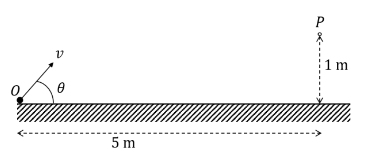
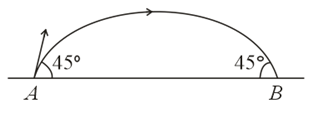
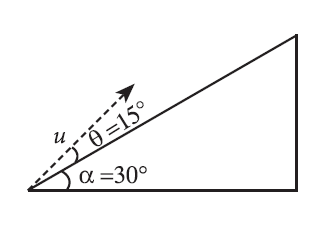
To solve this problem, we need to find the angular momentum of a ball at the highest point of its trajectory with respect to the point from which it was thrown. The ball has a mass of 160 g, is thrown at an angle of 60° to the horizontal with a speed of 10 m/s, and gravity is given as 10 m/s². Angular momentum is defined as the cross product of the position vector (from the reference point) and the linear momentum vector, so we'll calculate both at the highest point.
First, convert the mass to kilograms since SI units are required. The mass is 160 g, which is 160 divided by 1000, so mass $$ m = 0.160 $$ kg.
The initial velocity is 10 m/s at 60° to the horizontal. We resolve this into horizontal and vertical components:
Horizontal component: $$ u_x = u \cos \theta = 10 \cos 60^\circ $$
Since $$ \cos 60^\circ = \frac{1}{2} $$, $$ u_x = 10 \times \frac{1}{2} = 5 $$ m/s.
Vertical component: $$ u_y = u \sin \theta = 10 \sin 60^\circ $$
Since $$ \sin 60^\circ = \frac{\sqrt{3}}{2} $$, $$ u_y = 10 \times \frac{\sqrt{3}}{2} = 5\sqrt{3} $$ m/s.
At the highest point of the trajectory, the vertical component of velocity becomes zero ($$ v_y = 0 $$) because gravity acts downward, and the horizontal component remains unchanged since there is no horizontal acceleration. Therefore, the velocity at the highest point is purely horizontal: $$ v = v_x = u_x = 5 $$ m/s.
The linear momentum $$ \vec{p} $$ at the highest point is mass times velocity:
$$ \vec{p} = m \vec{v} = 0.160 \times 5 = 0.8 $$ kg m/s in the horizontal direction.
So, $$ \vec{p} = (0.8, 0) $$ kg m/s, where the first component is horizontal and the second is vertical.
Next, we find the position vector $$ \vec{r} $$ of the ball at the highest point relative to the point of projection. This requires the horizontal distance traveled ($$ x $$) and the maximum height ($$ H $$).
The maximum height $$ H $$ is given by the formula:
$$ H = \frac{u_y^2}{2g} $$
Substituting the values: $$ H = \frac{(5\sqrt{3})^2}{2 \times 10} = \frac{25 \times 3}{20} = \frac{75}{20} = 3.75 $$ m.
The time taken to reach the highest point $$ t $$ is the time when vertical velocity becomes zero:
$$ t = \frac{u_y}{g} = \frac{5\sqrt{3}}{10} = \frac{\sqrt{3}}{2} $$ seconds.
The horizontal distance $$ x $$ covered in this time is:
$$ x = u_x \times t = 5 \times \frac{\sqrt{3}}{2} = \frac{5\sqrt{3}}{2} $$ m.
So, the position vector $$ \vec{r} = \left( \frac{5\sqrt{3}}{2}, 3.75 \right) $$ m.
Angular momentum $$ \vec{L} $$ with respect to the point of projection is:
$$ \vec{L} = \vec{r} \times \vec{p} $$
In 2D, the magnitude of the cross product is $$ |\vec{L}| = |r_x p_y - r_y p_x| $$, where $$ r_x $$ and $$ r_y $$ are the components of $$ \vec{r} $$, and $$ p_x $$ and $$ p_y $$ are the components of $$ \vec{p} $$.
Here, $$ r_x = \frac{5\sqrt{3}}{2} $$, $$ r_y = 3.75 $$, $$ p_x = 0.8 $$, and $$ p_y = 0 $$.
So, $$ L = \left| \left( \frac{5\sqrt{3}}{2} \times 0 \right) - (3.75 \times 0.8) \right| = |0 - 3.75 \times 0.8| = | -3.0 | = 3.0 $$ kg m²/s.
Alternatively, using exact fractions:
$$ r_y = 3.75 = \frac{15}{4} $$ m (since $$ 3.75 = \frac{15}{4} $$),
$$ p_x = 0.8 = \frac{4}{5} $$ kg m/s,
So, $$ L = \left| -\left( \frac{15}{4} \times \frac{4}{5} \right) \right| = \left| -\frac{15 \times 4}{4 \times 5} \right| = \left| -\frac{15}{5} \right| = | -3 | = 3 $$ kg m²/s.
The magnitude is 3.0 kg m²/s, and the direction is perpendicular to the plane (negative sign indicates direction, but magnitude is positive).
Comparing with the options:
A. 1.73 kg m² s⁻¹
B. 3.46 kg m² s⁻¹
C. 3.0 kg m² s⁻¹
D. 6.0 kg m² s⁻¹
Hence, the correct answer is Option C.
 JEE WhatsApp Group