Join WhatsApp Icon JEE WhatsApp Group
JEE Fluid Mechanics Questions

Fluid Mechanics is a high-value chapter in the Properties of Matter unit of JEE Physics. It studies fluids at rest and in motion, introducing pressure, buoyancy, and the flow principles that govern everything from hydraulic lifts to aerodynamic lift. Because it blends conceptual reasoning with reliable numerical application, JEE Fluid Mechanics questions feature consistently in JEE Main and appear in JEE Advanced. This chapter covers fluid pressure, Pascal's law, Archimedes' principle, the equation of continuity, Bernoulli's theorem, and viscosity. JEE Main typically tests buoyancy, pressure, and Bernoulli applications, while JEE Advanced often integrates fluid statics and dynamics into multi-step problems. Practising topic-wise JEE Questions helps you master the distinction between static and dynamic fluid behaviour and apply the right principle quickly.

A clear grasp of fluid mechanics also reinforces concepts of pressure, energy conservation, and equilibrium that recur throughout Physics.

Fluid Mechanics Topic Overview

Parameter

Details

Topic Name

Fluid Mechanics

Subject

Physics

JEE Main Weightage

~3–5% (1–2 questions on average)

JEE Advanced Weightage

~4–6% (often in combined problems)

Difficulty Level

Moderate

Important Concepts

Pressure, Pascal's Law, Buoyancy, Continuity, Bernoulli's Theorem, Viscosity

Recommended Practice Level

High – attempt 60+ mixed problems

Why Practice JEE Fluid Mechanics Questions?

  • Reliable weightage: Fluid mechanics contributes 1–2 questions in JEE Main most years.
  • Conceptual and numerical mix: Questions test both understanding and calculation, rewarding balanced preparation.
  • Strong in Advanced: Bernoulli and viscosity problems appear in JEE Advanced multi-step sets.
  • Real-world intuition: Buoyancy and flow concepts build physical insight valued in problem-solving.
  • Energy connection: Bernoulli's theorem reinforces energy conservation in a new context.
  • Distinct sub-areas: Statics and dynamics offer varied question types for thorough practice.
  • Improves setup skills: Choosing the right principle quickly is a transferable exam skill.

Important Concepts and Subtopics

Concept

Importance

Difficulty Level

Frequently Asked In

Fluid Pressure & Pascal's Law

Very High

Easy–Moderate

JEE Main

Buoyancy & Archimedes' Principle

Very High

Moderate

JEE Main & Advanced

Equation of Continuity

High

Easy–Moderate

JEE Main

Bernoulli's Theorem & Applications

Very High

Moderate–High

JEE Main & Advanced

Viscosity & Stokes' Law

High

Moderate

JEE Main & Advanced

Terminal Velocity

Moderate

Moderate

JEE Main

Preparation Strategy for JEE Fluid Mechanics

Concept learning: Separate fluid statics (pressure, buoyancy) from fluid dynamics (continuity, Bernoulli). Understand how pressure varies with depth and how Bernoulli's theorem expresses energy conservation for flowing fluids.

Formula revision: Keep relations for pressure with depth, buoyant force, continuity, Bernoulli's equation, and Stokes' law handy. Pairing practice with structured JEE Online Coaching helps you reinforce these derivations and clear doubts on tricky Bernoulli applications.

Problem-solving techniques: For statics, balance pressures and forces carefully. For dynamics, apply continuity and Bernoulli together, choosing two points where conditions are known. Use Stokes' law for slow motion through viscous fluids.

Common mistakes: Confusing gauge and absolute pressure, ignoring the velocity term in Bernoulli's equation, misapplying buoyancy for partially submerged bodies, and unit errors in viscosity.

Exam strategy: Solve direct pressure and buoyancy questions first, then attempt Bernoulli and viscosity problems that need more setup.

JEE Main & Advanced Weightage Analysis

Exam

Average Questions

Expected Marks

JEE Main

1–2

4–8

JEE Advanced

1–2

4–8

Fluid Mechanics is a steady contributor in JEE Main through pressure, buoyancy, and Bernoulli questions. In JEE Advanced, it often appears within combined problems demanding both statics and dynamics reasoning.

Tips to Solve Fluid Mechanics Questions Faster

  • Distinguish gauge from absolute pressure before substituting values.
  • For floating bodies, equate weight to buoyant force to find the submerged fraction quickly.
  • Apply continuity and Bernoulli together by choosing two well-defined points in the flow.
  • Use Stokes' law and terminal-velocity relations directly for slow viscous motion.
  • Remember that higher fluid speed means lower pressure in Bernoulli's theorem.
  • Keep all quantities in SI units, especially for viscosity problems.

Reinforcing these methods with a timed JEE Mock Test helps you choose the right principle instantly under exam pressure.

JEE Fluid Mechanics Questions

Question 1

Question Stem for Question Nos. 15 and 16

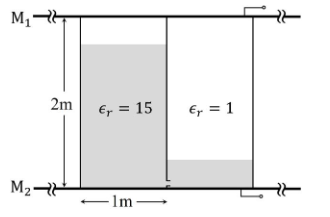
A container of height $$2\,\mathrm{m}$$, length $$2\,\mathrm{m}$$ and breadth $$1\,\mathrm{m}$$ is made of insulating vertical walls and two large area horizontal metal plates ($$M_1$$ and $$M_2$$) which extend far beyond the vertical walls in all directions. The container is partitioned into two equal chambers with a thin insulating vertical wall. The partition wall contains a small hole of cross-sectional area $$\sqrt{10}\,\mathrm{cm^2}$$ near its bottom edge. Initially the hole is closed and the left chamber of the container is completely filled with a liquid of dielectric constant $$\epsilon_r=15$$ and the right chamber is empty ($$\epsilon_r=1$$). At time $$t=0$$, the hole is opened and the liquid flows from the left chamber to the right chamber. In both the chambers, the space above the liquid has $$\epsilon_r=1$$ and is maintained at atmospheric pressure. The schematic of the container at a time $$t>0$$ is shown in the figure.

[Given: acceleration due to gravity is $$10\,\mathrm{ms^{-2}}$$.]

image

The height (in m) of the liquid in left chamber at $$t=500\,\mathrm{s}$$ is:

Question 2

A small metallic sphere of diameter 2 mm and density $$10.5 g/cm ^{3}$$ is dropped in glycerine having viscosity 10 Poise and density $$1.5 g/cm^{3}$$ respectively. The terminal velocity attained by the sphere is __ $$cm/s$$.
$$(\pi=\frac{22}{7} \text { and } g=10m/s^{2})$$

Video Solution
Question 3

A cubical block of density $$\rho_{b}= 600kg/m^{3}$$ floats in a liquid of density $$\rho_{e}= 900kg/m^{3}$$. If the height of block is H = 8.0 cm then height of the submerged part is ________ cm.

Question 4

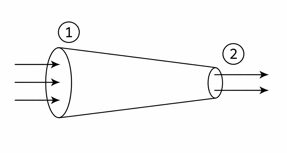
A water spray gun is attached to a hose of cross sectional area 30 cm$$^2$$. The gun comprises of 10 perforations each of cross sectional area of 15 mm$$^2$$. If the water flows in the hose with the speed of 50 cm/s, calculate the speed at which the water flows out from each perforation. (Neglect any edge effects)

Video Solution
Question 5

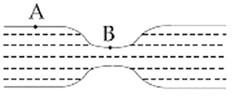
A liquid of density 600 kg/m$$^3$$ flowing steadily in a tube of varying cross-section. The cross-section at a point $$A$$ is 1.0 cm$$^2$$ and that at $$B$$ is 20 mm$$^2$$. Both the points $$A$$ and $$B$$ are in same horizontal plane, the speed of the liquid at $$A$$ is 10 cm/s. The difference in pressures at $$A$$ and $$B$$ points is __________ Pa.

Video Solution
Question 6

A cylindrical vessel of 40 cm radius is completely filled with water and its capacity is 528 dm$$^3$$ (dm : decimeter). The vessel is placed on a solid block of exactly same height as vessel. If a small hole is made at 70 cm below the top of water level, then horizontal range of water falling on the ground in the beginning is __________ cm.

Question 7

A spherical liquid drop of radius $$R$$ acquires the terminal velocity $$v_1$$ when falls through a gas of viscosity $$\eta$$. Now the drop is broken into 64 identical droplets and each droplet acquires terminal velocity $$v_2$$ falling through the same gas. The ratio of terminal velocities $$v_1/v_2$$ is __________.

Question 8

If an air bubble of diameter 2 mm rises steadily through a liquid of density 2000 kg/m$$^3$$ at a rate of 0.5 cm/s, then the coefficient of viscosity of liquid is _________ Poise. (Take $$g = 10$$ m/s$$^2$$)

Question 9

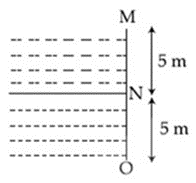
Water drops fall from a tap on the floor, 5 m below, at regular intervals of time, the first drop strikes the floor when the sixth drop begins to fall. The height at which the fourth drop will be from ground, at the instant when the first drop strikes the ground is _____ m.
$$(g=10m/s^{2}$$

Question 10

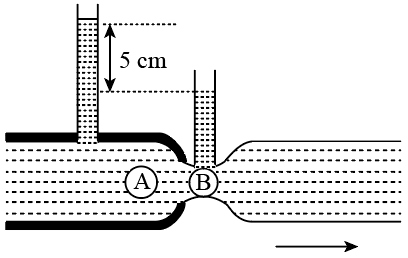
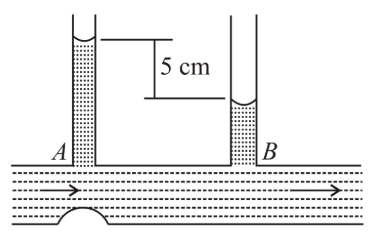
Water flows through a horizontal tube as shown in the figure. The difference in height between the water colunms in vertical tubes is 5 cm and the area of cross-sections at A and B are $$6cm^{2}$$ and $$3cm^{2}$$ respectively. The rate of flow will be ____ $$cm^{3/s}$$. $$(take g=10m/s^{2})$$

Screenshot_5
Question 11

Given below are two statements:

Statement I : Pressure of a fluid is exerted only on a solid surface in contact as the fluid-pressure does not exist everywhere in a still fluid.
Statement II: Excess potential energy of the molecules on the surface of a liquid, when compared to interior, results in surface tension.

In the light of the above statements, choose the correct answer from the options given below

Question 12

A spherical body of radius r and density $$\sigma$$ falls freely through a viscous liquid having density $$\rho$$ and viscosity $$\eta$$ and attains a terminal velocity $$\upsilon_{0}$$. Estimated maximum error in the quantity $$\eta$$ is: (Ignore errors associated with $$\sigma,\rho$$ and g, gravitational acceleration)

Question 13

A ball of radius r and density $$\rho$$ dropped through a viscous liquid of density $$\sigma$$ and viscosity $$\eta$$ attains its terminal velocity at time t, given by $$t= A \rho^{a}r^{b}\eta^{c}\sigma^{d}$$, where A is a constant and a, b, c and d are integers. The value of $$\frac{b+c}{a+d}$$ is _________.

Question 14

A soap bubble of surface tension 0.04 N/m is blown to a diameter of 7 cm. If (15000 - x) $$\mu J$$ of work is done in blowing it further to make its diameterl4 cm, then the value of x is_____.
$$\left(\pi=22/7\right)$$

Question 15

Sixty four rain drops of radius 1 mm each falling down w-ith a terminal velocity of 10 cm/s coalesce to fonn a bigger drop. The terminal velocity of bigger drop is_____cm/s

Question 16

A tub is filled with water and a wooden cube 10 cm × 10 cm × 10 cm is placed in the water. The wooden cube is found to float on the water with a part of it submerged in water. When a metal coin is placed on the wooden cube, the submerged part is increased by 3.87 cm. The mass of the metal coin is __________ gram. (Take water density as 1 g/cm$$^3$$ and density of wood = 0.4 g/cm$$^3$$)

Question 17

The terminal velocity of a metallic ball of radius 6 mm in a viscous fluid is 20 cm/s. The terminal velocity of another ball of same material and having radius 3 mm in the same fluid will be ________ cm/ s.

Question 18

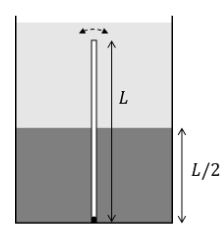
A tank contains two immiscible liquids of densities $$6\rho$$ and $$2\rho$$. The higher density liquid is filled up to a height $$L/2$$ from the bottom. A thin rod of density $$\rho$$ and length $$L$$ is fully immersed and hinged at the bottom so that it can oscillate freely, as shown in the figure. If the rod is slightly disturbed from its equilibrium, the time period of small oscillations is $$\dfrac{2\pi}{n}\sqrt{\dfrac{L}{g}}$$, where $$g$$ is the acceleration due to gravity. The value of $$n$$ is:

image

Frequently Asked Questions