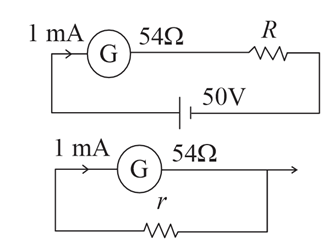
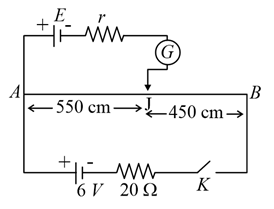
We have been told that the figure of merit of the galvanometer is $$k = 60\;\mu\text{A division}^{-1}$$. By definition,
$$I_g = k\,\theta$$
where $$I_g$$ is the current through the galvanometer and $$\theta$$ is the scale deflection in divisions. Substituting $$\theta = 9$$ divisions,
$$I_g = 60\;\mu\text{A}\times 9 = 540\;\mu\text{A}= 5.4\times10^{-4}\ \text{A}$$
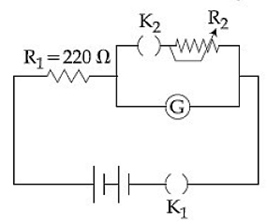
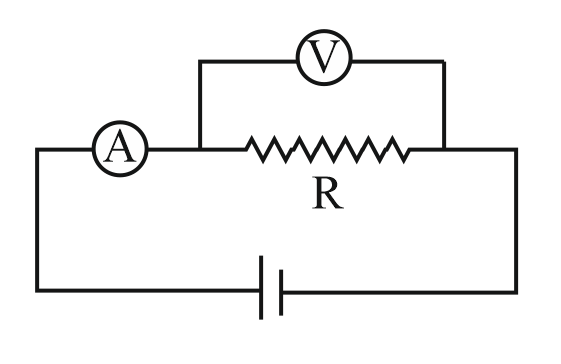
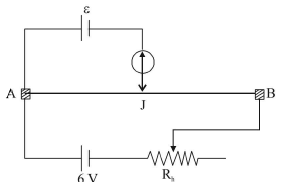
In the first observation (no shunt connected) the 6 V battery drives this current through the series combination of the high resistance $$R = 11\ \text{k}\Omega = 11000\ \Omega$$ and the unknown resistance $$G$$ of the galvanometer itself. Applying Ohm’s law,
$$V = I_g\,(R+G)$$
Substituting $$V = 6\ \text{V}$$ and $$I_g = 5.4\times10^{-4}\ \text{A}$$,
$$6 = 5.4\times10^{-4}\,(11000 + G)$$
$$\Rightarrow\; 11000 + G = \frac{6}{5.4\times10^{-4}}$$
$$\Rightarrow\; 11000 + G = 11111.11$$
$$\Rightarrow\; G = 11111.11 - 11000 = 111.11\ \Omega$$
So, the resistance of the galvanometer is approximately $$G \approx 111\ \Omega$$.
We now connect a shunt resistance $$S$$ in parallel with the galvanometer. We wish the new deflection to be $$\dfrac{\theta}{2}$$, i.e. the current through the galvanometer must fall to
$$I_g' = \frac{I_g}{2} = \frac{5.4\times10^{-4}}{2}= 2.7\times10^{-4}\ \text{A}$$
Let $$R_p$$ be the equivalent resistance of $$G$$ in parallel with $$S$$. The formula for two resistances in parallel is first stated:
$$R_p = \frac{G\,S}{G+S}$$
The total resistance in the circuit after the shunt is connected is $$R + R_p$$, so the total current delivered by the battery is
$$I = \frac{V}{R + R_p} = \frac{6}{11000 + R_p}$$
Current division tells us that the current through the galvanometer branch is
$$I_g' = I\;\frac{S}{G+S}$$
We require $$I_g' = 2.7\times10^{-4}\ \text{A}$$. Substituting all relations step by step,
$$2.7\times10^{-4} = \frac{6}{11000 + R_p}\;\frac{S}{G+S}$$
Because $$R_p = \dfrac{G\,S}{G+S}$$, we replace it and obtain one single equation containing only the unknown $$S$$:
$$2.7\times10^{-4} = \frac{6}{11000 + \dfrac{G\,S}{G+S}}\;\frac{S}{G+S}$$
To eliminate the fractions we multiply both sides by the two denominators:
$$\Bigl(2.7\times10^{-4}\Bigr)\Bigl(11000 + \dfrac{G\,S}{G+S}\Bigr)(G+S) = 6\,S$$
It is more convenient, however, to work with the ratio $$\dfrac{I_g'}{I_g}$$, because $$I_g'/I_g = 1/2$$ by design. Starting from
$$\frac{I_g'}{I_g} = \frac{V}{R+R_p}\;\frac{S}{G+S}\;\frac{R+G}{V}= \frac{R+G}{R+R_p}\;\frac{S}{G+S}$$
and demanding $$\dfrac{I_g'}{I_g}= \dfrac12$$, we write
$$\frac{1}{2} = \frac{R+G}{R+R_p}\;\frac{S}{G+S}$$
Now substitute the known numerical values $$R = 11000\ \Omega$$, $$G = 111.11\ \Omega$$ and $$R_p = \dfrac{G\,S}{G+S}$$:
$$\frac12 = \frac{11000+111.11}{11000+\dfrac{111.11\,S}{111.11+S}}\;\frac{S}{111.11+S}$$
The numerator $$R+G = 11000+111.11 = 11111.11$$, so a single explicit equation in $$S$$ is obtained:
$$\frac12 = \frac{11111.11}{11000+\dfrac{111.11\,S}{111.11+S}}\;\frac{S}{111.11+S}$$
Multiply both sides by the denominators to clear the fractions. First multiply by 2, then by the two bracketed terms:
$$2\times 11111.11\,S = \Bigl(11000+\dfrac{111.11\,S}{111.11+S}\Bigr)\,(111.11+S)$$
Compute the left-hand side:
$$2\times11111.11\,S = 22222.22\,S$$
For the right-hand side we distribute carefully:
$$\Bigl(11000+\dfrac{111.11\,S}{111.11+S}\Bigr)\,(111.11+S)=11000(111.11+S)+111.11\,S$$
Now insert this in the equality:
$$22222.22\,S = 11000(111.11+S)+111.11\,S$$
Expand the product containing 11000:
$$11000\times111.11 = 1222210$$
and
$$11000\times S = 11000\,S$$
so that the right-hand side becomes
$$1222210 + 11000\,S + 111.11\,S = 1222210 + 11111.11\,S$$
Our equation is now purely linear in $$S$$:
$$22222.22\,S = 1222210 + 11111.11\,S$$
Bring the term $$11111.11\,S$$ to the left to collect like terms:
$$(22222.22 - 11111.11)\,S = 1222210$$
$$11111.11\,S = 1222210$$
Finally divide to obtain $$S$$:
$$S = \frac{1222210}{11111.11} \approx 110\ \Omega$$
The answer that is the closest to this calculated value is 110 $$\Omega$$.
Hence, the correct answer is Option D.
 JEE WhatsApp Group