Join WhatsApp Icon JEE WhatsApp Group

JEE Electric Potential & Capacitance Questions

Electric Potential and Capacitance is a high-weightage, high-scoring chapter in the Electrodynamics unit of JEE Physics. Building directly on electric charges and fields, it introduces electric potential, potential energy, and the storage of charge in capacitors. Because the concepts are precise and the question patterns are well established, JEE Electric Potential and Capacitance questions appear reliably in both JEE Main and JEE Advanced and reward consistent, structured practice. This chapter covers electric potential and potential difference, equipotential surfaces, potential energy of charge systems, capacitance of various configurations, series and parallel combinations, dielectrics, and energy stored in capacitors. JEE Main typically tests capacitor networks and energy calculations, while JEE Advanced often integrates capacitance with circuits, dielectrics, or field reasoning. Practising topic-wise JEE Questions helps you simplify complex capacitor networks and apply energy relations with confidence.

A strong grasp of potential and capacitance also feeds directly into current electricity and electromagnetic induction, where charging, discharging, and energy storage recur. The chapter rewards students who treat potential as a scalar and who can redraw and reduce capacitor networks systematically. Because so many later topics depend on it, the time invested here pays back across the whole Electrodynamics unit, and the question patterns are stable enough that focused practice converts quickly into accuracy.

Electric Potential and Capacitance Topic Overview

Parameter

Details

Topic Name

Electric Potential and Capacitance

Subject

Physics

JEE Main Weightage

~4–6% (2–3 questions on average)

JEE Advanced Weightage

~5–8% (often in combined sets)

Difficulty Level

Moderate to High

Important Concepts

Electric Potential, Potential Energy, Capacitance, Dielectrics, Energy Stored

Recommended Practice Level

High – attempt 80+ mixed problems

Why Practice JEE Electric Potential and Capacitance Questions?

  • High weightage: This chapter contributes 2–3 questions in JEE Main most years.
  • Scalar simplicity: Potential is a scalar, so many problems are quicker than field calculations.
  • Strong in Advanced: Capacitor networks and dielectrics are JEE Advanced favourites.
  • Feeds later chapters: Charging and energy storage recur in circuits and induction.
  • Network reduction skills: Practice builds the ability to simplify complex combinations.
  • Reliable energy questions: Energy-stored formulas yield consistent, scoring problems.
  • Concept-rich: Equipotentials and potential energy deepen overall electrostatic intuition.

Important Concepts and Subtopics

Concept

Importance

Difficulty Level

Frequently Asked In

Electric Potential & Potential Difference

Very High

Moderate

JEE Main & Advanced

Potential Energy of Charge Systems

High

Moderate

JEE Main & Advanced

Equipotential Surfaces

Moderate

Easy–Moderate

JEE Main

Capacitance & Parallel-Plate Capacitor

Very High

Moderate

JEE Main & Advanced

Series & Parallel Combinations

Very High

Moderate–High

JEE Main & Advanced

Dielectrics & Capacitance Change

High

Moderate–High

JEE Advanced

Energy Stored in Capacitors

Very High

Moderate

JEE Main & Advanced

Charge Redistribution

Moderate

Moderate

JEE Advanced

Preparation Strategy for JEE Electric Potential and Capacitance

Concept learning: Start with electric potential as work done per unit charge and its relation to the electric field. Understand potential energy of charge configurations, then move to capacitance, learning how geometry and dielectrics determine it. Master series and parallel rules, which differ from those for resistors.

Formula revision: Keep relations for potential due to point charges, capacitance of standard configurations, combination rules, dielectric effects, and energy stored together for quick review. Well-organised JEE Study Material helps you keep these formulas and their conditions in one place for fast revision before the exam.

Problem-solving techniques: For networks, redraw the circuit to expose clear series and parallel sections, then reduce step by step. For dielectric problems, decide whether charge or voltage is held constant before computing changes. Use energy conservation for charge-redistribution questions.

Common mistakes: Swapping the series and parallel rules for capacitors, forgetting whether charge or voltage stays constant with a dielectric, sign errors in potential energy, and treating potential as a vector.

Exam strategy: Solve direct capacitance and energy questions first, then tackle network and dielectric problems that need more setup. When capacitance links to a circuit problem, resolve the steady-state charge before analysing transients.

JEE Main & Advanced Weightage Analysis

Exam

Average Questions

Expected Marks

JEE Main

2–3

8–12

JEE Advanced

2–3 (often combined)

8–16

Electric Potential and Capacitance is a consistently heavy chapter in JEE Main and a frequent source of network and dielectric problems in JEE Advanced. Mastery here strengthens the entire Electrodynamics unit.

Tips to Solve Electric Potential and Capacitance Questions Faster

  • Treat potential as a scalar and add contributions algebraically before finding the field.
  • Redraw capacitor networks to expose series and parallel sections clearly.
  • Remember capacitor combination rules are opposite to those for resistors.
  • For dielectrics, fix whether charge or voltage is constant before computing changes.
  • Use energy stored (½CV² or Q²/2C) directly for energy questions.
  • Apply charge conservation for redistribution between connected capacitors.

Reinforcing these techniques with a timed JEE Mock Test builds the network-reduction speed that this chapter demands.

JEE Electric Potential & Capacitance Questions

Question 1

Question Stem for Question Nos. 15 and 16

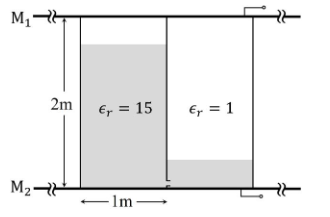
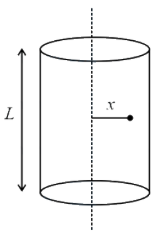
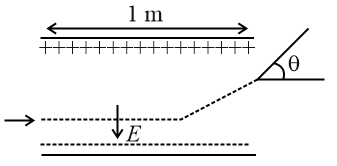
A container of height $$2\,\mathrm{m}$$, length $$2\,\mathrm{m}$$ and breadth $$1\,\mathrm{m}$$ is made of insulating vertical walls and two large area horizontal metal plates ($$M_1$$ and $$M_2$$) which extend far beyond the vertical walls in all directions. The container is partitioned into two equal chambers with a thin insulating vertical wall. The partition wall contains a small hole of cross-sectional area $$\sqrt{10}\,\mathrm{cm^2}$$ near its bottom edge. Initially the hole is closed and the left chamber of the container is completely filled with a liquid of dielectric constant $$\epsilon_r=15$$ and the right chamber is empty ($$\epsilon_r=1$$). At time $$t=0$$, the hole is opened and the liquid flows from the left chamber to the right chamber. In both the chambers, the space above the liquid has $$\epsilon_r=1$$ and is maintained at atmospheric pressure. The schematic of the container at a time $$t>0$$ is shown in the figure.

[Given: acceleration due to gravity is $$10\,\mathrm{ms^{-2}}$$.]

image

The difference in the capacitance (in F) between the metal plates at $$t=0$$ and that at $$t=500\,\mathrm{s}$$ is $$(8-n)\epsilon_0$$, where $$\epsilon_0$$ is the permittivity of free space. The value of $$n$$ is:

Question 2

The electrostatic potential in a charged spherical region of radius r varies as $$V=ar^{3}+b$$, where a and b are constants. The total charge in the sphere of unit radius is $$\alpha \times \pi a\in_{\circ}$$. the value of $$\alpha$$ is_____. (permittivity of vacuum is $$\in_{\circ}$$)

Question 3

Electric field in a region is given by $$\overrightarrow{E}=Ax\widehat{i}+By\widehat {j}$$, where $$A= 10V/m^{2}$$, and $$B= 5V/m^{2}$$. If the electric potential at a point (10, 20) is 500 $$V$$, then the electric potential at origin is____ $$V$$.

Question 4

Identify the correct statements:
A. Effective capacitance of a series combination of capacitors is always smaller than the smallest capacitance of the capacitor in the combination.
B. When a dielectric mediwn is placed between the charged plates of a capacitor, displacement of charges cannot occurdue to insulation property of dielectric.
C. Increasing of area of capacitor plate or decreasing of thickness of dielectric is an alternate method to increase the capacitance.
D. For a point charge, concentric spherical shells centered at the location of the charge are equipotential surfaces.
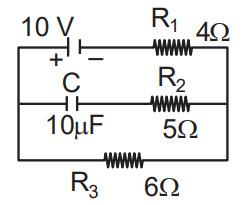
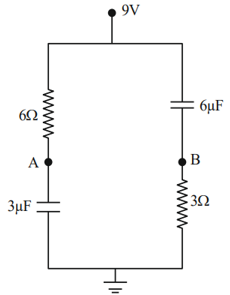
Choose the correct answer from the options given below :

Video Solution
Question 5

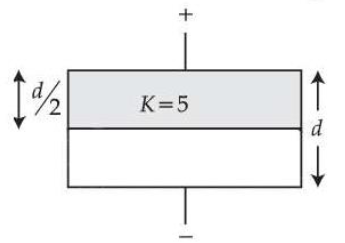
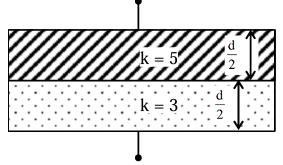
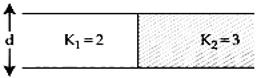
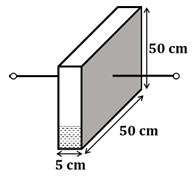
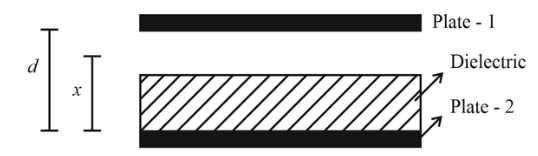
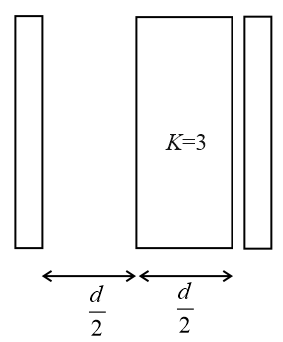
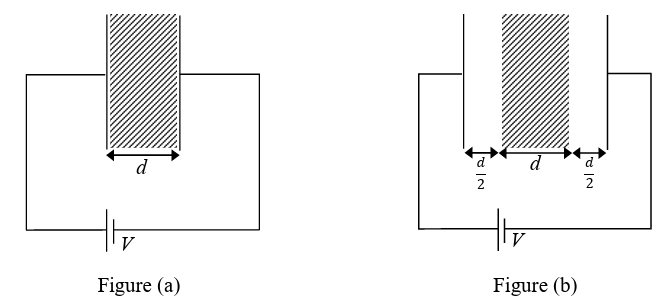
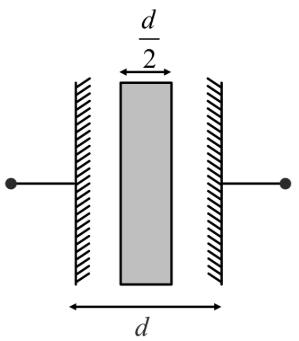
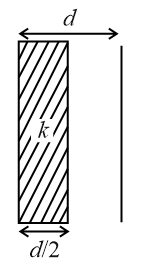
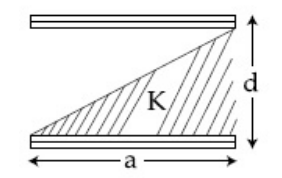
A parallel plate air capacitor has a capacitance C. When it is half filled as shown in figure with a dielectric constant $$K = 5$$, the percentage increase in the capacitance is __________.
image
Video Solution
Question 6

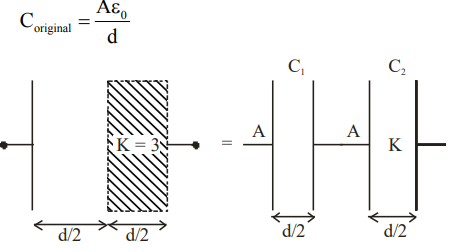
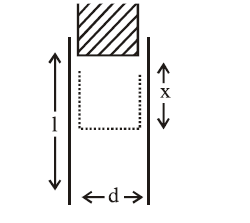
A parallel plate capacitor has capacitance C, when there is vacuum within the parallel plates. A sheet having thickness $$\left(\frac{1}{3}\right)^{rd}$$ of the separation between the plates and relative permittivity K is introduced between the plates. The new capacitance of the system is:

Question 7

There are three co-centric conducting spherical shells A, B and C of radii a, b and c respectively (c > b > a) and they are charged with charge $$q_{1},q_{2}\text{ and }q_{3}$$ respectively. The potentials of the spheres A, Band C respectively, are :

Question 8

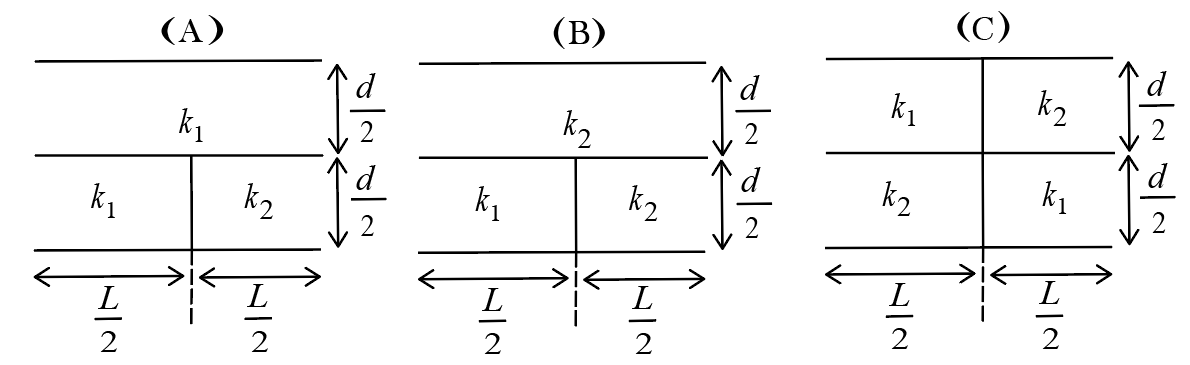
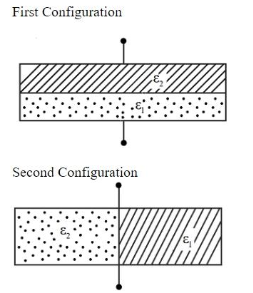
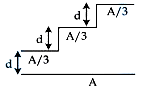
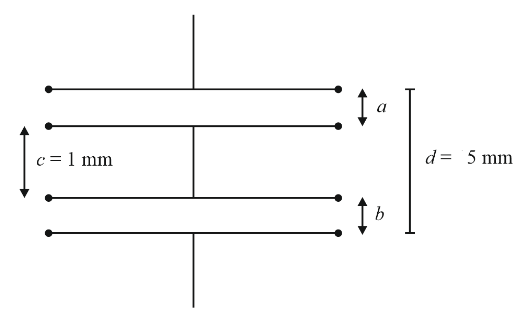
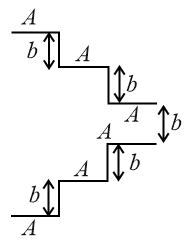
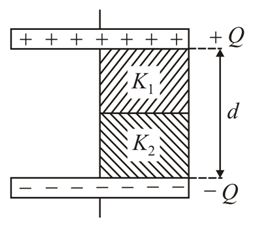
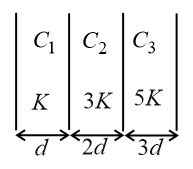
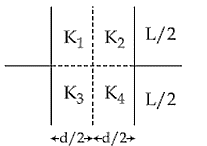
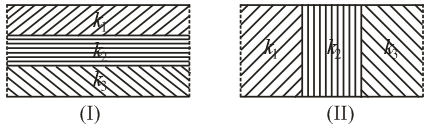
Three parallel plate capacitors each with area A and separation dare filled with two dielectric $$(k_{1} \text{and} k_{2})$$ in the following fashion. Which of the following is true? $$(k_{1}>  k_{2})$$

image
Question 9

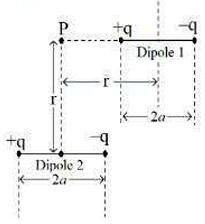
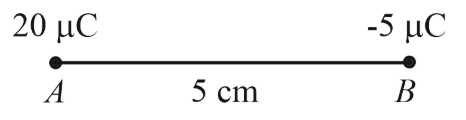
Two charges $$7\mu C$$ and  $$-2\mu C$$ are placed at (-9,0,0)cm and (9,0,0)cm respectively in an external field $$E=\frac{A}{r^{2}}\overline{r}$$, where $$A=9\times 10^{5}N/C.m^{2}.$$ Considering the potential at infinity is 0, the electrostatic energy of the configuration is ______J.

Question 10

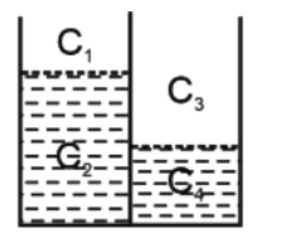
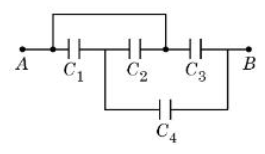
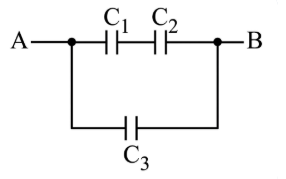
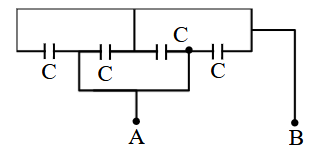
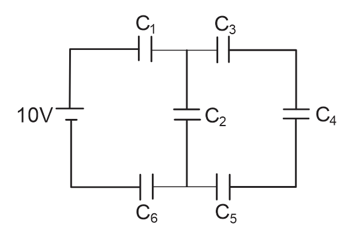
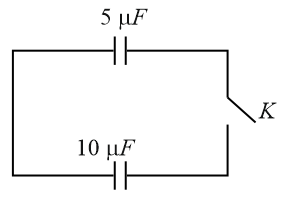
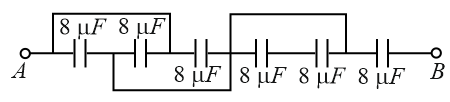
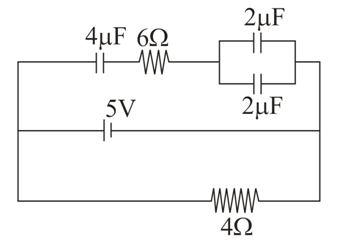
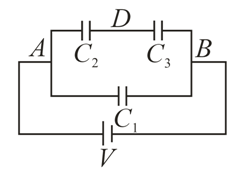
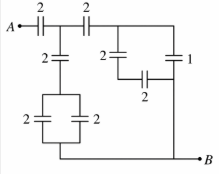
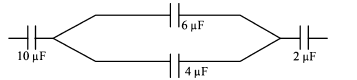
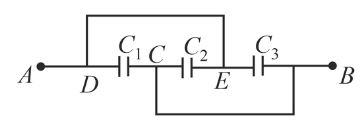
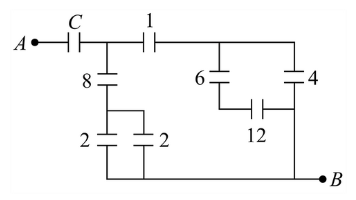
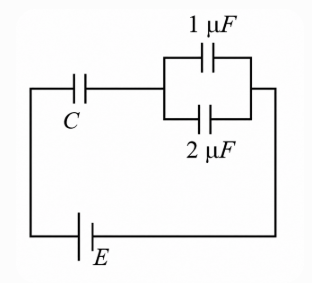
From the circuit given below, the capacitance between terminals A and B shown in the circuit is ______ $$\mu$$F.
(take $$C_1 = C_2 = C_3 = 1$$ $$\mu$$F and $$C_4 = 2$$ $$\mu$$F.)

image
Question 11

Two metal plates (A, B) are kept horizontally with separation of $$\frac{12}{\pi}$$ cm, with plate A on the top. An atomizer jet sprays oil (density $$1.5$$ g/cm$$^3$$) droplets of radius 1 mm horizontally. All oil droplets carry a charge 5 nC. The potentials $$V_A$$ and $$V_B$$ are required on plates A and B respectively in order to ensure the droplets do not descend. The values of $$V_A$$ and $$V_B$$ are ______.
(Neglect the air resistance to the droplets and take $$g = 10$$ m/s$$^2$$)

Question 12

A parallel plate air capacitor is connected to a battery. The plates are pulled apart at uniform speed $$v$$. If $$x$$ is the separation between the plates at any instant, then the time rate of change of electrostatic energy of the capacitor is proportional to $$x^{\alpha}$$, where $$\alpha$$ is :

Question 13

A sphere of capacitance 100 pF is charged to a potential of 100 V. Another identical uncharged metal sphere is brought in contact with the charged sphere, then the change in the total energy stored on these spheres, when they touch is $$\alpha \times 10^{-7}$$ J. The value of $$\alpha$$ is __________. (combined capacitance of spheres is 200 pF)

Question 14

A parallel plate capacitor with plate separation 5 mm is charged by a battery. On introducing a mica sheet of 2 mm and maintaining the connections of the plates with the terminals of the battery, it is found that it draws 25% more charge from the battery. The dielectric constant of mica is _______.

Question 15

Three small identical bubbles of water having same charge on each coalesce to form a bigger bubble. Then the ratio of the potentials on one initial bubble and that on the resultant bigger bubble is :

Question 16

A parallel plate capacitor is having separation between plates 0.885 mm. It has a capacitance of 1 $$\mu$$F when the space between the plates is filled with an insulating material of resistivity $$1 \times 10^{13}$$ $$\Omega$$m and resistance $$17.7 \times 10^{14}$$ $$\Omega$$. Relative permittivity of the insulating material is $$a \times 10^7$$. The value of $$a$$ is __________. (Take permittivity of free space $$= 8.85 \times 10^{-12}$$ F/m)

Question 17

A capacitor P with capacitance $$10 \times 10^{-6} F$$ is fully charged with a potential difference of 6.0 V and disconnected from the battery. The charged capacitor P is connected across another capacitor Q with capacitance $$20 \times 10^{-6} F$$. The charge on capacitor Q when equilibrium is established will be $$\alpha \times 10^{-5}C$$ (assume capacitor Q does not have any charge initially), the value of $$\alpha$$ is _________.

Question 18

A three coulomb charge moves from the point (0, -2, -5) to the point (5, 1, 2) in an electric field expressed as $$\vec{E} = 2x\hat{i} + 3y^2\hat{j} + 4\hat{k}$$ N/C. The work done in moving the charge is _______ J.

Question 19

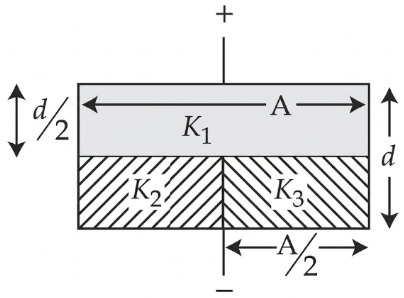
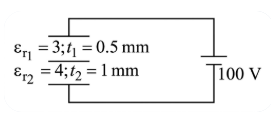
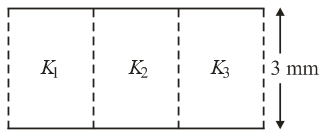
The space between the plates of a parallel plate capacitor of capacitance C (without any dielectric) is now filled with three dielectric slabs of dielectric constants $$K_{1}=2,K_{2}=3\text{ and } K_{3}=5$$ (as shown in figtue). lf new capacitance is $$\frac{n}{3}C$$ then the value of n is_____.

49
Question 20

Two charges $$Q_1=q$$ and $$Q_2=mq$$ are placed at the points $$P_1(a,b)$$ and $$P_2(ma,mb)$$, respectively, in the $$XY$$ plane, where $$a,b\neq 0$$ and $$m\neq 0,1$$. If $$V_1$$ is the potential at a point in the $$XY$$ plane due to charge $$Q_1$$ and $$V_2$$ is the potential at that point due to charge $$Q_2$$. Correct statement(s) for the points at which $$|V_1|=|V_2|$$ is/are:

Frequently Asked Questions