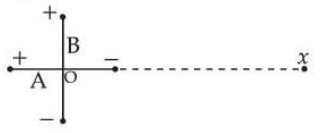
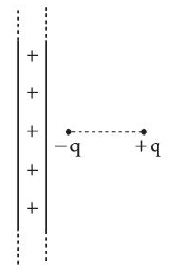
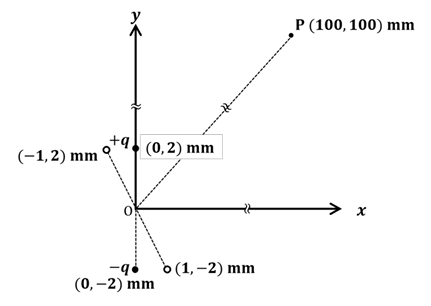
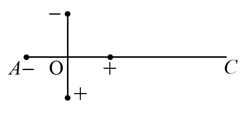
We have four point charges placed on the y-axis. Their positions and values are
$$q_1=-q\;{\rm at}\;(0,-2d),\qquad
q_2=+q\;{\rm at}\;(0,-d),\qquad
q_3=+q\;{\rm at}\;(0,+d),\qquad
q_4=-q\;{\rm at}\;(0,+2d).$$
The point at which we want the electric field is $$P(D,0)\,,$$ i.e. a point on the x-axis with $$x=D$$ and $$y=0$$, where $$D\gg d.$$
For any point charge $$q_i$$ located at $$(0,y_i)$$ the position vector from the charge to $$P$$ is
$$\vec r_i=\bigl(D\,\hat i+(0-y_i)\,\hat j\bigr)=D\,\hat i-y_i\,\hat j.$$
The distance of the point from the charge is therefore
$$r_i=\sqrt{D^{\,2}+y_i^{\,2}}.$$
Statement of the formula: The electric field due to a point charge is
$$\vec E_i=\dfrac{k\,q_i}{r_i^{\,2}}\;\hat r_i
=\dfrac{k\,q_i}{r_i^{\,3}}\;\vec r_i,$$
where $$k=\dfrac{1}{4\pi\varepsilon_0}$$ and $$\hat r_i=\dfrac{\vec r_i}{r_i}.$$
Substituting $$\vec r_i$$ we get the two Cartesian components for every charge:
$$E_{ix}= \dfrac{k\,q_i D}{\bigl(D^{\,2}+y_i^{\,2}\bigr)^{3/2}},\qquad
E_{iy}= \dfrac{k\,q_i(-y_i)}{\bigl(D^{\,2}+y_i^{\,2}\bigr)^{3/2}}.$$
Now we first check the $$y$$-components. The charges at $$y=+d$$ and $$y=-d$$ have the same sign $$+q$$ but opposite $$y_i$$, so their $$E_{iy}$$ cancel. In the same way the charges at $$y=+2d$$ and $$y=-2d$$ have the same sign $$-q$$ and again opposite $$y_i$$, so those $$E_{iy}$$ also cancel. Hence,
$$\sum_{i=1}^{4}E_{iy}=0,$$
and the total electric field at $$P$$ is purely along the x-direction.
Therefore the magnitude of the net field equals the sum of the x-components:
$$E=\sum_{i=1}^{4}E_{ix}=kD\sum_{i=1}^{4}
\dfrac{q_i}{\bigl(D^{\,2}+y_i^{\,2}\bigr)^{3/2}}.$$
Because $$D\gg d,$$ we expand each denominator with the binomial series. We start from
$$\bigl(D^{\,2}+y_i^{\,2}\bigr)^{-3/2}=D^{-3}\Bigl(1+\dfrac{y_i^{\,2}}{D^{\,2}}\Bigr)^{-3/2}.$$
Using $$(1+s)^{-3/2}=1-\dfrac{3}{2}s+\dfrac{15}{8}s^{2}-\ldots,$$ we substitute $$s=\dfrac{y_i^{\,2}}{D^{\,2}}$$ to obtain
$$\bigl(D^{\,2}+y_i^{\,2}\bigr)^{-3/2}=D^{-3}\Bigl[1-\dfrac{3}{2}\dfrac{y_i^{\,2}}{D^{\,2}}
+\dfrac{15}{8}\dfrac{y_i^{\,4}}{D^{\,4}}-\ldots\Bigr].$$
Substituting this expansion back into the expression for $$E$$ gives
$$E=kD\sum_{i=1}^{4}q_i
D^{-3}\Bigl[1-\dfrac{3}{2}\dfrac{y_i^{\,2}}{D^{\,2}}
+\dfrac{15}{8}\dfrac{y_i^{\,4}}{D^{\,4}}-\ldots\Bigr].$$
Simplifying the common factor $$D$$ with $$D^{-3}$$ we have
$$E=k\sum_{i=1}^{4}q_i
\Bigl[D^{-2}-\dfrac{3}{2}\dfrac{y_i^{\,2}}{D^{\,4}}
+\dfrac{15}{8}\dfrac{y_i^{\,4}}{D^{\,6}}-\ldots\Bigr].$$
We now evaluate the sums term by term.
1. The monopole term (total charge):
$$\sum_{i=1}^{4}q_i=(-q)+(+q)+(+q)+(-q)=0.$$
So the entire $$D^{-2}$$ contribution vanishes.
2. The next (quadrupole) term involves $$\sum q_i y_i^{\,2}\!:$$
$$\begin{aligned}
\sum_{i=1}^{4}q_i y_i^{\,2}&=(-q)(4d^{2})+(+q)(d^{2})+(+q)(d^{2})+(-q)(4d^{2})\\
&=-4qd^{2}+qd^{2}+qd^{2}-4qd^{2}\\
&=-6qd^{2}\;\;(\neq0).
\end{aligned}$$
Hence the first non-vanishing contribution to $$E$$ is
$$E=-\dfrac{3}{2}k\bigl(\sum q_i y_i^{\,2}\bigr)D^{-4}
+\text{higher-order terms}.$$
Since $$\sum q_i y_i^{\,2}$$ is merely a constant factor, this clearly shows
$$E\propto\dfrac{1}{D^{4}}.$$
All still-higher terms vary as $$1/D^{6},\,1/D^{8},\ldots$$ and are even smaller when $$D\gg d.$$ Thus the leading behaviour of the electric field magnitude is
$$E\;{\Large\sim}\;\dfrac{\text{constant}}{D^{4}}.$$
Hence, the correct answer is Option A.
 JEE WhatsApp Group