Join WhatsApp Icon JEE WhatsApp Group
JEE Current & Resistance Questions

Current and Resistance, often studied as Current Electricity, is one of the most important and consistently tested chapters in the Electrodynamics unit of JEE Physics. It governs how charge flows through conductors and circuits, introducing current, resistance, Ohm's law, and the analysis of complex networks. Because circuit problems are both abundant and scoring, JEE Current and Resistance questions are essential practice for JEE Main and JEE Advanced alike. This chapter covers electric current and drift velocity, Ohm's law and resistivity, series and parallel resistor combinations, Kirchhoff's laws, Wheatstone bridge, meter bridge and potentiometer, and electrical power and energy. JEE Main typically tests circuit reduction, Kirchhoff's laws, and power calculations, while JEE Advanced often presents intricate multi-loop networks and measurement-based problems. Practising topic-wise Cracku JEE Questions helps you build the systematic circuit-analysis skills that this chapter demands.
A strong command of circuits rewards methodical students who apply Kirchhoff's laws cleanly and reduce networks step by step. Because the same techniques extend to capacitor and inductor circuits, mastering this chapter strengthens a broad part of your electrodynamics preparation.

Current and Resistance Topic Overview

Parameter

Details

Topic Name

Current and Resistance (Current Electricity)

Subject

Physics

JEE Main Weightage

~4–6% (2–3 questions on average)

JEE Advanced Weightage

~5–7% (often multi-loop networks)

Difficulty Level

Moderate to High

Important Concepts

Ohm's Law, Resistivity, Kirchhoff's Laws, Wheatstone Bridge, Power

Recommended Practice Level

High – attempt 80+ mixed problems

Why Practice JEE Current and Resistance Questions?

  • High weightage: Current electricity contributes 2–3 questions in JEE Main most years.
  • Abundant practice material: Circuit problems offer endless varied practice.
  • Strong in Advanced: Multi-loop networks and bridges are JEE Advanced staples.
  • Transferable skills: Kirchhoff's laws extend to capacitor and inductor circuits.
  • Reliable power questions: Power and energy calculations are direct and scoring.
  • Builds method discipline: Systematic analysis trains careful, error-free problem-solving.
  • Measurement focus: Potentiometer and meter-bridge problems appear in both exams.

Important Concepts and Subtopics

Concept

Importance

Difficulty Level

Frequently Asked In

Current, Drift Velocity & Ohm's Law

Very High

Moderate

JEE Main & Advanced

Resistivity & Temperature Dependence

High

Easy–Moderate

JEE Main

Series & Parallel Resistors

Very High

Moderate

JEE Main & Advanced

Kirchhoff's Laws

Very High

Moderate–High

JEE Main & Advanced

Wheatstone Bridge & Meter Bridge

High

Moderate

JEE Main & Advanced

Potentiometer

High

Moderate

JEE Main & Advanced

Electrical Power & Energy

Very High

Moderate

JEE Main

Cells, EMF & Internal Resistance

High

Moderate

JEE Main & Advanced

Preparation Strategy for JEE Current and Resistance

Concept learning: Begin with current, drift velocity, and Ohm's law, then learn resistivity and its temperature dependence. Master series and parallel reduction before moving to Kirchhoff's laws for networks that cannot be simplified directly. Finally, study measurement devices like the Wheatstone bridge and potentiometer.

Formula revision: Keep relations for resistance, combinations, Kirchhoff's laws, balanced-bridge conditions, and power together for quick review. Structured JEE Online Coaching helps you reinforce circuit-analysis methods and clear doubts on multi-loop and measurement problems efficiently.

Problem-solving techniques: Always try series-parallel reduction first; apply Kirchhoff's laws only when reduction fails. Label currents and loops consistently, write equations methodically, and use symmetry to simplify complex networks. For potentiometer problems, use the balance condition where no current flows.

Common mistakes: Sign errors in Kirchhoff's loop equations, mishandling internal resistance, confusing balanced and unbalanced bridges, and miscalculating power for series versus parallel elements.

Exam strategy: Solve direct reduction and power questions first, then attempt multi-loop and measurement problems that require more equations. Keep your current-labelling consistent to avoid sign mistakes under time pressure.

JEE Main & Advanced Weightage Analysis

Exam

Average Questions

Expected Marks

JEE Main

2–3

8–12

JEE Advanced

2–3 (often multi-loop)

8–16

Current and Resistance is a consistently heavy chapter in JEE Main and a frequent source of intricate network and measurement problems in JEE Advanced. Its techniques transfer directly to other circuit-based chapters, making mastery especially valuable.

Tips to Solve Current and Resistance Questions Faster

  • Attempt series-parallel reduction before reaching for Kirchhoff's laws.
  • Label all currents and loop directions consistently to avoid sign errors.
  • Use symmetry to collapse complex networks into simpler equivalents.
  • For balanced Wheatstone bridges, ignore the galvanometer branch entirely.
  • Apply the potentiometer balance condition where no current flows through the cell.
  • Compute power using the form (I²R, V²/R, or VI) that matches the known quantities.

Reinforcing these techniques with a timed JEE Mock Test builds the methodical speed that circuit problems reward.

JEE Current & Resistance Questions

Question 1

A metal wire of cross-sectional area $$0.5\,\mathrm{mm^2}$$ and length $$100\,\mathrm{m}$$ is connected across a battery of e.m.f. $$2\,\mathrm{V}$$ and internal resistance $$1\,\Omega$$. The density, atomic mass and electrical conductivity of the metal are $$6.35\times 10^{3}\,\mathrm{kg\,m^{-3}}$$, $$63.5\,\mathrm{gm/mole}$$ and $$2\times 10^{8}\,\mathrm{mho\,m^{-1}}$$, respectively. Assuming one conduction electron per atom of the metal, the drift velocity (in $$\mathrm{mm\,s^{-1}}$$) of the electrons in the wire is:

[Take Avogadro's number as $$6\times 10^{23}$$ and charge of the electron as $$1.6\times 10^{-19}\,\mathrm{C}$$.]

Question 2

A regular hexagon is fonned by six wires each of resistance $$r \Omega$$ and the corners are joined to the centre by wires of same resistance. If the current enters at one corner and and leaves at. the opposite corner,the equivalent. resistance of the hexagon between the two opposite corners will be

Question 3

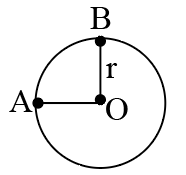
A wire of uniform resistance $$\lambda$$Ω/m is bent into a circle of radius r and another piece of wire with length 2r is connected between points A and B (AOB) as shown in figure. The equivalent resistance between points A and B is ____Ω .

34
Question 4

An electric power line having total resistance of $$2\Omega$$, delivers 1 kW of power at 250 V. The percentage efficiency of transmission line is ____ .

Video Solution
Question 5

A moving coil of galvanometer when shunted with 2 $$\Omega$$ resistance gives a full scale deflection for a current of 500 mA. When a resistance of 470 $$\Omega$$ is connected in series it gives a full scale deflection for 10 V potential applied on it. The value of resistance of galvanometer coil is __________ $$\Omega$$.

Question 6

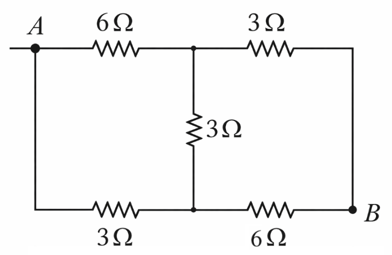
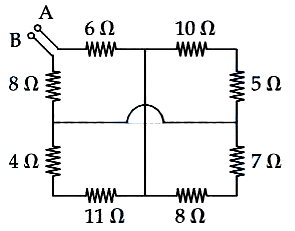
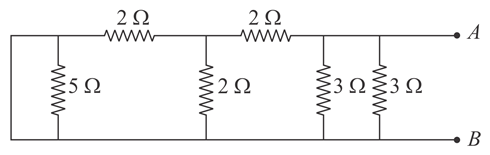
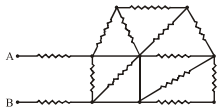
The equivalent resistance between the points A and B in the following circuit is $$\frac{x}{5}$$Ω. The value ofx is________.

50-1

Frequently Asked Questions