
 Group
Group
 Group
Group
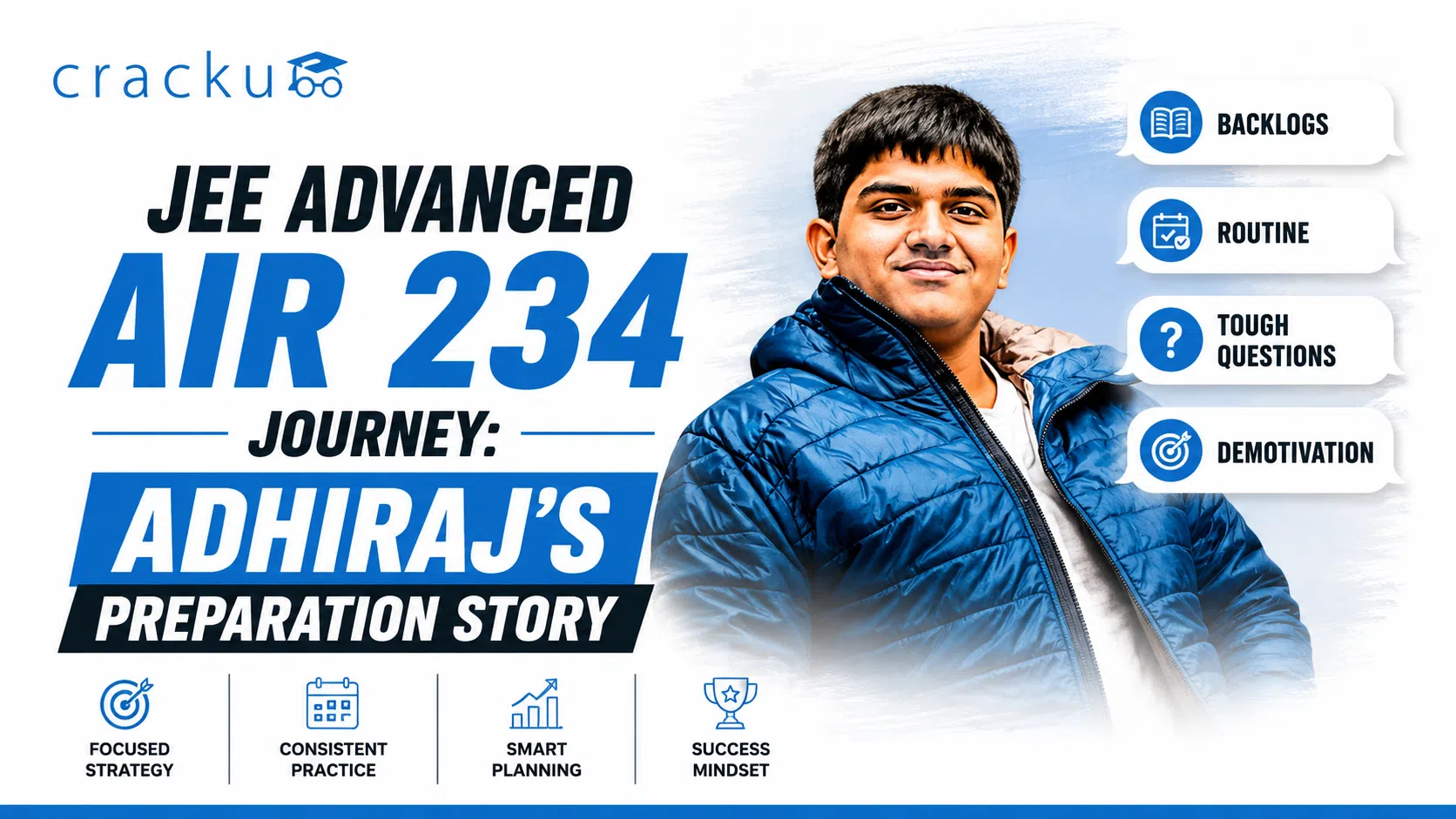
JEE Advanced AIR 234 Journey
Success is the sum of small efforts, repeated day in and day out. Adhiraj’s JEE journey reflects that idea beautifully. From clearing IOQM in Class 8 to reaching the RMO stage, he built his mathematical base early. He later secured AIR 234 in JEE Advanced while pursuing an integrated B.Tech program at the Indian Statistical Institute. His preparation included JEE online coaching, Cengage books, regular practice, and a sharp focus on difficult questions. But what really stands out is his approach to mistakes, backlogs, revision, and distractions. So, learn from your mistakes and guide your path for the upcoming JEE 2027 in Adhiraj’s words.
Building a Strong JEE Foundation Through IOQM
Adhiraj’s preparation for competitive exams started well before his formal JEE preparation.
He began preparing for the Indian Olympiad Qualifier in Mathematics in Class 8. That early exposure helped him develop mathematical thinking beyond routine school questions.
He appeared for IOQM in Class 8 and cleared the examination. He repeated the achievement in Class 9 with another qualification. In Class 10, his mathematics journey moved another step forward. He cleared IOQM again and reached the Regional Mathematics Olympiad stage.
He also appeared for IOQM again later, securing qualification with a much higher score. This took him back to the RMO stage.
These efforts helped him build a strong mathematical foundation for JEE Advanced.
Rank | Details |
JEE Advanced | AIR 234 |
JEE Main | AIR 913 |
JEE Advanced choice | IIT Kanpur CSE |
IOQM | Qualified in Class 10 |
JEE preparation | Started in Class 11 |
After Class 10, Adhiraj joined the integrated B.Tech program at the Indian Statistical Institute, Bengaluru centre.
The four-year program meant his academic path differed from a conventional Class 11 and 12 route.
However, he started JEE preparation alongside this academic journey during Class 11.
That decision required discipline because his preparation had to fit around another demanding academic environment.
Class 11 & 12 Strategy for JEE Advanced Preparation
Adhiraj began formal JEE preparation in Class 11 through various JEE PYQ materials and books.
Adhiraj’s JEE Advanced Preparation Strategy
- His Class 11 approach was relatively simple. He concentrated primarily on understanding concepts rather than taking frequent tests.
- This distinction is important for your JEE preparation strategy. Tests become useful only when your conceptual base can support them.
- Instead of chasing test scores too early, Adhiraj spent Class 11 strengthening his understanding.
- His preparation also remained fairly focused in terms of resources. He did not depend on an endless collection of books.
- Teacher-guided questions played a significant role during Classes 11 and 12. He generally solved the questions recommended by his teachers.
- That approach helped him avoid turning preparation into a race between different books and modules.
- His experience also shows why awareness of your weak areas matters more than simply finishing material.
For example, Fluid Mechanics became one of his toughest Physics chapters.
The theory itself was not his biggest concern. The difficulty level of his teacher’s questions made the chapter feel intimidating. Surface Tension was especially difficult because the questions were exceptionally challenging.
In Mathematics, Trigonometry and Solution of Triangles created a similar challenge. Chemistry brought different difficulties across its three branches.
Subject | Difficult areas for Adhiraj | Main difficulty |
Physics | Fluid Mechanics | High-level questions, especially Surface Tension |
Mathematics | Trigonometry, Solution of Triangles | Difficulty with the chapter concepts and problems |
Physical Chemistry | Surface Chemistry | Large memorisation component |
Inorganic Chemistry | P-block, Salt Analysis | Difficulty handling the content |
Organic Chemistry | Broadly difficult | He found all chapters challenging |
This is a useful reminder for JEE 2027 aspirants. A difficult chapter does not automatically mean your preparation is failing.
Sometimes, the real issue is simply exposure to a higher level of questions.
Adhiraj’s response was not to abandon difficult topics. He continued working through questions until the difficulty became manageable.
Adhiraj began formal JEE preparation in Class 11 through various JEE PYQ materials and books.
Adhiraj’s JEE Advanced Preparation Strategy
- His Class 11 approach was relatively simple. He concentrated primarily on understanding concepts rather than taking frequent tests.
- This distinction is important for your JEE preparation strategy. Tests become useful only when your conceptual base can support them.
- Instead of chasing test scores too early, Adhiraj spent Class 11 strengthening his understanding.
- His preparation also remained fairly focused in terms of resources. He did not depend on an endless collection of books.
- Teacher-guided questions played a significant role during Classes 11 and 12. He generally solved the questions recommended by his teachers.
- That approach helped him avoid turning preparation into a race between different books and modules.
- His experience also shows why awareness of your weak areas matters more than simply finishing material.
For example, Fluid Mechanics became one of his toughest Physics chapters.
The theory itself was not his biggest concern. The difficulty level of his teacher’s questions made the chapter feel intimidating. Surface Tension was especially difficult because the questions were exceptionally challenging.
In Mathematics, Trigonometry and Solution of Triangles created a similar challenge. Chemistry brought different difficulties across its three branches.
Subject | Difficult areas for Adhiraj | Main difficulty |
Physics | Fluid Mechanics | High-level questions, especially Surface Tension |
Mathematics | Trigonometry, Solution of Triangles | Difficulty with the chapter concepts and problems |
Physical Chemistry | Surface Chemistry | Large memorisation component |
Inorganic Chemistry | P-block, Salt Analysis | Difficulty handling the content |
Organic Chemistry | Broadly difficult | He found all chapters challenging |
This is a useful reminder for JEE 2027 aspirants. A difficult chapter does not automatically mean your preparation is failing.
Sometimes, the real issue is simply exposure to a higher level of questions.
Adhiraj’s response was not to abandon difficult topics. He continued working through questions until the difficulty became manageable.
Adhiraj’s JEE Advanced Preparation Strategy
- His Class 11 approach was relatively simple. He concentrated primarily on understanding concepts rather than taking frequent tests.
- This distinction is important for your JEE preparation strategy. Tests become useful only when your conceptual base can support them.
- Instead of chasing test scores too early, Adhiraj spent Class 11 strengthening his understanding.
- His preparation also remained fairly focused in terms of resources. He did not depend on an endless collection of books.
- Teacher-guided questions played a significant role during Classes 11 and 12. He generally solved the questions recommended by his teachers.
- That approach helped him avoid turning preparation into a race between different books and modules.
- His experience also shows why awareness of your weak areas matters more than simply finishing material.
For example, Fluid Mechanics became one of his toughest Physics chapters.
The theory itself was not his biggest concern. The difficulty level of his teacher’s questions made the chapter feel intimidating. Surface Tension was especially difficult because the questions were exceptionally challenging.
In Mathematics, Trigonometry and Solution of Triangles created a similar challenge. Chemistry brought different difficulties across its three branches.
Subject | Difficult areas for Adhiraj | Main difficulty |
Physics | Fluid Mechanics | High-level questions, especially Surface Tension |
Mathematics | Trigonometry, Solution of Triangles | Difficulty with the chapter concepts and problems |
Physical Chemistry | Surface Chemistry | Large memorisation component |
Inorganic Chemistry | P-block, Salt Analysis | Difficulty handling the content |
Organic Chemistry | Broadly difficult | He found all chapters challenging |
This is a useful reminder for JEE 2027 aspirants. A difficult chapter does not automatically mean your preparation is failing.
Sometimes, the real issue is simply exposure to a higher level of questions.
Adhiraj’s response was not to abandon difficult topics. He continued working through questions until the difficulty became manageable.
Also Read: How AIR 32 Aarush Goel Prepared for JEE Mains and Advanced?
How Adhiraj Improved His Weak Subjects & Chapters
One of the most useful parts of Adhiraj’s journey is how he handled questions that exposed his weaknesses.
He did not treat every solved question as equally valuable during revision. Instead, he created a simple system while solving questions for the first time.
Questions he could not solve were marked. Questions he got wrong were also highlighted. That small habit later made revision far more targeted.
“The questions which I was not able to solve or the questions which I got wrong, I highlighted those questions.”
This method becomes especially valuable when a chapter contains hundreds of questions.
Pro Tip to Revise JEE topics: Suppose you complete 400 questions from Definite Integration. Repeating all 400 during revision would consume too much time. Adhiraj instead returned to the questions that had already exposed a gap.
He would first discuss a difficult question with his teacher. After returning home, he solved it again himself.
When he revised the chapter later, he attempted that same question again. Therefore, a difficult question could receive at least two rounds of independent solving.
The process created a useful learning loop:
- Attempt the question independently.
- Mark questions that remain unsolved or incorrect.
- Discuss difficult questions with the teacher.
- Re-solve them at home.
- Revisit the marked questions during chapter revision.
This is a practical approach to JEE previous year questions and other high-level question sets.
The aim is not simply to increase your question count. The aim is to understand why particular questions defeated you. That difference can turn practice from a numbers game into genuine skill development.
Also Read: Suryash’s Journey to AIR 977 in JEE Advanced 2026
Solving Thousands of Questions for JEE Advanced
Adhiraj’s preparation also highlights the importance of question volume. JEE Advanced cannot be mastered by solving only a few hundred comfortable questions.
You need exposure to different concepts, structures, traps, and difficulty levels across the syllabus. However, quantity becomes useful only when you examine your mistakes carefully.
Adhiraj’s marked-question approach helped him combine large-scale practice with focused revision.
Adhiraj’s Book Choices for JEE Preparation
- For Physics, he mentioned solving H.C. Verma. For Mathematics, he had worked with S.L. Loney, including coordinate geometry.
- For Chemistry, he referred to separate resources for Physical, Inorganic, and Organic Chemistry.
- He also relied heavily on questions provided by his teachers during Classes 11 and 12.
A strong JEE Advanced strategy can come from a focused source, repeated practice, and careful mistake analysis.
This becomes even more important when your current classroom work continues alongside older unfinished chapters.
Backlogs are common during intense JEE preparation, but Adhiraj followed an unusual rule. He did not allow old pending work to replace current classroom preparation.
“What is being taught in the class, you first study that. If you have time, then try to complete the backlog.”
His reasoning was straightforward and highly practical. If you stop current work to finish your backlog, fresh topics keep accumulating behind you.
Soon, the attempt to clear one backlog creates another.
“When somebody gets backlog, he first tries to cover that backlog and leaves what is being taught in the class. Then after that he covers that backlog, he gets a new backlog.”
If spare time remained, he used it to attack pending chapters. Anything unfinished could be handled later. That approach prevented the backlog from becoming a permanent shadow over his preparation.
Revision, Mock Tests & Final Exam Strategy
Adhiraj’s revision method was closely connected to his question-solving habits. Instead of reopening every question, he returned to the questions that had previously caused trouble.
This made chapter-wise JEE Mians mock tests and practice sessions more useful because mistakes could guide future revision.
His Class 11 preparation involved relatively little testing because his primary focus remained conceptual understanding.
As his preparation progressed, practice and testing became more relevant to checking his readiness. The final stage also brought an important psychological challenge.
A Day Before JEE Advanced 2026
- The night before JEE Advanced, Adhiraj was quite anxious and struggled to sleep.
- He tried going to bed around 10 PM but remained awake for nearly three hours.
- He eventually slept around 1 AM, leaving him with less rest than he wanted before the examination.
However, the anxiety did not carry into the morning.
- He woke up feeling confident and entered the examination without allowing the previous night’s poor sleep to dominate his mindset.
- Between the two JEE Advanced papers, he ate food and tried to sleep.
- Although he could not actually fall asleep, he remained in bed and rested.
- That is a useful exam-day lesson. Rest still has value even when sleep does not come easily.
Adhiraj also faced another modern challenge during Class 12: digital distraction. He realised that YouTube Shorts were taking roughly one to two hours from his day.
Parents Support During JEE Preparation
Instead of relying purely on willpower, he acknowledged the problem and told his mother. She then placed a parental lock on his phone, preventing access to those applications.
This simple decision removed the distraction rather than repeatedly fighting it.
“I acknowledged that I am facing this distraction, so I told my mother.”
His final advice goes beyond books, mock tests, and question counts. He believes consistency and focus matter throughout the JEE journey.
At the same time, he places unusual importance on staying happy while preparing.
“You are doing IIT so that you can stay happy. So there is no point of being sad now.”
That thought gives his JEE preparation story a different ending.
AIR 234 was not built through one magical resource or one extraordinary study session.
It came through years of mathematical exposure, focused preparation, extensive question solving, targeted revision, and honest self-correction.
JEE Advanced AIR 234 Journey: Conclusion
Adhiraj’s JEE Advanced AIR 234 journey shows that a strong JEE preparation strategy is built through consistent improvement rather than simply solving more questions. His focus on concept building, JEE PYQs, difficult questions, mistake tracking, and targeted revision helped make his preparation more effective. Instead of revising every problem repeatedly, he identified the questions that exposed his weaknesses and returned to them until the concepts became clearer.
For JEE 2027 aspirants, Adhiraj’s preparation journey offers several practical lessons. Stay consistent with current topics, manage JEE backlogs without allowing them to disrupt ongoing preparation, analyse mistakes, revise weak chapters, and gradually increase mock-test practice. Most importantly, difficult chapters and incorrect answers should be treated as opportunities to improve. A focused preparation strategy, regular practice, and the willingness to correct weaknesses can take you closer to your target JEE Advanced rank.
.webp)