
 Group
Group
 Group
Group


 Preferred Source

 Google Discover
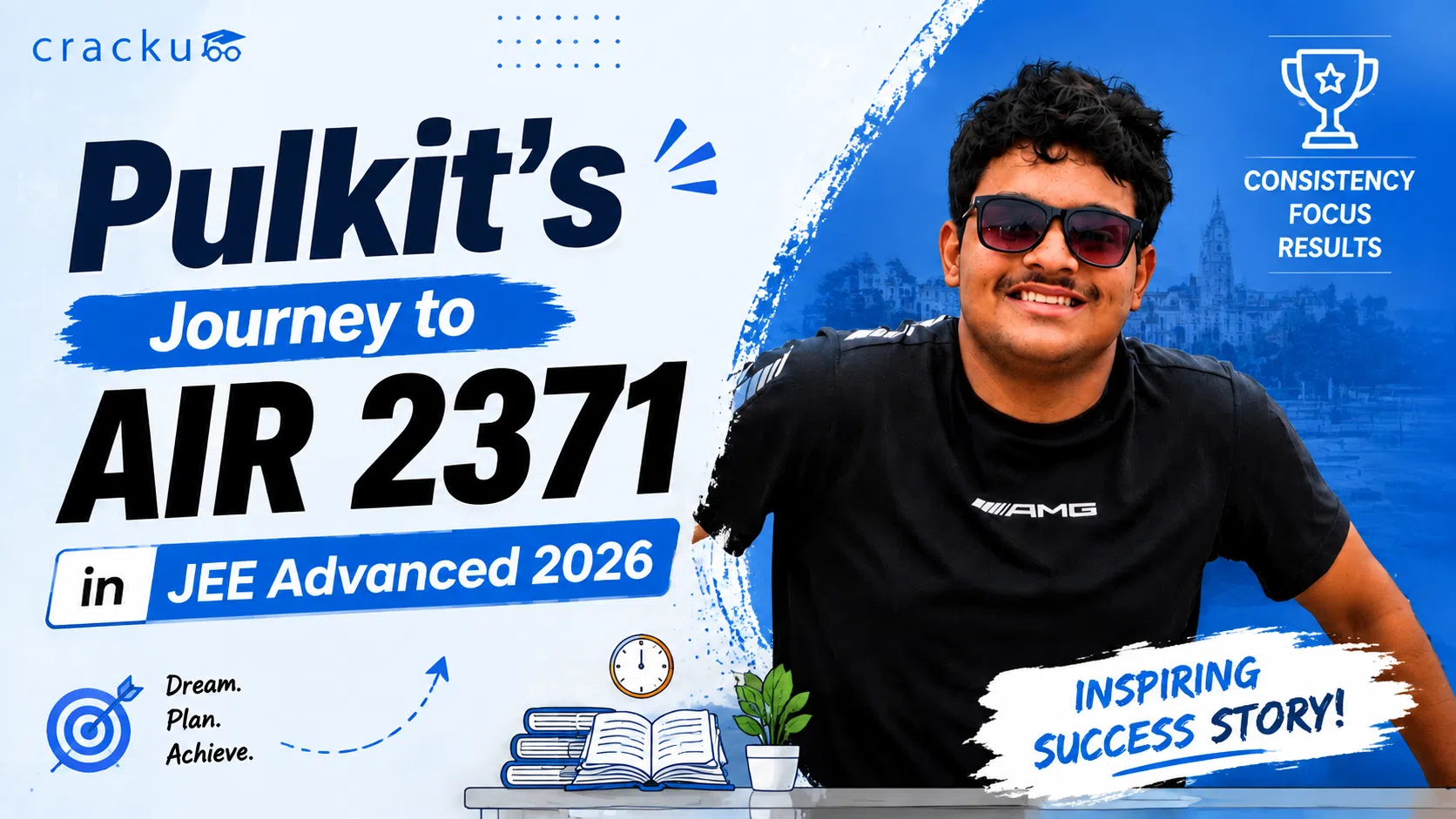
Pulkit’s Journey to AIR 2371 in JEE Advanced 2026
What does it take to secure AIR 2371 in JEE Advanced 2026 while attending regular school? Pulkit’s journey offers a practical answer. He secured JEE Main rank 1633 with 99.9 percentile and earned Engineering Physics at IIT Delhi through JoSAA mock seat allocation. His preparation combined conceptual learning, consistent problem practice, coaching, school, and hobbies. Rather than chasing a fixed rank, he focused on improving through regular tests and difficult questions. His experience also highlights the value of a JEE foundation course, JEE Advanced mock tests, chemistry revision, and disciplined phone usage.
Building JEE Advanced Skills Through Conceptual Learning and Practice
Pulkit started his foundation preparation during Class 10 after joining coaching earlier than regular preparation.
His interest in physics had already developed during middle school through books by Stephen Hawking. He became fascinated by space, astrophysics, and questions about how the universe works.
His childhood JEE Foundation course later gave that curiosity a stronger academic direction. Mechanics, magnetism, and electromagnetism helped him discover that physics came naturally to him.
According to Pulkit, foundation preparation matters because JEE Advanced rarely rewards simple memory. The examination regularly introduces unfamiliar problems requiring strong intuition and flexible thinking.
Preparation Area | Pulkit’s Approach | Why It Helped |
Foundation | Started coaching during Class 10 | Built early problem-solving experience |
Physics | Focused strongly on conceptual understanding | Helped tackle unfamiliar problems |
Mathematics | Practised different question patterns | Improved recognition of useful approaches |
Chemistry | Strengthened concepts and later memorised required facts | Improved JEE Main performance |
JEE Advanced | Prepared directly through advanced-level problems | Built depth beyond routine questions |
JEE Main | Added speed and NCERT reading | Covered exam-specific requirements |
Pulkit explained that JEE Main can often be handled through strong concepts and formula awareness. JEE Advanced, however, demands greater comfort with unfamiliar situations.
He believes early exposure increases your experience with different problem structures. That experience eventually becomes almost like muscle memory during difficult questions.
For example, an electricity problem containing inductors and capacitors immediately suggests specific physical relationships. With enough practice, you begin recognising which equations deserve attention first.
Mathematics works similarly because familiar question structures can reveal the examiner’s intended approach. A permutation and combination problem may require pattern recognition instead of lengthy calculation.
Practice is the bridge between knowing a concept and applying it under pressure.
Pulkit also discussed his experience with I.E. Irodov, especially the mechanics portion. He completed the Class 11 mechanics section and found it highly relevant to JEE Advanced preparation.
He recommended being selective with advanced books because JEE preparation already contains extensive coaching material. Advanced resources should strengthen understanding rather than simply increase your workload.
His experience gives a useful message: depth matters more than collecting books.
Pulkit’s Key Preparation Numbers
Metric | Pulkit’s Performance |
JEE Advanced 2026 Rank | AIR 2371 |
JEE Main Rank | 1633 |
JEE Main Percentile | 99.9% |
Desired Branch | Engineering Physics |
College Received | IIT Delhi |
Foundation Preparation | Started during Class 10 |
Coaching Schedule | 4 PM to 8 PM |
His results also show why a JEE foundation course can support long-term preparation. The objective should be stronger concepts and better problem exposure, rather than simply finishing chapters early.
Also Read: Suryash’s Journey to AIR 977 in JEE Advanced 2026
How Pulkit Balanced School, Coaching, and Self-Study
Pulkit did not attend dummy school during his JEE preparation. He continued regular schooling while attending coaching classes and studying independently.
This made his daily routine demanding because school consumed a significant part of his available time. During summer days, he travelled directly from school to coaching.
His coaching ran from approximately 4 PM to 8 PM. After returning home, he took a short break before starting his own problem-solving work.
On school days, he generally studied until around 1 AM or 1:30 AM. He then slept and repeated the routine the following morning.
Day Type | Routine |
School Day | School → Coaching → Break → Self-study |
Coaching | Approximately 4 PM–8 PM |
Night Study | Usually until 1 AM–1:30 AM |
Weekday Without School | Study from around 9:30 AM–2:30 PM |
Weekend | Two subjects with two-to-three-hour study blocks |
Recreation | Cricket, piano, and personal breaks |
Pulkit did not follow a rigid timetable every weekend. Instead, he used focused two-to-three-hour study blocks according to his pending work.
He also continued playing cricket and practising piano whenever his schedule allowed. He has played piano since the age of five and holds professional certificates from Trinity College London.
That balance helped him maintain an identity beyond examinations. All work and no play makes Jack a dull boy, and his routine reflected that principle.
His experience also proves that regular school does not automatically block serious JEE preparation.
Key Takeaways You Must Know from Pulkit’s JEE Journey
- Start early: Foundation preparation can build strong concepts and problem-solving intuition.
- Focus on JEE Advanced: Advanced-level practice can cover most JEE Main concepts too.
- Practise regularly: Different question types help develop faster problem recognition.
- Analyse mocks: Do not just check scores; identify repeated mistakes after every test.
- Use PYQs: JEE PYQs show how familiar concepts become unfamiliar exam questions.
- Read NCERT: Regular chemistry NCERT revision helped Pulkit improve factual recall.
- Strengthen weak areas: Start with easy questions before moving towards difficult problems.
- Use visual learning: Diagrams and 3D structures can make difficult concepts easier.
- Control social media: Avoid Reels and Shorts if they affect your concentration.
- Do not ignore chemistry: Even if it is not your favourite, chemistry can offer scoring opportunities.
- Balance your routine: School, coaching, hobbies, and self-study can coexist with discipline.
- Trust the process: Focus on consistent effort instead of obsessing over a specific rank.
Pulkit’s Approach to Problem Solving, Mock Tests, and Mistake Analysis
Pulkit never prepared separately for JEE Main for most of his preparation. His primary target remained JEE Advanced.
He believed that strong JEE Advanced preparation would naturally cover most JEE Main concepts. However, JEE Main requires greater speed because the paper demands quicker decisions.
Chemistry was the main exception. Pulkit started reading NCERT regularly around November and December before his JEE Main attempt.
He continued reading chemistry NCERT daily for nearly two months. This helped him cover factual areas that required direct recall and textbook-based awareness.
For JEE aspirants, NCERT solutions, chapter notes, and repeated textbook revision can strengthen this section. Chemistry often rewards accurate recall alongside conceptual understanding.
His approach can be adapted into a simple preparation framework.
Stage | Focus | Useful Resource |
Concept Building | Understand theory and formulas | Coaching notes |
Basic Practice | Strengthen direct applications | Topic-wise questions |
Advanced Practice | Solve unfamiliar problems | JEE Advanced PYQs |
Speed Building | Improve question selection | JEE Mock tests |
Analysis | Identify repeated errors | JEE Advanced mock tests |
Chemistry Revision | Strengthen factual recall | NCERT and NCERT solutions |
Final Practice | Simulate exam pressure | JEE Mains chapter-wise mock tests |
Pulkit also admitted that mock-test analysis was initially a weakness in his preparation. He would attempt a test, check his score, identify incorrect questions, and move ahead.
Later, he realised that this approach was incomplete. Repeated mistakes often appeared across the same chapters or concepts.
Checking your score is only the first step; understanding the mistake creates improvement.
He felt that deeper analysis could have improved his final JEE Advanced rank. Interestingly, the same mistake patterns also appeared during his JEE Main examination.
This makes JEE Advanced mock tests especially useful when analysed properly. After every test, you should identify conceptual errors, calculation mistakes, time losses, and poor question selection.
JEE PYQs should also be treated as diagnostic tools rather than simple practice sheets. They reveal how familiar concepts are converted into unfamiliar examination problems.
A useful analysis table can look like this:
Mistake Type | Question to Ask Yourself |
Conceptual Error | Did I misunderstand the underlying concept? |
Formula Error | Did I remember or apply the formula incorrectly? |
Calculation Error | Did I rush an otherwise familiar calculation? |
Selection Error | Should I have skipped this question initially? |
Time Error | Did this problem consume too much time? |
Silly Error | What caused the avoidable mistake? |
This method turns every mock into a feedback system. Instead of simply collecting scores, you build awareness around the habits affecting your performance.
Also Read: How AIR 32 Aarush Goel Prepared for JEE Mains and Advanced?
Overcoming Difficult Chapters and Challenges During JEE Preparation
Pulkit faced difficult topics across all three subjects. Chemistry caused his biggest confidence issues during the final phase of Class 12.
Solid state, thermodynamics, and fluid mechanics were difficult areas for him. In mathematics, ellipses and hyperbolas required additional effort.
His response to difficulty was practical rather than emotional. When solid state became confusing, he searched for three-dimensional lattice structures online.
He then drew cubes in his notebook and marked the positions of lattices and voids. Visualising the structure helped him understand something that formulas alone could not explain.
For mathematics and physics, he relied heavily on graded practice. He recommended starting with easier questions before moving towards difficult problems.
Challenge | Pulkit’s Response |
Solid State | Used 3D visual references and drawings |
Thermodynamics | Revisited concepts through additional practice |
Fluid Mechanics | Strengthened understanding through questions |
Ellipse & Hyperbola | Practised questions progressively |
Weak Topics | Started easy, then moved to medium and hard |
Chemistry Memorisation | Used teacher support and repeated revision |
He strongly advised against attacking the hardest questions immediately after learning a weak chapter. Difficult problems can create frustration when the basic structure is still unclear.
His chemistry struggle became particularly serious near the end of Class 12. He scored only 2 out of 15 in one JEE Advanced chemistry test from 2016.
Instead of ignoring the problem, he sought individual support from his chemistry teacher. One-to-one sessions helped him clear organic and inorganic chemistry doubts.
His chemistry performance eventually improved substantially. He scored around 85 marks in chemistry in JEE Main, despite physics being his favourite subject.
This experience offers a valuable reminder: your weakest subject can become your biggest score opportunity. You do not need to love every subject to perform well in it.
Pulkit also found rotational motion less difficult than thermodynamics. He believed rotation becomes easier when you visualise forces and torque instead of relying only on formulas.
He suggested observing real objects to understand how force and torque affect rotation. This physical intuition can make abstract mechanics concepts easier to remember.
His approach to difficult chapters followed a clear progression:
Understand → Visualise → Practise → Review → Repeat.
That cycle works particularly well when you feel stuck. Instead of jumping between resources, build understanding through controlled repetition.
Pulkit’s Advice for JEE 2027 and 2028 Aspirants
Pulkit’s strongest advice concerns social media and short-form content. He believes Instagram Reels and YouTube Shorts can reduce your ability to maintain deep focus.
He personally used social media platforms, including Instagram, Reddit, and Discord. However, he stressed that controlled usage matters more than simply owning a smartphone.
He also used his phone positively for learning. During his commute from coaching, he watched educational material related to topics he had struggled with.
Pulkit’s 5 Lessons for JEE 2027 & 2028
1. Build concepts before chasing difficult questions
Start with basic applications, then gradually move towards advanced problems. Strong fundamentals make difficult questions less intimidating.
2. Analyse every JEE Mock test
Do not stop after checking your score. Record conceptual, calculation, selection, and time-management mistakes after every test.
3. Give chemistry the attention it deserves
Even if physics or mathematics interests you more, chemistry can offer valuable scoring opportunities. Use NCERT regularly and revise factual topics repeatedly.
4. Keep social media under control
Short videos can quietly consume your breaks and weaken your focus. If you are not already using Instagram, Pulkit recommends staying away during preparation.
5. Use difficulty as feedback, not failure
When a chapter feels difficult, begin with easier questions and increase the level gradually. Visualisation, repeated practice, and teacher support can turn weak areas into strengths.
Pulkit’s AIR 2371 journey shows that strong preparation does not require a perfect routine. It requires consistent effort, honest mistake analysis, and the courage to fix weaknesses.
Pulkit’s Journey to AIR 2371 in JEE Advanced 2026: Conclusion
Pulkit’s journey to AIR 2371 in JEE Advanced 2026 highlights the importance of strong concepts, consistent practice, and smart preparation. His experience shows that success in JEE Advanced is not only about studying longer hours but also about understanding concepts deeply, solving challenging questions, and learning from mistakes through proper analysis.
For JEE 2027 and 2028 aspirants, Pulkit’s preparation strategy offers valuable lessons. Starting early with a JEE Foundation course, practising JEE PYQs, attempting JEE Advanced mock tests, and maintaining discipline can significantly improve performance. His story proves that with focused effort, balanced routines, and continuous improvement, students can achieve their goals in competitive exams.
.webp)