Join WhatsApp Icon JEE WhatsApp Group

JEE Advanced 2013 Paper-2

For the following questions answer them individually

Using the expression $$2d \sin \theta = \lambda$$, one calculates the values of d by measuring the corresponding angles $$\theta$$ in the range 0 to $$90^\circ$$. The wavelength $$\lambda$$ is exactly known and the error in $$\theta$$ is constant for all values of $$\theta$$. As $$\theta$$ increases from $$0^\circ$$,

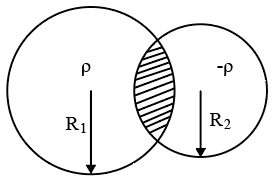
Two non-conducting spheres of radii $$R_1$$ and $$R_2$$ and carrying uniform volume charge densities $$\rho$$ and $$\rho$$ respectively, are placed such that they partially overlap, as shown in the figure. At all points in the overlapping region,

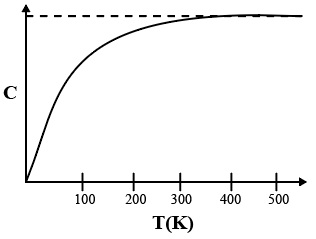
The figure below shows the variation of specific heat capacity (C) of a solid as a function of temperature (T). The temperature is increased continuously from 0 to 500 K at a constant rate. Ignoring any volume change, the following statement(s)is (are) correct to a reasonable approximation.

The radius of the orbit of an electron in a Hydrogen-like atom is 4.5 $$a_0$$, where $$a_0$$ is the bohr radius. Its orbital angular momentum is $$\frac{3h}{2 \pi}$$. It is given that h is Planck constant and R is Rydberg constant. The possible wavelength(s), when the atom de-excites, is (are)

Two bodies, each of mass M, are kept fixed with a separation 2L. A particle of mass m is projected from the midpoint of the line joining their centres, perpendicular to the line. The gravitational constant is G. The correct statement(s) is (are)

A particle of mass mis attached to one end of a mass-less spring of force constant k, lying on a frictionless horizontal plane. The other end of the spring is fixed. The particle starts moving horizontally from its equilibrium position at time t = 0 with an initial velocity $$u_0$$. When the speed of the particle is 0.5 $$u_0$$,it collides elastically with a rigid wail. After this collision,

A steady current I flows along an infinitely long hollow cylindrical conductor of radius R. This cylinder is placed coaxially inside an infinite solenoid of radius 2R. The solenoid has n turns per unit length and carries a steady current I. Consider a point P at a distance r from the common axis. The correct statement(s) is (are)

Two vehicles, each moving with speed u on the samehorizontal straight road, are approaching each other. Wind blows along the road with velocity w. One of these vehicles blows a whistle of frequency $$f_1$$. An observerin the other vehicle hears the frequency of the whistle to be $$f_2$$. The speed of soundin still air is V. The correct statement(s) is (are)

Following Questions of a paragraph has only one correct answer amongthe four choices(A), (B), (C) and (D).

A point charge Q is moving in a circular orbit of radius R in the x-y plane with an angular velocity $$\omega$$ This can be considered as equivalent to a loop carrying a steady current $$\frac{Q \omega}{2 \pi}$$. A uniform magnetic field along the positive z-axis is now switched on, which increases at a constant rate from 0 to B in one second. Assumethat the radius of the orbit remains constant. The application of the magnetic field induces an emf in the orbit. The induced
emf is defined as the work done by an induced electric field in moving a unit positive charge around a closed loop. It is knownthat, for an orbiting charge, the magnetic dipole momentis proportional to the angular momentum with a proportionality constant $$\gamma$$

The magnitude of the induced electric field in the orbit at any instant of time during the time interval of the magnetic field change is

The change in the magnetic dipole moment associated with the orbit, at the end of the time interval of the magnetic field change, is

Following Questions of a paragraph has only one correct answer among the four choices(A), (B), (C) and (D).

The mass of a nucleus $$_{Z}^{A}X$$ is less than the sum of the masses of (A-Z) number of neutrons and Z number of protons in the nucleus. The energy equivalent to the corresponding mass difference is known as the binding energy of the nucleus. A heavy nucleus of mass M can break into two light nuclei of masses $$m_1$$ and $$m_2$$ only if $$(m_1 + m_2) < M$$. Also two light nuclei of masses $$m_3$$ and $$m_4$$ can undergo complete fusion and form a heavy nucleus of mass $$M'$$ only if $$(m_3 + m_4) > M'$$. The masses of some neutral atoms are given in the table below:

The correct statement is

The kinetic energy (in keV) of the alpha particle, when the nucleus $$^{210}_{84}Po$$ at rest undergoes alpha decay, is

Following Questions of a paragraph has only one correct answer among the four choices(A), (B), (C) and (D).

A small block of mass 1 kg is released from rest at the top of a rough track. The track is a circular arc of radius 40 m. The block slides along the track without toppling and frictional force acts on it in the direction opposite to the instantaneous velocity. The work done in over coming the friction up to the point O, as shown in the figure below, is 150 J. (Take the acceleration due to gravity, g = 10m $$s^{-2}$$).

A thermal power plant produces electric power of 600 kW at 4000 V, which is to be transported to a place 20 km away from the powerplant for consumers’ usage. It can be transported either directly with a cable of large current carrying capacity or by using a combination of step-up and step-downtransformers at the two ends. The drawbackof the direct transmission is the large energy dissipation. In the method using transformers, the dissipation is much smaller. In this method, a step-up transformeris used at the plant side so that the current is reduced to a smaller value. At the consumers’ end, a step-down transformer is used to supply powerto the consumersat the specified lower voltage. It is reasonable to assume that the powercable is purely resistive and the transformers are ideal with a powerfactor unity. All the currents and voltages mentioned are rms values.

If the direct transmission method with a cable of resistance $$0.4Ωkm^{-1}$$ is used, the power dissipation (in %) during transmission is

In the method using the transformers, assume that the ratio of the numberof turns in the primary to that in the secondary in the step-up transformeris 1 : 10. If the power to the consumers has to be supplied at 200 V, the ratio of the numberof turns in the primary to that in the secondary in the step-down transformer is

For the following questions answer them individually

Match List I with List II and select the correct answer using the codes given below the lists :

A right angled prism of refractive index $$\mu_{1}$$ is placed in a rectangular block of refractive index $$\mu_{2}$$, which is surrounded by a medium of refractive index $$\mu_{3}$$, as Shown in the figure. A ray of light ‘e’ enters the rectangular block at normal incidence. Depending upon the relationships between $$\mu_{1},\mu_{2}$$ and $$\mu_{3}$$, it takes one of the four possible paths ‘ef’, ‘eg’, ‘eh’ or ‘ei’.


Match the paths in List I with conditions of refractive indices in List II and select the correct answer using the codes given below the lists:

Match List I of the nuclear processes with List II containing parent nucleus and one of the end products of each process and then select the correct answer using the codes given below the lists :

One mole of a monatomic ideal gas is taken along two cyclic processes $$E\rightarrow F\rightarrow G \rightarrow E$$ and $$E\rightarrow F\rightarrow H \rightarrow E$$ as shown in the PV diagram. The processes involved are purely isochoric, isobaric, isothermal or adiabatic.


Match the paths in List I with the magnitudes of the work done in List II and select the correct answer using the codes given below the lists.

The correct statement(s) about $$O_{3}$$ is(are)

The carbon-based reduction method is NOT used for the extraction of

The thermal dissociation equilibrium $$CaCO_{3}(s)$$ is studied under different conditions.
$$CaCO_{3}(s)\rightleftharpoons CaO(s)+CO_{2}(g)$$

The $$K_{sp}$$ of $$Ag_{2}CrO_{4}$$ is $$1.1\times10^{-12}$$ at 298 K. The solubility (in $$\frac{mol}{L}$$) of $$Ag_{2}CrO_{4}$$ in a $$0.1M \ AgNO_{3}$$ solution is

After completion of the reactions (I and IT), the organic compound(s) in the reaction mixtures is(are)

A fixed mass ‘m’ of a gas is subjected to transformation of states from K to L to M to N and back to K as shown in the figure

The succeeding operations that enable this transformation of states are

The pair of isochoric processes among the transformation of states is

The reactions of $$Cl_{2}$$ gas with cold-dilute and hot-concentrated $$NaOH$$ in water give sodium salts of two (different) oxoacids of chlorine, P and Q, respectively. The $$Cl_{2}$$ gas reacts with $$SO_{2}$$ gas, in presence of charcoal, to give a product R. R reacts with white phosphorus to give a compound s. On hydrolysis, s gives an oxoacid of phosphorus, T.

P and Q,respectively, are the sodium salts of

R, S and T, respectively, are

An aqueoussolution of a mixture of two inorganic salts, when treated with dilute $$HCL$$, gave a precipitate (P) and filtrate (Q). The precipitate P was found to dissolve in hot. water. The filtrate (Q) remained unchanged, when treated with $$H_{2}S$$ in a dilute mineral acid medium. However,it gave a precipitate (R) with $$H_{2}S$$ in an ammoniacal medium. The precipitate R gave a coloured solution (S), when treated with $$H_{2}O_{2}$$ in an
aqueous $$NaOH$$ medium.

P and Q are isomers of dicarboxylic acid $$C_{4}H_{4}O_{4}$$. Both decolorize $$\frac{Br}{H_{2}O}$$. On heating, P forms the cyclic anhydride.

Upon treatment with dilute alkaline $$KMnO_{4}$$, P as well as Q could produce one or more than one from S, T and U.

Compounds formed from P and @Q are, respectively

For the following questions answer them individually

Match the chemical conversions in List I with the appropriate reagents in List II and select the correct answer using the code given below the lists:

The unbalanced chemical reactions given in List I show missing reagent or condition (?) which are provided in List II. Match List I with List Il and select the correct answer using the code given below the lists :

The standard reduction potential data at $$25^\circ C$$ is given below.
$$E^\circ(Fe^{3+}, Fe^{2+}) = + 0.77 V$$;

$$E^\circ(Fe^{2+}, Fe) = - 0.44 V$$;

$$E^\circ(Cu^{2+}, Cu) = + 0.34 V$$;

$$E^\circ(Cu^{+}, Cu) = + 0.52 V$$;

$$E^\circ[O_2(g) + 4H^+ + 4e^{-} \rightarrow 2H_2O] = + 1.23 V$$;

$$E^\circ[O_2(g) + 2H_2O + 4e^{-} \rightarrow 4OH^{-}] = + 0.40 V$$;

$$E^\circ(Cr^{3+}, Cr) = - 0.74 V$$;

$$E^\circ(Cr^{2+}, Cr) = - 0.91 V$$

Match $$E^\circ$$ of the redox pair in List I with the values given in List II and select the correct answer using the code given below the lists:

An aqueous solution of X is added slowly to an aqueous solution of Y as shown in List J. The variation in conductivity of these reactions is given in List II. Match List I with List II and select the correct answer using the code given below the lists:

Let $$w=\frac{\sqrt{3}+i}{2}$$ and $$p={{w^{n}}:n=1,2,3,...}$$. Further $$H_{1}= \left\{Z\epsilon C : Rez>\frac{1}{2}\right\}$$ and $$H_{2}= \left\{Z\epsilon C : Rez<\frac{-1}{2}\right\}$$ where C is the set of all complex numbers. If $$Z_{1}\epsilon P \cap H_{1}$$, $$Z_{2}\epsilon P \cap H_{2}$$ and O represents the origin, then $$\angle z_{1}Oz_{2}=$$

If $$3^x = 4^{x - 1}$$, then x =

Let $$\omega$$ be a complex cuberoot of unity with $$\omega \neq 1$$ and $$P = [p_{ij}]$$ be a $$n \times n$$ matrix with $$p_{ij} = \omega^{i+j}$$. Then $$P^2 \neq 0$$, when n =

The function $$f(x) = 2 \mid x \mid + \mid x + 2 \mid - \mid \mid x + 2 \mid - 2 \mid x \mid \mid$$ has a local minimum or a local maximum at x =

For a $$x \in R$$ (the set of all real numbers), $$a \neq -1$$,
$$\lim_{n \rightarrow \infty}\frac{(1^a + 2^a + ... + n^a)}{(n + 1)^{a - 1}[(na + 1) + (na + 2) + ... + (na + n)]}= \frac{1}{60}$$Then a =

Circle(s) touching x - axis at a distance 3 from the origin and having an intercept of length $$2\sqrt{7}$$ on y-axis is (are)

Two lines $$L_1 : x = 5, \frac{y}{3 - \alpha} = \frac{z}{-2}$$ and $$L_2 : x = \alpha, \frac{y}{-1} = \frac{z}{2 - \alpha}$$ are coplanar. Then $$\alpha$$ can take value(s)

In a triangle PQR, P is the largest angle and $$\cos P = \frac{1}{3}$$. Further the incircle of the triangle touches the sides PQ, QR and RP at N, L and M respectively, such that the lengths of PN, QL and RM are consecutive even integers. Then possible length(s) of the side(s) of the triangle is (are)

Let $$S = S_1 \cap S_2 \cap S_3$$, where
$$S_1 = \left\{z \in C: \mid z \mid < 4\right\}, S_2 = \left\{z \in C: Im\left[\frac{z - 1 + \sqrt{3} i}{1 - \sqrt{3} i}\right]> 0\right\}$$ and $$S_3 = \left\{z \in C: Rez > 0\right\}.$$

$$\min_{z \in S} \mid 1 - 3i - z \mid =$$

A box $$B_1$$ contains 1 white ball, 3 red balls and 2 black balls. Another box $$B_2$$, contains 2 white balls, 3 red balls and 4 black balls. A third box $$B_3$$ contains 3 white balls, 4 red balls and 5 black balls.

If 1 ball is drawn from each of the boxes $$B_1, B_2$$, and $$B_3$$, the probability that all 3 drawn balls are of the same colour is

If 2 balls are drawn (without replacement) from a randomly selected box and one of the balls is white and the otherball is red, the probability that these 2 balls are drawn
from box $$B_2$$ is

Let $$f : [0, 1] \rightarrow R$$ (the set of all real numbers) be a function. Suppose the function f is twice differentiable, f(0) = f(1) = 0 and satisfies $$f"(x) - 2f'(x) + f(x) \geq e^x, x \in [0, 1]$$.

Which of the following is true for 0 < x < 1?

If the function $$e^{-x} f(x)$$ assumes its minimum in the interval [0, 1] at $$x = \frac{1}{4}$$ which of the following is true ?

Let PQ be a focal chord of the parabola $$y^2 = 4ax$$. The tangents to the parabola at P and Q meet at a point lying on the line $$y = 2x + a, a > 0.$$

If chord PQ subtends an angle $$\theta$$ at the vertex of $$y^2 = 4ax$$, then $$\tan \theta =$$

For the following questions answer them individually

A line L : y = mx + 3 meets y-axis at E(0, 3) and the arc of the parabola $$y^2 = 16 x, 0 \leq y \leq 6$$ at the point $$F(x_0, y_0)$$. The tangent to the parabola at $$F(x_0, y_0)$$ intersects the y-axis at $$G(0, y_1)$$. The slope m of the line L is chosen such that the area of the triangle EFG has a local maximum.
Match List I and List II and select the correct answer using the code given below the lists:

Match List I with List II and select the correct answer using the code given below the lists:

Consider the lines $$L_1 : \frac{x - 1}{2} = \frac{y}{-1} = \frac{z + 3}{1}, L_2 : \frac{x - 4}{1} = \frac{y+3}{1} = \frac{z + 3}{2}$$ and the planes $$P_1 : 7x + y + 2z = 3, P_2 : 3x + 5y - 6z = 4$$. Let ax + by + cz = d be the equation of the plane pasing through the point of intersection of lines $$L_1$$ and $$L_2$$, and perpendicular to planes $$P_1$$ and $$P_2$$.
Match List — I with List — II and select the correct answer using the code given below the lists :

Match List - I with List - II and select the correct answer using the code given below the lists: