91- 6303239042
Match the Indian Gold Medal Winners at the 2014 Commonwealth Games held at Glasgow with the sports type in which the medal was awarded:

Sign in
Please select an account to continue using cracku.in
↓ →
Match the Indian Gold Medal Winners at the 2014 Commonwealth Games held at Glasgow with the sports type in which the medal was awarded:
Joshna Chinappa is an Indian professional squash player. She reached a career-high world ranking of World No. 10 in July 2016. Joshna was the first Indian to win the British Squash Championship title in 2003 in the under 19 category and was also the youngest Indian women's national champion.
Vinesh Phogat is an Indian wrestler who comes from a successful background of wrestling with her cousins Geeta Phogat and Babita Kumari, both international wrestlers and Commonwealth Games medalists. She became the first Indian woman wrestler to win Gold in both Commonwealth and Asian games.
Vikas Shive Gowda is an Indian discus thrower and shot putter. Born in Mysore, he grew up in Frederick, Maryland in the United States. His father, Shive, coached the 1988 Indian Olympic track team. Vikas Gowda is a Padma Shri awardee in 2017.
Sathish Sivalingam is an Indian weightlifter who won gold medals in the men's 77 kg weight class at both the 2014 and the 2018 Commonwealth Games. He is supported by the GoSports Foundation through the Rahul Dravid athlete mentorship programme.
Therefore, option C is the correct answer.
According to the Economic Survey for 2013-14, India had the second fastest growing services sector over the 11-year period from 2001 to 2012. Which country had the fastest growing service sector, in the corresponding period?
Loading solution...
Which of the following countries did not qualify for the 2014 FIFA World Cup semi-final?
Loading solution...
Lifebuoy is a brand of soap marketed by which of the following companies?
Loading solution...
According to the Human Development report published by UNDP in July 2014, which among the following South Asian countries have the highest and the least rank in Human Development Index (2013)? In each option first name is indicated for highest rank and second name for the least rank.
Loading solution...
Which of the following India -origin academician became the Dean of the Harvard College with effect from July 2014?
Loading solution...
The Ebola virus disease is named after the Ebola River. The river is located at:
Loading solution...
In the Pro-Kabaddi leagues played in India in 2014, the Future Group is the owner of which team?
Loading solution...
Which of the following is headquartered in USA?
Loading solution...
Match the following:

Loading solution...
In the Union Budget for 2014-15, the government proposed to keep aside Rs. 500 crores fir “Deen Dayal Upadhyaya Gram Jyoti Yojana” for:
Loading solution...
Who among the following legends has been the latest recipient of the prestigious Dadasaheb Phalke Award (in 2013)?
Loading solution...
Who is the Brand Ambassador of Telangana State?
Loading solution...
Which Country has become the member of the World Trade Organisation recently?
Loading solution...
Shri Pranab Mukherjee is the _______ President of the Republic of India.
Loading solution...
Which among the following options is the oldest surviving brand of Tata Group?
Loading solution...
Who among the following is the first woman to become MD/Chairman of a Bank in India?
Loading solution...
Who amongst the following has not won the Man Booker Prize?
Loading solution...
Match the Country with the Leader:

Loading solution...
Which of the following is not headquartered in China?
Loading solution...
Who is the first CEO of AirAsia India?
Loading solution...
Who among the following has been appointed as the Chief Justice of India in September 2014?
Loading solution...
The winner of the Wimbledon Men’s singles Final 2014 has been:
Loading solution...
According to the Primary Census Abstract 2011, which of the following states in India has the highest population density?
Loading solution...
The Prime Minister of India has laid the foundation of which of the following port-based Special Economic Zone (SEZ) in August 2014?
Loading solution...
Pradhan Mantri Jan Dhan Yojana has been launched in which year?
Loading solution...
Read the following passage carefully and answer the questions given at the end.
No club in the English Premier League generated less money than Wigan Athletic. No club in the Premier League had so little history, or so few fans. Ever since 2005, when they won promotion to the top flight for the first time in their existence, Wigan started the season listening to prophecies of doom. 2013 was the year that football gravity finally caught up with them, and they returned to their 'rightful' place among the also-rans. Even as the naysayers and doubters were ignoring seven years of wrong forecasts and congratulating themselves for seeing Wigan's fate, this little David took out one last Goliath. Manchester City, in the FA Cup final.
In their book Why England Lose, the football journalist Simon Kuper and the economist Stefan Szymanski found that money matters a great deal for the success of football clubs. According to their calculations, 92 per cent of the differences in English football clubs' league position can be explained by a club's relative wage bill. It might not be the case that the team with the highest wage bill finishes top each and every season, but over the long term, the correlation is uncanny. At the other end of the table, it seems inevitable that, eventually, in football poverty will drag you down.
For Wigan, this was unfortunate. The annual reports into football's finances prepared by the accountants Deloitte must have made miserable reading for anyone who followed the club: their turnover, wages and attendance were all fractions of the Premier League's giants. And yet Wigan managed to avoid relegation for seven years. It was almost pathological. They defied the laws of football economics. They disobeyed the laws of football gravity.
Part of the reason Wigan managed to survive so long in the rarefied air of the Premier League is Dave Whelan, the local magnate who owns the club. Wigan's average attendance was just 17,000 - they rarely sold out their home ground, the DW Stadium, its initials a (self-awarded) tribute to the club's benefactor - on a par with the likes of Vitesse Arnhem or the average German second-division side, but half the Premier League's average. That's a considerable shortfall in revenue. It's the same when we look at television and commercial earnings: in 2010- 11, they earned £50.5 million from all of these streams - a tidy sum, to be sure, but half what the average Premier League team took. Only because of Whelan's enduring generosity did the club avoid sinking into the red. In 2011-12, he wrote off a £48 million loan to the club to balance the books. Financially, Wigan could not compete. And yet on the pitch they did.
In truth, Wigan did not dramatically outperform their wage bill, the gauge - for Kuper and Szymanski - of a manager's true impact. From 2006 to 2011, they finished eighteenth, fifteenth, fifteenth, sixteenth and sixteenth in the salary league, not far off their finishes in the actual division. Yet Wigan's continued survival was still, as the respected financial blog The Swiss Ramble had it, 'a minor modem miracle'. To explain why. we have to consider the odds that - given their spending on wages - Wigan would have been relegated well before the final axe fell in 2013. To do that properly, we need to calculate the odds of relegation as a function of a club's payroll.
The notional odds of relegation from the Premier League in any given season, for any team, are 15 per cent: three sides out of twenty endure the pain of demotion every year. But of course those three clubs are not simply drawn out of a hat: money does matter. More specifically, when we examined twenty years of club finances with the help of data from Deloitte, we found that a club's odds of relegation are 7.2 per cent if its wage spends is greater than average. In other words, you can halve the chances of being relegated just by spending a little more on your salaries than the average side. But for clubs that spend less, the odds of relegation shoot up from 15 to 21 per cent. For a team that spends as little as Wigan or less, these odds can even be as high as 44 per cent in any given season.
Spending less isn't a death sentence, but you are flirting with the chair. And spending less than the average year after year means the odds of relegation accumulate. For Wigan, the odds that they would be relegated at some point over the five Premier League seasons to 2012 were 95 per cent. It was, both mathematically and financially, almost a certainty. With wage bills four, two, and one and a half times Wigan's £40 million, Manchester United, Aston Villa and Fulham faced odds of demotion of 0, 31 and 69 per cent, respectively.
All this suggests that Wigan's continued survival was more than just good luck, and it was not simply attributable to their individual wage spending in any given year: the numbers were squarely against them. So Wigan's story is not just about money, but also how that money is put to use. By any standard measure Wigan had been a mediocre team for a long time. They conceded more goals than they scored in every season they were in the Premier League. They tended to have more possession than most of their peers at the wrong end of the table, but much of that came from the sterile domination of their own half. Roberto Martinez's team, though, had been doing more than just passing the ball around at the back and getting lucky. With the help of Ramzi Ben Said, a student at Cornell University, and the performance chalkboards published online by the British newspaper the Guardian in conjunction with Opta Sports, we tried to establish how Wigan went about scoring their goals in the 2010-11 season. Ramzi collected and coded a year's worth of data of attacking production (how each Premier League club scored their goals that season).
The data showed that the vast majority - 66 per cent - of the 1.4 goals a team scored in the average match that year came from open play. By far the smallest proportion of goals came from direct free kicks: just 2.8 per cent per team, per match. The average team produced one goal a game from open play, but needed to take thirty-five direct free kicks before finding the net that way.
But Martinez's Wigan was not your typical club. In 2010-11, they created goals in extremely unusual ways. They relied much less on traditional open-play goals than most, and did not bother with anything that resembled a patient build-up. In half their games they failed to score from open play at all. When they did, they tended to come from what are known among analysts as 'fast breaks' - lightning-quick counter-attacks. And the rest of their goals came from free kicks. Their output in both these categories was exceptional. They scored twice as many goals on the break as the average side, and they scored almost four times as many goals from free kicks.
Rather than choosing one or the other, Martinez as a manager seemed to have forsaken both high frequency - not scoring from the most common source of goals - as well as good odds - trying to score from low probability shots (free kicks) - as a way to win matches. Martinez was not trying to fight his opponents in a conventional way. Instead, he was beating them any way he could. Albert Larcada, an analyst at ESPN's Stats & Information Group, filled in the picture further. Using Opta's master file of play-by-play data, Larcada discovered Wigan were unusual in a number of other ways.
Not only did they score from fast breaks and free kicks, but when Larcada calculated the average distances from which Premier League clubs attempted shots that season. Wigan were the overall league leaders. Their average shooting distance was some twenty-six yards. This looked deliberate: their goals came from a longer distance than any of their peers - an average of 18.5 yards, way ahead of second-placed Tottenham, while their players Charles N'Zogbia and Hugo Rodallega both finished in the top five scorers from distance in the Premier League in 2010-11.
Martinez was thinking outside the box in the most literal fashion. Indeed, his team had the lowest number of goals scored from inside the penalty area of any side in the league - just twenty-eight, compared to Manchester United's sixty-nine. This sounds very defensive - hitting teams on the break, relying on set pieces and long-range shots - but Wigan's formations told a more nuanced story. Martinez's strategy relied on highly accurate long- range shooting, firing from distance - allowing his team to recover their defensive shape more easily - and persistence. He did not place any emphasis on corners - Wigan scored just one goal from a corner in the entire 2010-11 season - because it meant allowing his troops out of hiding and into open sight, leaving them vulnerable. Martinez was playing guerrilla football. He had his team lie in wait for their opponents and then punish them on the counter-attack. He employed sharpshooters, to let fly from distance, and snipers, to hit free kicks. His team were adaptable, unpredictable.
Identify the correct statement:
Loading solution...
As per the research conducted by the ESPN’s Stats & Information Group, the average distances from which Wigan Athletic attempted shots during 2010-11 was:
Loading solution...
Match the following:

Loading solution...
Wigan’s playing style has been termed as ‘guerrilla football’ because:
Loading solution...

Identify the incorrect statement:
Loading solution...
Read the following passage carefully and answer the questions given at the end.
The tight calendar had calmed him, as did the constant exertion of his authority as a judge. How he relished his power over the classes that had kept his family pinned under their heels for centuries - like the stenographer, for example, who was a Brahmin. There he was, now crawling into a tiny tent to the side, and there was Jemubhai reclining like a king in a bed carved out of teak, hung with mosquito netting.
"Bed tea", the cook would shout "Baaad tee". He would sit up to drink.
6:30: he'd bathe in water that had been heated over the fire so it was redolent with the smell of wood smoke and flecked with ash. With a dusting of powder he graced his newly washed face, with a daub of pomade, his hair. Crunched up toast like charcoal from having been toasted upon the flame, with marmalade over the burn.
8:30: he rode into the fields with the local officials and everyone else in the village going along for fun. Followed by an orderly holding an umbrella over his head to shield him from the glare, he measured the fields and checked to make sure his yield estimate matched the headman's statement. Farms were growing less than ten maunds an acre of rice or wheat, and at two rupees a maund, every single man in a village, sometimes, was in debt to the bania. (Nobody knew that Jemubhai himself was noosed, of course, that long ago in the little town of Piphit in Gujarat, money-lenders had sniffed out in him a winning combination of ambition and poverty ... that they still sat waiting cross-legged on a soiled mat in the market, snapping their toes, cracking their knuckles in anticipation of repayment .... )
2.00: after lunch, the judge sat at his desk under a tree to try cases, usually in a cross mood, for he disliked the informality, hated the splotch of leaf shadow on him imparting an untidy
mongrel look. Also, there was a worse aspect of contamination and corruption: he heard cases in Hindi, but they were recorded in Urdu by the stenographer and translated by the judge into a second record in English, although his own command of Hindi and Urdu was tenuous; the witnesses who couldn't read at all put their thumbprints at the bottom of "Read Over and Acknowledged Correct", as instructed. Nobody could be sure how much of the truth had fallen between languages, between languages and illiteracy; the clarity that justice demanded was nonexistent. Still, despite the leaf shadow and language confusion, he acquired a fearsome reputation for his speech that seemed to belong to no language at all, and for his face like a mask that conveyed something beyond human fallibility. The expression and manner honed here would carry him, eventually, all the way to the high court in Lucknow where, annoyed by lawless pigeons shuttlecocking about those tall, shadowy halls, he would preside, white powdered wig over white powdered face, hammer in hand.
His photograph, thus attired, thus annoyed, was still up on the wall, in a parade of history glorifying the progress of Indian law and order.
4:30: tea had to be perfect, drop scones made in the frying pan. He would embark on them with forehead wrinkled, as if angrily mulling over something important, and then, as it would into his retirement, the draw of the sweet took over, and his stern work face would hatch an expression of tranquillity.
5:30: out he went into the countryside with his fishing rod or gun. The countryside was full of game; lariats of migratory birds lassoed the sky in October; quail and partridge with lines of babies strung out behind whirred by like nursery toys that emit sound with movement; pheasant - fat foolish creatures, made to be shot - went scurrying through the bushes. The thunder of gunshot roiled away, the leaves shivered, and he experienced the profound silence that could come only after violence. One thing was always missing, though, the proof of the pudding, the prize of the action. the manliness in manhood, the partridge for the pot. because he returned with - Nothing!
He was a terrible shot.
8:00: the cook saved his reputation, cooked a chicken, brought it forth, proclaimed it "roast bastard", just as in the Englishman's favourite joke book of natives using incorrect English. But sometimes, eating that roast bustard, the judge felt the joke might also be on him, and he called for another rum, took a big gulp, and kept eating feeling as if he were eating himself, since he, too, was (was he?) part of the fun ....
9:00: sipping Ovaltine, he filled out the registers with the day's gleanings. The Petromax lantern would be lit - what a noise it made - insects fording the black to dive - bomb him with soft flowers (moths), with iridescence (beetles). Lines, columns, and squares. He realized truth was best looked at in tiny aggregates, for many baby truths could yet add up to one big size unsavory lie. Last, in his diary also to be submitted to his superiors, he recorded the random observations of a cultured man, someone who was observant, schooled in literature as well as economics; and he made up hunting triumphs: two partridge ... one deer with thirty- inch horns....
11:00: he had a hot water bottle in winter, and, in all seasons, to the sound of the wind buffeting the trees and the cook's snoring, he fell asleep.
Which of the following statements is incorrect?
Loading solution...
What always happened when the judge went to the countryside?
Loading solution...
People were in debt to the “bania” because:
Loading solution...
Which is the odd one out:
Loading solution...
Read the following passage carefully and answer the questions given at the end.
The movement to expel the Austrians from Italy and unite Italy under a republican government had been gaining momentum while Garibaldi was away. There was a growing clamour, not just from Giuseppe Mazzini's republicans, but from moderates as well, for a General capable of leading Italy to independence. Even the King of Piedmont, for whom Garibaldi was still an outlaw under sentence of death, subscribed to an appeal for a sword for the returning hero. Meanwhile, the 'year of revolutions', 1848, had occurred in which Louis Philippe had been toppled from the French throne. In Austria, an uprising triggered off insurrections in Venice and Milan, and the Austrian garrisons were forced out. The King of Piedmont, Charles Albert ordered his troops to occupy these cities. There had also been insurrections in Sicily, causing the King Ferdinand II, to grant major constitutional freedoms in 1849, prompting both the Pope and Charles Albert to grant further concessions.
Meanwhile, largely ignorant of these developments, Garibaldi was approaching Italy at a leisurely pace, arriving at Nice on 23 June 1848 to a tumultuous reception. The hero declared himself willing to fight and lay down his life for Charles Albert, who he now regarded as a bastion of Italian nationalism.
Mazzini and the republicans were horrified, regarding this as outright betrayal: did it reflect Garibaldi's innate simple-mindedness, his patriotism in the war against Austria, or was it part of a deal with the monarchy? Charles Albert had pardoned Garibaldi, but to outward appearances he was still very wary of the General and the Italian Legion he had amassed of 150 'brigands'. The two men met near Mantua, and the King appeared to dislike him instantly. He suggested that Garibaldi's men should join his army and that Garibaldi should go to Venice and captain a ship as a privateer against the Austrians.
Garibaldi, meanwhile, met his former hero Mazzini for the first time, and again the encounter was frosty. Seemingly rebuffed on all sides, Garibaldi considered going to Sicily to fight King Ferdinand II of Naples, but changed his mind when the Milanese offered him the post of General - something they badly needed when Charles Albert's Piedmontese army was defeated at Custoza by the Austrians. With around 1,000 men, Garibaldi marched into the mountains at Varese, commenting bitterly: 'The King of Sardinia may have a crown that he holds on to by dint of misdeeds and cowardice, but my comrades and I do not wish to hold on to our lives by shameful actions'.
The King of Piedmont offered an armistice to the Austrians and all the gains in northern Italy were lost again. Garibaldi returned to Nice and then across to Genoa, where he learned that, in September 1848, Ferdinand II had bombed Messina as a prelude to invasion - an atrocity which caused him to be dubbed 'King Bomba'. Reaching Livorno he was diverted yet again and set off across the Italian peninsula with 350 men to come to Venice's assistance, but on the way, in Bologna, he learned that the Pope had taken refuge with King Bomba. Garibaldi promptly altered course southwards towards Rome where he was greeted once again as a hero. Rome proclaimed itself a Republic. Garibaldi's Legion had swollen to nearly 1,300 men, and the Grand Duke of Tuscany fled Florence before the advancing republican force.
However, the Austrians marched southwards to place the Grand Duke of Tuscany back on his throne. Prince Louis Napoleon of France despatched an army of 7,000 men under General Charles Oudinot to the port of Civitavecchia to seize the city. Garibaldi was appointed as a General to defend Rome.
The republicans had around 9,000 men, and Garibaldi was given control of more than 4,000 to defend the Janiculum Hill, which was crucial to the defence of Rome, as it commanded the city over the Tiber. Some 5,000 well-equipped French troops arrived on 30 April 1849 at Porta Cavallegeri in the old walls of Rome, but tailed to get through, and were attacked from behind by Garibaldi, who led a baton charge and was grazed by a bullet slightly on his side. The French lost 500 dead and wounded, along with some 350 prisoners, to the Italians, 200 dead and wounded. It was a famous victory, wildly celebrated by the Romans into the night, and the French signed a tactical truce.
However, other armies were on the march: Bomba's 12,500-strong Neapolitan army was approaching from the south, while the Austrians had attacked Bologna in the north. Garibaldi too, a force out of Rome and engaged in a flanking movement across the Neapolitan army's rear at Castelli Romani; the Neapolitans attacked and were driven off leaving 50 dead. Garibaldi accompanied the Roman General, Piero Roselli, in an attack on the retreating Neapolitan army. Foolishly leading a patrol of his men right out in front of his forces, he tried to stop a group of his cavalry retreating and fell under their horses, with the enemy slashing at him with their sabres. He was rescued by his legionnaires, narrowly having avoided being killed, but Roselli had missed the chance to encircle the Neapolitan army.
Garibaldi boldly wanted to carry the fight down into the Kingdom of Naples, but Mazzini, who by now was effectively in charge of Rome, ordered him back to the capital to face the danger of Austrian attack from the north. In fact, it was the French who arrived on the outskirts of Rome first, with an army now reinforced by 30,000. Mazzini realized that Rome could not resist and ordered a symbolic stand within the city itself, rather than surrender, for the purposes of international propaganda and to keep the struggle alive, whatever the cost. On 3 June the French arrived in force and seized the strategic country house, Villa Pamphili.
Garibaldi rallied his forces and fought feverishly to retake the villa up narrow and steep city streets, capturing it, then losing it again. By the end of the day, the sides had 1,000 dead between them. Garibaldi once again had been in the thick of the fray, giving orders to his troops and - fighting, it was said, like a lion. Although beaten 'off for the moment, the French imposed a siege in the morning, starving the city of provisions and bombarding its beautiful centre.
On 30 June the French attacked again in force, while Garibaldi, at the head of his troops, fought back ferociously. But there was no prospect of holding the French off indefinitely, and Garibaldi, decided to take his men out of the city to continue resistance in the mountains. Mazzini fled to Britain while Garibaldi remained to fight for the cause. He had just 4,000 men, divided into two legions, and faced some 17,000 Austrians and Tuscans in the north, 30,000 Neapolitans and Spanish in the south, and 40,000 French in the west. He was being directly pursued by 8,000 French and was approaching Neapolitan and Spanish divisions of some 18,000 men. He stood no chance whatever. The rugged hill country was ideal, however, for his style of irregular guerrilla warfare, and he manoeuvred skilfully, marching and counter-marching in different directions, confounding his pursuers before finally aiming for Arezzo in the north. But his men were deserting in droves and local people were hostile to his army: he was soon reduced to 1500 men who struggled across the high mountain passes to San Marino where he found temporary. refuge.
The Austrians, now approaching, demanded that he go into exile in America. He was determined to fight on and urged the ill and pregnant Anita, his wife, to stay behind in San Marino, but she would not hear of it. The pair set off with 200 loyal soldiers along the mountain tracks to the Adriatic coast, from where Garibaldi intended to embark for Venice which was still valiantly holding out against the Austrians. They embarked aboard 13 fishing boats and managed to sail to within 50 miles of the Venetian lagoon before being spotted by an Austrian flotilla and fired upon.
Only two of Garibaldi's boats escaped. He carried Anita through the shallows to a beach and they moved further inland. The ailing Anita was placed in a cart and they reached a farmhouse, where she died. Her husband broke down into inconsolable wailing and she was buried in a shallow grave near the farmhouse, but was transferred to a churchyard a few days later. Garibaldi had no time to lose; he and his faithful companion Leggero escaped across the Po towards Ravenna.
At last Garibaldi was persuaded to abandon his insane attempts to reach Venice by sea and to return along less guarded routes on the perilous mountain paths across the Apennines towards the western coast of Italy. He visited his family in Nice for an emotional reunion with his mother and his three children - but lacked the courage to tell them what had happened to their mother.
Find the correct statement:
Loading solution...
Which of the following statements can be deduced from the passage?
Loading solution...
Match the Following:

Loading solution...
After his failure to reach Venice, Garibaldi left towards _______ with _______.
Loading solution...
Find the incorrect statement:
Loading solution...
Read the following passage carefully and answer the questions given at the end.
Passage 4
Public sector banks (PSBs) are pulling back on credit disbursement to lower rated companies, as they keep a closer watch on using their own scarce capital and the banking regulator heightens its scrutiny on loans being sanctioned. Bankers say the Reserve Bank of India has started strictly monitoring how banks are utilizing their capital. Any big-ticket loan to lower rated companies is being questioned. Almost all large public sector banks that reported their first quarter results so far have showed a contraction in credit disbursal on a year-to-date basis, as most banks have shifted to a strategy of lending largely to government-owned "Navratna" companies and highly rated private sector companies. On a sequential basis too, banks have grown their loan book at an anaemic rate.
To be sure, in the first quarter, loan demand is not quite robust. However, in the first quarter last year, banks had healthier loan growth on a sequential basis than this year. The country's largest lender State Bank of India grew its loan book at only 1.21% quarter-on-quarter. Meanwhile, Bank of Baroda and Punjab National Bank shrank their loan book by 1.97% and 0.66% respectively in the first quarter on a sequential basis.
Last year, State Bank of India had seen sequential loan growth of 3.37%, while Bank of Baroda had seen a smaller contraction of 0.22%. Punjab National Bank had seen a growth of 0.46% in loan book between the January-March and April-June quarters last year. On a year-to-date basis, SBI's credit growth fell more than 2%, Bank of Baroda's credit growth contracted 4.71% and Bank of India's credit growth shrank about 3%. SBI chief Arundhati Bhattacharya said the bank's year-to-date credit growth fell as the bank focused on ‘A’ rated customers. About 90% of the loans in the quarter were given to high-rated companies. "Part of this was a conscious decision and part of it is because we actually did not get good fresh proposals in the quarter," Bhattacharya said.
According to bankers, while part of the credit contraction is due to the economic slowdown, capital constraints and reluctance to take on excessive risk has also played a role. "Most of the PSU banks are facing pressure on capital adequacy. It is challenging to maintain 9% core capital adequacy. The pressure on monitoring capital adequacy and maintaining capital buffer is so strict that you cannot grow aggressively," said Rupa Rege Nitsure, chief economist at Bank of Baroda.
Nitsure said capital conservation pressures will substantially cut down "irrational expansion of loans" in some smaller banks, which used to grow at a rate much higher than the industry average. The companies coming to banks, in turn, will have to make themselves more creditworthy for banks to lend. "The conservation of capital is going to inculcate a lot of discipline in both banks and borrowers," she said.
For every loan that a bank disburses, some amount of money is required to be set aside as provision. Lower the credit rating of the company, riskier the loan is perceived to be. Thus, the bank is required to set aside more capital for a lower rated company than what it otherwise would do for a higher rated client. New international accounting norms, known as Basel III norms, require banks to maintain higher capital and higher liquidity. They also require a bank to set aside "buffer" capital to meet contingencies. As per the norms, a bank's total capital adequacy ratio should be 12% at any time, in which tier-I, or the core capital, should be at 9%. Capital adequacy is calculated by dividing total capital by risk-weighted assets. If the loans have been given to lower rated companies, risk weight goes up and capital adequacy falls.
According to bankers, all loan decisions are now being assessed on the basis of the capital that needs to be set aside as provision against the loan and as a result, loans to lower rated companies are being avoided. According to a senior banker with a public sector bank, the capital adequacy situation is so precarious in some banks that if the risk weight increases a few basis points, the proposal gets cancelled. The banker did not wish to be named. One basis point is one hundredth of a percentage point. Bankers add that the Reserve Bank of India has also started strictly monitoring how banks are utilising their capital. Any big-ticket loan to lower rated companies is being questioned.
In this scenario, banks are looking for safe bets, even if it means that profitability is being compromised. "About 25% of our loans this quarter was given to Navratna companies, who pay at base rate. This resulted in contraction of our net interest margin (NIM)," said Bank of India chairperson V.R. Iyer, while discussing the bank's first quarter results with the media. Bank of India's NIM, or the difference between yields on advances and cost of deposits, a key gauge of profitability, fell in the first quarter to 2.45% from 3.07% a year ago, as the bank focused on lending to highly rated customers.
Analysts, however, say the strategy being followed by banks is short-sighted. "A high rated client will take loans at base rate and will not give any fee income to a bank. A bank will never be profitable that way. Besides, there are only so many PSU companies to chase. All banks cannot be chasing them all at a time. Fact is, the banks are badly hit by NPA and are afraid to lend now to big projects. They need capital, true, but they have become risk-averse," said a senior analyst with a local brokerage who did not wish to be named.
Various estimates suggest that Indian banks would require more than Rs. 2 trillion of additional capital to have this kind of capital adequacy ratio by 2019. The central government, which owns the majority share of these banks, has been cutting down on its commitment to recapitalize the banks. In 2013-14, the government infused Rs. 14,000 crore in its banks. However, in 2014-15, the government will infuse just Rs. 11,200 crore.
Which of the following statements is correct according to the passage?
Loading solution...
Which of the following cannot be concluded from the passage?
Loading solution...
Based on the information given in the passage, which of the following is a likely outcome of lending to highly rated customers?
Loading solution...
Read the following sets of four sentences and arrange them in the most logical sequence to form a meaningful and coherent paragraph.
I. Doubts linger about Facebook’s ability to be a business. Financial markets had also cratered since the Microsoft deal.
II. Big, as that is, it’s considerably less than the $15 billion valuation that Microsoft and Li Ka-shing accepted in October 2007.
III. Milner’s confidence that Facebook will eventually be profitable at a gigantic scale is what emboldened him to invest initially at a price that valued the company at $10 billion.
IV. But Milner’s enthusiasm is such that not only did he buy stock from Facebook, he will also be spending as much as $300 million more buying stock from employees and outside investors
Loading solution...
I. No light, no sound comes in from the world.
II. My violin misses him more than I do. I tune it, and we enter my soundproof cell.
III. Electrons along copper, horsehair across acrylic create my only impressions of sense.
IV. I have not played Schubert for more than a month.
Loading solution...
Which of the following words is spelled correctly?
Loading solution...
Which of the following options has both words spelled correctly?
Loading solution...
Fill in the blanks with the most appropriate option.
Mrs. Kapoor hovered around the patient in a display of great _______.
Loading solution...
Whenever she asked the doctor how long she had left to live, he would dive off into long- winded explanations about the incertainties inherent in medicines, and eventually tail off as if he had forgotten her original question altogether; it was the worst form of _______ she’d ever come across.
Loading solution...
For the underlined part of the given sentence, choose the option that is grammatically correct, effective and reduces ambiguity and redundancy.
Many of the workers currently deployed on the assembly line, hope for the exchanging of their routine jobs for new assignments that are interesting.
Loading solution...
Saundarya’s Skin Nourishing cream sold 5 lakh packs last quarter, 20% more than their Face Wash did and nearly five times as much as their Anti-Ageing cream sales.
Loading solution...
Select the option which expresses a relationship similar to the one expressed in the capitalized pair.
MUMBLE : INDISTINCT ::
Loading solution...
RUFFLE : EQUANIMITY ::
Loading solution...
The first and last parts of the sentence are marked 1 and 6. The rest of the sentence is split into five parts and marked i, ii, iii, iv and v. These five parts are not given in their proper order. Frim the options given, please choose the most appropriate order to form a coherent, logical and grammatically correct sentence.
1. Having started
i. In less time than it takes
ii. More than half of your capital
iii. With just $5.8 million
iv. You squandered
v. In seed financing
6. To soft boil an egg
Loading solution...
1. You could behave badly, say you were sorry,
i. Who now had both to suffer the crime
ii. In the same position
iii. And the difficulty of forgiving
iv. You would get extra fun and be reinstated
v. As the one who had done nothing
6. With no goodies in addition at all
Loading solution...
Select the option which is grammatically correct.
Loading solution...
Loading solution...
Pick out the odd option.
Loading solution...
Loading solution...
Fill in the blanks with the word or phrase that completes the idiom correctly in the given sentences.
The bigger they come, _______ they fall, or so it is said.
Loading solution...
You almost frightened the life _______ me.
Loading solution...
How many meaningful words of four or more letters can be made with the following, with the condition that at least one “E” appears in each word?
E, T, Y, T, E, L, A
Loading solution...
How many meaningful words of four or more letters can be made with the following, with the condition that “A” appears in each word?
A, H, N, E, T, E, H
Loading solution...
Read the given information carefully and answer the questions below.
The management of the national daily newspaper Tomorrow Digest decides to enhance its subscriber base through major changes in the style, layout, design and content of the paper. In order to make the content more amenable to the mindset of the growing younger population of the country, the paper decides to appoint a number of young and promising Associate Editors. For facilitating the appointment process, several selection criteria were finalized and provided to the selection panel, which are noted in the following. It was noted that in order to get selected, the candidates are required to fulfil, in addition to I, at least three of the following conditions.
I. The age of the candidates must not be lower than 25 years, but should not cross 30 years.
II. The candidate has secured 60 percent and above at her / his Graduation level.
III. The candidate has obtained a Post Graduate Diploma in journalism with at least 55 percent marks.
IV. The candidate has gained working experience of a minimum period of 2 years in a daily newspaper with responsibility of regular writing assignments.
V. The candidate has been awarded at state-level for her / his articles published in state-level English daily.
If, however, it is observed that some candidates fulfil only two conditions from II-V, but does
not fulfil:
(a) V above, but he /she has already gathered an experience of 5 years in a news agency, the case of the candidate will be referred to the Managing Editor of Tomorrow Digest.
(b) II above, but he /she holds a Post Graduate Diploma in journalism with 80 percent marks, the case of the candidate will be referred to the Chairman of Tomorrow Digest.
(c) III above, but he /she has completed Graduation with 70 percent marks, the case of the candidate will be referred to the Editor of Tomorrow Digest.
All the information about a few candidates applying for the Associate Editor position provided in the following are dated on August 31, 2014. Based on the information furnished, decide in each case, which of the following course of action the selection panel should adopt, from the available options. You are not to assume any information.
Sarangsh Malhotra has graduated from Agra University with 66 percent marks and later has completed PG Diploma in Journalism from Indian Institute of Mass Communication, New Delhi with 71 percent. After completion of the PG Diploma programme, she joined Galaxy News at Jaipur on Christmas Eve in 2006. She received an award from the hands of the Governor of Rajasthan for her series of investigative articles on January 26, 2008, a day which coincided with her twenty-fifth birthday. During June next year, she joined in a corporate house and is working there since then.
Loading solution...
Nalin Saxena graduated in Sociology Honours from Bangalore University with 61 percent marks, after which he joined an NGO for social work. After two years, he took migration and joined Mumbai University for the PG Diploma in Journalism Programme, and he secured 59 percent in the exam. He subsequently joined Ahmadabad Weekly magazine, which is published in English, in July 18, 2011, to write regular features on city life. He was born in June 1986, in the midst of the FIFA World Cup.
Loading solution...
Geetika Arora is working as a reporter on issues pertaining to international news events in the Indore-based English news daily The New Dawn since September 20, 2012. She was awarded by the Madhya Pradesh Newspapers Guild in 2013 for her series of articles on global climate change concerns. Geetika had graduated in Political Science from Udaipur University in 2010 with 58 percent marks. After graduation, she immediately joined Allahabad University and earned her Gold Medal in PG Diploma in Journalism by securing 82 percent marks two years later. While studying at Allahabad, she celebrated her twenty- fourth birthday.
Loading solution...
Manjeet Tyagi was born on September 5, 1988 and completed his graduation in Economics from Garwal University with 68 percent marks in 2009. He subsequently completed his PG Diploma in Journalism from Punjab University in July 2010, but his marks dropped ny ten percentage points vis-à-vis his graduation results. After completing PG degree, Manjeet immediately joined in a data analytics firm and worked there for one and half years as business analyst, after which he joined the Delhi-based English daily Financial Standard as a trade and industry expert for writing regular columns on these areas.
Loading solution...
Complete the series:
EPFS, GPHS, IPJS, _________, MPNS
Loading solution...
Read the following passage and solve the questions based on it.
In an. Engineering College, five students from five different cities were elected as Secretaries by the students to perform different student activities. Each student studies in a different branch of engineering. Additionally, the following information is provided:
(i) Abhishek does not stay in the Aravalli hostel where the student from Nagpur stays.
(ii) The student, whose name is not Abhishek and does not study in Metallurgy, stays in Satpura hostel. He is the only student among the five to stay at Satpura hostel
(iii) Hardeep neither belongs to Jodhpur, nor does he study Mechanical Engineering.
(iv) The student-in-charge of Cultural activity stays in the Aravalli hostel where Civil Engineering student does not stay.
(v) Sanjoy and thistudent, who studies Metallurgy, both stay in the same hostel.
(vi) The student who belongs to Allahabad does not stay with the student-in-charge of the Sports activity staying at Aravalli hostel.
(vii) Sanjoy is not the student-in-charge of the Cultural activity.
(viii) Ravi, the student-in-charge of Mess activity, stays at Satpura hostel.
(ix) The student from Patna and the student, who studies Mechanical Engineering, both stay at Aravalli hostel. They are the only two among the five students to stay at this hostel.
(x) The student, who stays at Satpura hostel, studies Computer Science.
(xi) Hemant, who does not belong to Kochi, studies Chemical Engineering. He is not the General Secretary of the Student Body.
(xii) Sanjoy does not belong to Allahabad.
(xiii) The student from Kochi and the student-in-charge of Placement activity, both stay at the Vindhya hostel.
Which of the following statement(s) is (are) incorrect?
I. The Chemical Engineering student and the student-in-charge of Cultural activity, both stay in the same hostel.
II. The student in-charge of Placement activity is studying Metallurgy.
III. The student who belongs to Nagpur is the student-in-charge of Sports activity.
IV. Ravi belongs to Jodhpur.
Loading solution...
Which of the following statements is correct?
I. Sanjay and Abhishek stay at the same hostel
II. The General Secretary of the Student Body studies Mechanical Engineering.
III. The student who belongs to Patna is studying Metallurgy.
IV. The student who belongs to Kochi is studying Computer Science.
Loading solution...
The student who belongs to Allahabad is studying in ______________.
Loading solution...
The General Secretary of the Student Body belongs to:
Loading solution...
Read the following passage and solve the questions based on it.
Taking note of the day-long heavy queue in front of the Tarangabad Transport Department
office everyday for obtaining transport permits, the City Administration comes out with a
‘Single Office-Five Windows’ system for facilitating the process. For simplicity, the windows are
named as W1, W2, W3, W4 and W5 respectively. Office hours are from 8:00 AM to 5:30 PM,
barring Saturday, when the office closes by 2.30 PM. To streamline the rush and reduce
pressure on the employees, the working hours of the aforesaid windows are defined in the
following manner:
1. W1 is open between 9.30 AM and 2.30 PM on Monday and Wednesday, between 8.00 AM and 11.30 AM on Tuesday and Thursday and between 3.00 PM and 5.00 PM on Friday.
2. W2 is open between 8.30 AM and 11.30 AM on Wednesday and Thursday, between 8.00 AM and 10.00 AM on Friday, and between 12.30 PM and 2.30 PM on Monday and Saturday.
3. W3 is open between 10.00 AM and 12.30 PM on Wednesday and Saturday, between 10.00 AM and 12.00 Noon on Friday, and between 3.30 PM and 5.30 PM on Monday and Thursday.
4. W4 is open between 11.30 AM and 3.00 PM on Tuesday, between 12.30 PM and 3.00 PM on Thursday and Friday, between 8 AM and 10 AM on Saturday and Monday and between 3.30 PM to 5.30 PM on Wednesday.
5. W5 is open between 2.00 PM and 4.00 PM on Monday, 3.30 PM and 5.30 PM on Tuesday and Friday, between 8 AM and 10 AM on Wednesday and between 10.30 AM to 12.30 PM on Thursday.
On which of the following days, maximum number of windows is simultaneously open at 9.45 AM?
Loading solution...
On which of the following days, not more than one window is open simultaneously at any given time during office hours?
Loading solution...
All windows of the transport permit office are closed for 1 hour during the office hours on which of the following days?
Loading solution...
Read the following passage and solve the questions based on it.
Federation of Indian Chamber of Commerce and Industries organized a business conclave on India's emerging electronic goods sector. CEOs and Managing Directors of four leading companies, namely, Klentech Industries, Andromeda Infotech, Zoomerng Technologies and Spearhead Unlimited were invited to deliver lectures on this occasion. The CEOs of the four companies were Mr. Sethi, Mr. D'Souza, Mr. Puri and Mr. Bisht respectively, while the Managing Directors were Mr. Tandon, Mr. Arora, Mr. Karare and Mr. Reddy in that order. The speeches were delivered subject to the condition that each of the Managing Directors delivered their speeches immediately after that of the CEOs of their company.
The first CEO to speak was Mr. D’Souza and the next CEO to deliver his address was Mr. Puri. If Mr. Tandon is the third Managing Director to deliver his address, which of the following statements must be true?
Loading solution...
If Mr. Bisht was the second CEO to speak after Mr. D’Souza, and two more Managing Directors speak after the address of the Managing Director of Spearhead Unlimited, then who is the last CEO to speak?
Loading solution...
In the question below, a statement is followed by three assumptions numbered I, II and III. An assumption is something supposed or taken for granted. You have to consider the statement and the following assumptions and decide which assumptions are implicit in the statement.
It is believed by many economists that to realize a 7 percent GDP growth rate in India, which is very much attainable, the gross fixed capital formation in the country must increase to 30 percent of GDP from the present level of 28 percent.
I. The target of 7 percent GDP growth is not feasible.
II. GDP growth rate is directly related to capital formation rate.
III. The GDP growth rate in a country is the only indicator of country’s economic development.
Loading solution...
The statement below is followed by three outcomes numbered I, II and II. An outcome is either a step of administrative decision to be undertaken for improvement, or a follow-up for further action, or natural response by stakeholders, etc. on the basis of the information provided in the statement. Everything mentioned in the statement is to be assumed to be true, on the basis of which the most logically followed course of action has to be decided.
Statement: The city council of Brownwood City has decided to install a plant of mineral water to provide the citizens mineral water bottles at US $ 1 per bottle as against bottles costing US $ 1.5 being sold by local private players.
I. All the local private companies selling bottled water in Brownwood City will have to close their operations.
II. The city council of Brownwood City will have to provide for the losses from this project in its budget.
III. The normal tap water supply of Brownwood City will have no takers and that will have to be discontinued.
Loading solution...
A word arrangement machine, when given a particular input, rearranges it following a particular rule upto step 4. The following is the illustration of the input and the steps of the arrangements. Study the inherent logic and the answer the following question.

If the input is, 'don’t cry because it’s over smile since it actually happened’, then Step 4 will be:
Loading solution...
If Step 4 generates, ‘dog sea school star ice moon flower home rock ball’, then the input was:
Loading solution...
In each question given below, there are three statements followed by four conclusions numbered I, II, III and IV. You have to take the given statements to be true even if they seem to be at variance with commonly known facts and then decide which of the conclusion(s) logically follows from the given statements.
Statements:
a. All tigers are lions.
b. All lions are horses.
c. No horses are monkeys.
Conclusions:
I. All tigers are horses.
II. No tigers are monkeys.
III. Some lions are tigers.
IV. Some monkeys are not tigers
Loading solution...
Statements:
a. Some shirts are pants.
b. All shoes are shirts.
c. All pants are gloves.
Conclusions:
I. Some shoes are gloves.
II. Some shirts are gloves.
III. No pants are shoes.
IV. All gloves are shirts.
Loading solution...
Read the following information and Tables and answer the questions.
BHUBANESWAR, CHENNAI, KANYAKUMARI, KOCHI, MUMBAI and VIZAG are 6 major Indian cities. For some reason people use only a certain mode of transport between a pair of cities. The modes of transport are provided in Table 1, while in Table 2 the distances between different pairs of cities are given. Table 3 provides the speed of the mode of transport and the cost associated with each of them.
Table 1: Mode of Transport between Cities

Table 2: Distance between Cities (KM)

Table 3: Mode of Transport and Cost

For which of the following options, travel time is the least?
Loading solution...
Mr. Ranjith lives in MUMBAI and wants to travel to KOCHI. However, the train services are on halt due to laying of track for bullet trains across the country. In this scenario, which of the following is the least cost route to reach KOCHI?
Loading solution...
A school in Chennai is planning for an excursion tour for its students. They want to show them KANYAKUMARI, VIZAG, and BHUBANESWAR, not necessarily in the same order. What is the minimum travel cost (in RS.) the school should charge from each of the student for the entire tour?
Loading solution...
Which of the following cities can be reached from BHUBANESWAR in least time?
Loading solution...
What is the least cost way to reach to VIZAG from KOCHI?
Loading solution...
Read the following information on ‘Sectoral Trends in Mergers & Acquisitions in India (2001-02 to 2006-07)’ given in Tables below and answer the questions.
Table: Sector wise Number of ‘Mergers & Acquisitions’

Table: Sector wise Number of ‘Mergers’

What is the approximate proportion of ‘mergers’ to ‘acquisitions’ for the entire period (2001 - 02 to 2006 - 07)?
Loading solution...
For how many sectors is the proportion of ‘mergers’ to mergers & acquisitions’ greater than 20% for the entire period (2001 - 02 to 2006 - 07)?
Loading solution...
For how many sectors merger activity (measured by number of mergers) is more in the first 3 years as compared to the last 3 years?
Loading solution...
If the turbulence over a period is defined by the sum of each of the differences (in absolute terms) in number of mergers & acquisitions on a year-on-year basis, then which sector is considered most turbulent for the entire period (2001 - 02 to 2006 - 07)?
Loading solution...
In which year maximum sectors have exhibited higher number of acquisitions compared to previous year?
Loading solution...
Charts given below describe the energy scenario of a country. Assume that the country does not export any form of energy and whatever is produced and imported is consumed in the same year. Go through the Charts and answer the questions.


What was the approximate total import of energy in 2010?
Loading solution...
The import of natural gas in 2012, when compared to 2010, is approximately:
Loading solution...
What is the approximate domestic production of crude oil in 2011?
Loading solution...
What is the approximate proportion of coal in the domestic consumption of energy in 2012?
Loading solution...
What is the sum of the approximate domestic production of nuclear energy and hydroelectricity in 2011?
Loading solution...
Let P$$_{1}$$ be the circle of radius R. A square Q$$_{1}$$ is inscribed in P$$_{1}$$ such that all the vertices of the square Q$$_{1}$$ lie on the circumference of P$$_{1}$$. Another circle P$$_{2}$$ is inscribed in Q$$_{1}$$. Another Square Q$$_{2}$$ is inscribed in the circle P$$_{2}$$. Circle P$$_{3}$$ is inscribed in the square Q$$_{2}$$ and so on. If S$$_{N}$$ is the area between Q$$_{N}$$ and P$$_{N+1}$$, where N represents the set of natural numbers, then the ratio of sum of all such S$$_{N}$$ to that of the area of the square Q$$_{1}$$ is :
Loading solution...
In a school, students were called for the Flag Hoisting ceremony on August 15. After the ceremony, small boxes of sweets were distributed among the students. In each class, the student with roll no. 1 got one box of sweets, student with roll number 2 got 2 boxes of sweets, student with roll no. 3 got 3 boxes of sweets and so on. In class III, a total of 1200 boxes of sweets were distributed. By mistake one of the students of class III got double the sweets he was entitled to get. Identify the roll number of the student who got twice as many boxes of sweets as compared to his entitlement.
Loading solution...
A Boat is being rowed away in still water, from a 210 metres high cliff at the speed of 3 km/hr. What is the approximate time taken for the angle of depression of the cliff at the boat to change from 60 deg. To 45 deg.?
Loading solution...
X and Y are the two alloys which were made by mixing Zinc and Copper in the ratio 6 : 9 and 7 : 11 respectively. If 40 grams of alloy X and 60 grams of alloy Y are melted and mixed to form another alloy Z, what is the ratio of Zinc and Copper in the new alloy Z?
Loading solution...
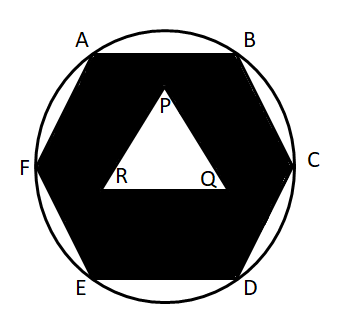
ABCDEF is a regular hexagon of side a and PQR is an equilateral triangle. The area of the shaded portion is X and CD : PQ : : 2 : 1. Find the area of the circle circumscribing the hexagon in terms of X.
Loading solution...
Ravindra and Rekha got married 10 years ago, their ages were in the ratio of 5 : 4. Today Ravindra’s age is one sixth more than Rekha’s age. After marriage, they had 6 children including a triplet and twins. The age of the triplets, twins and the sixth child is in the ratio of 3 : 2 : 1. What is the largest possible value of the present total age of the family?
The ages of all the kids are natural numbers.
Loading solution...
In the MBA Programme of a B - School, there are two sections A and B. 1/4th of the students in Section A and 4/9th of the students in section B are girls. If two students are chosen at random, one each from section A and Section B as class representative, the probability that exactly one of the students chosen is a girl, is :
Loading solution...
A milk vendor sells 10 litres of milk from a can containing 40 litres of pure milk to the 1st customer. He then adds 10 litres of water to the milk can. He again sells 10 litres of mixture to the 2nd customer and then adds 10 litres of water to the can. Again he sells 10 litres of mixture to the 3rd customer and then adds 10 litres of water to the can and so on. What amount of pure milk will the 5th customer receive?
Loading solution...
A ferry carries passengers to Rock of Vivekananda and back from Kanyakumari. The distance of Rock of Vivekananda from Kanyakumari is 100km. One day, the ferry started for Rock of Vivekananda with passengers on board, at a speed of 20 km per hour. After 90 minutes, the crew realized that there is a hole in the ferry and 15 gallons of sea water had already entered the ferry. Sea water is entering the ferry at the rate of 10 gallons per hour. It requires 60 gallons of water to sink the ferry. At what speed should the driver now drive the ferry so that it can reach the Rock of Vivekananda and return back to Kanyakumari just in time before the ferry sinks? (Current of the sea water from Rock of Vivekananda to Kanyakumari is 2km per hour.)
Loading solution...
The sum of $$1 - \frac{1}{6} + (\frac{1}{6} \times \frac{1}{4})-(\frac{1}{6} \times \frac{1}{4} \times \frac{5}{18})+$$ .... is
Loading solution...
The value of $$\text{log}_{7} \text{log}_{7} \sqrt{7(\sqrt{7\sqrt{7}})}$$
Loading solution...
A ladder just reaches a window that is 8 metres high above the ground on one side of the street. Keeping one end of the ladder at the same place, the ladder is moved to the other side of the street so as to reach a 12 metre high window. If the ladder is 13 metres long, what is the width of the street?
Loading solution...
The total number of eight - digit landline telephone numbers that can be formed having at least one of their digits repeated is:
Loading solution...
The business consulting division of TCS has overseas operations in 3 locations: Singapore, New York and London. The Company has 22 analysts covering Singapore, 28 covering New York and 24 covering London. 6 analysts cover Singapore and New York but not London, 4 analysts cover Singapore and London but not New York, and 8 analysts cover New York and London but not Singapore. If TCS has a total of 42 business analysts covering at least one of the three locations: Singapore, New York and London, then the number of analysts covering New york alone is:
Loading solution...
Eight years after completion of your MBA degree, you start a business of your own. You invest INR 30,00,000 in the business that is expected to give you a return of 6%, compounded annually. If the expected number of years by which your investment shall double is 72/r, where r is the percent interest rate, the approximate expected total value of investment (in INR) from your business 48 years later is:
Loading solution...
A right circular cylinder has a radius of 6 and a height of 24. A rectangular solid with a square base and a height of 20, is placed in the cylinder such that each of the corners of the solid is tangent to the cylinder wall. If water is then poured into the cylinder such that it reaches the rim, the volume of water is:
Loading solution...
The student fest in an Engineering College is to be held in one month’s time and no sponsorship has yet been arranged by the students. Finally the General Secretary (GS) of the student body took the initiative and decided to go alone for sponsorship collection. In fact, he is the only student doing the fund raising job on the first day. However, seeing his enthusiasm, other students also joined him as follows: on the second day, 2 more students join him; on the third day, 3 more students join the group of the previous day; and so on. In this manner, the sponsorship collection is completed in exactly 20 days. If an MBA student is twice as efficient as an Engineering student, the number of days which 11 MBA students would take to do the same activity , is:
Loading solution...
A pharmaceutical company manufactures 6000 strips of prescribed diabetic drugs for Rs. 8,00,000 every month. In July 2014, the company supplied 600 strips of free medicines to the doctors at various hospitals. Of the remaining medicines, it was able to sell 4/5th of the strips at 25 percent discount and the balance at the printed price of Rs. 250. Assuming vendor’s discount at the rate of a uniform 30 percent of the total revenue, the approximate percentage profit / loss of the pharmaceutical company in July 2014 is:
Loading solution...
A bouncing tennis ball is dropped from a height of 32 metre. The ball rebounds each time to a height equal to half the height of the previous bounce. The approximate distance travelled by the ball when it hits the ground for the eleventh time, is:
Loading solution...
In an Engineering College in Pune, 8 males and 7 females have appeared for Student Cultural Committee selection process. 3 males and 4 females are to be selected. The total number of ways in which the committee can be formed, given that Mr. Raj is not to be included in the committee if Ms. Rani is selected, is:
Loading solution...
Start your IIM journey with the right preparation and crack CAT 2026.

Educational materials for CAT preparation
 Share
Share