91- 6303239042



 Group
Group
 Group
Group


 Preferred Source

 Google Discover
The National Mathematics Talent Contest, commonly known as NMTC, is conducted by the Association of Mathematics Teachers of India. Unlike a regular school examination, NMTC tests whether students can apply mathematical concepts to unfamiliar and non-routine problems.
The NMTC 2026 examination is suitable for students from school to undergraduate level. The contest aims to identify students with original thinking, mathematical aptitude and strong problem-solving ability. The examination is conducted only in English for all levels.
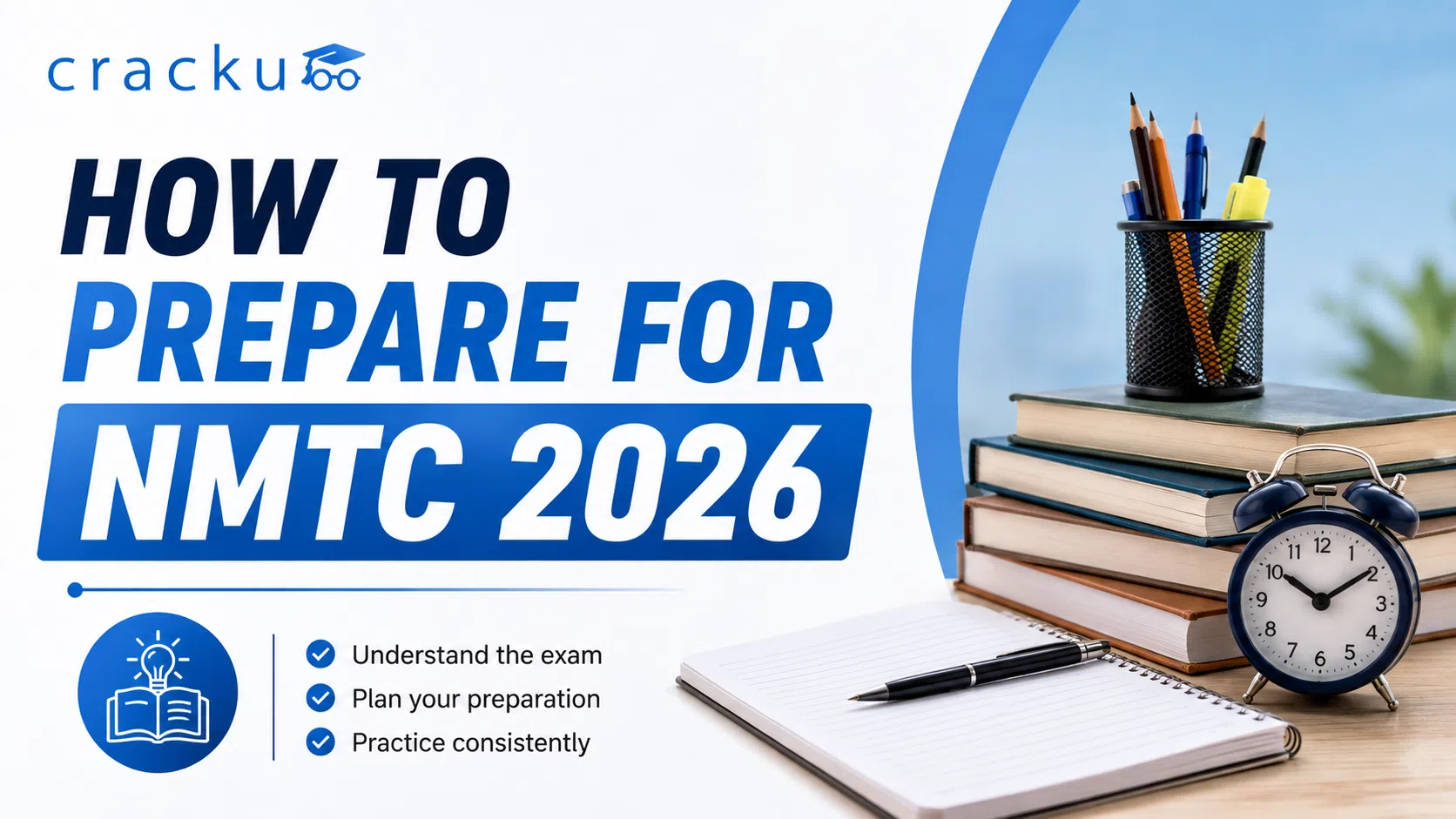
Preparing for NMTC requires more than memorising formulas. Students must strengthen their concepts, practise different types of mathematical problems and learn how to present their reasoning clearly.
How to Prepare for NMTC 2026
The best way to prepare for NMTC 2026 is to combine conceptual learning with regular problem-solving practice. Students should first understand their level-specific syllabus and then prepare a realistic study plan.
1. Strengthen the Basic Concepts
Begin with your school mathematics textbook. Make sure you understand the concepts behind every formula instead of simply memorising steps.
For example, while studying divisibility, do not stop after learning divisibility rules. Practise questions involving remainders, factors, multiples and patterns in numbers. Similarly, while studying geometry, focus on understanding why a result is true.
2. Practise Non-Routine Mathematics Problems
NMTC questions may combine two or more familiar concepts in an unfamiliar way. Therefore, solving only routine textbook exercises may not be sufficient.
Include problems that require:
- Logical reasoning
- Finding mathematical patterns
- Trying different approaches
- Constructing examples
- Proving a statement
- Eliminating impossible cases
- Explaining each step clearly
Do not immediately look at the solution when a question appears difficult. Spend enough time understanding the problem and testing different methods.
3. Follow a Structured Study Plan
Students can divide their preparation into four stages.
| Preparation Stage | Main Focus |
|---|---|
| Concept building | Study basic formulas, definitions and properties |
| Topic-wise practice | Solve easy, moderate and advanced questions from each topic |
| Previous-paper practice | Attempt NMTC previous year papers under timed conditions |
| Revision and testing | Revise mistakes and take full-length practice tests |
A student preparing alongside school may study for around 45 to 60 minutes daily. Longer weekend sessions can be used for previous papers and difficult questions.
4. Maintain a Problem-Solving Notebook
Create a separate notebook containing:
- Important concepts
- Useful observations
- Questions you could not solve
- Alternative methods
- Common calculation mistakes
- Important geometry diagrams
- Number patterns and identities
Revise this notebook every week. It will become more useful than repeatedly reading complete textbooks before the examination.
5. Learn to Write Complete Solutions
The final stage of NMTC requires students to communicate their mathematical thinking properly. A correct answer without sufficient reasoning may not demonstrate the complete solution.
While practising descriptive questions, write:
- What information is given
- What needs to be found or proved
- Which property or method is being used
- The complete calculation or reasoning
- The final conclusion
NMTC Exam Pattern 2026
The 58th National Mathematics Talent Contest is being conducted in two stages. According to the official NMTC portal, the Preliminary Test is scheduled for 30 August 2026, while the Final Test is scheduled for 25 October 2026.
| Stage | NMTC 2026 Date | Main Purpose |
|---|---|---|
| Preliminary Test | 30 August 2026 | Screening and shortlisting students |
| Final Test | 25 October 2026 | Testing advanced mathematical reasoning and complete problem-solving ability |
The exact number and format of questions may differ according to the candidate’s group. Students should carefully read the instructions provided on their question paper and official admit card.
NMTC participants are generally divided into the following levels:
| NMTC Group | Eligible Classes |
|---|---|
| Primary – Gauss Contest | Classes 5 and 6 |
| Sub-Junior – Kaprekar Contest | Classes 7 and 8 |
| Junior – Bhaskara Contest | Classes 9 and 10 |
| Inter – Ramanujan Contest | Classes 11 and 12 |
| Senior – Aryabhata Contest | Degree-level students |
These level-wise groups have been used by AMTI for school, junior college, degree college and technical institution students.
Students should not prepare by trying to predict only the number of questions. The more important requirement is developing the ability to solve unfamiliar problems accurately.
NMTC Exam Syllabus 2026
AMTI provides recommended topics for the NMTC examination through its official syllabus document. The syllabus varies according to the student’s class and contest group.
The main areas generally covered in NMTC preparation include arithmetic, algebra, geometry, mensuration, number theory, combinatorics and mathematical reasoning.
| NMTC Level | Important Preparation Areas |
|---|---|
| Primary | Fractions, percentages, ratio, divisibility, LCM, HCF, basic algebra, mensuration and elementary geometry |
| Sub-Junior | Roots, averages, time and work, algebraic identities, linear equations, geometry and three-dimensional mensuration |
| Junior | Number theory, algebra, geometry, inequalities, equations, counting methods and logical reasoning |
| Inter | Advanced algebra, number theory, combinatorics, geometry, sequences, inequalities and mathematical proofs |
| Senior | Higher-level algebra, number theory, geometry, combinatorics and proof-based problem solving |
The table should be used as a preparation overview. Candidates must refer to the latest level-wise syllabus provided by AMTI before finalising their study plan.
Important NMTC Topics to Practice
Some important skills that students should develop across different levels include:
- Divisibility and remainder-based problems
- Factors, multiples and prime numbers
- Fractions, percentages and ratios
- Algebraic expressions and equations
- Mathematical identities
- Lines, angles, triangles and circles
- Area, perimeter, volume and mensuration
- Number patterns and sequences
- Logical arrangements
- Counting and combinatorics
- Proof-based questions
- Non-routine word problems
Instead of trying to complete every advanced chapter, students should first master the topics included in their own level.
Also Read: NMTC Syllabus 2026: Classes 5th to 12th, Download PDF
Best Books and Study Material for NMTC
Students should use a limited number of good resources. Using too many books often leads to incomplete preparation and confusion.
School Mathematics Textbooks
Start with the mathematics textbook prescribed by your school board. NCERT Mathematics books can also be used to strengthen basic concepts. Complete the solved examples and important exercises before moving to advanced material.
AMTI Books and Study Material
The official AMTI book list includes several resources designed for mathematical problem-solving and different NMTC levels.
| Student Level or Purpose | Recommended AMTI Material |
|---|---|
| Beginners | Sample Questions and Solutions |
| General problem solving | The Charm of Problem Solving |
| Primary level | Gems – Primary, Volumes I to III |
| Sub-Junior level | Gems – Sub-Junior, Volumes I to III |
| Junior level | Gems – Junior, Volumes I to III |
| Inter level | Gems – Inter, Volumes I to III |
| Advanced practice | Non-Routine Problems in Mathematics with Solutions |
| Counting problems | Combinatorics |
| Additional practice | GEMS from The Mathematics Teacher |
Students do not need to purchase every available book. Choose material according to your contest level and current ability.
How to Use NMTC Previous Year Papers
NMTC previous year papers are among the most useful preparation resources because they help students understand how ordinary mathematical concepts are converted into challenging problems.
However, students should not solve an NMTC previous year question paper like a normal homework exercise.
Step 1: Solve Topic-Wise Questions
During the initial preparation stage, identify questions connected to the topic you are studying. Solve them without worrying about the total time.
The goal at this stage is to understand the different ways in which a concept may be tested.
Step 2: Attempt the Complete Paper
After completing most of the syllabus, select an NMTC previous paper and attempt it in one sitting. Avoid using books, notes, calculators or solution keys during the test.
Step 3: Analyse Every Question
Divide the questions into four categories:
| Category | Action Required |
|---|---|
| Correct and easy | Revise briefly |
| Correct but time-consuming | Find a shorter or clearer method |
| Incorrect | Identify the exact mistake |
| Not attempted | Study the missing concept and retry |
Step 4: Reattempt Difficult Questions
Do not consider a question completed after reading its solution. Close the solution and attempt the same problem again after two or three days.
This confirms whether you have understood the method or only remembered the answer.
Step 5: Write Full Solutions
For descriptive problems, compare not only your answer but also your reasoning with the available solution. Practise writing clear, logically connected steps.
Students should ideally solve several NMTC previous year papers before the examination, but proper analysis is more valuable than completing a large number of papers without reviewing mistakes.
Also Read: NMTC Important Topics 2026: Classes 5th to 12th, Download PDF
Common Mistakes to Avoid While Preparing for NMTC 2026
Students can improve their performance by avoiding a few common preparation mistakes.
Memorising Solutions
Memorising the method used in one question will not always help because a similar concept may appear in a completely different form. Understand why each step works.
Ignoring Basic Concepts
Advanced books cannot compensate for weak fundamentals. Students who regularly make errors in fractions, algebraic manipulation or basic geometry should correct these areas first.
Using Too Many Books
Collecting several books without completing any of them creates unnecessary pressure. Select one main concept resource, one problem-solving book and previous year papers.
Checking Solutions Too Quickly
Looking at the answer after only a few minutes prevents the development of patience and independent thinking. Try different approaches before checking the solution.
Avoiding Difficult Topics
Students often practise only the topics they already enjoy. Maintain a list of weak areas and include at least one weak-topic session every week.
Not Practising Under Time Limits
Untimed practice is useful during concept building, but students must also learn to work within examination conditions. Take regular timed tests during the final weeks.
Focusing Only on the Final Answer
NMTC evaluates mathematical thinking, especially in descriptive problems. Practise presenting complete reasoning instead of writing only the numerical answer.
Skipping Revision
Previously solved problems should be revisited. Revision helps students recognise patterns and apply useful methods more quickly.
Consistent preparation is more effective than studying for several hours only during the final few days. Students who understand their concepts, practise non-routine questions, analyse NMTC previous year papers and revise their mistakes regularly will be better prepared for NMTC 2026.
Also Read: Why Every JEE Aspirant Should Participate in Olympiads
How to Prepare for NMTC 2026: Conclusion
Preparing for NMTC 2026 requires a balanced approach that combines strong mathematical fundamentals with regular problem-solving practice. Students should understand the level-wise NMTC syllabus, practise important topics and gradually move from school-level exercises to non-routine and proof-based questions. Following a realistic study plan and maintaining a notebook of mistakes, concepts and useful methods can make revision more effective.
NMTC previous year papers should be an important part of the preparation strategy. Students must attempt them under timed conditions, analyse incorrect and unattempted questions and reattempt difficult problems after a few days. Consistent practice, regular revision and clear solution writing will help students improve their confidence, accuracy and overall NMTC 2026 performance
.webp)